




About this worksheet
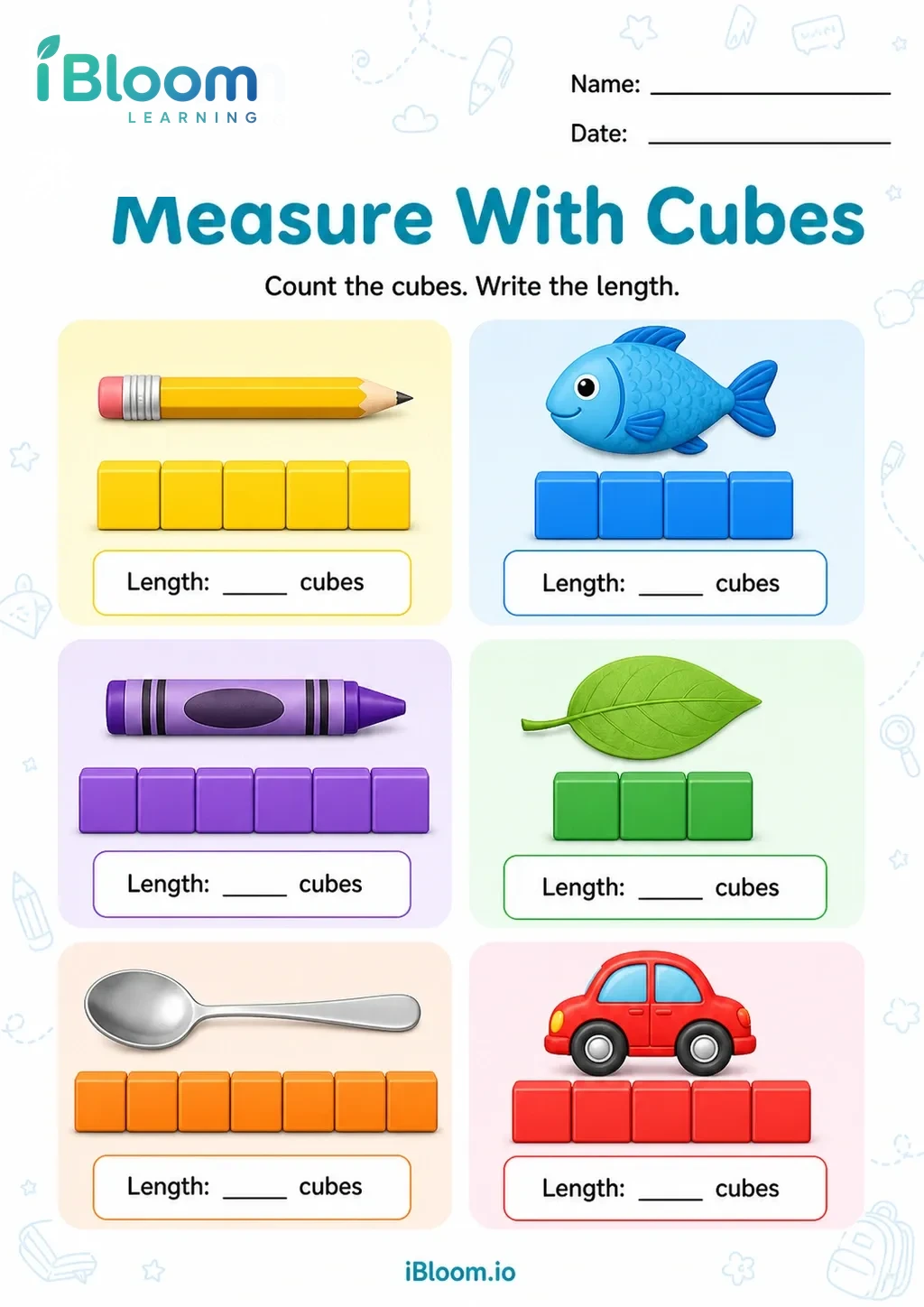
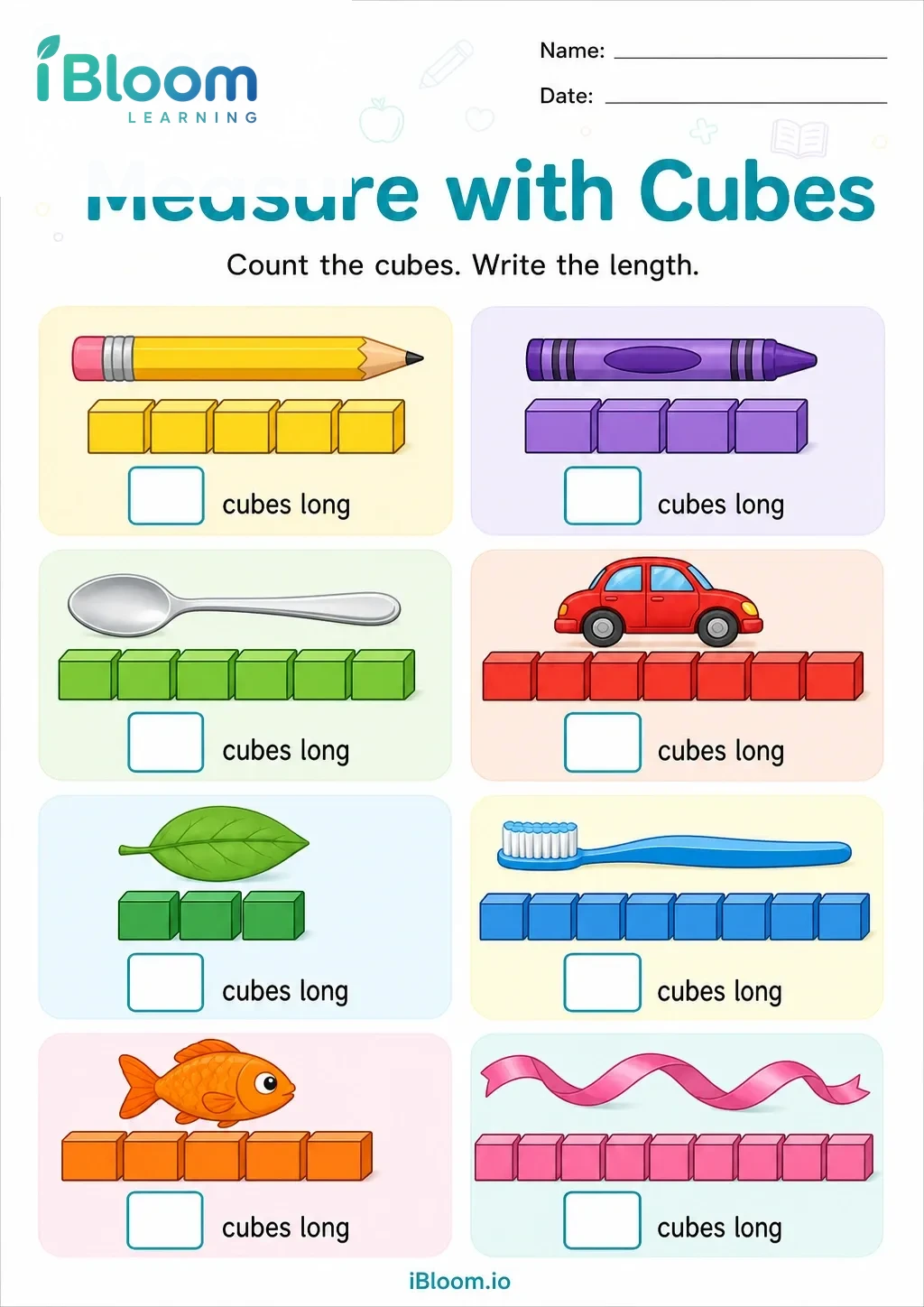
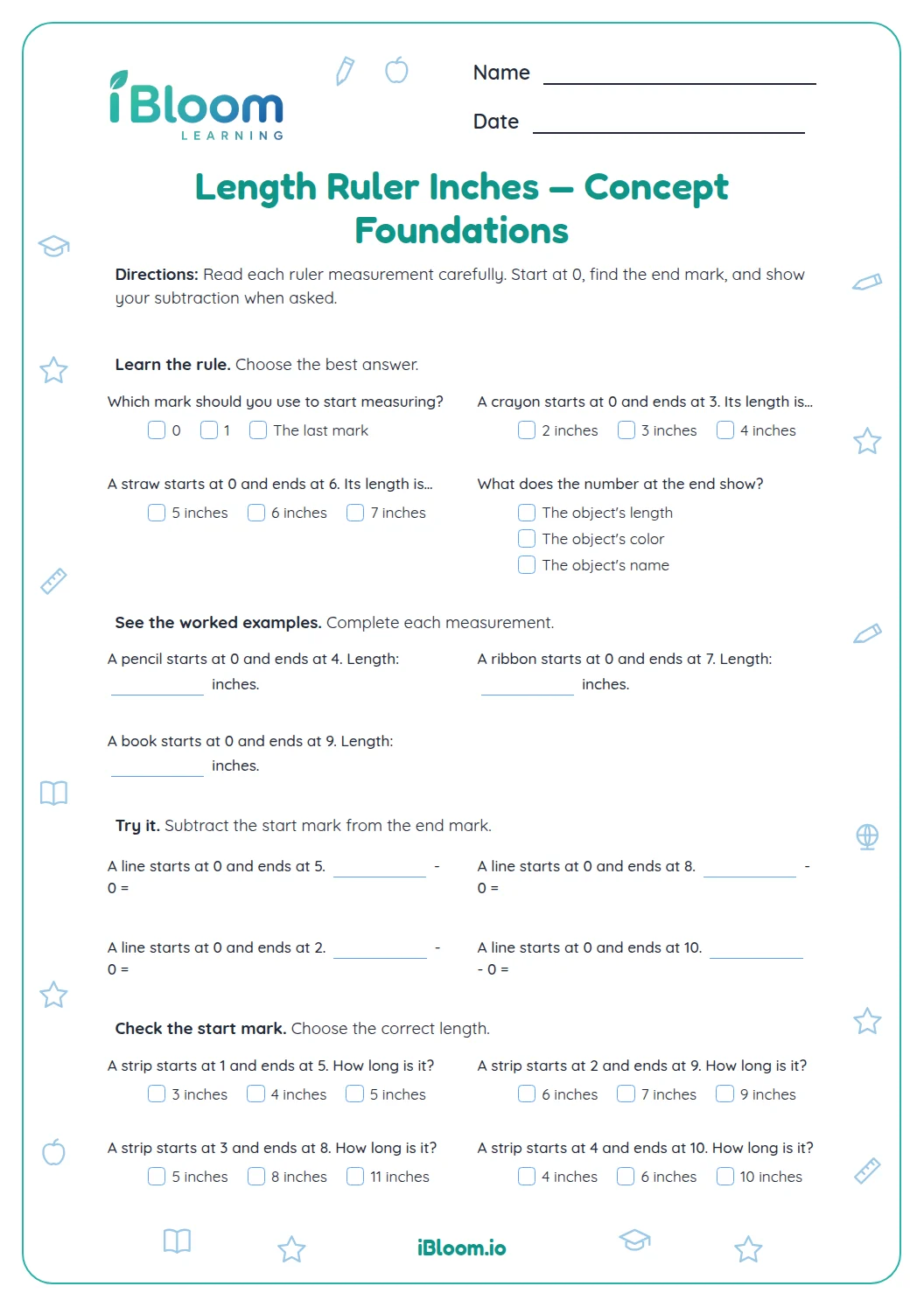
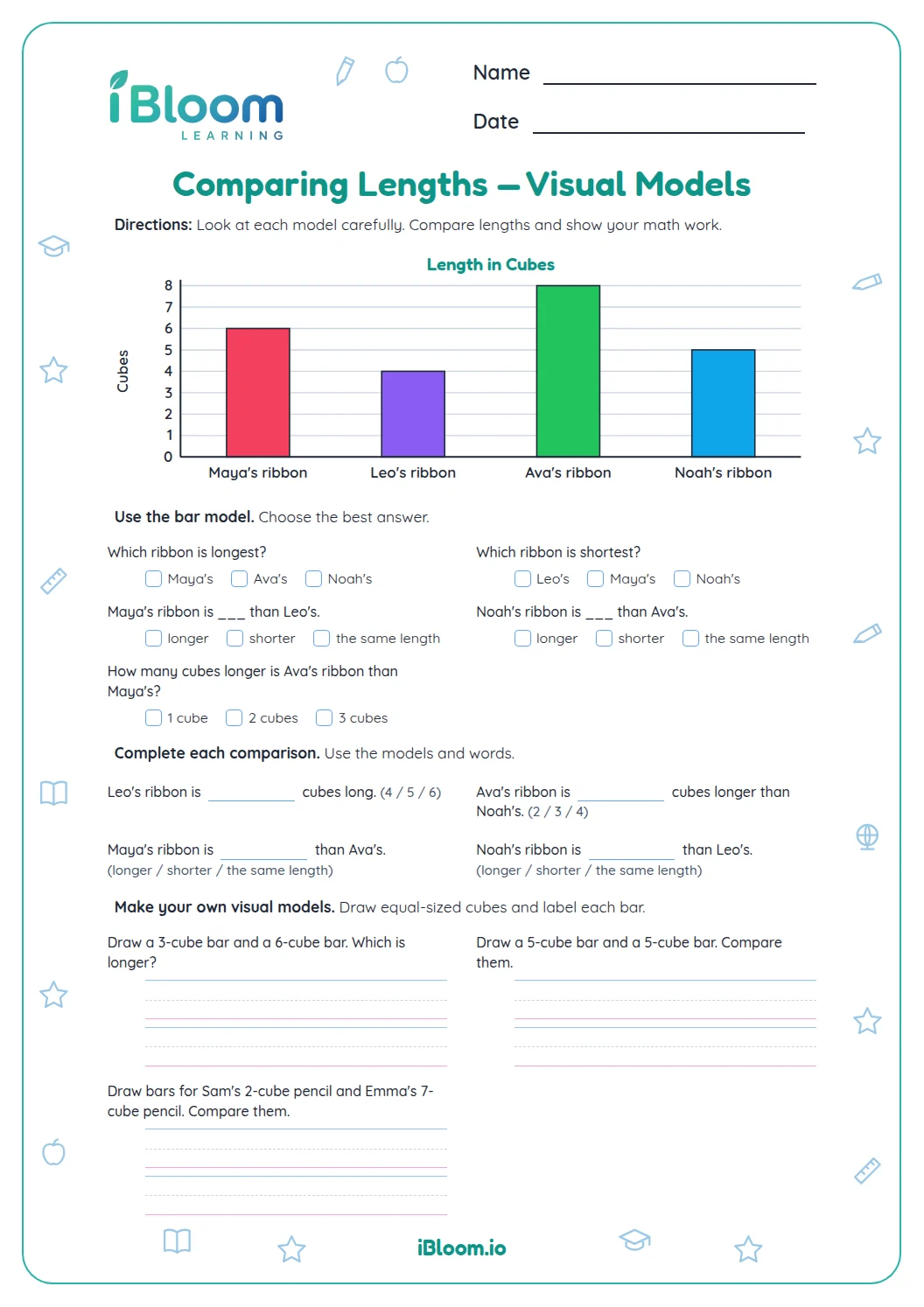
This free printable Grade 1 worksheet practices whole-inch measurement with seven ruler diagrams and seven prompts about counting one-inch spaces. Every pictured bar begins at zero, so children count equal spaces to its endpoint. Part A offers three multiple-choice measurements; four later diagrams use fill-in answers. The space-count prompts range from 1 to 6 inches. A separate answer key shows each result. The sheet practices the equal-unit length idea in Common Core 1.MD.A.2.
Aligned to 1.MD.A.2
Why do children count spaces instead of marks?
The space from 0 to 1 is one inch. The next space, from 1 to 2, adds another inch. Tick marks mark the ends of the units; the spaces are the lengths being counted.
All bars start at zero and finish at a whole-number mark. Read the numbered whole-inch marks as you move along the ruler.
How does the first ruler give an answer of 2 inches?
Question 1 has a bar that begins at 0 and ends at 2. Move a finger through the space from 0 to 1, then through the space from 1 to 2. Two equal one-inch spaces span the bar.
- 1Start at 0.
- 20 to 1 is one inch.
- 31 to 2 is one more inch.
- 4Circle 2 in.
How do the ruler diagrams and space counts build measurement practice?
Part A has three multiple-choice ruler readings. Four later diagrams ask children to write a bar length, and seven short prompts ask how many one-inch spaces run from zero to a numbered endpoint. The pictured bars include every whole-inch length from 1 through 6.
Every bar starts at zero and ends on a whole-inch mark. Ask the child to trace the spaces, rather than count the tick marks, before writing the length.
How to use this worksheet
- 1Point to zero and explain that it marks the start of the bar.
- 2Move through the space from 0 to 1 and say “one inch.”
- 3Count complete one-inch spaces to the end of question 1.
- 4Complete Part A by circling the measured lengths.
- 5Write the seven lengths in Parts B and C, then use the key to check the endpoints.
Mistakes to check and how to help
The mistake
Counting zero as the first inch.
The fix
Rest a finger on zero without counting, then say “one” after moving to 1.
The mistake
Counting tick marks instead of the spaces between them.
The fix
Trace each gap from one numbered mark to the next; a 2-inch bar spans two gaps.
The mistake
Measuring the printed drawing with a separate ruler.
The fix
Read the labels on the illustrated ruler. The diagram’s printed size can change when the page is scaled.
Common Core alignment
Count equal one-inch spaces from zero to an endpoint to find a whole-number length.
On this sheet: Children count consecutive equal one-inch spaces spanning a bar from zero and record its whole-number length.
Show the official wordingHide the official wording
Express the length of an object as a whole number of length units, by laying multiple copies of a shorter object (the length unit) end to end; understand that the length measurement of an object is the number of same-size length units that span it with no gaps or overlaps. Limit to contexts where the object being measured is spanned by a whole number of length units with no gaps or overlaps.
What to practice next
Make more practice
Further reading
Questions parents and teachers ask
Does my child need a separate ruler?
Use the seven ruler diagrams printed on the sheet. Children read each bar’s endpoint and count the one-inch spaces from zero. A separate ruler can be useful for measuring real objects, but this worksheet’s answers come from the illustrated scales, whose printed size can vary.
What does in mean beside an answer?
The abbreviation in means inches. It appears in each Part A choice and after the blanks for the four additional ruler diagrams, so children write only the number there. The seven space-count prompts ask how many one-inch spaces there are. Say a full measurement aloud together: “The bar is two inches long.”
Are all the measurements whole inches?
Yes, every pictured bar ends at a whole-number inch mark, and the lengths range from 1 through 6 inches. The final three space-count prompts ask about 4, 5, and 6 inches. Have children follow the numbered marks and count complete one-inch spaces from zero to the endpoint.
Why does a bar ending at 4 measure four inches?
A bar starting at zero and ending at 4 spans four equal one-inch spaces. Count them as 0 to 1, 1 to 2, 2 to 3, and 3 to 4. The zero mark starts the measurement; it is not an extra inch to include in the count.
How can I check whether my child understands the ruler?
Ask your child to explain one measurement by tracing the spaces between the numbered marks. A correct endpoint number is useful, but the explanation shows why that number represents a length. Check the remaining answers with the separate key, then revisit any bar where the child counted marks instead.