


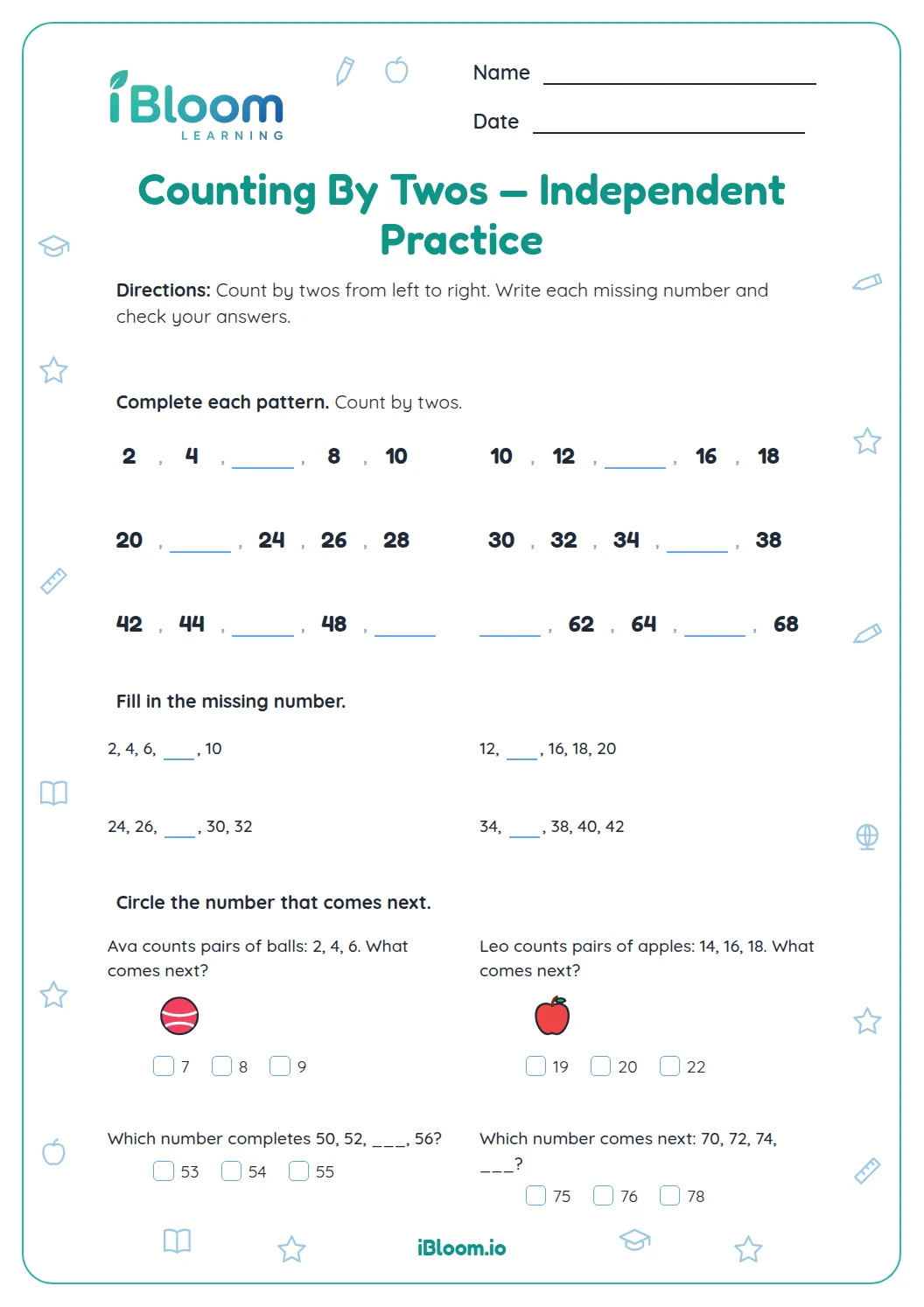
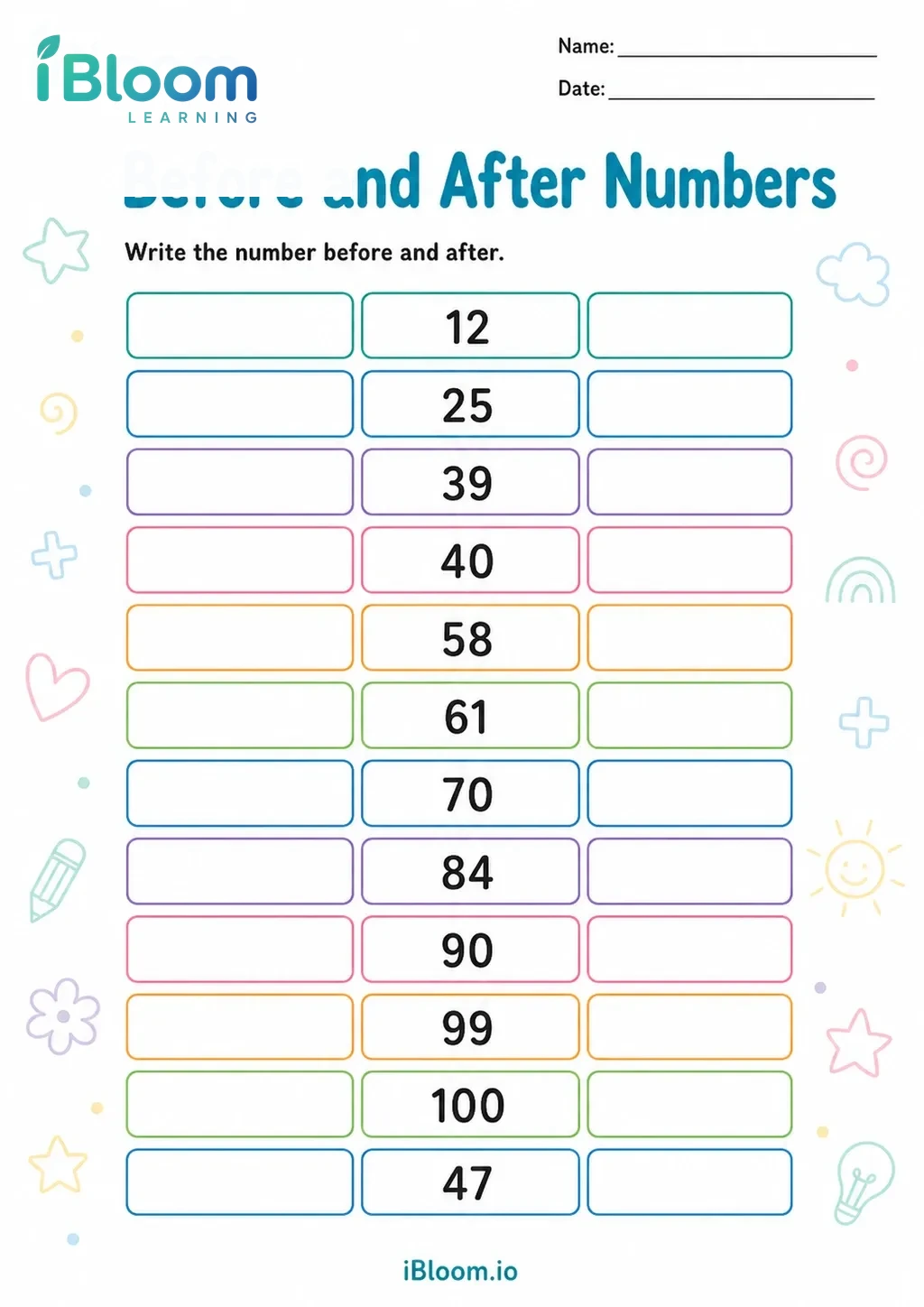
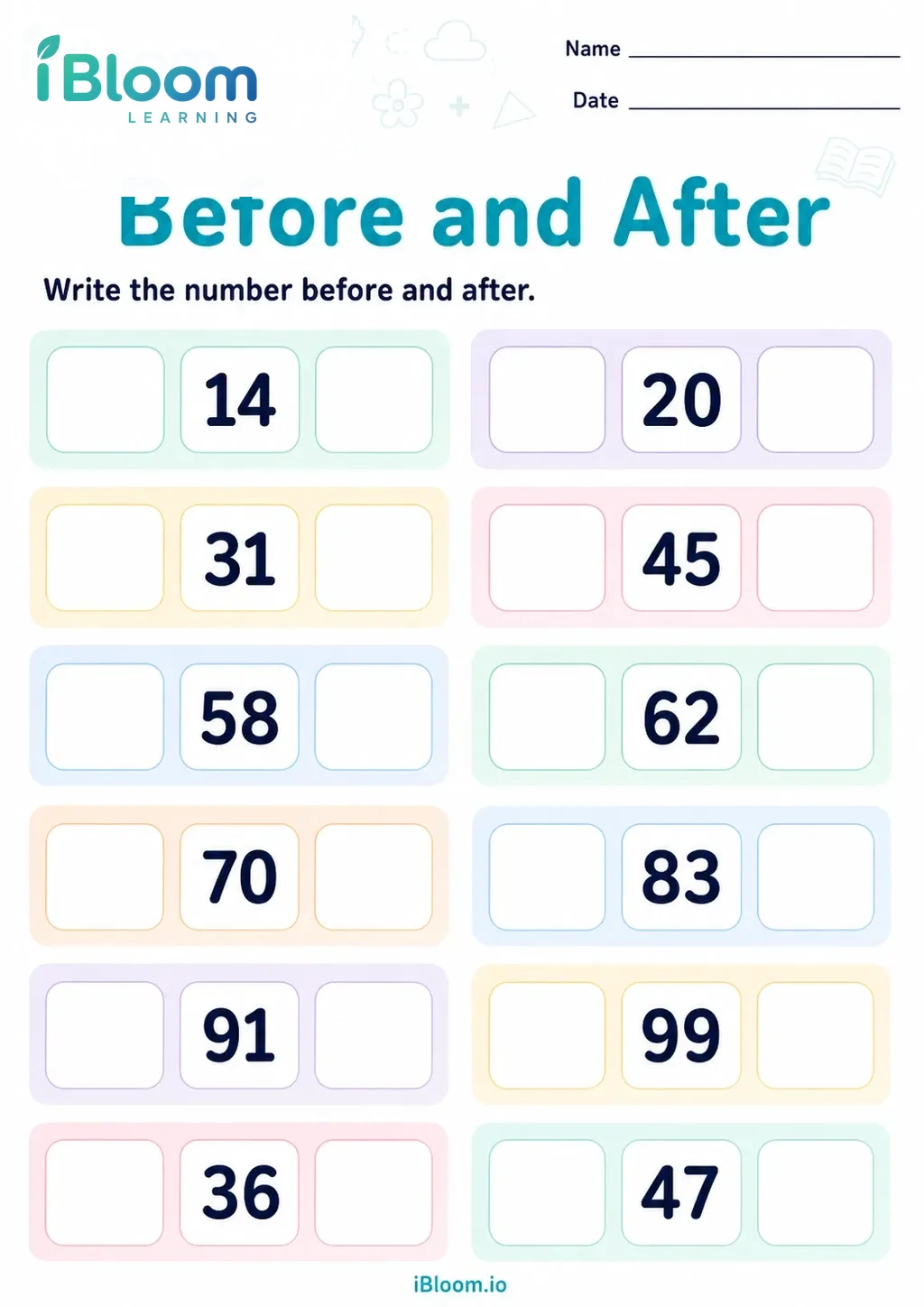
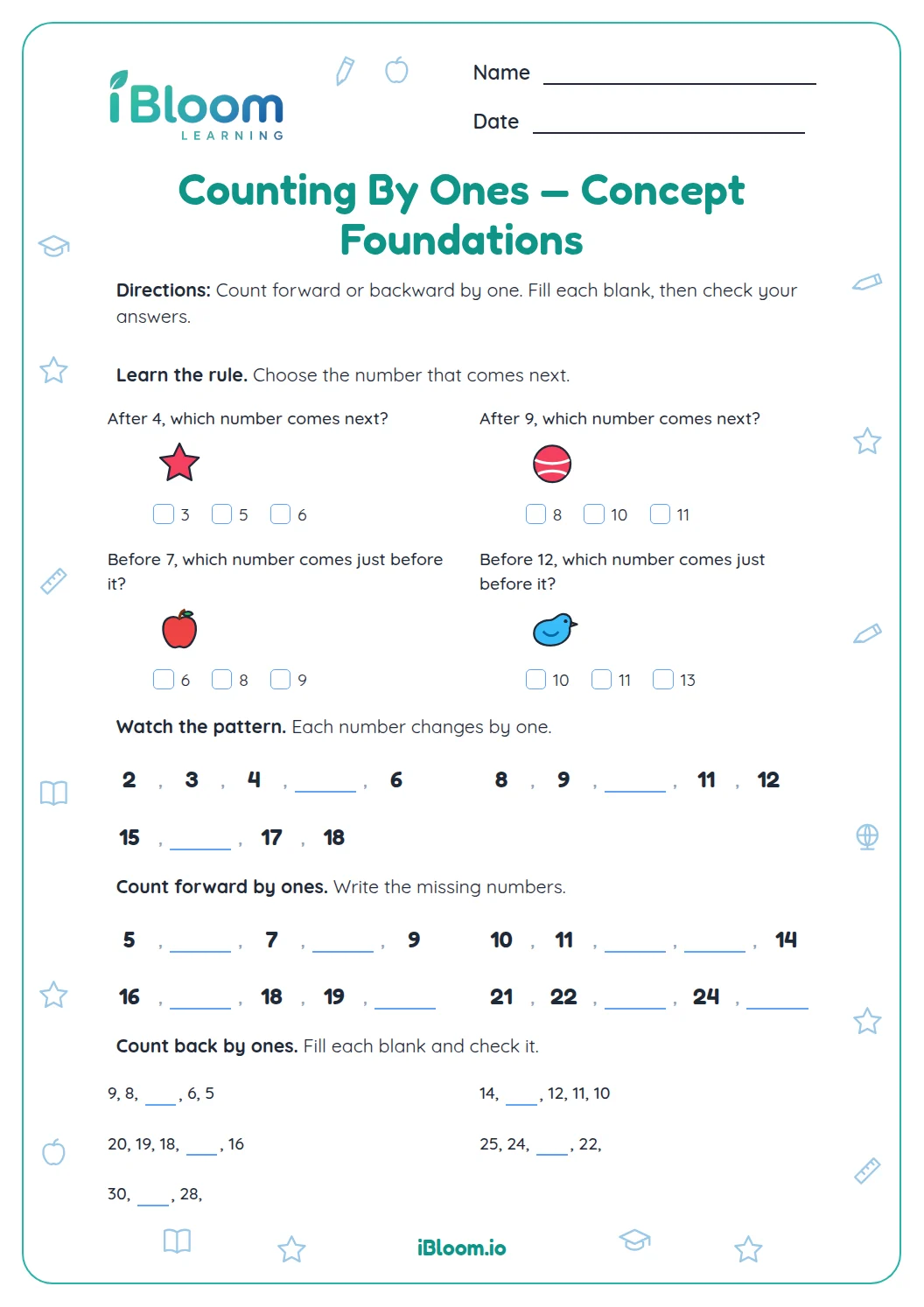


About this worksheet
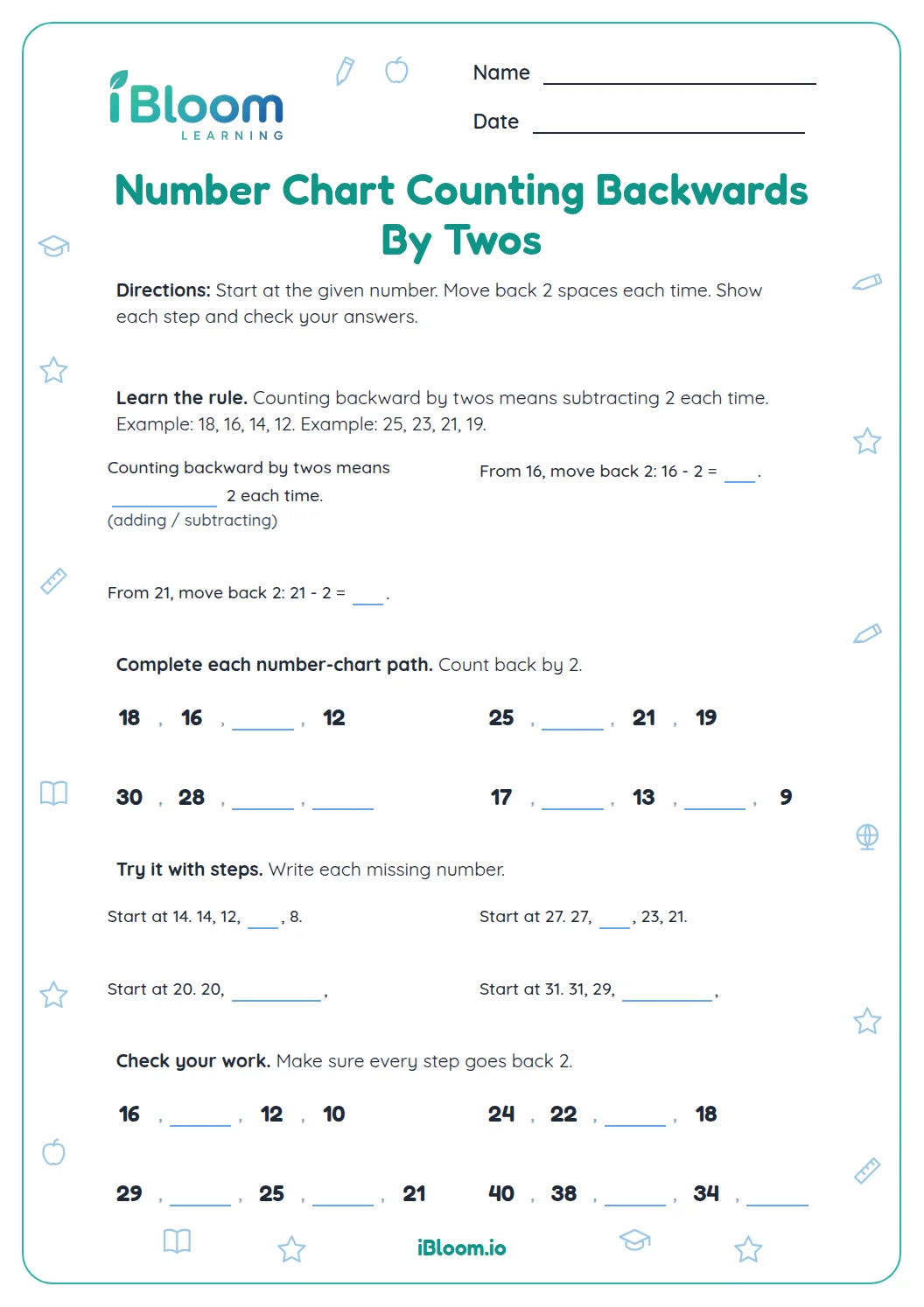
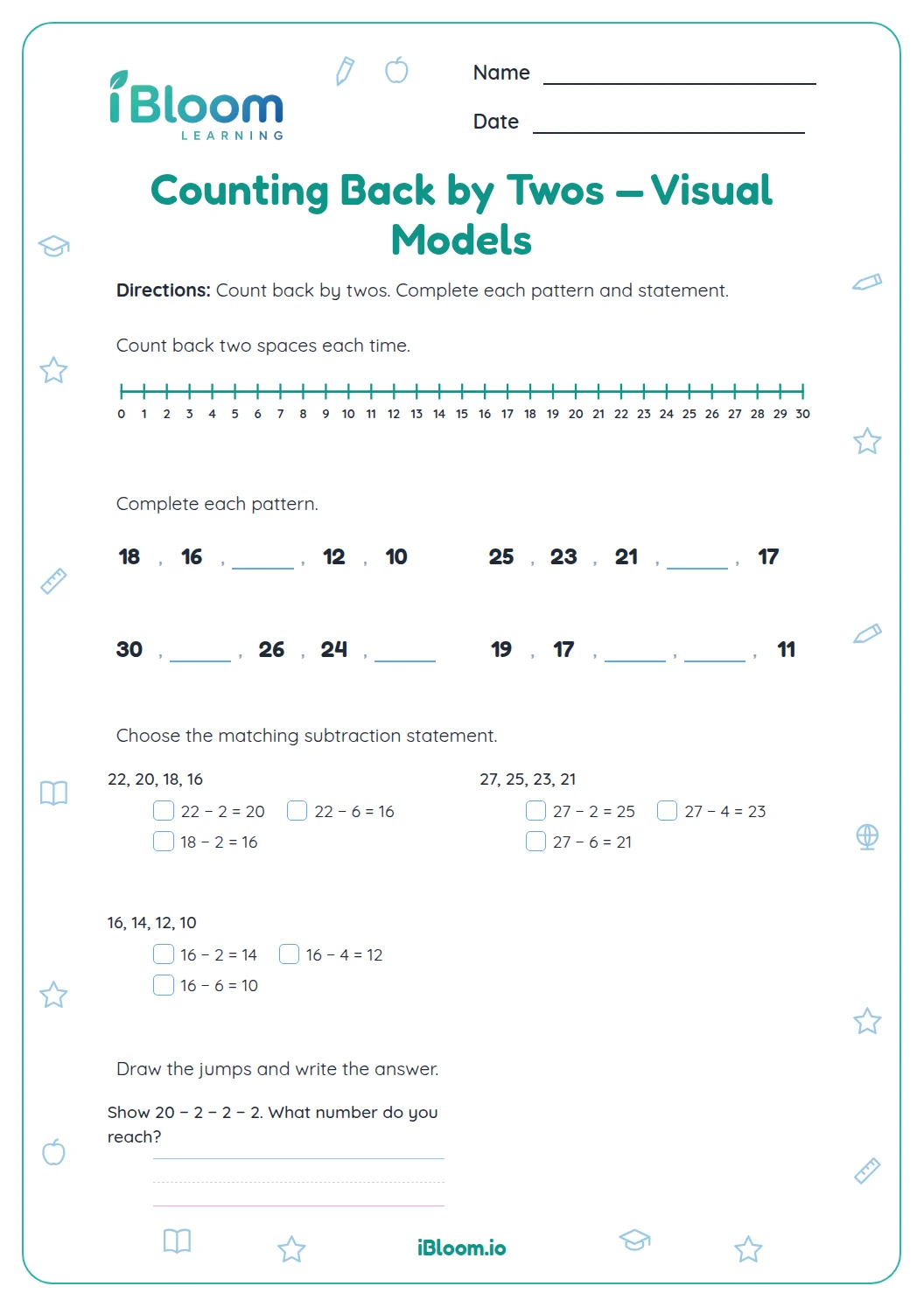
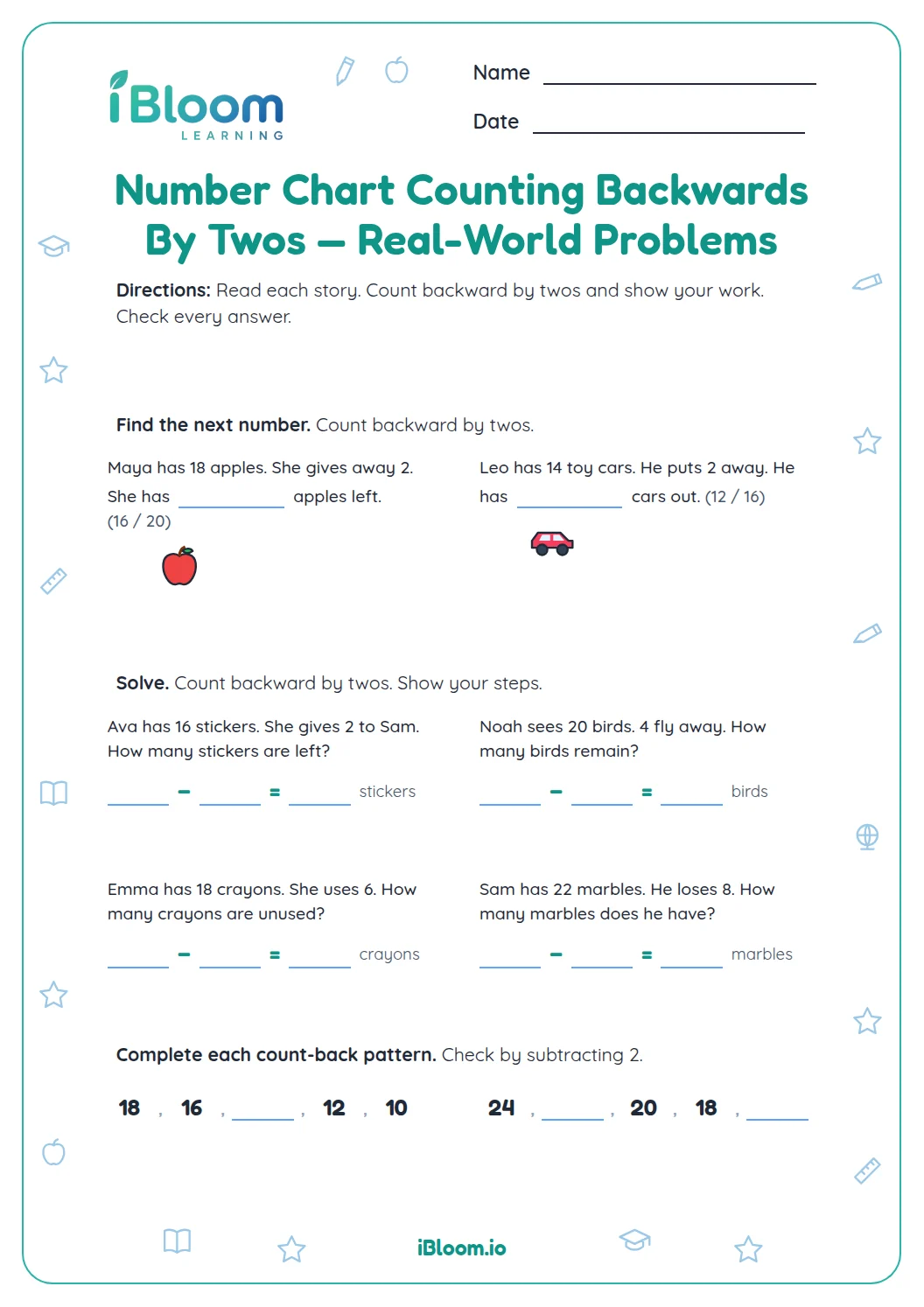
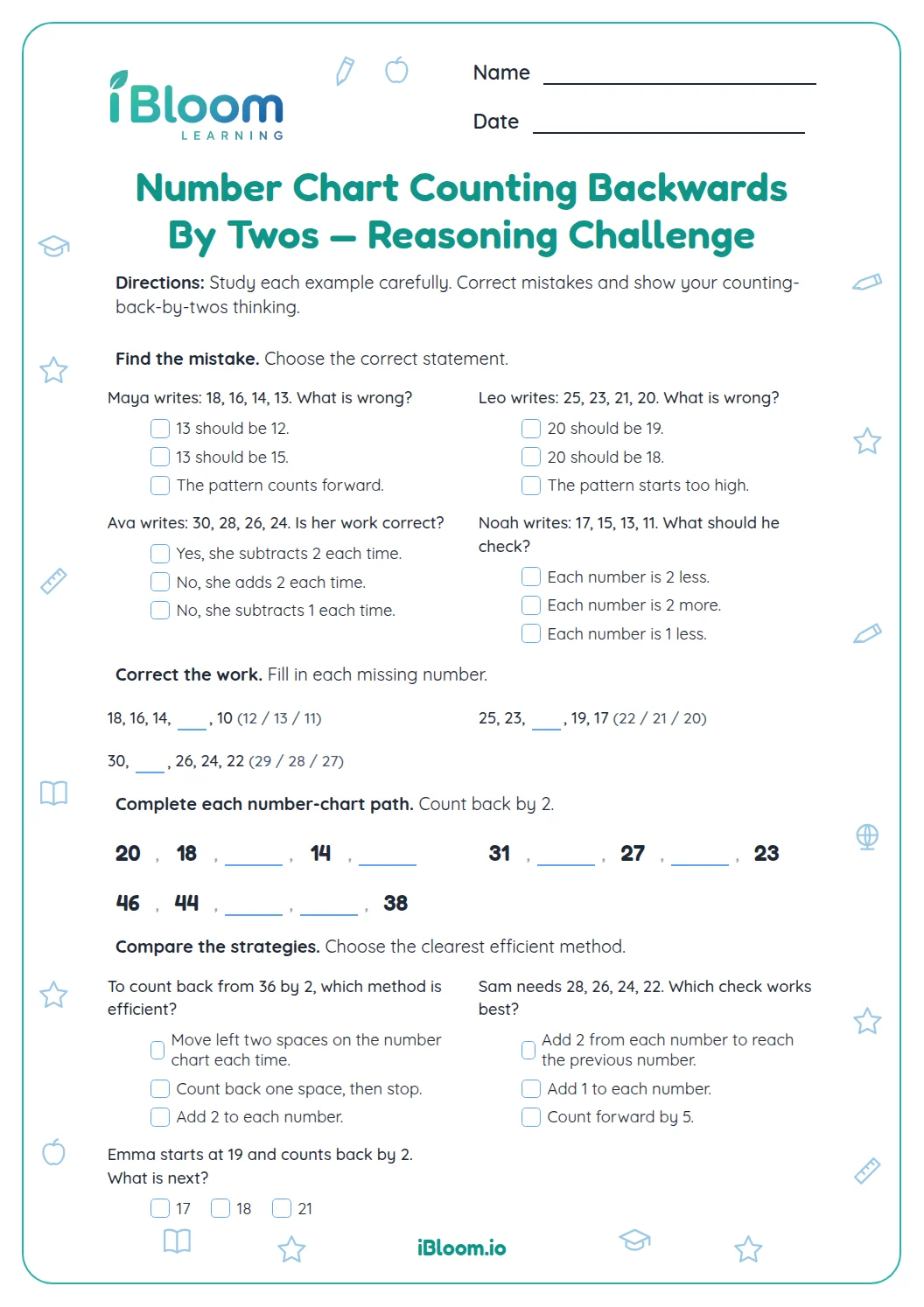
Use this Grade 1 practice sheet to follow and complete backward counting patterns. Children begin with full sequences, then find a missing number in a count that steps back by two.
Aligned to 1.NBT.A.1
How does counting backward by twos work?
Start with a number and take away 2 each time. The next number is always two less, so the ones digit alternates between the same two digits.
For example, 20 becomes 18, then 16, then 14. Saying the sequence aloud or tracking each jump on a number chart can help a learner keep the step size steady.
- 1Start: 20
- 2Take away 2: 20 − 2 = 18
- 3Take away 2 again: 18 − 2 = 16
- 4Continue: 16 − 2 = 14
What is on these two practice pages?
The sheet has 16 sequences in two parts. Part A has eight sequences with three missing numbers after a starting number. Part B has eight sequences with one missing number between the given terms.
The starting numbers vary, and each sequence keeps the same backward step of two. The separate key gives the missing numbers in order.
How can a number chart help?
On a hundred chart, moving up one row from a number subtracts ten; moving two places to the right adds two. For backward-by-two practice, a child can also find the next smaller even or odd number in the same count.
Use the chart as a check, then ask the learner to explain the jump between neighboring numbers.
How to use this worksheet
- 1Read the starting number and the direction for its part.
- 2Say the count aloud, taking away two each time.
- 3Write each missing number from left to right.
- 4Check every neighboring pair; each step should go down by two.
- 5Use the separate key after completing the page to check the sequences.
Common mistakes and quick fixes
The mistake
Taking away one instead of two.
The fix
Compare the first two terms and say the jump aloud: “20, 18” is down two.
The mistake
Changing the step size partway through a sequence.
The fix
Check every pair of neighbors; subtract two from each term to get the next.
The mistake
Writing the numbers in increasing order.
The fix
Follow the direction: backward means each number gets smaller.
Common Core alignment
This worksheet supports first-grade number sequence work.
Continue counting patterns from different numbers within 120.
On this sheet: Learners continue number sequences from several starting numbers, keeping a consistent step of two.
Show the official wordingHide the official wording
Count to 120, starting at any number less than 120. In this range, read and write numerals and represent a number of objects with a written numeral.
What to practice next
Make more practice
Questions parents and teachers ask
What does counting backward by twos mean?
It means saying or writing numbers that decrease by two each time. For example, starting at 20 gives 20, 18, 16, and 14. This sheet asks learners to continue several such sequences and fill in a missing number in others, then check each jump.
How many questions are on the worksheet?
There are 16 sequences across two worksheet pages: eight with three blanks after a starting number and eight with one blank in the middle. The separate answer key follows the same question order so an adult or learner can check each sequence carefully.
Can a child use a number chart?
Yes. A hundred chart can help a learner see how numbers change, while saying the sequence aloud builds the counting pattern. Encourage the child to check that each step goes down by exactly two, then use the answer key after finishing the full page.
What is the answer to the first sequence?
Question 1 starts at 20 and asks for three numbers counting backward by twos. The sequence is 20, 18, 16, 14, so the blanks are 18, 16, and 14 in that order. Check each step: every number decreases by two.
How long should this practice take?
The page is designed as a short independent practice set, but children can take the time they need to say each pattern and check it. A chart or adult read-aloud can support a learner who is still building confidence with number sequences.