



About this worksheet
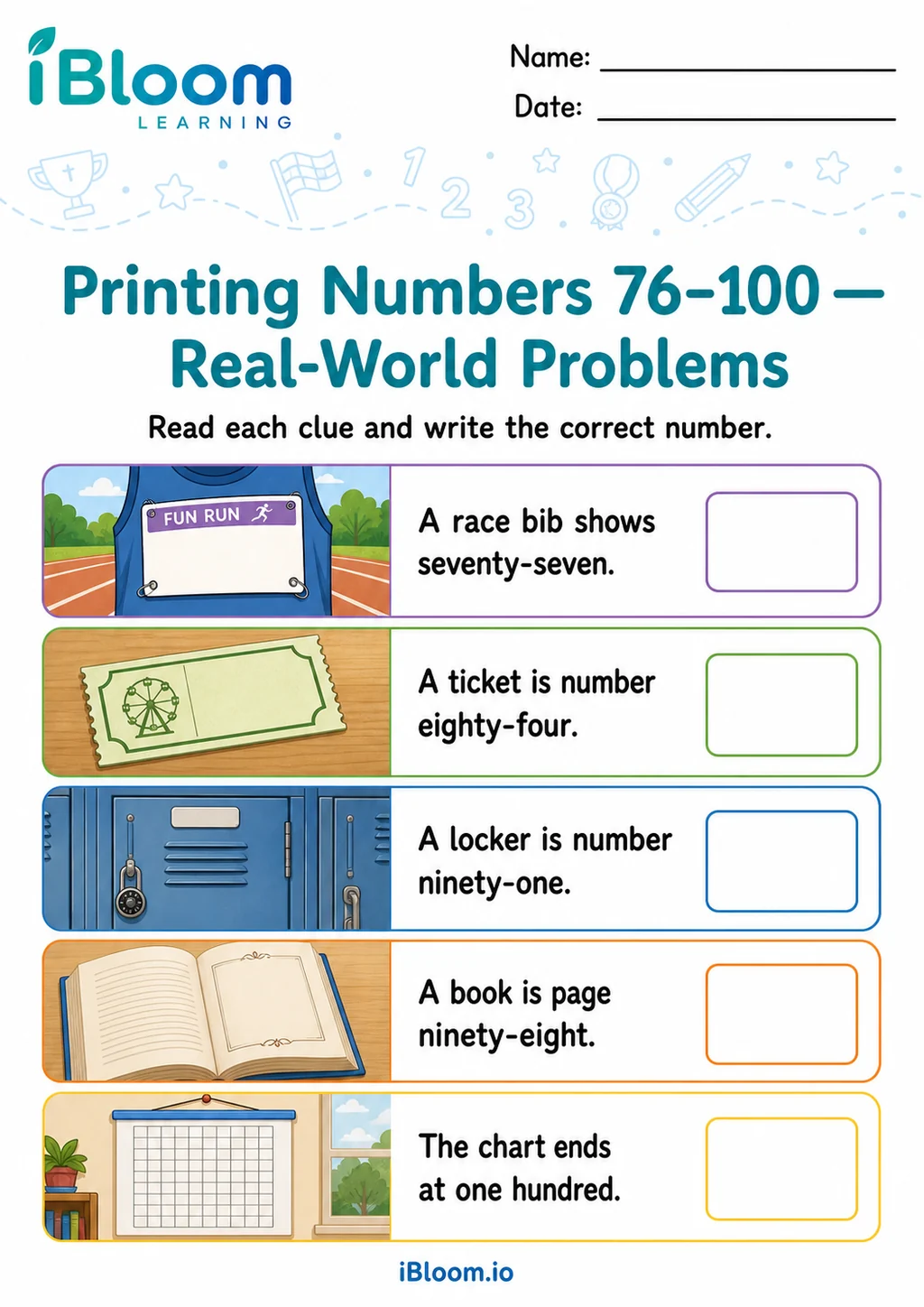
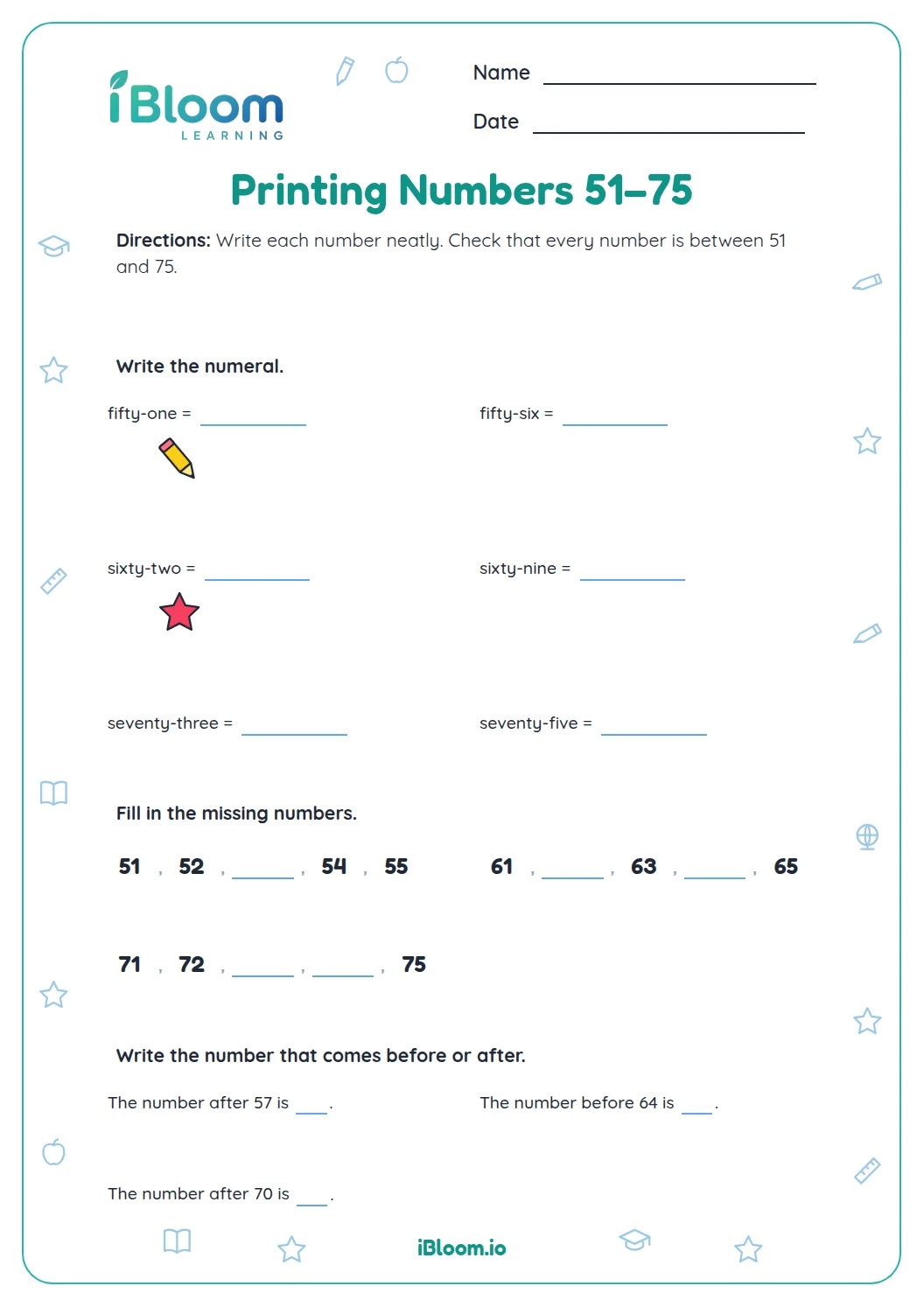
This free printable Grade 1 worksheet practices reading and writing every numeral from 76 through 100. Children trace one short group, copy all five groups of numbers, and complete eight counting-by-ones sequences with a missing numeral. The sequence includes the transitions from 79 to 80, 89 to 90, and 99 to 100. The answer key lists the groups and missing numbers for checking.
Aligned to 1.NBT.A.1
Which numbers will my child write?
The worksheet includes every numeral from 76 to 100. Children trace 76–80, copy five groups that together cover 76–100, then complete eight sequences with one numeral missing.
Reading aloud while pointing to the numerals connects the spoken number name with its written form. Leave a small space between numbers so they do not run together.
What happens after 99?
After 99 comes 100. A child needs space for three digits: one 1 and two zeros. In the final copied group and the last sequence, draw attention to that wider numeral before the child writes it.
- 1Copy: 96, 97, 98, 99, 100.
- 2Write the numerals in that order.
- 3Check that 100 has two zeros.
How much help should I give with printing?
Model one numeral if the child needs help starting a digit, then let the child complete that group. Compare the copy with the printed model, looking at the order of digits and the spaces between numbers.
The copying groups cover all 25 numerals without tracing guides. The sequences then check whether children can keep counting by ones and supply a missing numeral.
How to use this worksheet
- 1Say 76 through 80 together while pointing to the first row.
- 2Trace the first group and copy it underneath.
- 3Finish the remaining tracing rows, noticing 80, 90, and 100.
- 4Copy each Part B group on its answer line.
- 5Use the key to check missing numbers, reversed digits, and spacing.
Mistakes to check together
The mistake
Writing 67 instead of 76.
The fix
Read seventy-six and point first to the 7, then the 6.
The mistake
Writing 89, 80 instead of 89, 90.
The fix
Say eighty-nine, ninety and compare the tens digits in the printed group.
The mistake
Writing 10 when copying 100.
The fix
Count the digits in 100: one 1 followed by two zeros.
Common Core alignment
Read and write every numeral from 76 through 100.
On this sheet: Both parts require reading and writing numerals in the 76–100 sequence.
Show the official wordingHide the official wording
Count to 120, starting at any number less than 120. In this range, read and write numerals and represent a number of objects with a written numeral.
What to practice next
Make more practice
Further reading
Questions parents and teachers ask
Does this worksheet include all numbers from 76 to 100?
Yes, every number from 76 through 100 appears in both parts. Part A divides the range into five tracing and copying groups. Part B repeats those groups as copying tasks. This gives each of the 25 numerals attention, including the three-digit number 100 at the end.
How many questions are there?
There are ten numbered rows, with five numbers in each row. Five rows ask children to trace and copy, and five ask them to copy without tracing. Count a row as one task when planning a session, while remembering that each row includes five separate numerals.
Is Part B meant to be done from memory?
Part B asks children to copy the printed groups without tracing. They may look back at the prompt as often as needed. The purpose is to form the numerals clearly and in order. Reading each group aloud before writing can help a child keep track of the sequence.
How should I help with 99 to 100?
Say ninety-nine, one hundred while pointing to the final two numerals. Notice that 100 uses three digits and has two zeros. Give your child enough space to write all three digits, then compare the copy with the model before moving to the last independent copying task.
What should I check on the answer key?
Check that every group contains the five numbers in the right order, with each numeral clearly separated from the next. Use the key as a model for the digits, especially 76, 80, 90, and 100. A child can correct one numeral without rewriting an entire row.