
About this worksheet
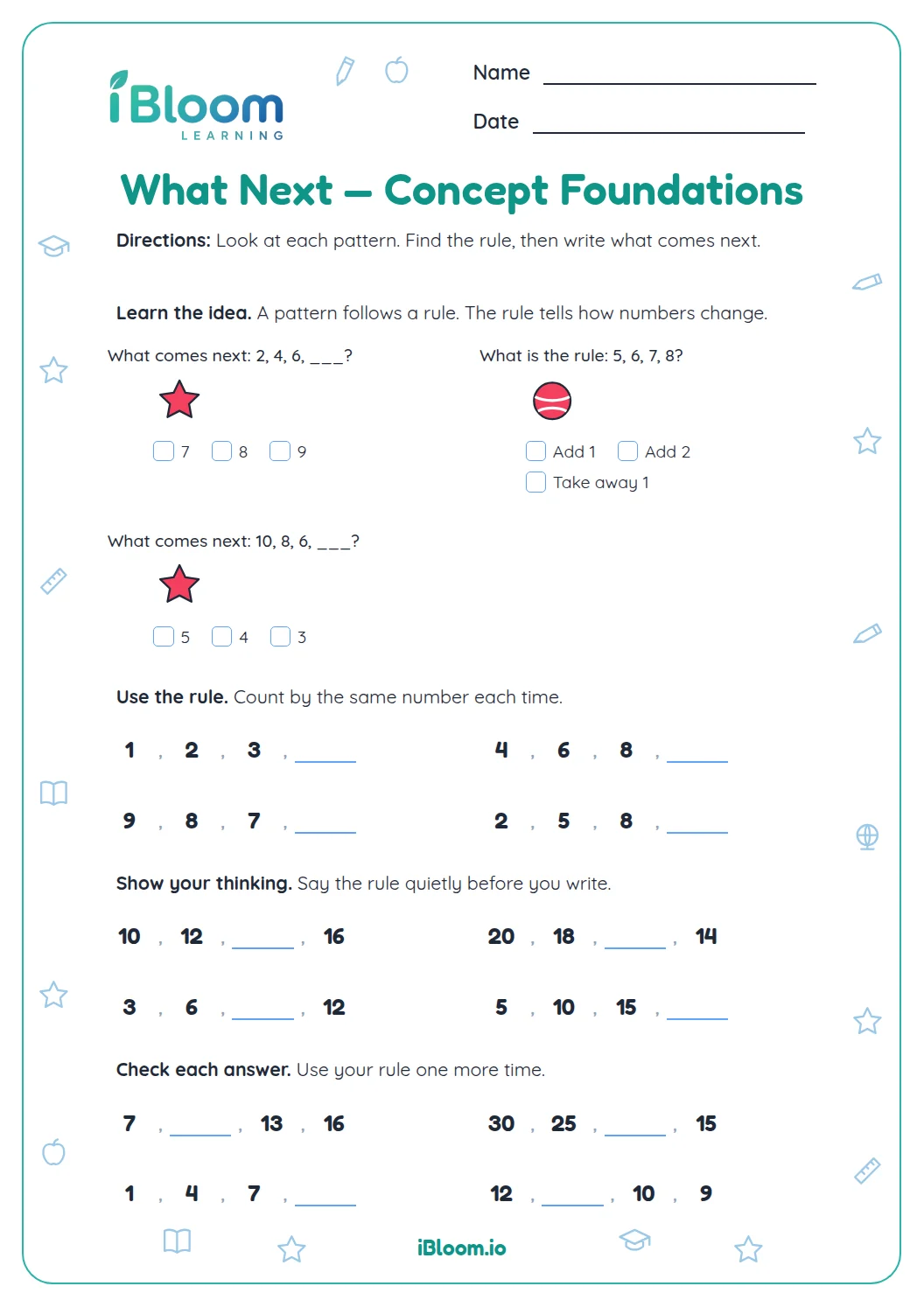
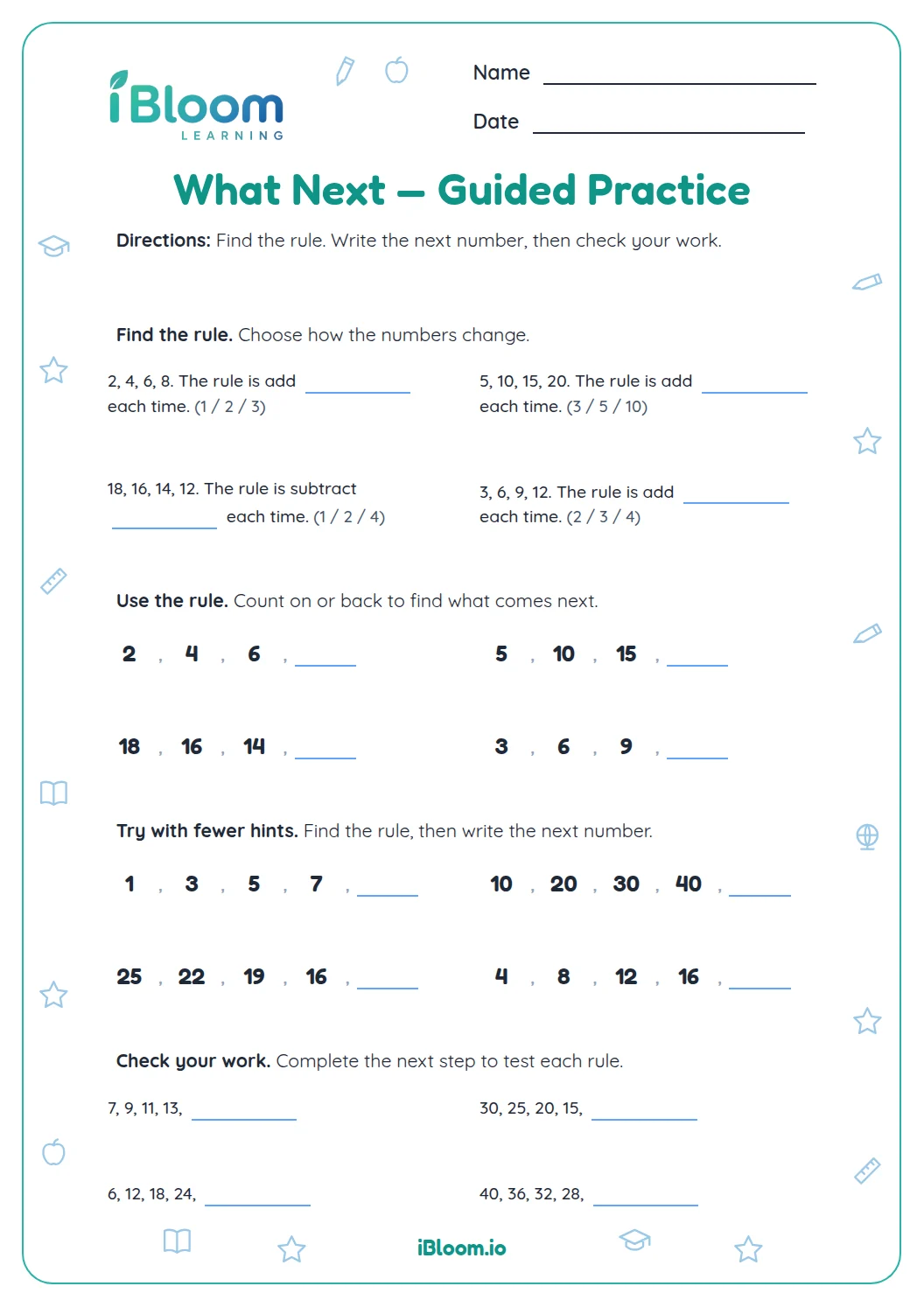
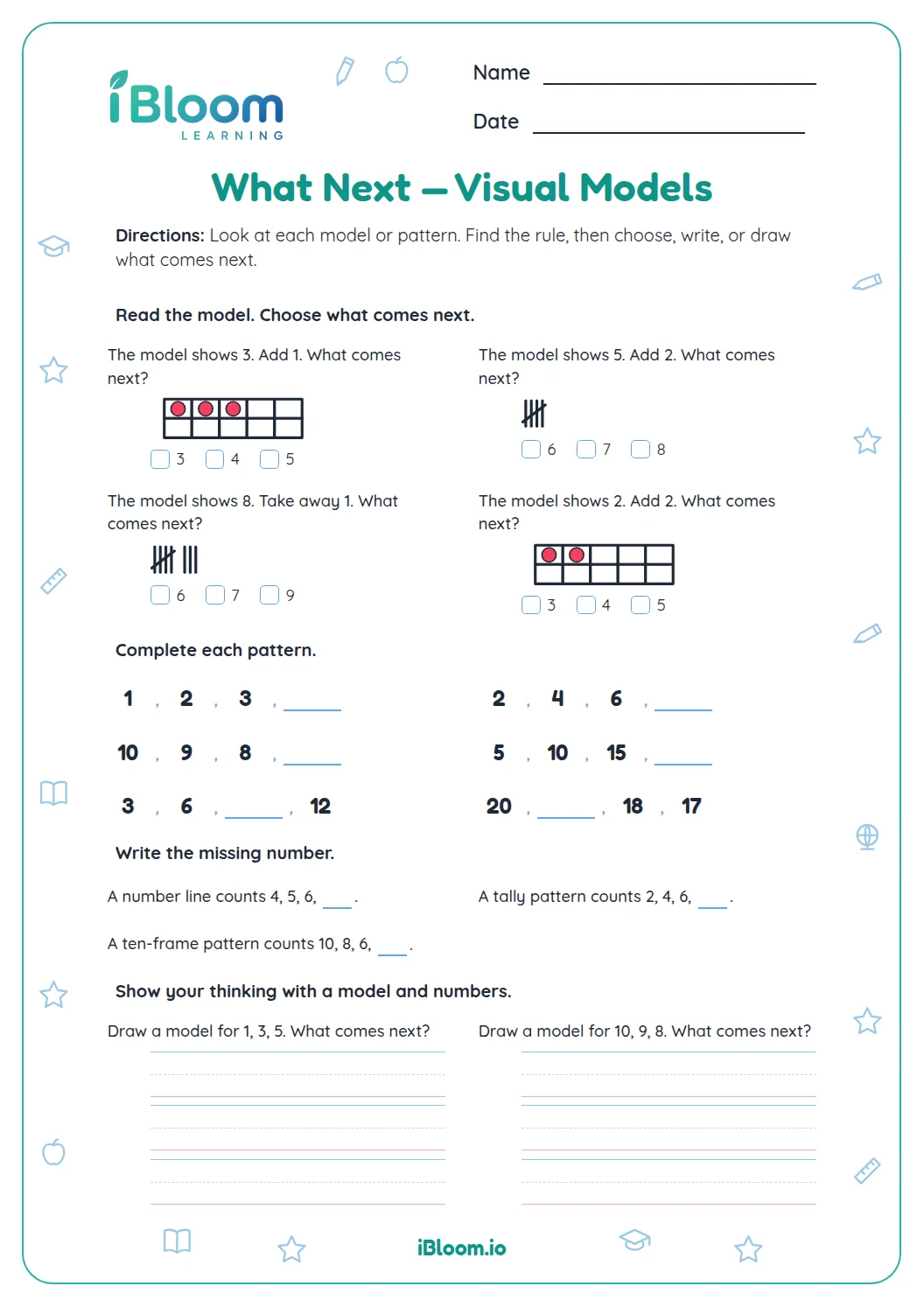
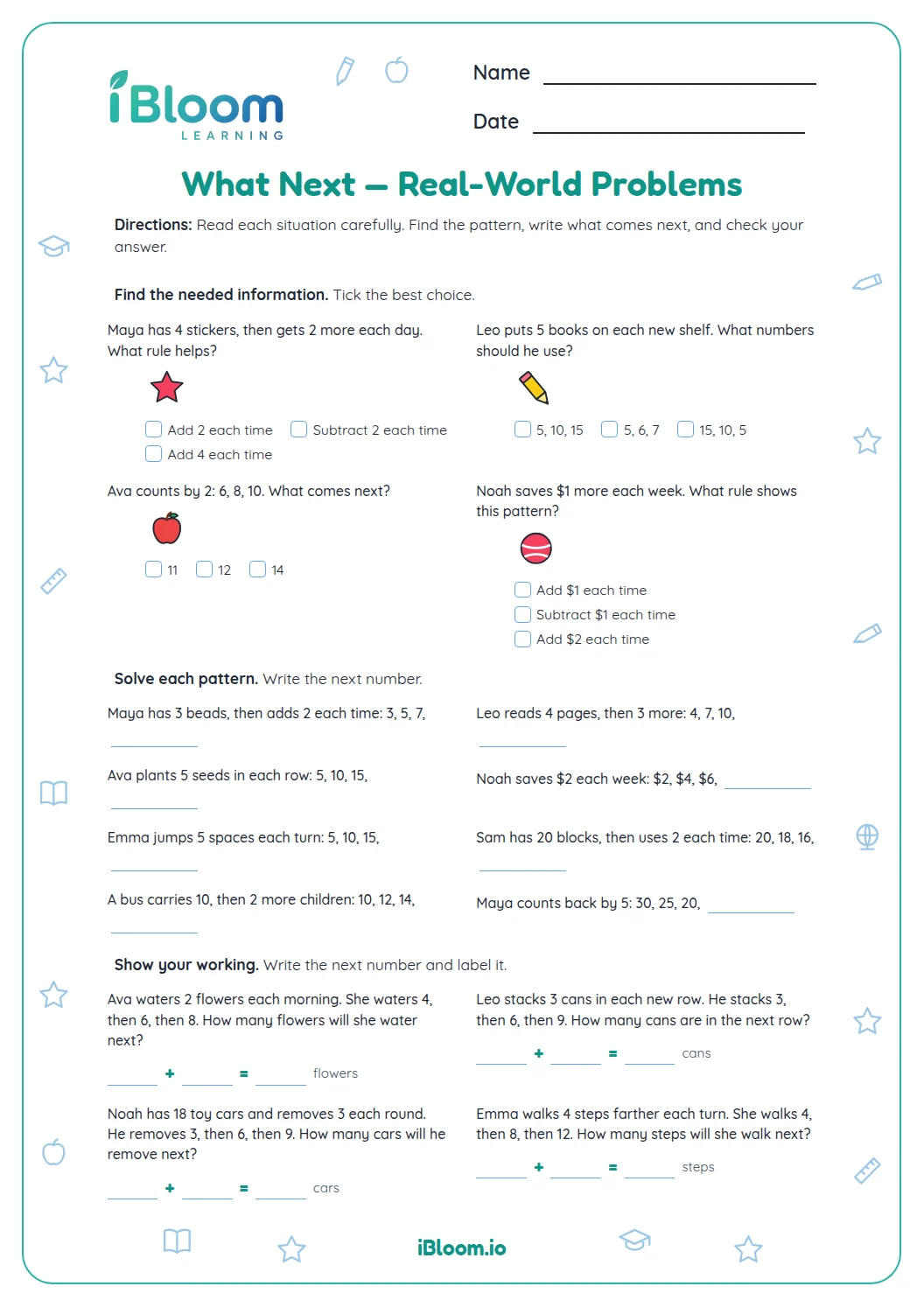
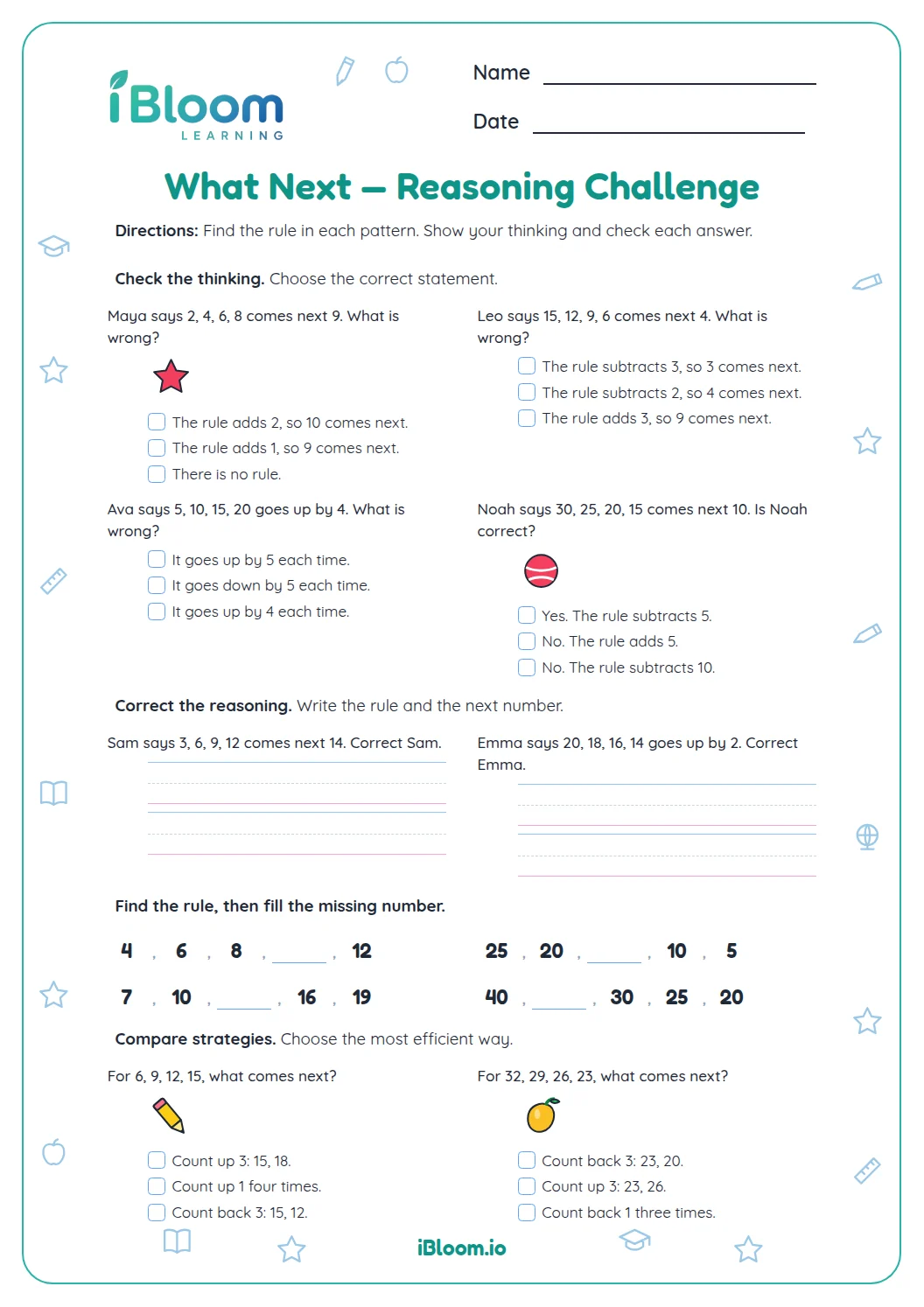
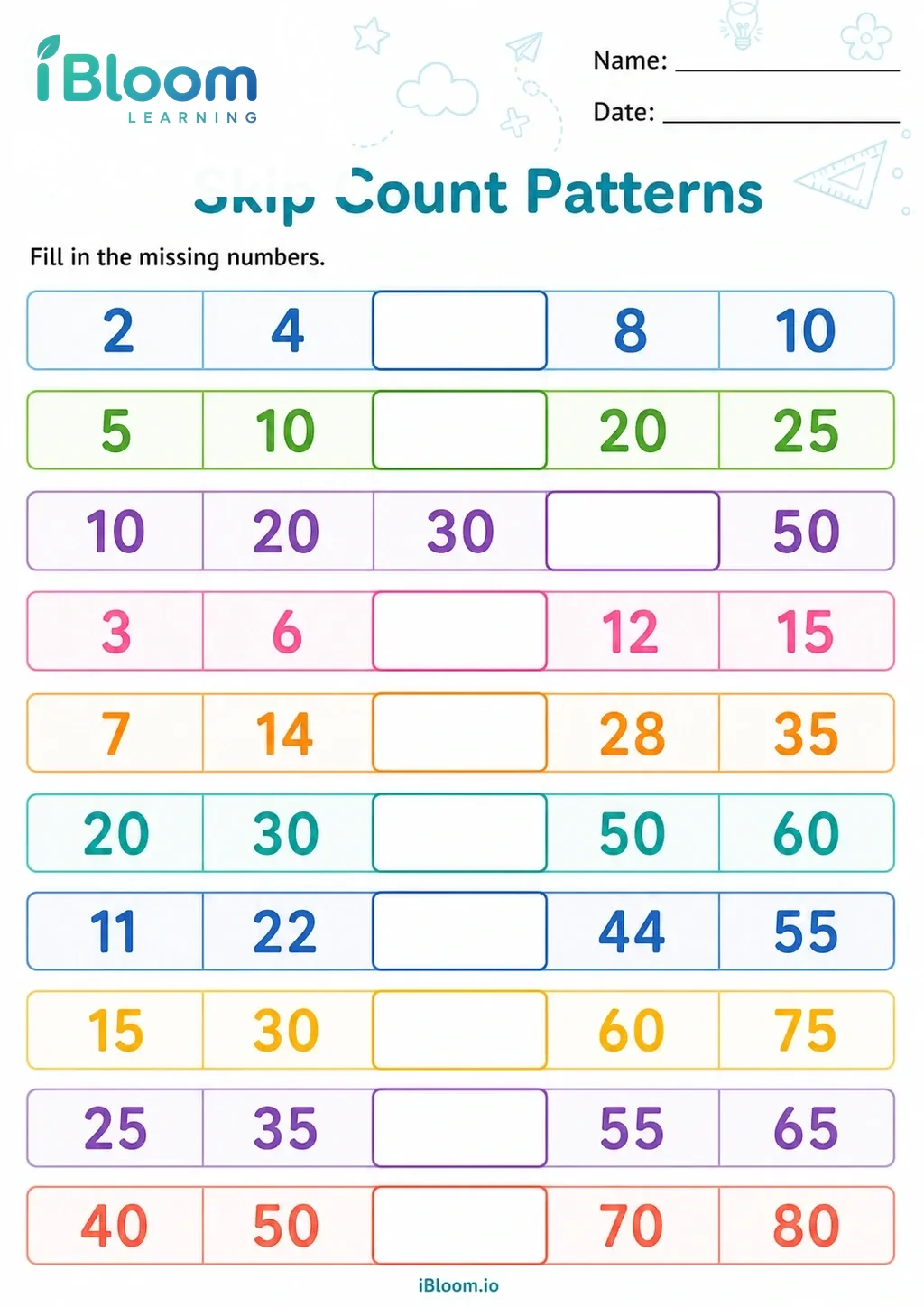
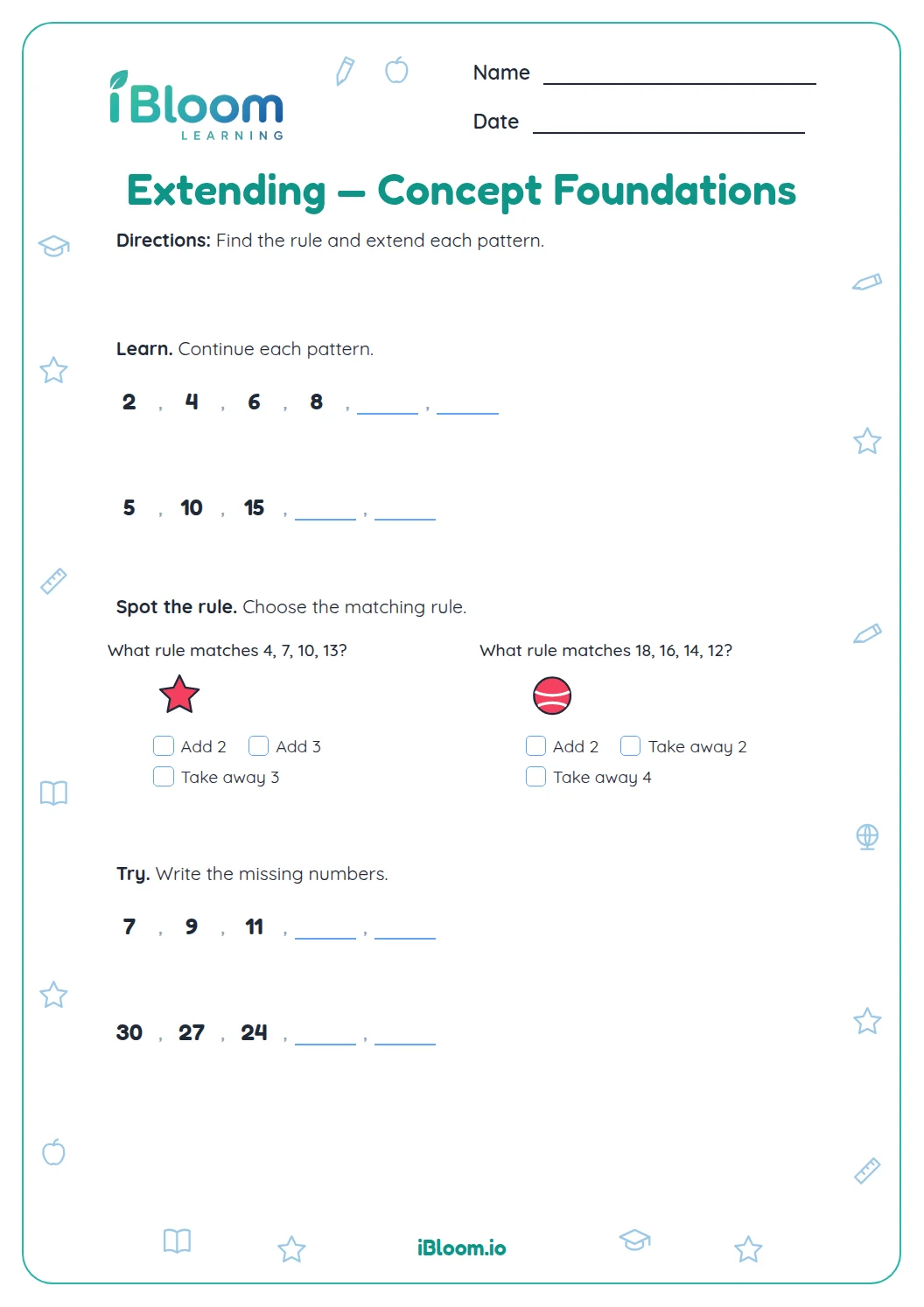
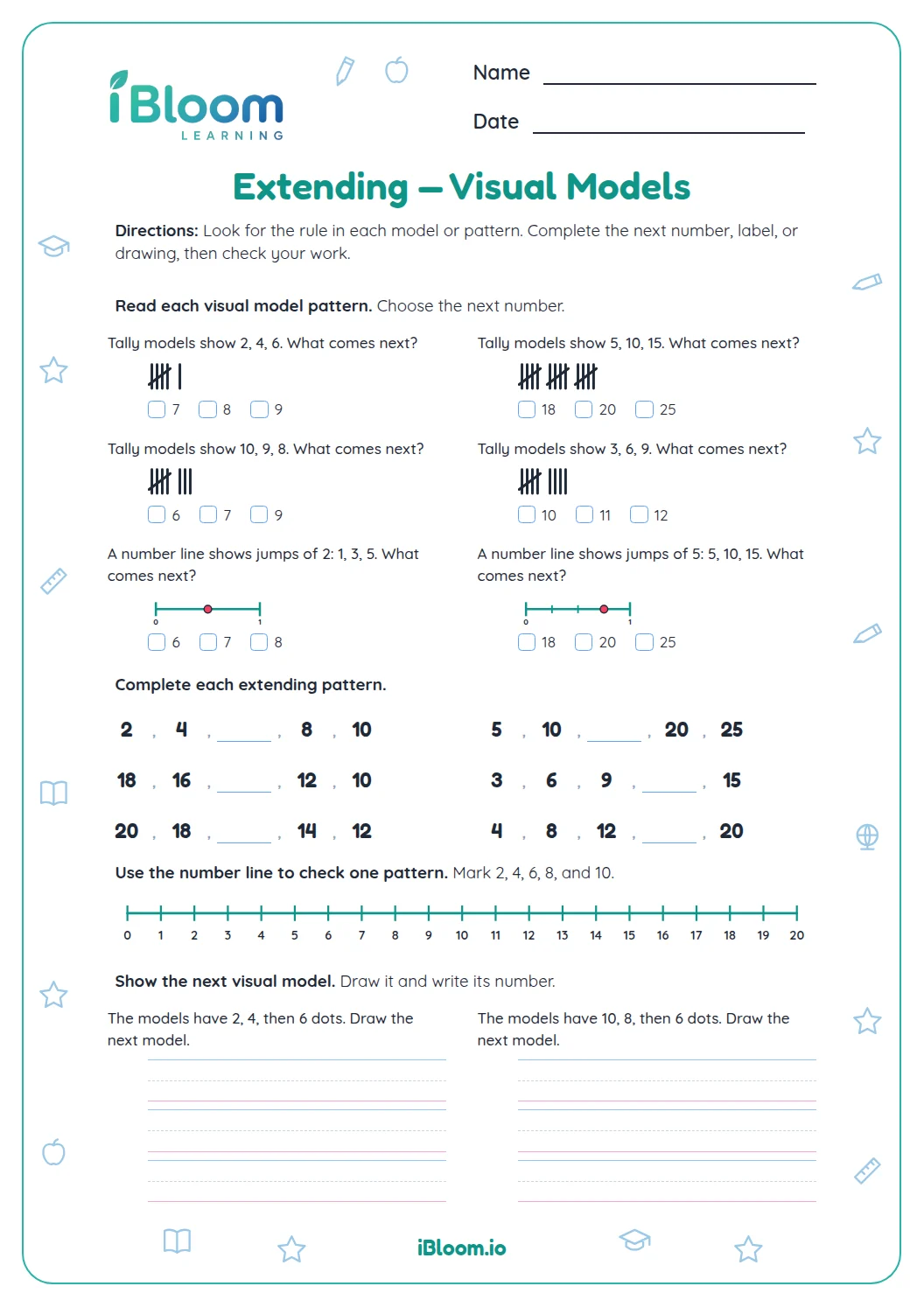
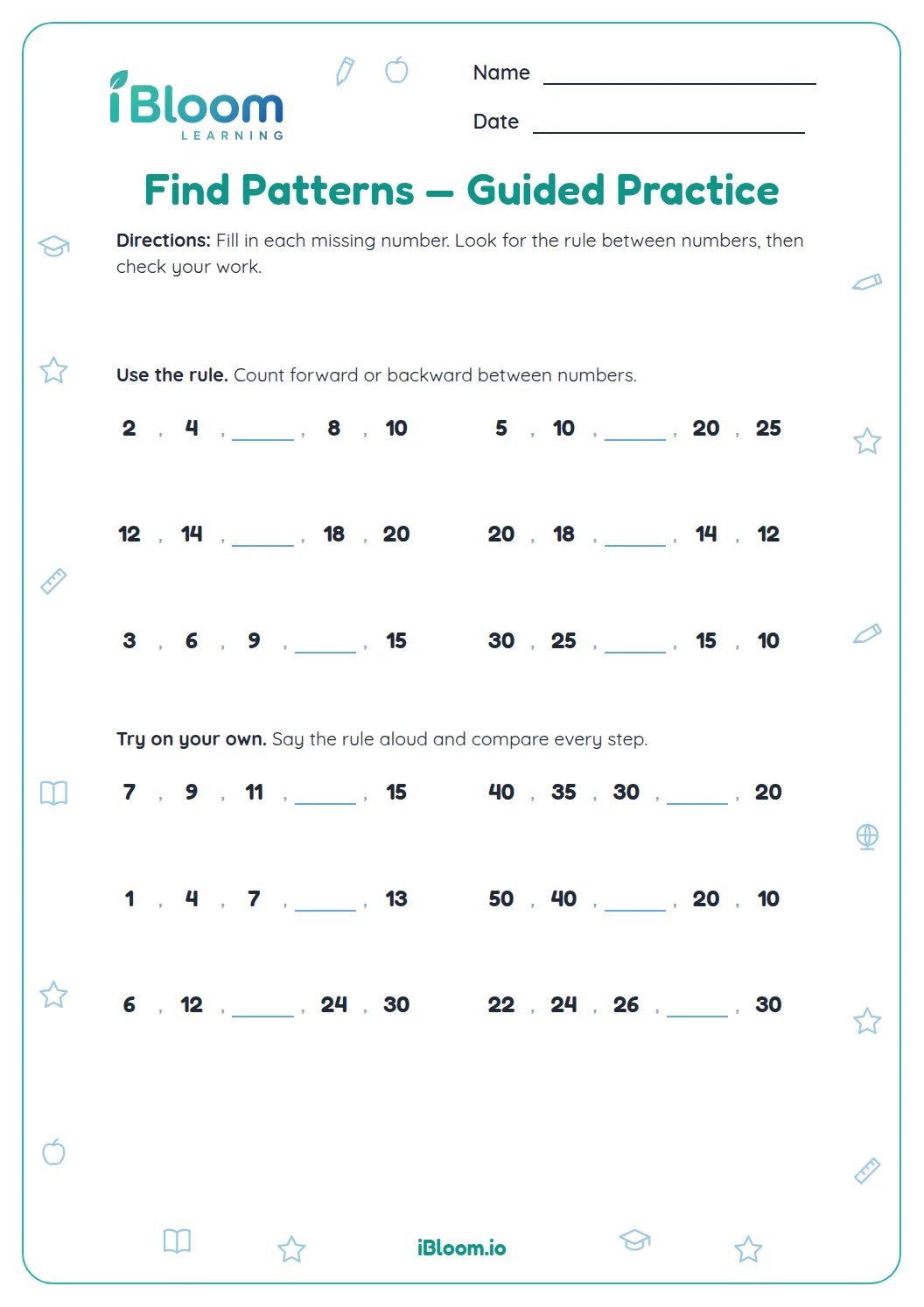
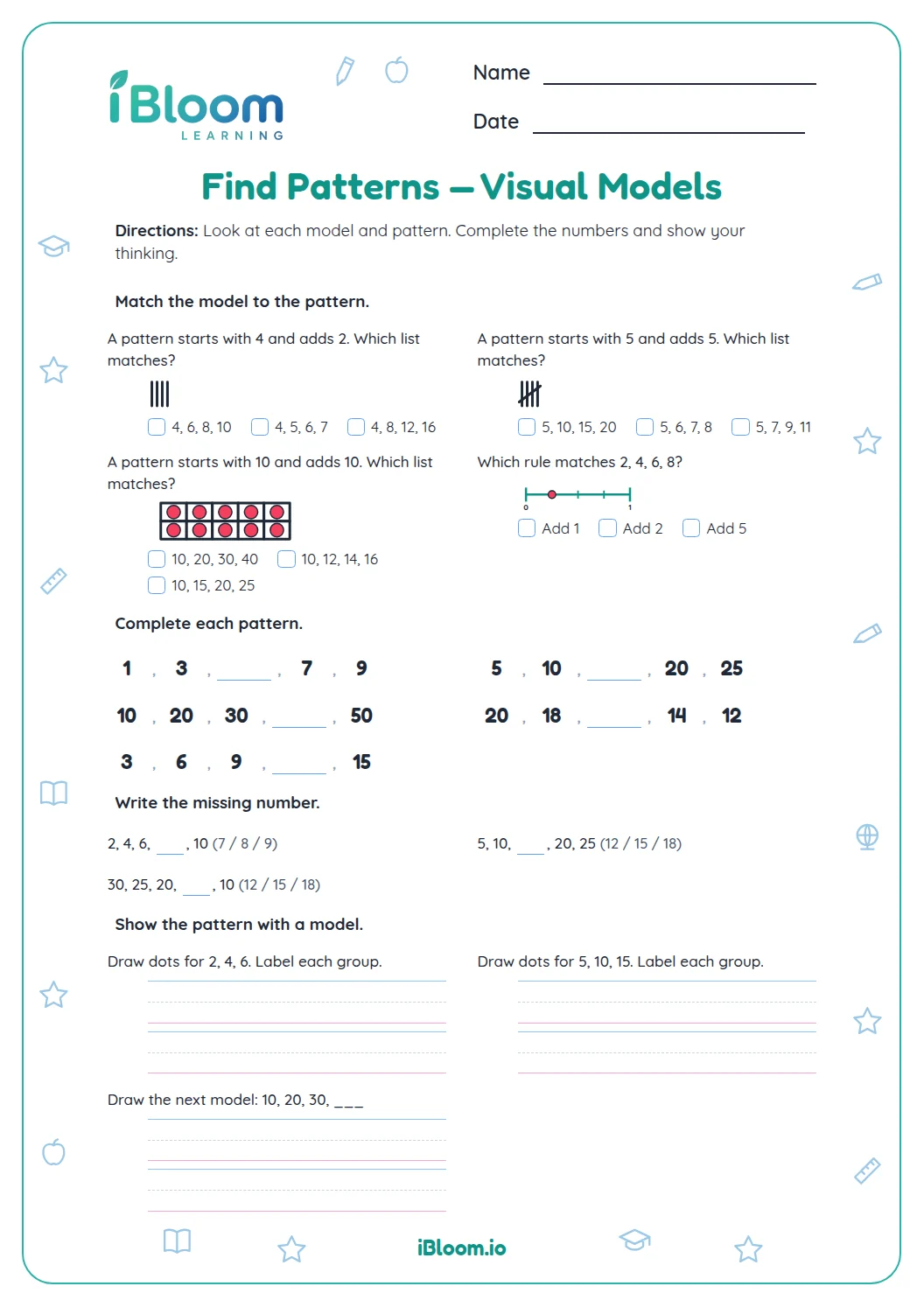
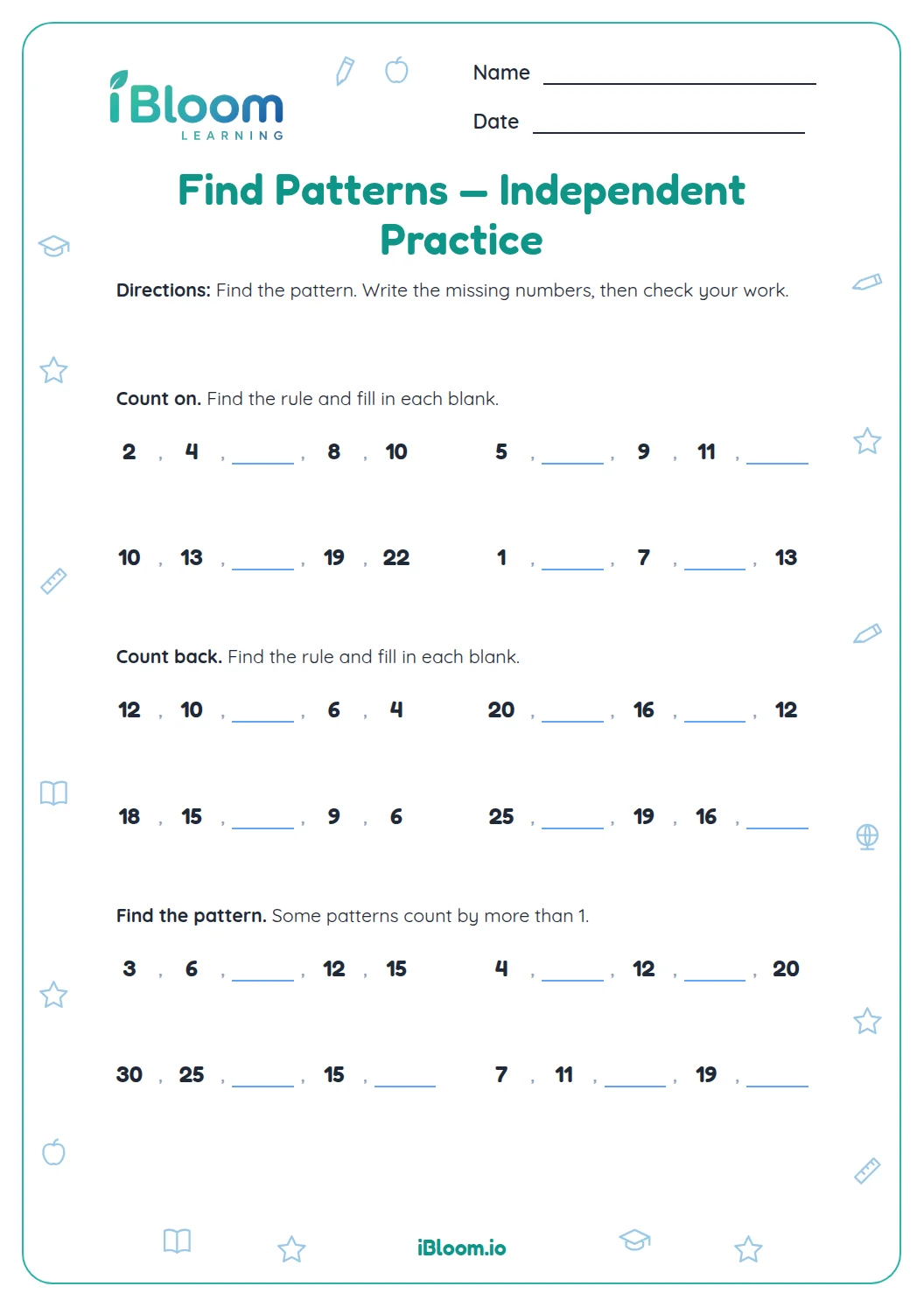
This Grade 1 printable asks students to find a repeating change in number sequences and write the missing term. The 20 items count forward and backward by 1, 2, 3, 5, or 10, with numbers staying within 100. Four short parts move from simple patterns to missing terms within a sequence. A separate answer key is included.
Aligned to 1.OA.C.5
How can a child find the next number in a pattern?
Compare neighboring numbers to find the step.
Check that the same step repeats.
Add or subtract the step to fill the blank.
- 14, 6, 8, ___, 12
- 2The numbers go up by 2.
- 38 + 2 = 10
What is on this worksheet?
The two-page worksheet has 20 number sequences in four parts, followed by a separate answer key.
- Part A: recognize simple counting patterns
- Part B: continue sequences with equal steps
- Part C: identify missing terms in a sequence
- Part D: use the same rule to complete final patterns
How to use this worksheet
- 1Read the directions and try the first question carefully.
- 2Complete each part in order, showing a calculation or clue when it helps.
- 3Return to the prompt to check that the answer fits.
- 4Use the separate key to review any missed item.
Common mistakes and quick checks
The mistake
Changing the step size in the middle.
The fix
Compare each neighboring pair to make sure the same amount repeats.
The mistake
Adding when the sequence is counting backward.
The fix
Check whether the numbers get smaller, then subtract the step.
The mistake
Using the number before the blank instead of the pattern rule.
The fix
Use the rule to check both numbers around the blank.
Common Core alignment
This worksheet practices the grade-level skill named below.
Relate counting on and counting back to addition and subtraction.
On this sheet: Students continue forward and backward counting sequences by equal steps and find missing terms.
Show the official wordingHide the official wording
Relate counting to addition and subtraction
What to practice next
Make more practice
Questions parents and teachers ask
What is a number pattern?
A number pattern follows a rule, such as adding 2 each time or subtracting 5 each time. Students compare neighboring numbers to find the step, then use it to continue the sequence or fill a gap. A rule must explain every pair of neighboring terms.
What counting steps appear on this page?
The 20 sequences count forward or backward by 1, 2, 3, 5, or 10. Numbers stay within 100, and some blanks appear in the middle of a sequence rather than at its end, so children use both nearby terms.
How can children check a missing number?
Use the same step on both sides of the blank. In 4, 6, 8, blank, 12, the rule is plus 2, so the missing number is 10; adding 2 again gives 12. Checking both sides confirms the term fits.
Does the worksheet include backward counting?
Yes. Several patterns get smaller by a steady amount. Students recognize that the sequence counts backward and subtract the same step each time to continue it, checking that the same rule works across every number. Other patterns count forward by equal amounts.
Is an answer key included?
Yes. A separate answer key follows the worksheet and lists each missing number. Check that every answer follows the same counting rule as the numbers around it, including blanks placed in the middle of a sequence. The key makes self-checking straightforward.