
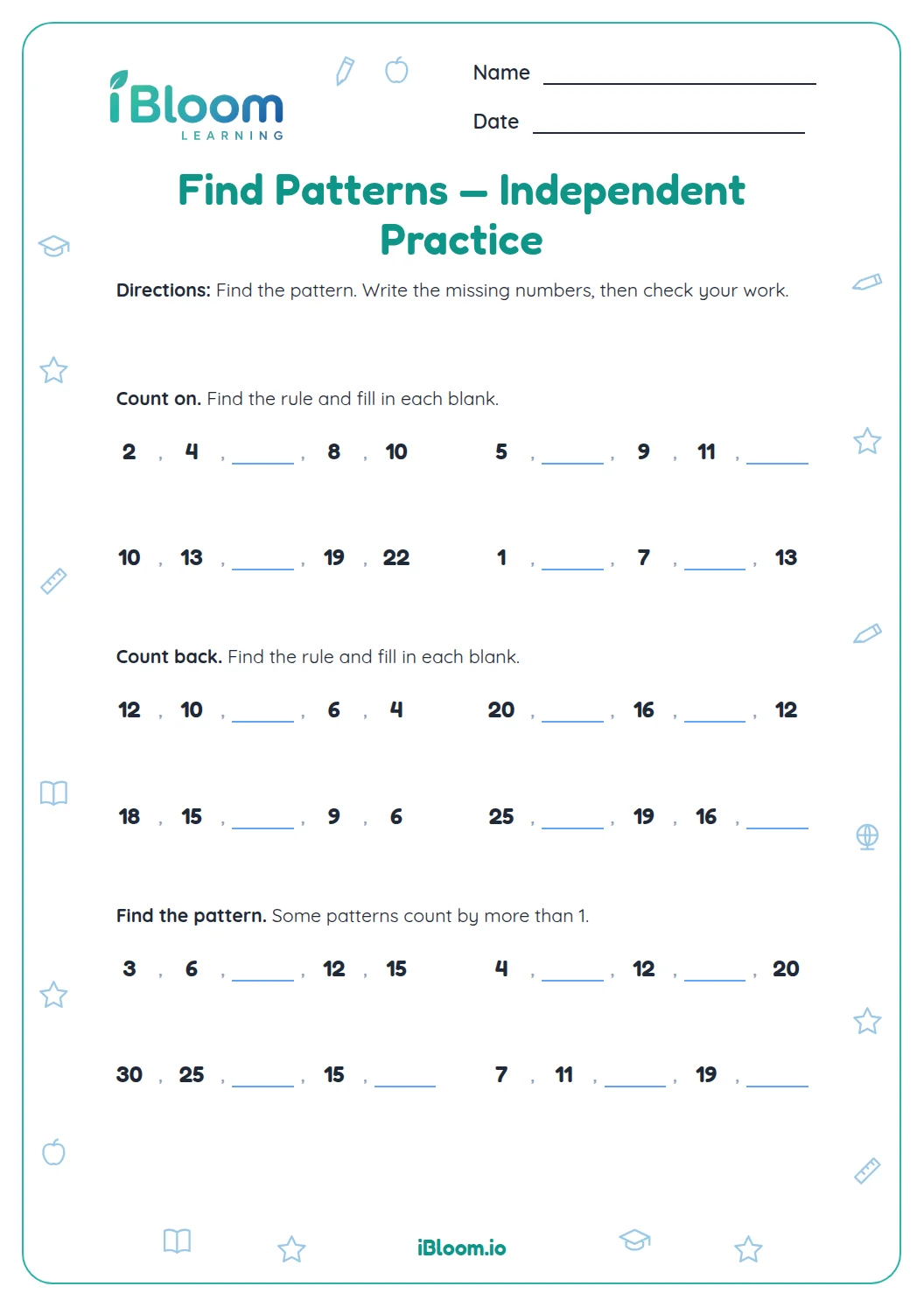
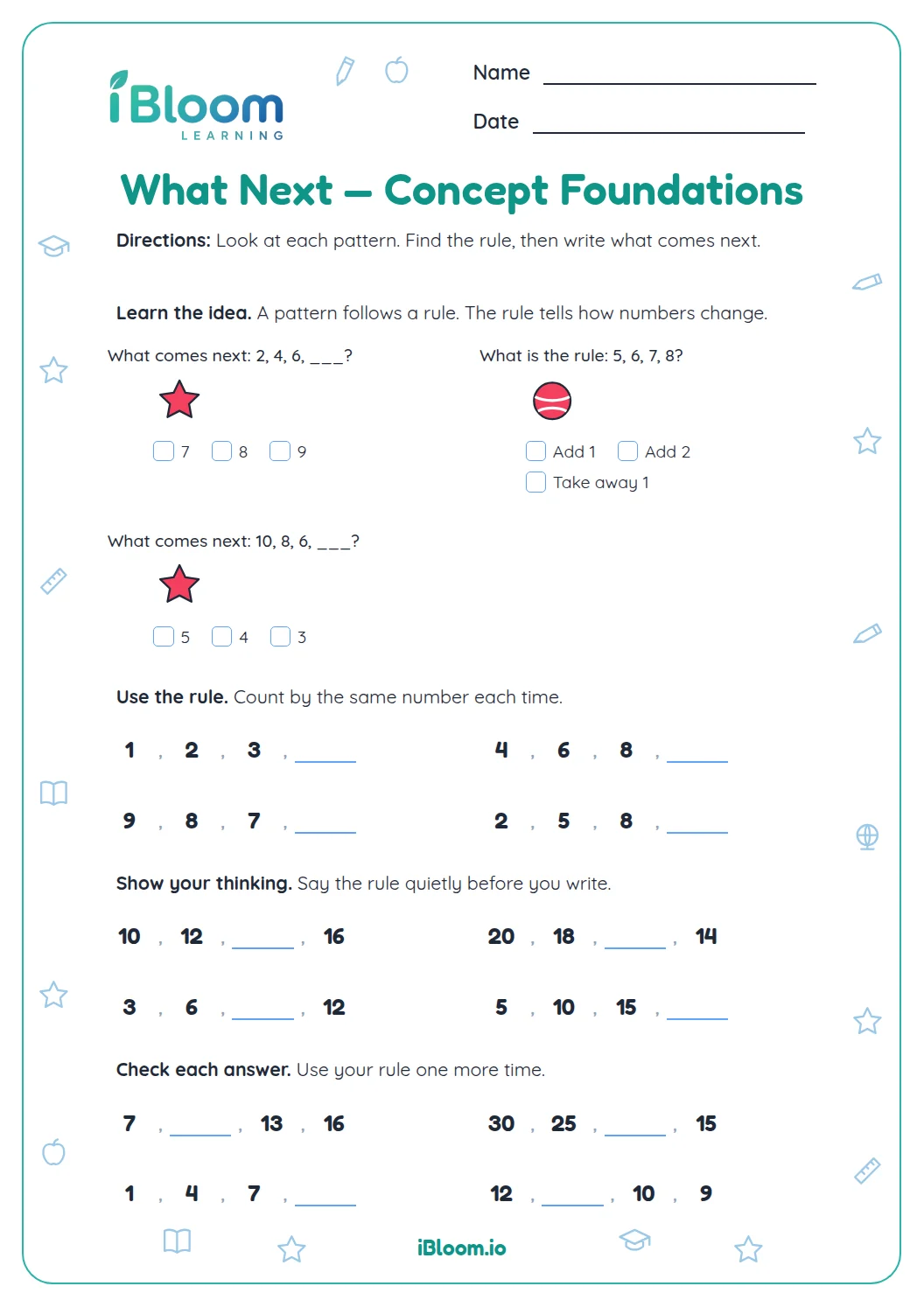
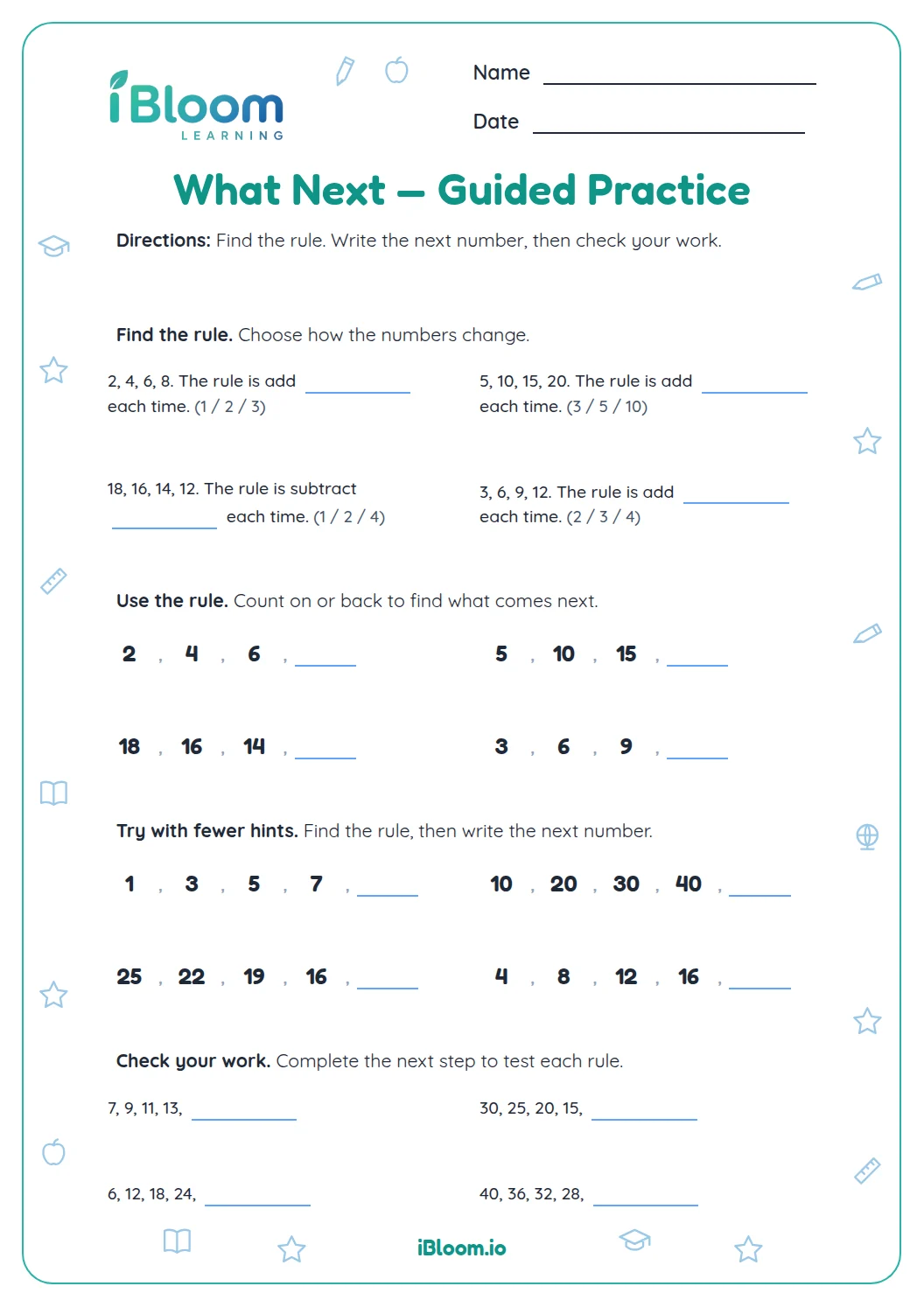
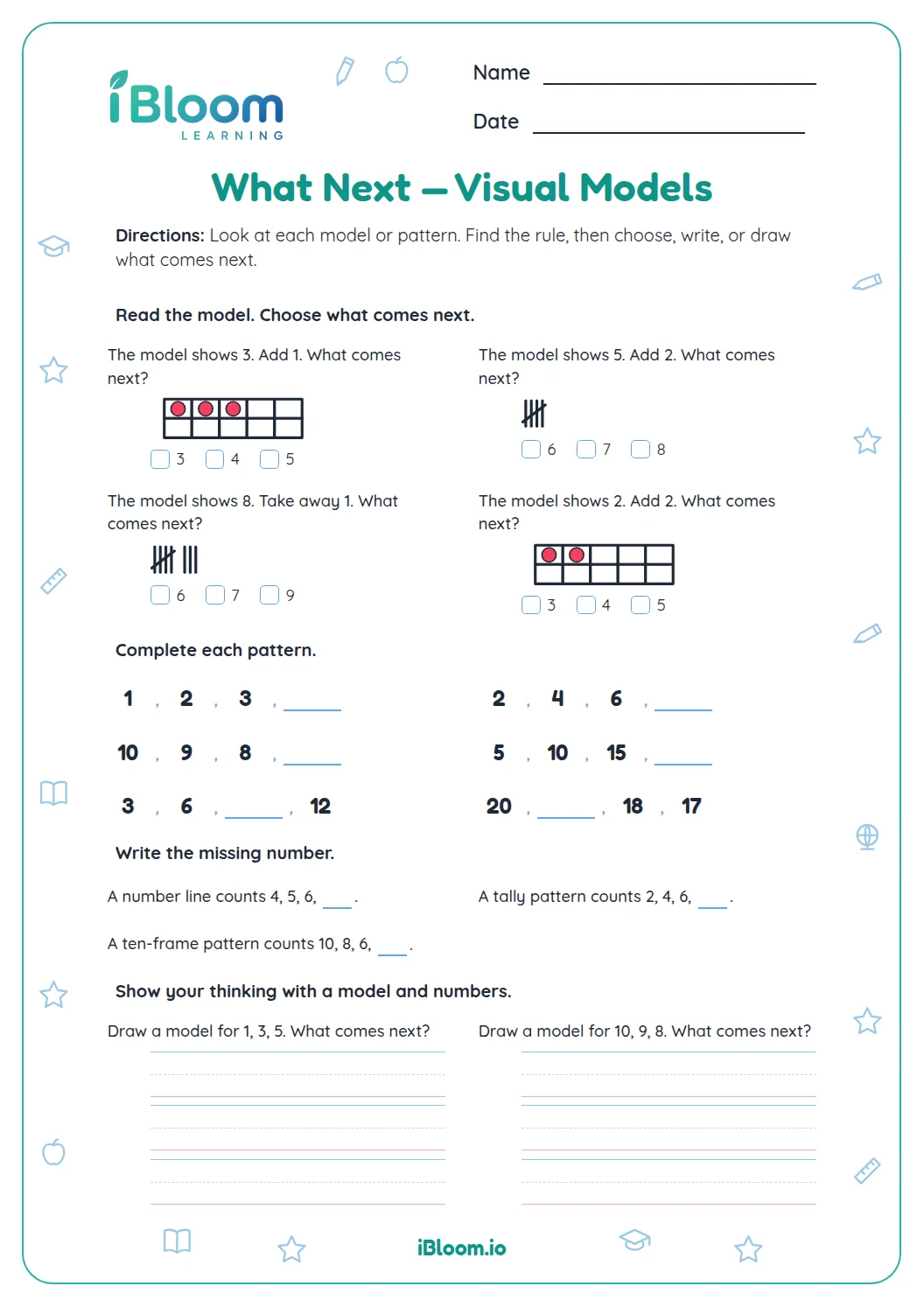
About this worksheet
This free printable worksheet helps Grade 1 children extend number patterns by finding the rule and counting on or back. Part A asks for the next number in four patterns, such as 5, 8, 11, 14, ___. Part B asks children to name the rule. Part C has a missing number inside the pattern, and Part D has two short stories about stickers and coins. Rules are add or subtract 2, 3, 5 and 10, and every number stays under 60. It practices CCSS 1.NBT.A.1 and 1.OA.C.5, and a separate answer key is included.
Aligned to 1.NBT.A.1 and 1.OA.C.5
What is a number pattern, and what does extending one mean?
A number pattern is a list of numbers that follows a rule. In 2, 4, 6, 8, each number is 2 more than the one before. To extend a pattern means to keep going with the same rule and write the numbers that come next.
Grade 1 children do this by counting on or back. If the rule is add 3, they start at the last number and count three more. If the rule is subtract 2, they count back two. Counting aloud and using fingers is a good way to check.
- 15, 8, 11, 14, ___
- 2From 5 to 8 is 3 more. From 8 to 11 is 3 more.
- 3The rule is add 3.
- 4Count on 3 from 14: 15, 16, 17.
- 5The next number is 17.
How can a child tell which rule a pattern follows?
Look at the first two numbers and ask how far it is from one to the other. Then check the next pair. In Part B, question 8 shows 50, 40, 30, 20. The numbers go down by 10 each time, so the rule is subtract 10, not add 10.
Two questions in Part B include a rule that goes the wrong way, such as add 2 for 25, 23, 21, 19. Children learn to check whether the numbers get bigger or smaller before they pick.
What is on this worksheet?
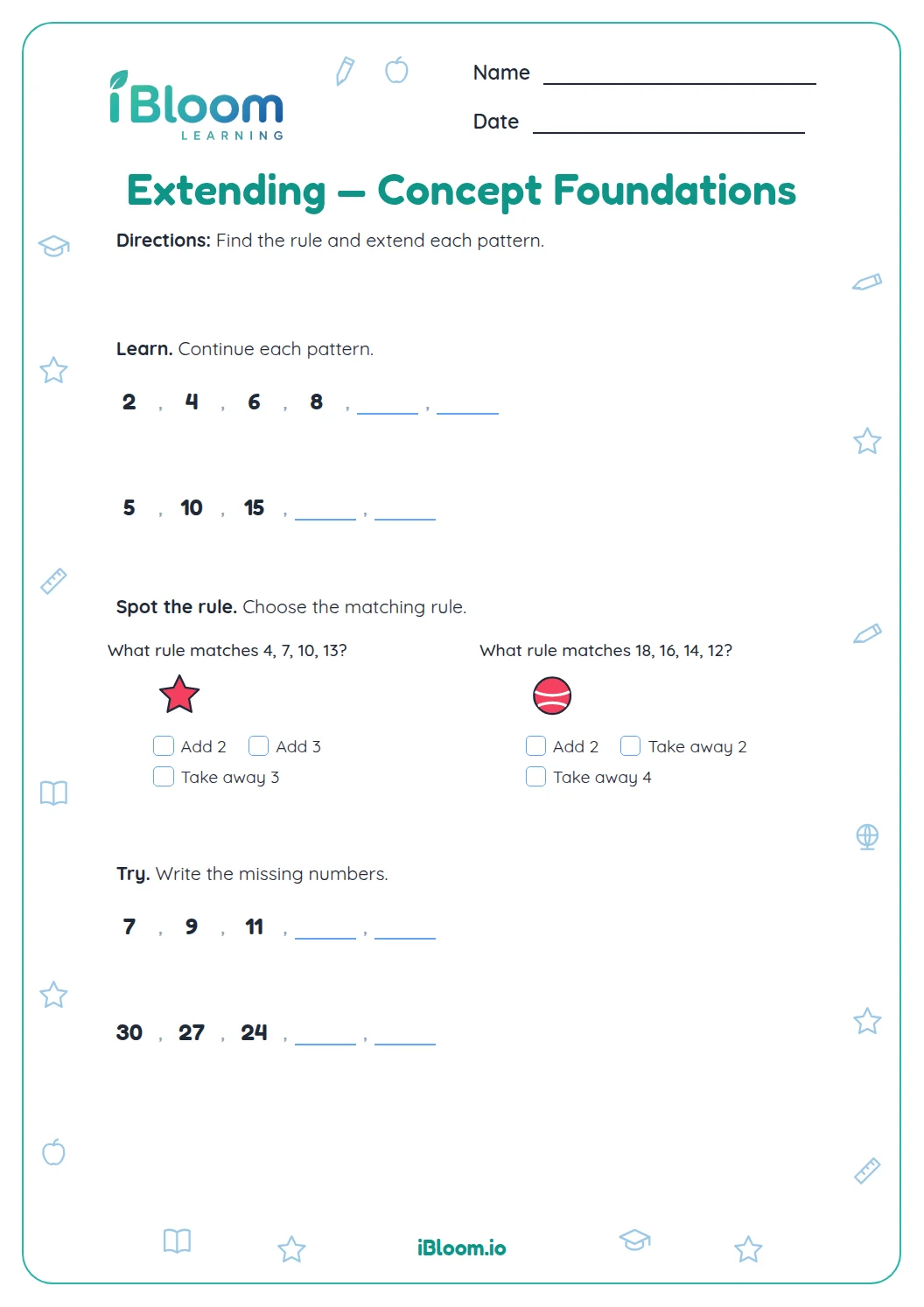
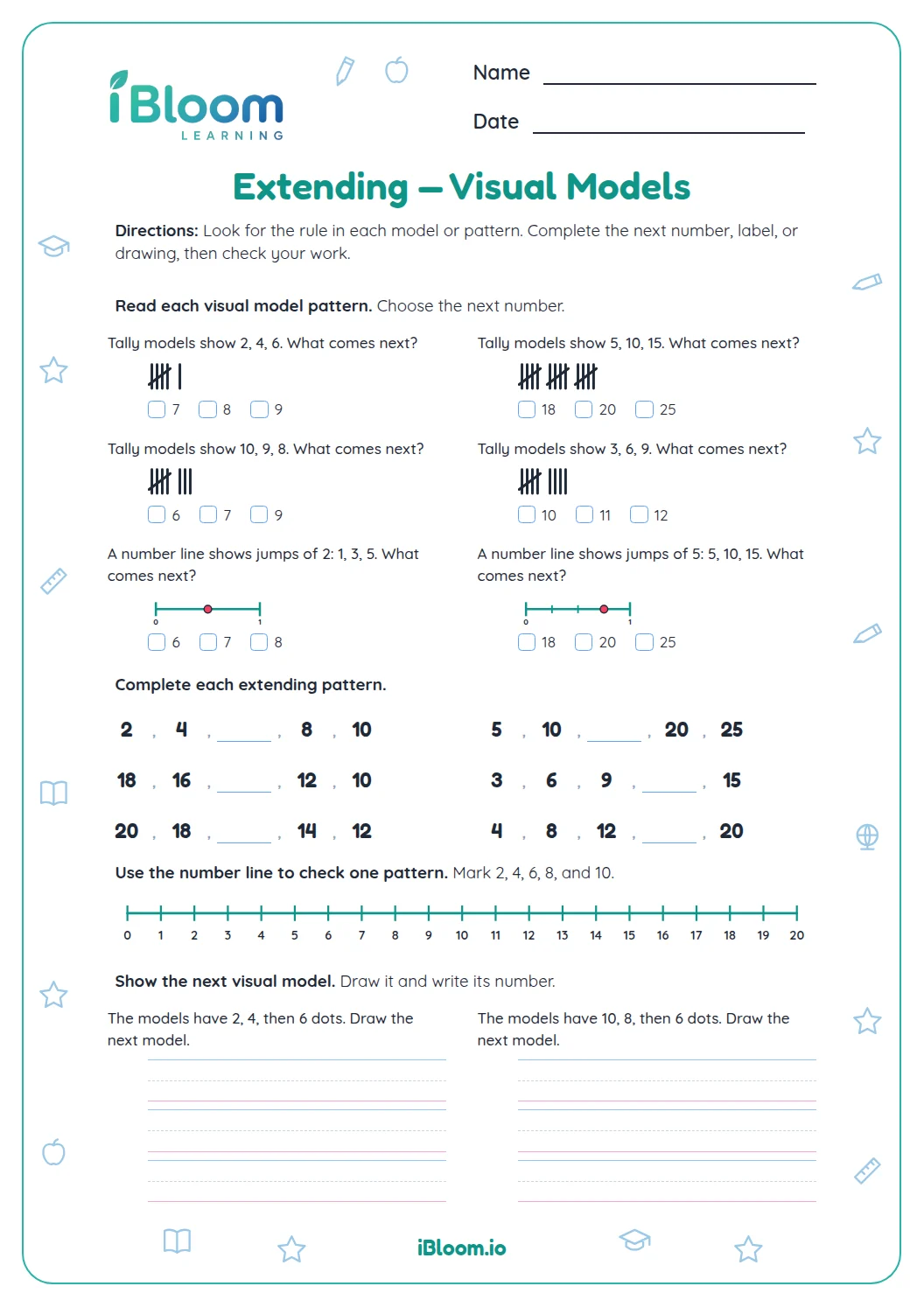
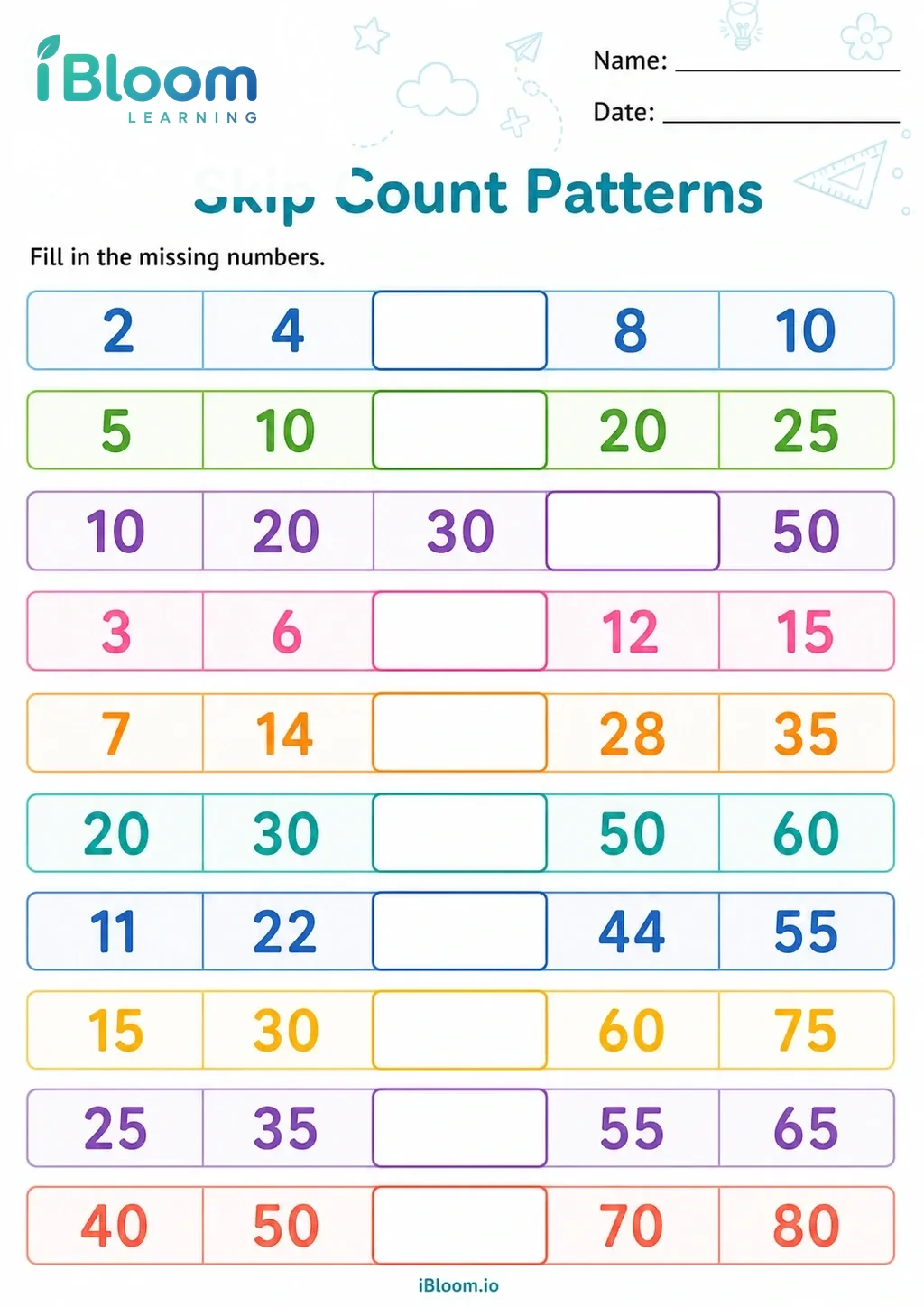
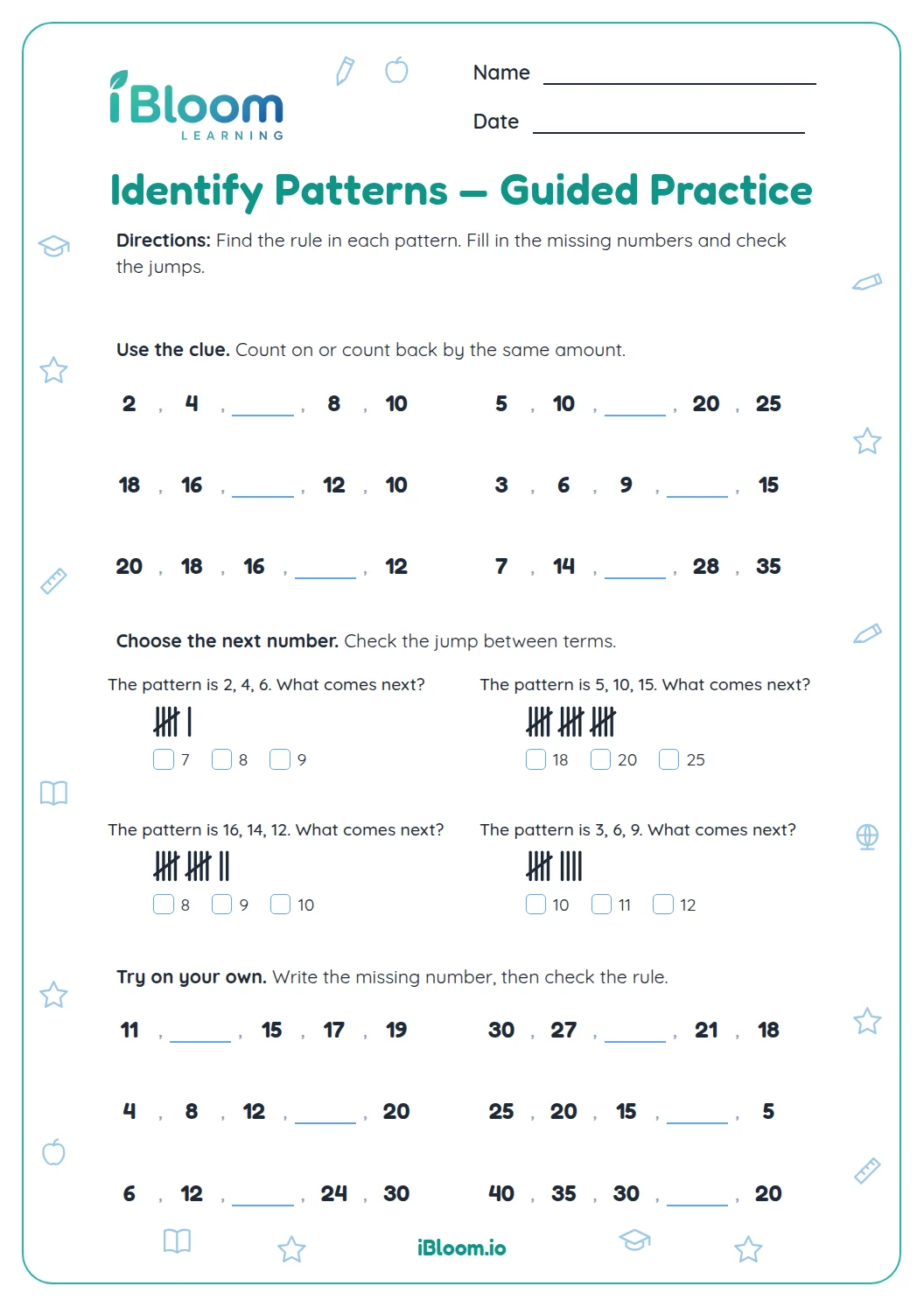
Thirteen questions over two pages, in four parts that move from using a rule to naming one to finding a missing number.
- Part A, Next number: four patterns to extend by one number (add 2, add 3, subtract 2, add 10)
- Part B, Name the rule: four patterns, each with three rules to choose from
- Part C, Missing number: three patterns with a gap in the middle
- Part D, Pattern stories: stickers on pages and coins in rows, with space to work out each answer
- Answer key on separate pages
Why is a missing number in the middle harder?
When the gap is at the end, children can count on from the last number. When it is in the middle, as in 4, 9, ___, 19, they need to find the rule first and then use it. Counting on 5 from 9 gives 14, and counting on 5 from 14 gives 19, so the pattern checks out.
That last check, counting on from the new number to reach the next given one, is a good habit to build at this age.
How to use this worksheet at home or in class
- 1Warm up by counting by 2s, 5s and 10s aloud, clapping on each number you say.
- 2Do question 1 together. Ask: "How far is it from 2 to 4? From 4 to 6?" Then count on to find the next number.
- 3Let your child finish Part A alone, saying the rule aloud before writing each answer.
- 4In Part B, check whether the numbers are going up or down before choosing a rule.
- 5For Part C, have your child count on from the new number to the next number given, to check it.
- 6Mark with the answer key and replay any missed pattern with coins or counters.
Common mistakes and quick fixes
The mistake
Counting the starting number as the first step, so 5 plus 3 becomes 7 instead of 8.
The fix
Say the starting number, then put up one finger for each step: 5, then 6, 7, 8. The last number said is the answer.
The mistake
Adding when the pattern goes down, such as writing 16 after 20, 18, 16, 14.
The fix
Check the first two numbers. If the second is smaller, the rule is subtract. Count back instead of on.
The mistake
Changing the rule partway through, such as writing 5, 8, 11, 14, 16.
The fix
Say the rule out loud, "add 3," and use it every time. Ask whether 14 and 16 are 3 apart.
Common Core alignment
Most US states use the Common Core standards or a close state version. This sheet practices the two Grade 1 standards below.
Count on from any starting number and write the numbers.
On this sheet: Every pattern starts at a number such as 3, 5 or 20, and children count on or back from there.
Show the official wordingHide the official wording
Count to 120, starting at any number less than 120.
Count on to add and count back to subtract.
On this sheet: Rules like add 2, add 3 and subtract 2 turn counting on and back into addition and subtraction.
Show the official wordingHide the official wording
Relate counting to addition and subtraction (e.g., by counting on 2 to add 2).
What to practice next
Make more practice
Further reading
Questions parents and teachers ask
What is a number pattern in first grade?
A number pattern is a list of numbers that follows a rule, like adding the same number each time. In 2, 4, 6, 8, the rule is add 2. First graders extend patterns by counting on or back, and name the rule by seeing how far apart the numbers are.
What is the answer to 5, 8, 11, 14, ___?
The answer is 17. Each number is 3 more than the one before, so the rule is add 3. Counting on 3 from 14 gives 15, 16 and 17. Question 2 on the sheet uses this pattern, and your child can check by counting back 3 from 17 to reach 14.
How do I help my child tell add from subtract in Part B?
Ask whether the numbers are getting bigger or smaller. If they get bigger, the rule is add. If they get smaller, the rule is subtract. Then check how far it is between the first two numbers. For 50, 40, 30, 20, the numbers go down by 10, so the rule is subtract 10.
Why does the sheet use steps of 2, 3, 5 and 10?
Steps of 2, 5 and 10 match the skip counting first graders practice on a hundred chart, so the patterns feel familiar. Add 3 in question 2 and the 4, 9, 14, 19 pattern in question 9 make children work the step out instead of reciting it. Every number stays under 60, so counting on stays manageable.
What if my child counts the wrong number of steps?
Use fingers or counters. Say the starting number, then put up one finger for each step and say the next number each time. To add 3 to 14, say 14, then 15, 16, 17. The last number said is the answer. Practicing with objects before the sheet makes the idea clear.
Is there an answer key for this worksheet?
Yes. The separate answer key pages show the next number in each Part A pattern, the correct rule in Part B, the missing numbers in Part C and the answers to both pattern stories in Part D. Print the worksheet alone, keep the key for checking, or download both as a free PDF.