
About this worksheet
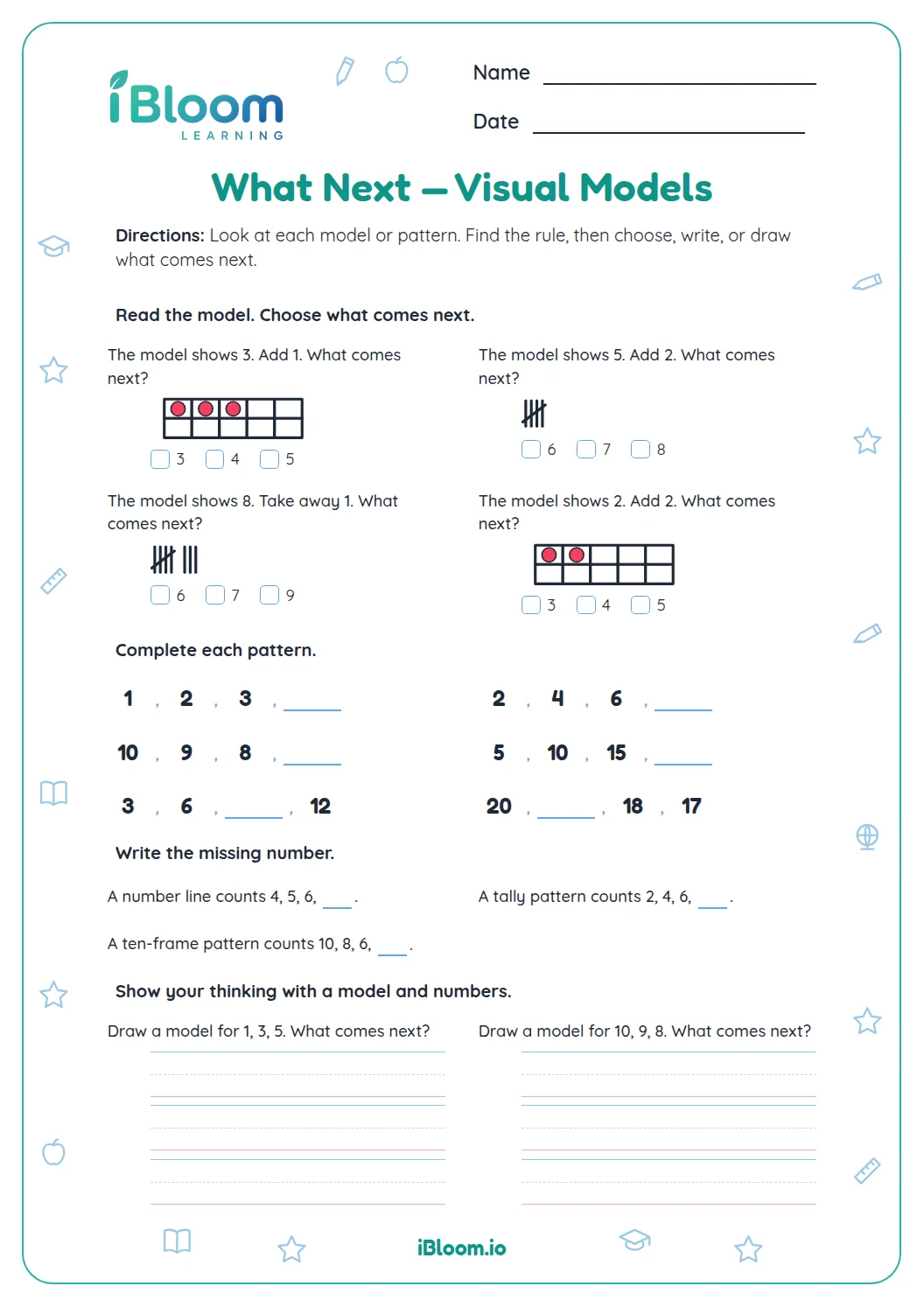
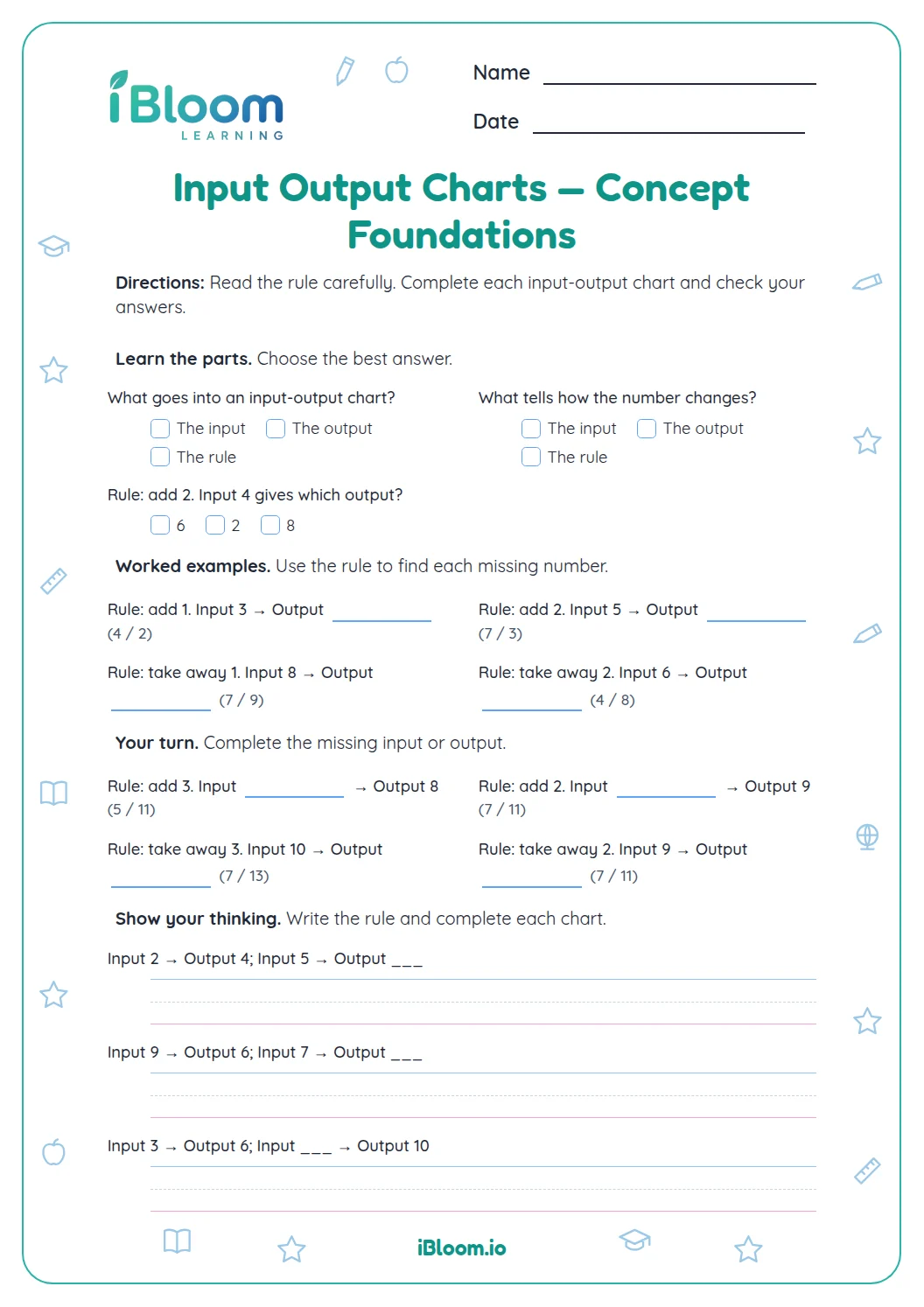
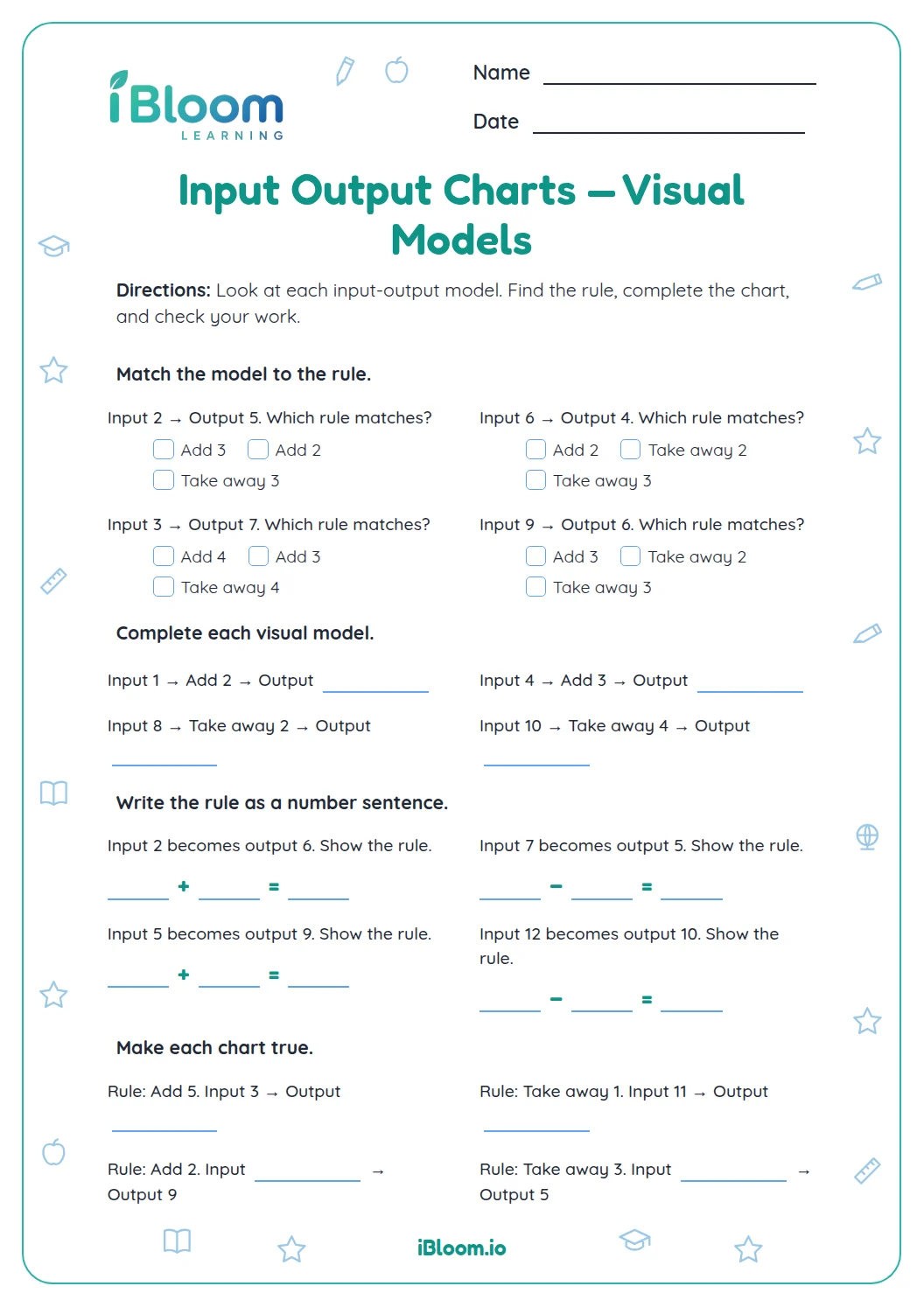
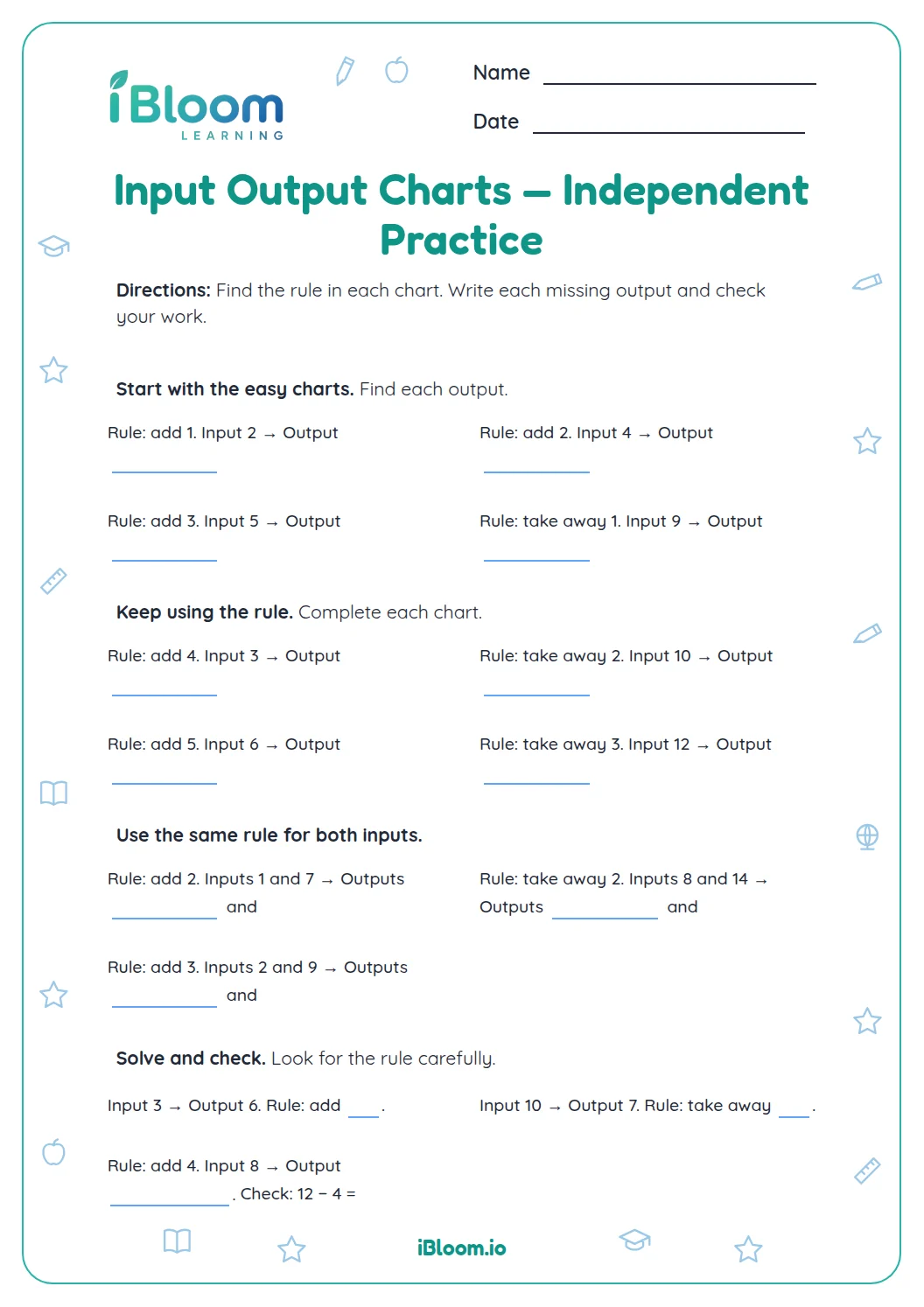
This free printable Grade 1 worksheet puts number patterns into everyday situations. Children continue numbered seats, book pages and tickets, then extend growing totals of socks, shoes, blocks and stickers. Each story states how the numbers change, so children can count on and write one next number. The twelve questions move from adding one to adding two, then mix these with adding five. This practices Common Core 1.NBT.A.1 and 1.OA.C.5. A separate answer key lists all twelve missing numbers for easy checking at home or in class.
Aligned to 1.NBT.A.1 and 1.OA.C.5
Where do these number patterns appear?
Part A uses seat labels, book pages, tickets and steps, all counting by one. Part B uses items added two at a time. Part C mixes stickers, toy cars, blocks and numbered houses. These contexts give a reason for the next number.
Read each short story aloud if needed. Ask what the number measures: a label, a page or a total collection. The missing number must follow the rule stated in that story.
How do children find the next total?
Keep the amount added separate from the total. In question 5, two socks are added each time, while the totals are 2, 4 and 6. The answer asks for the next total, so count two more after 6.
- 1Socks go in a basket 2 at a time: 2, 4, 6, ___.
- 2Start at 6. Count 7, 8.
- 3The next total is 8 socks.
- 4Check the steps: 2 more, 2 more, 2 more.
How can we handle 99 followed by a blank?
Question 12 counts house numbers by one: 97, 98, 99, then 100. Saying the sequence aloud helps children cross the change to three digits while keeping the same one-step rule.
The sheet also begins some counts above 100. Use a number chart through 120 if a child needs help reading these numbers, then cover the next number and ask them to say it before writing.
How to use this worksheet
- 1Read the situation and identify what is being counted.
- 2Underline the amount added each time: one, two or five.
- 3Check that this amount connects the first two numbers.
- 4Start at the last given number and count on by the same amount.
- 5Write the next number and read the completed pattern aloud.
- 6Check the answer key, returning to the story rule for any correction.
Mistakes to notice and how to help
The mistake
Adding one in every story, such as writing 7 after 2, 4, 6.
The fix
Find the words 2 at a time. Count on two from 6 to reach 8.
The mistake
Writing the step size as the answer, such as 2 for the sock total.
The fix
Ask how many socks are in the basket after two more join the six already there.
The mistake
Writing 991 after 99 in the house-number pattern.
The fix
Say 98, 99, 100 aloud and locate the numbers on a chart before writing 100.
Common Core alignment
Continue counting from starting numbers within 120.
On this sheet: Part A and question 12 ask children to continue counting by ones from different starting numbers.
Show the official wordingHide the official wording
Count to 120, starting at any number less than 120. In this range, read and write numerals and represent a number of objects with a written numeral.
Count on to find a new total when the same number is added again.
On this sheet: Children count on by two or five to extend totals in everyday situations.
Show the official wordingHide the official wording
Relate counting to addition and subtraction (e.g., by counting on 2 to add 2).
What to practice next
Make more practice
Further reading
Questions parents and teachers ask
Are these repeating shape patterns or growing number patterns?
These are growing number patterns in everyday counting stories. Each question gives three numbers and asks for the next one. The stated step stays the same within a question. Children add one, two or five to continue labels or totals rather than repeat a sequence of shapes.
Can I read the story problems aloud to my child?
Yes, reading the stories aloud lets the child concentrate on the number pattern. Pause after the words that explain the step, such as two at a time. Ask the child to tell you the rule, point to the last given number and count on before writing.
Why are some numbers above 100?
The seat, page and ticket questions practice starting a count at different places within 120. Children use the same add-one rule with 101 as with 27. A number chart can support reading the numerals while the child focuses on continuing the count from the given starting point.
How can objects help with the add-two questions?
Use small objects to act out a growing collection. For question 5, place two counters down, then two more, then two more, saying the totals 2, 4 and 6. Add another pair and count eight. Compare that total with the number your child wrote in the blank.
What should I check besides the twelve answers?
Ask your child to explain the counting step in one question from each part. A correct next number is more useful when the child can say how it was found. The separate key gives all twelve numbers; the story wording supplies the rule for checking each answer.