
About this worksheet
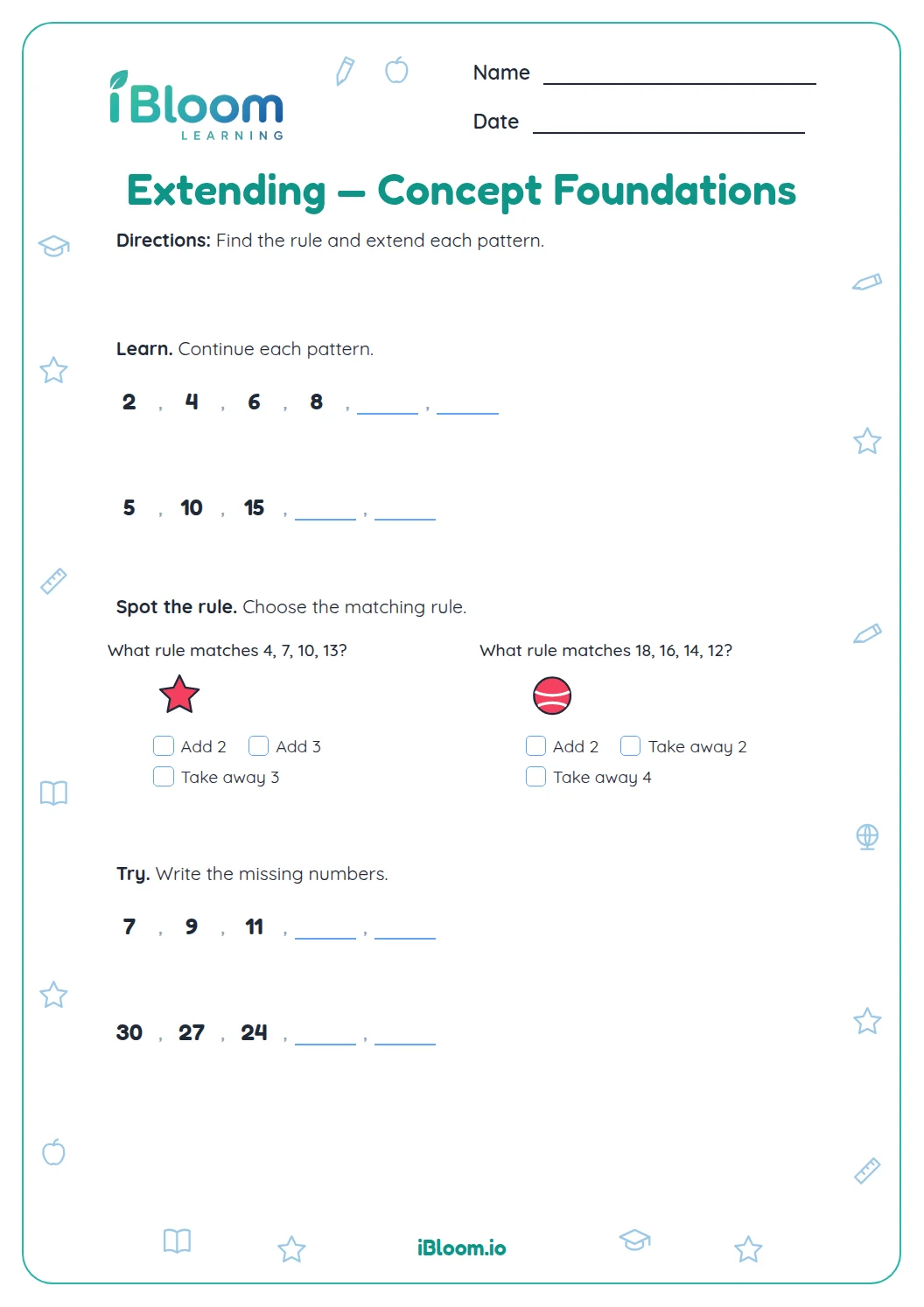
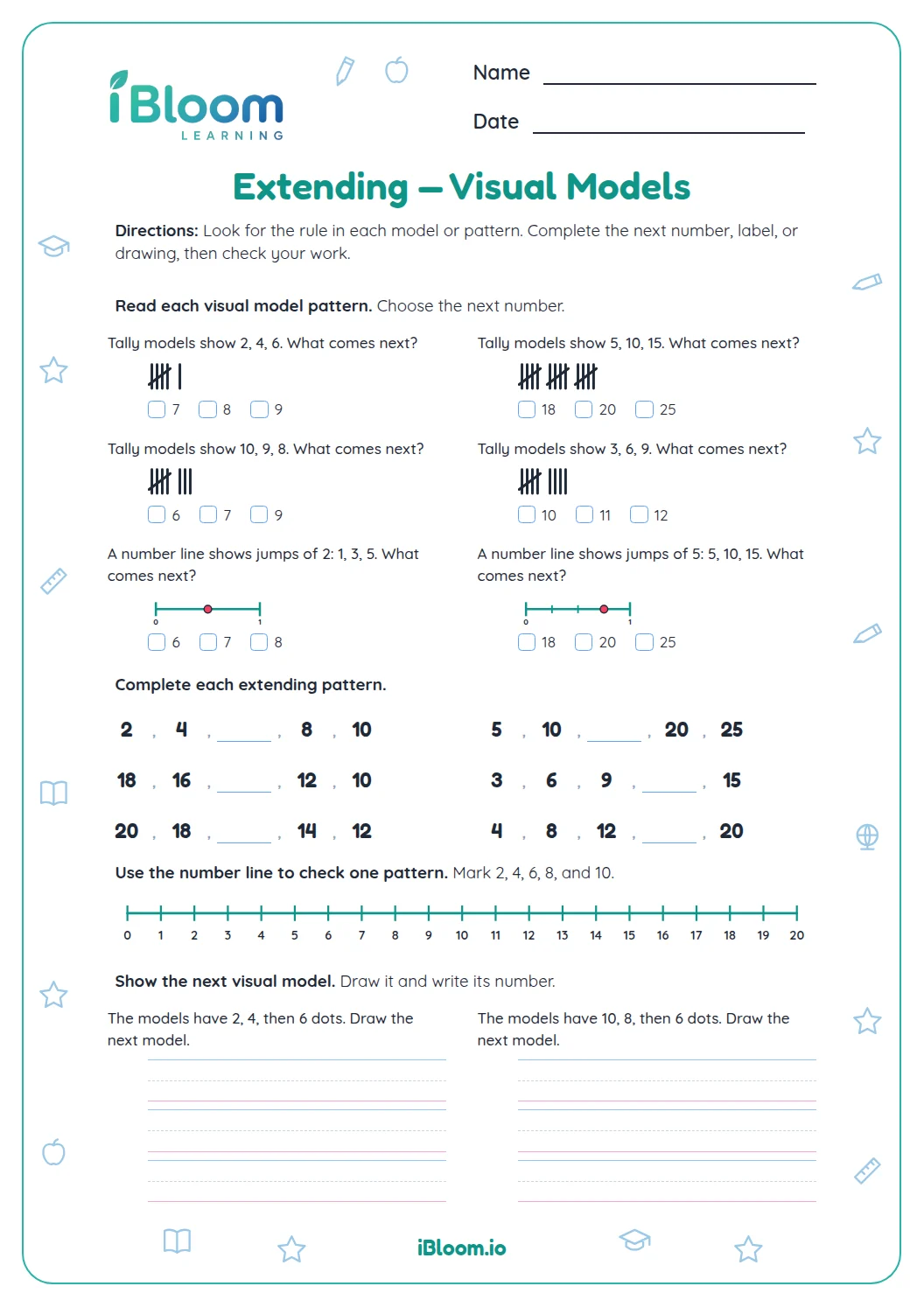
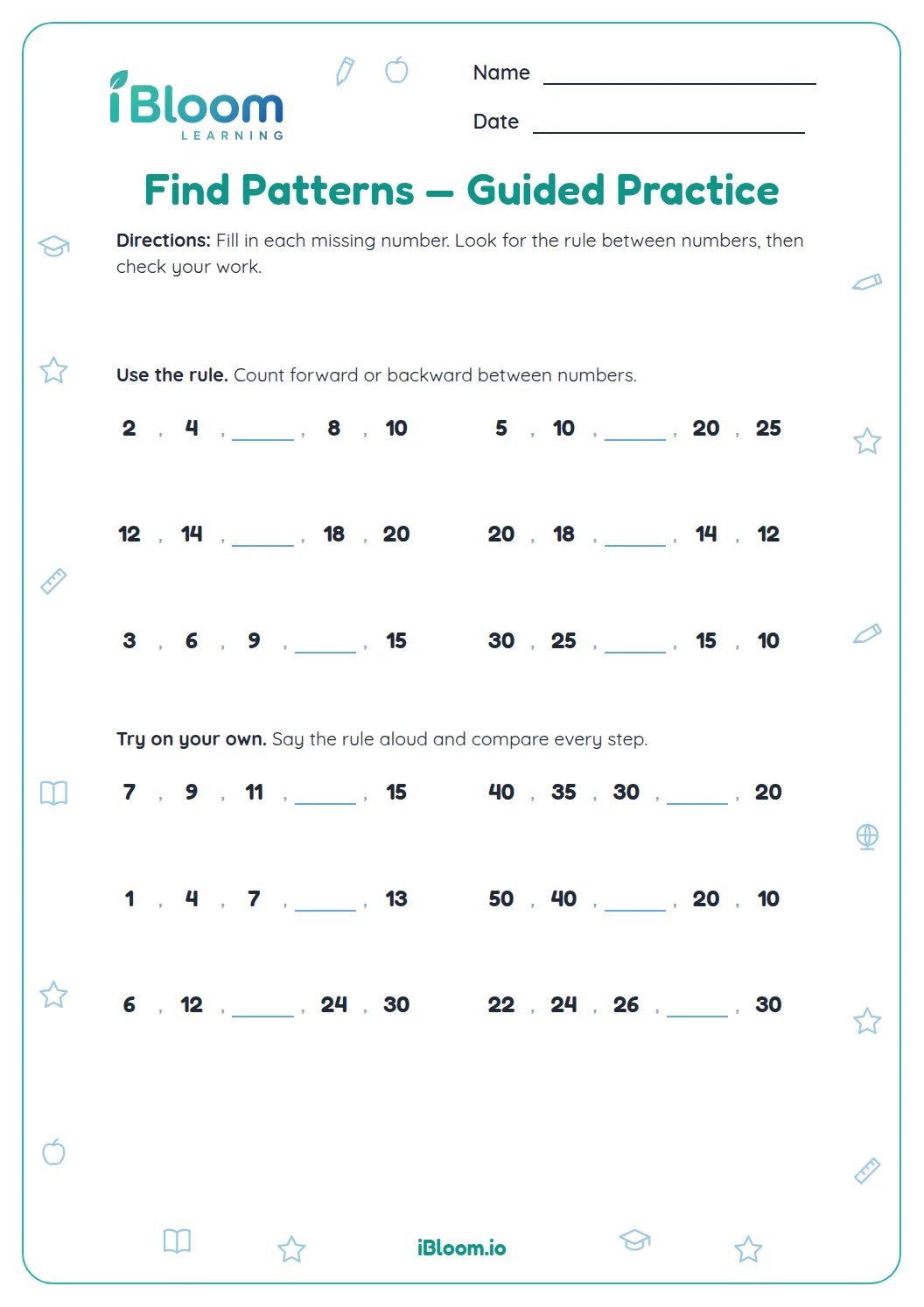
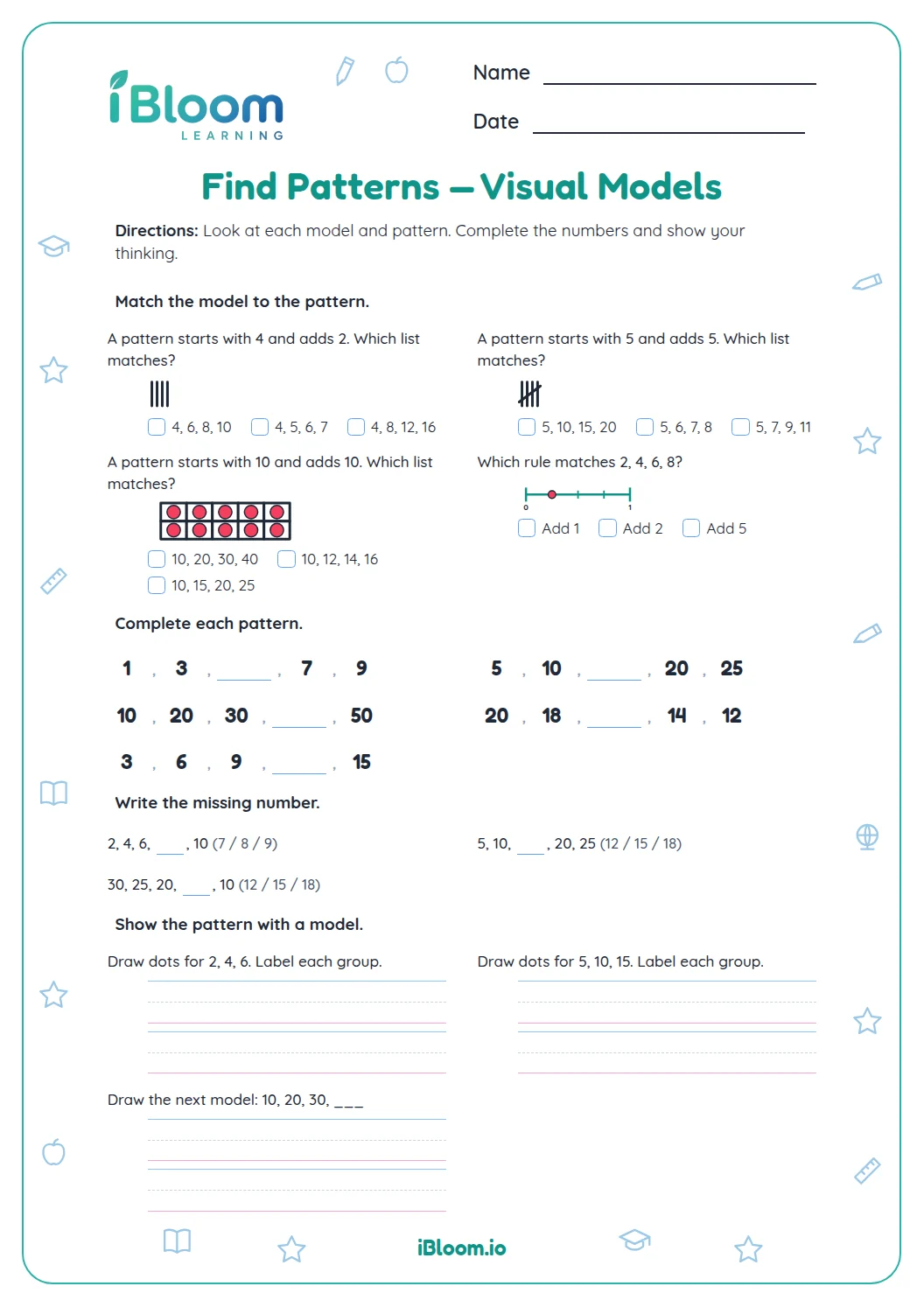
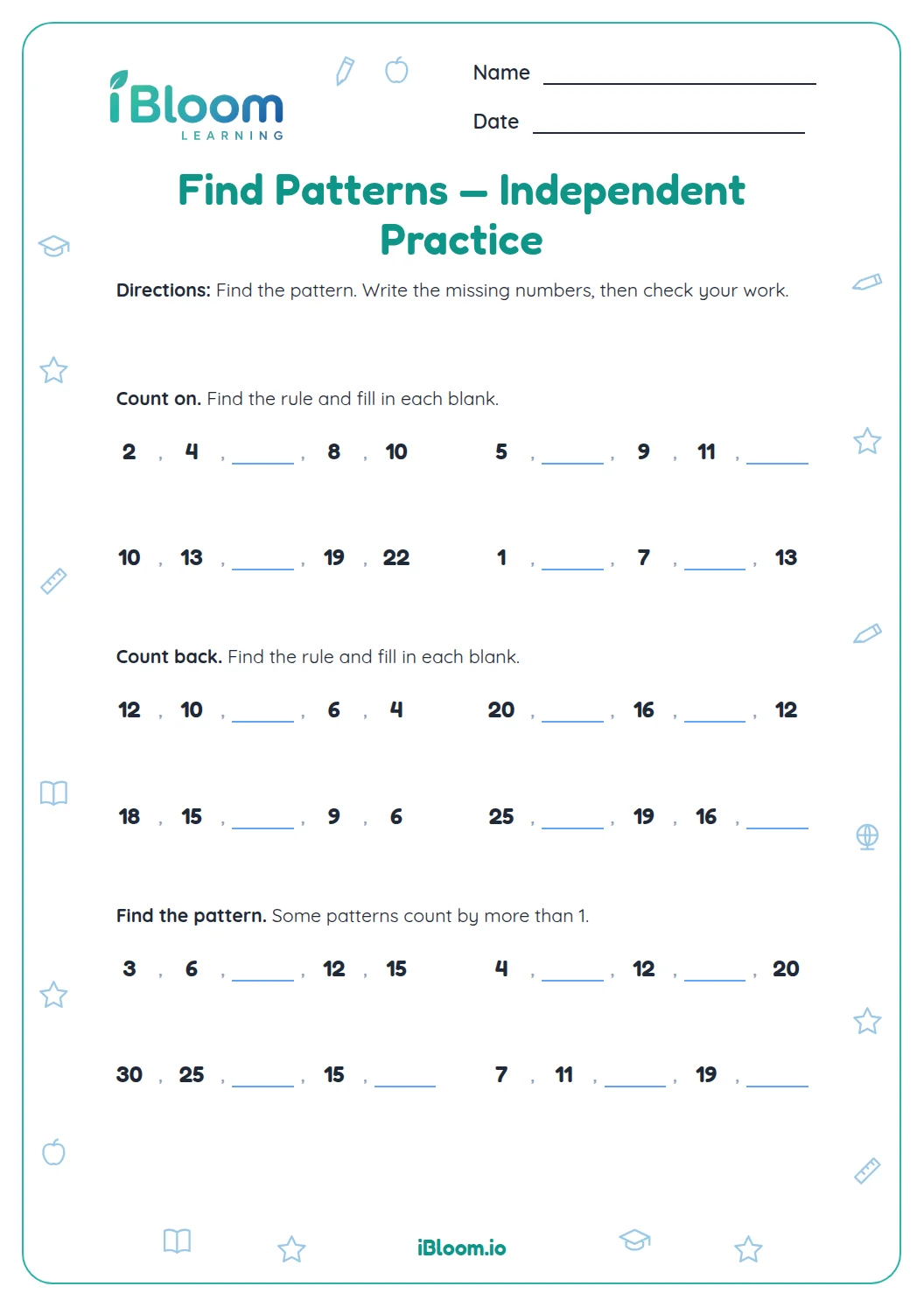
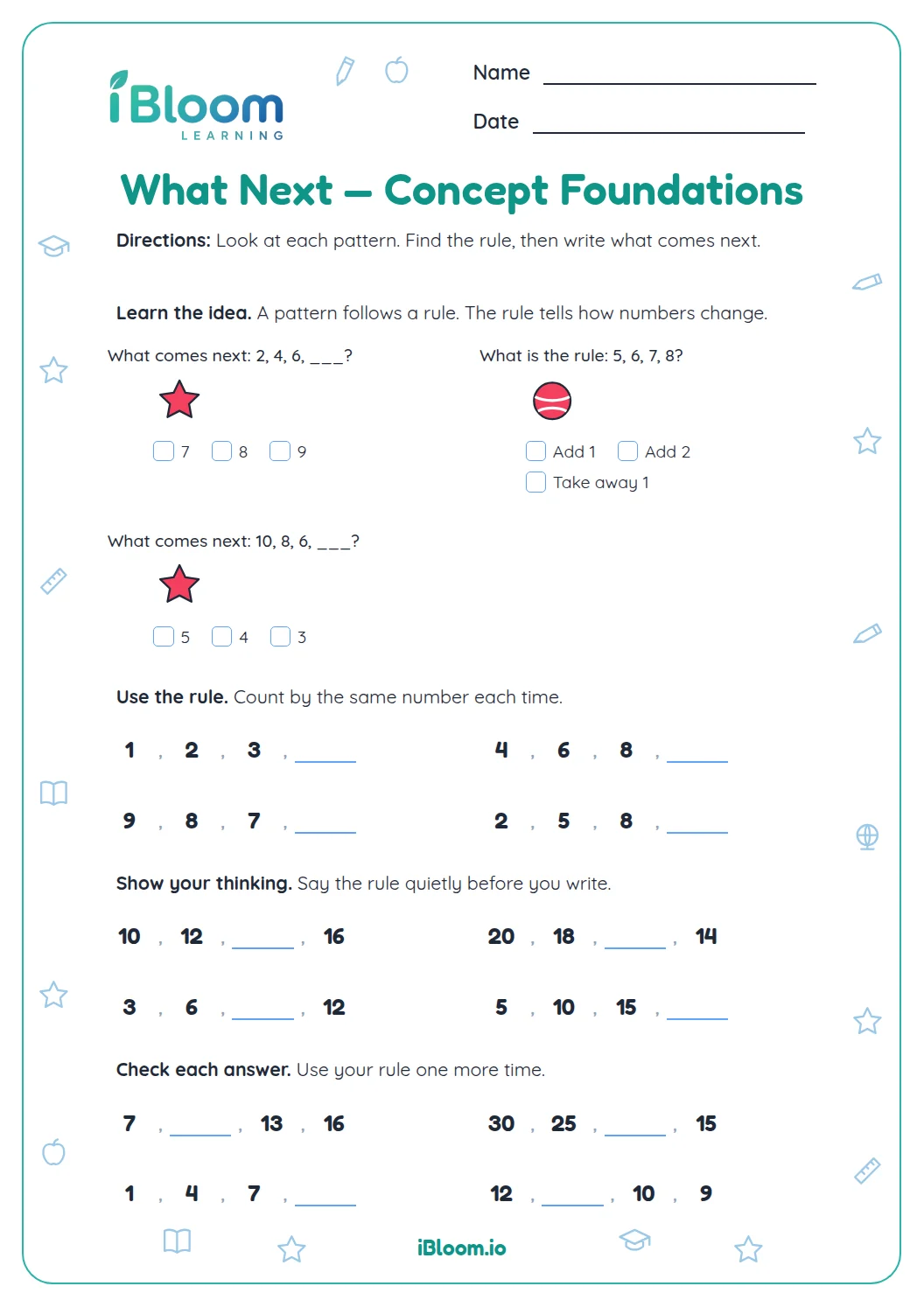
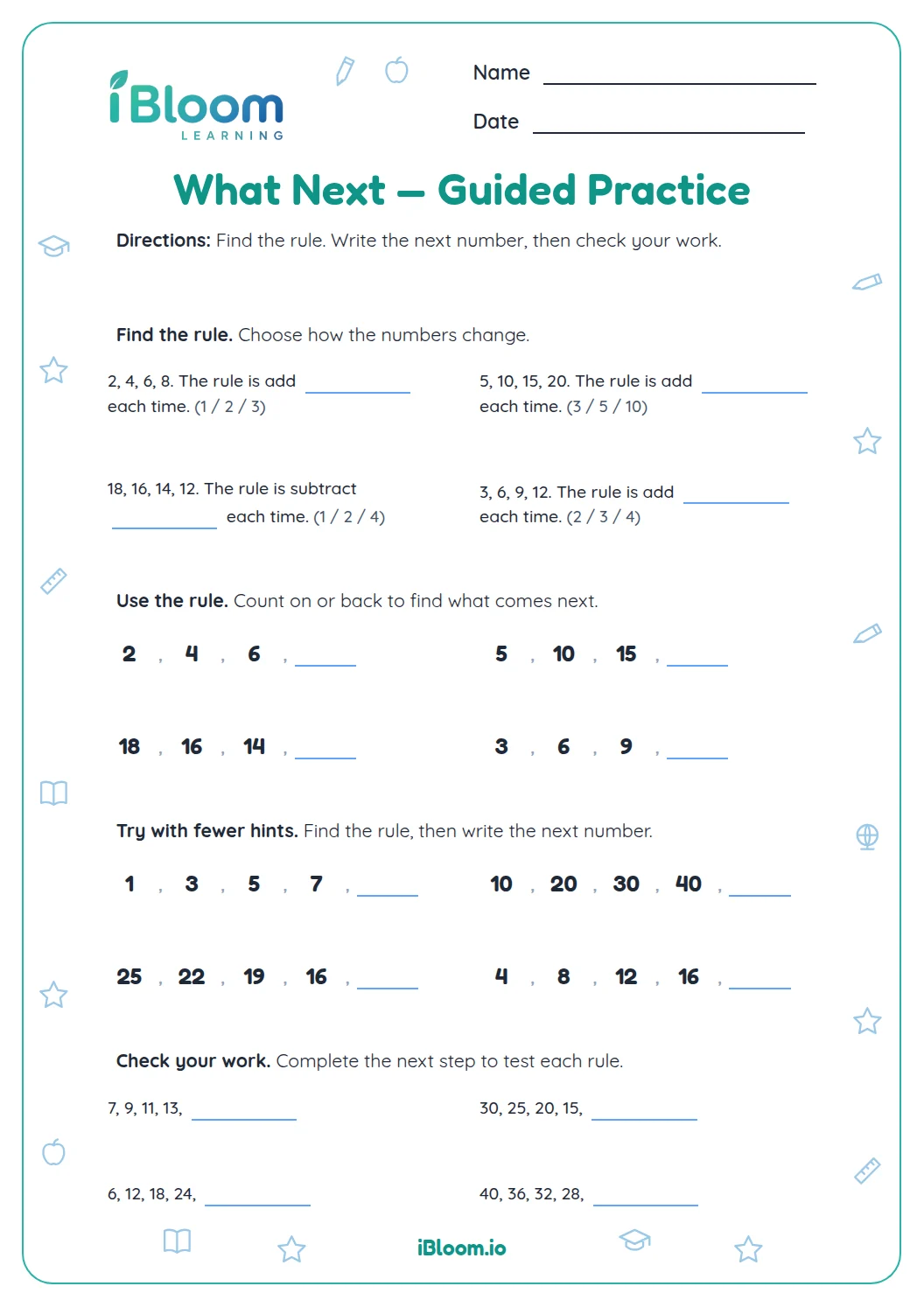
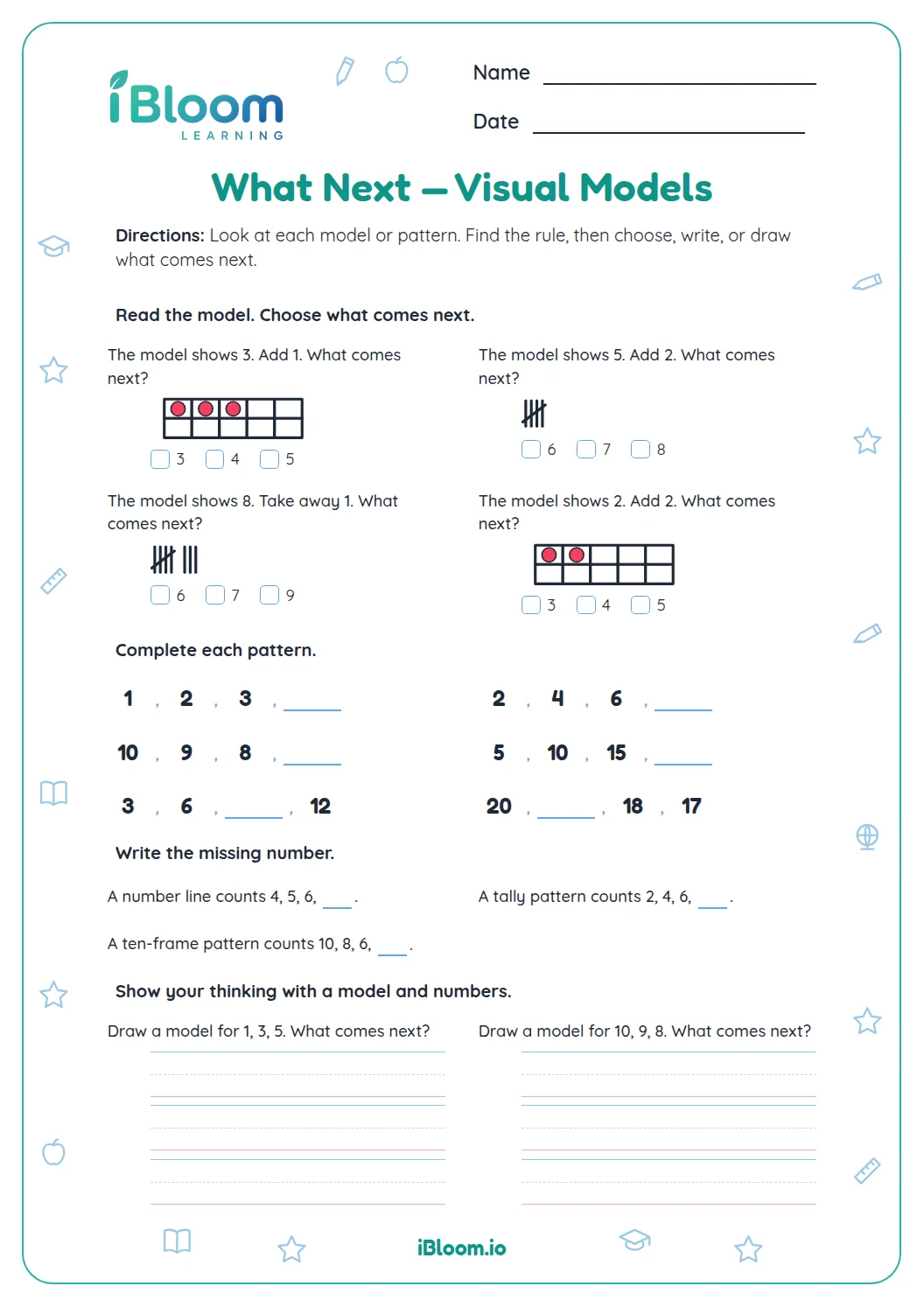
This Grade 1 printable uses input-output charts to practice simple addition and subtraction rules. Learners complete charts with a stated rule, name a change from an input-output pair, and finish missing entries independently. The 16 questions include an answer key and practice finding unknown numbers in additive relationships.
Aligned to 1.OA.D.8
How do you use an input-output chart?
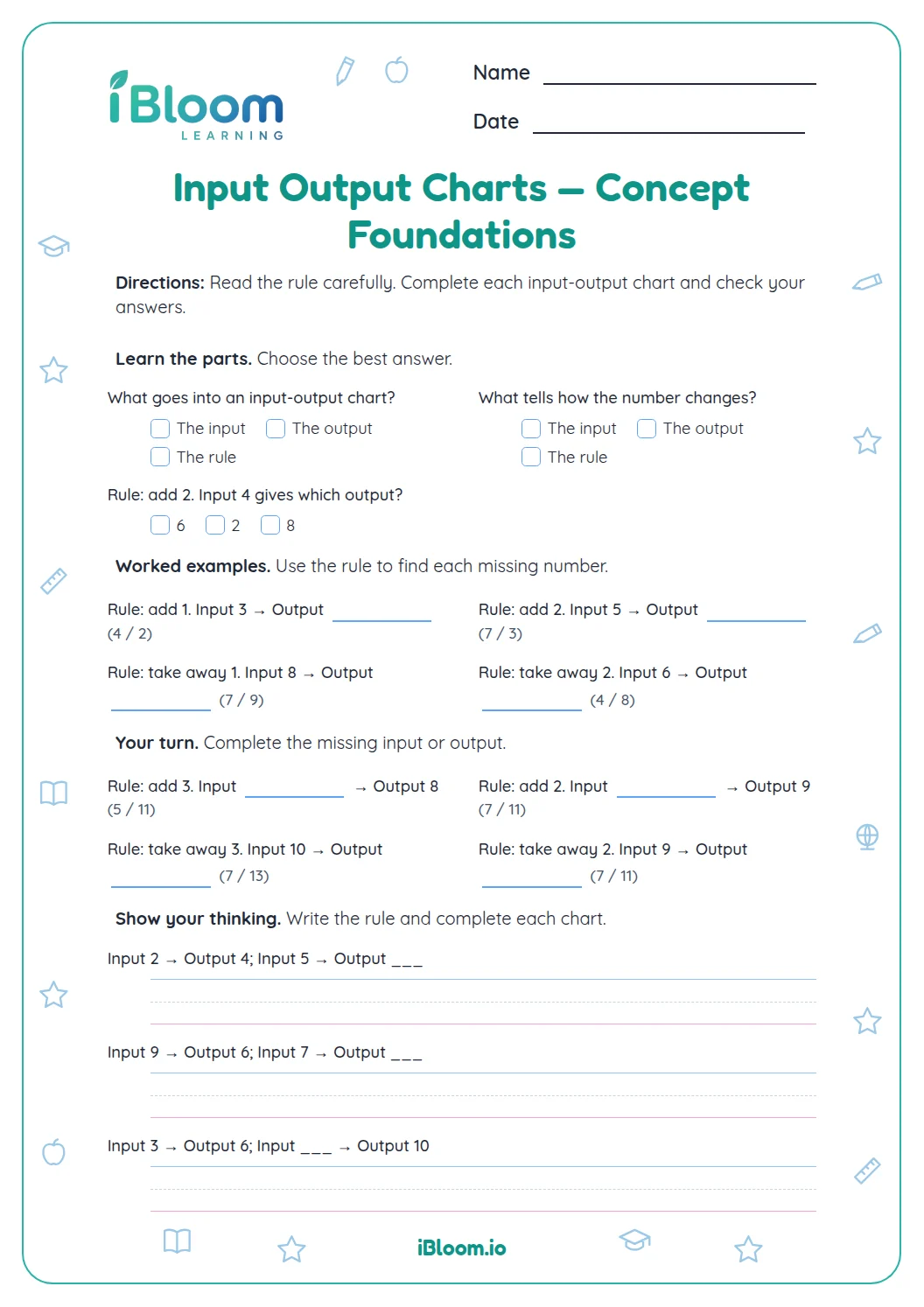
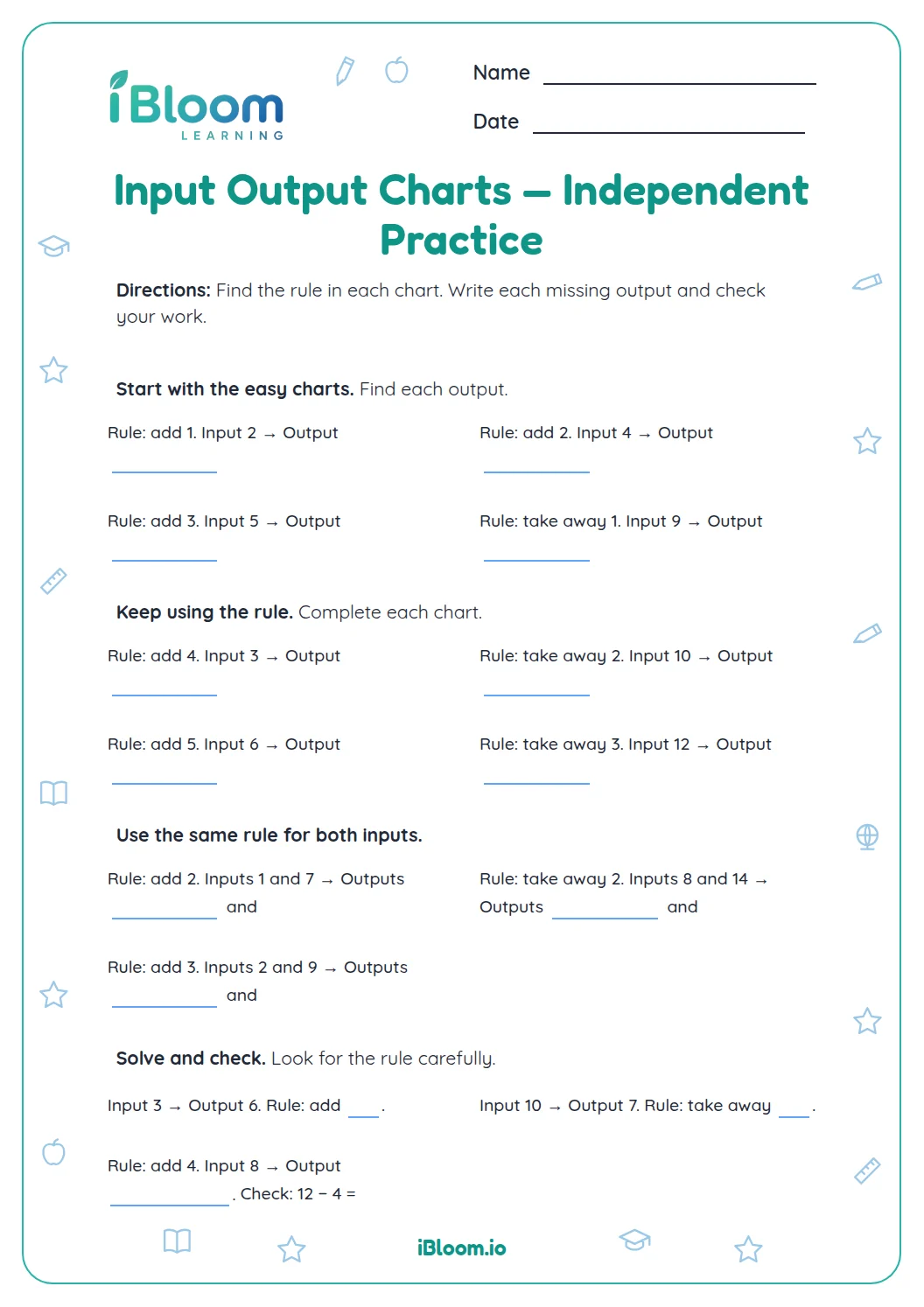
Each chart pairs an input with the output made by the same rule. In the first group, add 2 to each input; for input 5, the output is 7. Apply that rule to every row.
- 1Input 1 gives output 2.
- 2The rule adds 2.
- 3Input 3 gives output 5.
How can you find the change?
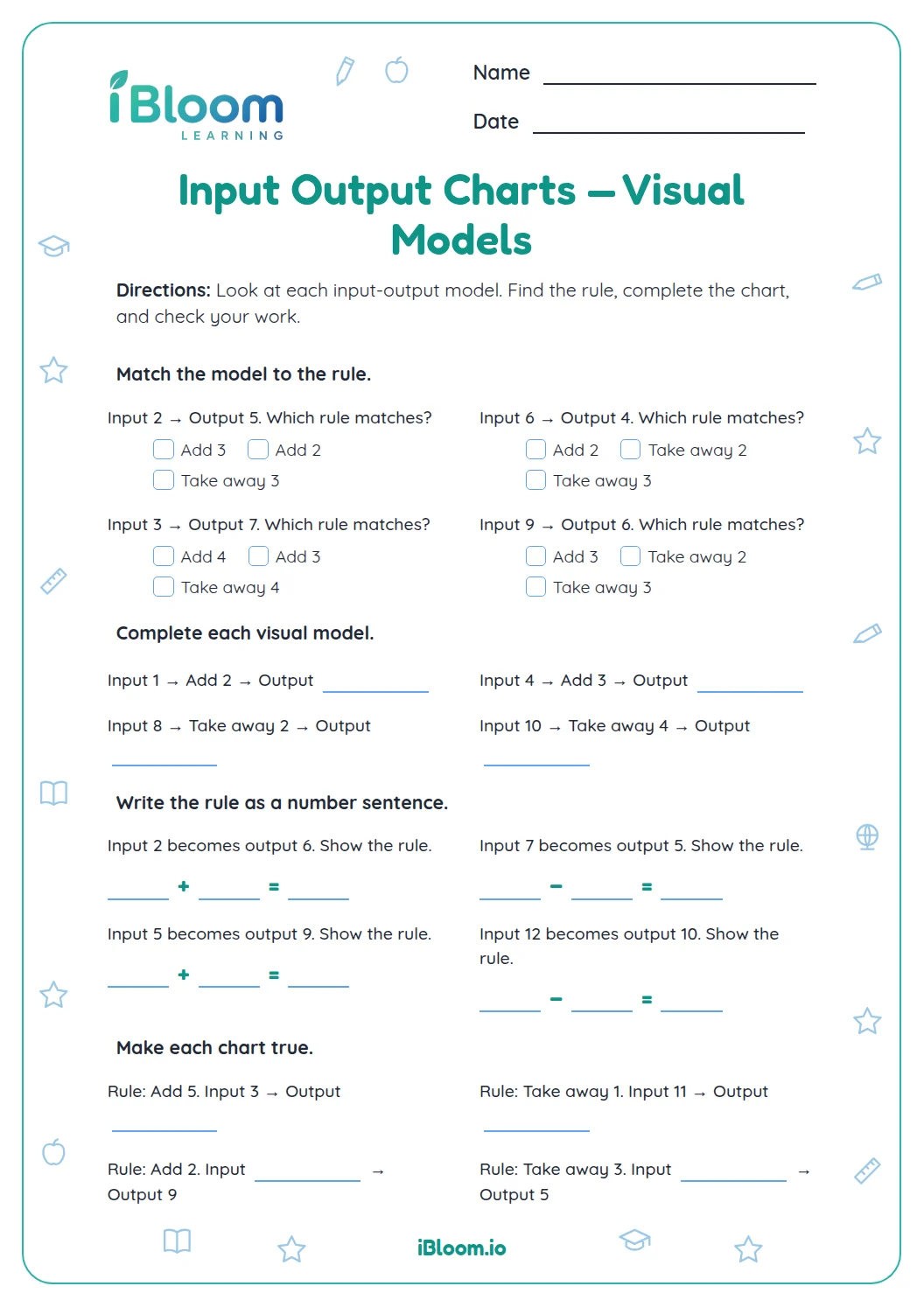
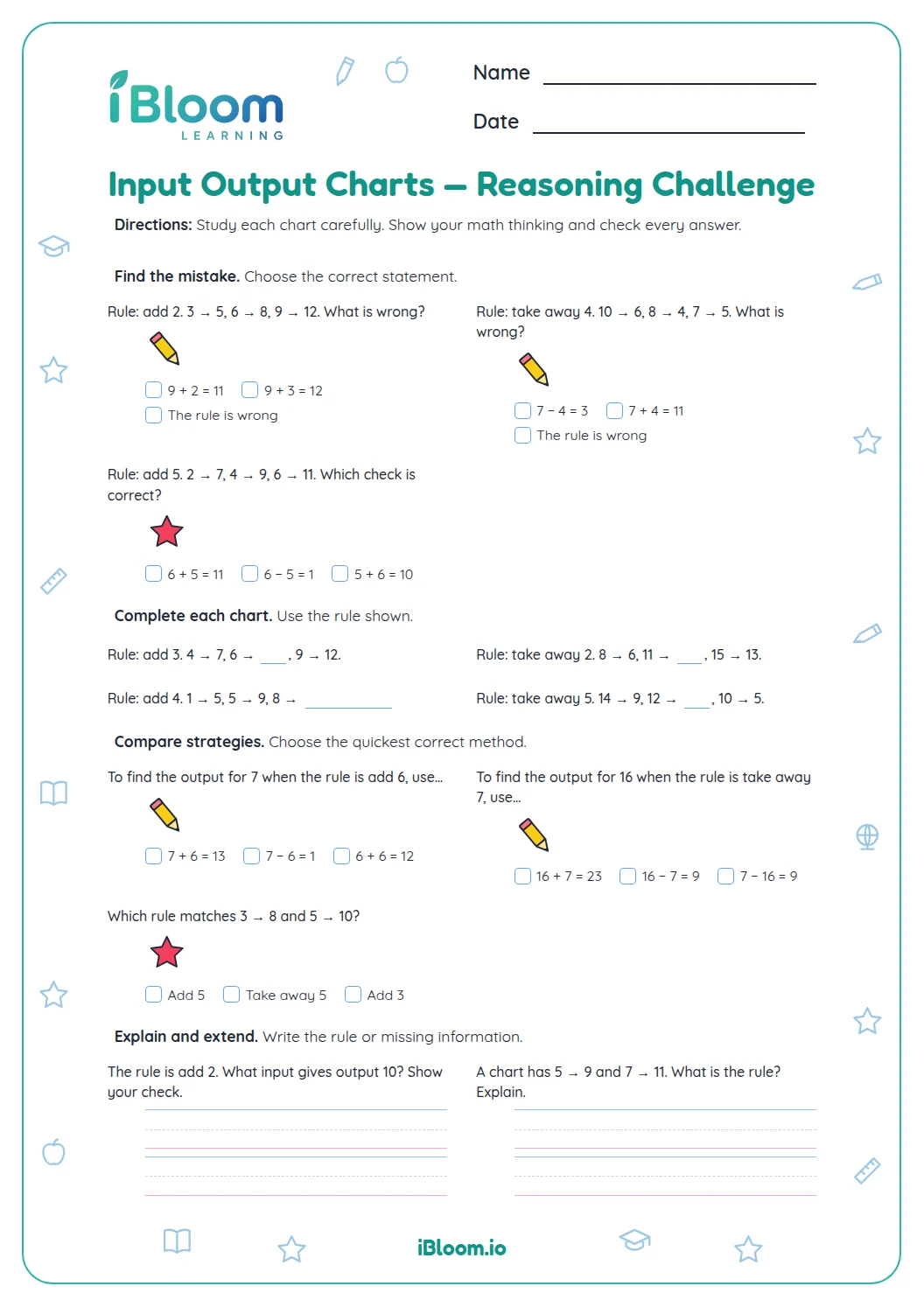
Compare the input and output. If 2 becomes 4, the output is 2 greater, so the rule is add 2. If 4 becomes 3, the rule is subtract 1. Keep the direction clear: describe what happens to the input.
How do you check a rule?
Test the same change on another row. If the rule is subtract 1, an input of 10 must give an output of 9. A rule that works for every pair is a better fit than one guessed from a single row.
How to work through the charts
- 1Read the rule or compare the input and output.
- 2Apply one consistent change to every input in a chart.
- 3When naming a rule, state whether you add or subtract.
- 4Check a second pair to see if the rule still works.
- 5Use the answer key to review each output.
Common chart mistakes
The mistake
Applying the rule to the output instead of the input.
The fix
Start with the input value, then make the stated change.
The mistake
Reversing add and subtract.
The fix
Compare the output with its input and describe the change from input to output.
The mistake
Guessing a rule from one pair.
The fix
Test the rule on another pair before writing it.
Common Core alignment
The questions practice 1.OA.D.8 by applying the target skill in each item.
Find the unknown whole number in an addition or subtraction equation.
On this sheet: Students determine missing outputs and identify additive changes in input-output relationships.
Show the official wordingHide the official wording
Determine the unknown whole number in an addition or subtraction equation relating three whole numbers.
What to practice next
Make more practice
Further reading
Questions parents and teachers ask
What does this input-output worksheet ask learners to do?
Learners use charts to apply addition and subtraction rules, identify the change between an input and output, and complete missing entries. The 16 questions move from stated rules to naming a rule independently. A separate answer key follows the two worksheet pages.
How many questions are on the printable?
There are 16 questions: eight chart entries with stated rules, four rule-finding questions, and four more missing-output charts. The mix lets learners practice reading a rule and noticing the change from a pair. The answer key includes the expected output or rule for each item.
What is an input-output rule?
An input-output rule tells how to change each input to get its matching output. For example, the rule “add 2” turns an input of 5 into an output of 7. The chart questions practice applying the same change consistently across entries.
Does the worksheet include an answer key?
Yes. The answer key gives the missing outputs and the changes learners name. For rule-finding items, accept an equivalent description such as “plus 2” for “add 2.” Ask the learner to test that rule on another pair in the question before checking the key.
How can I support a learner who reverses the rule?
Have the learner read one row aloud from input to output, then ask whether the output is greater or smaller. For example, input 8 becomes output 7, so one is subtracted. This direction check helps distinguish “subtract 1” from “add 1.”