
About this worksheet
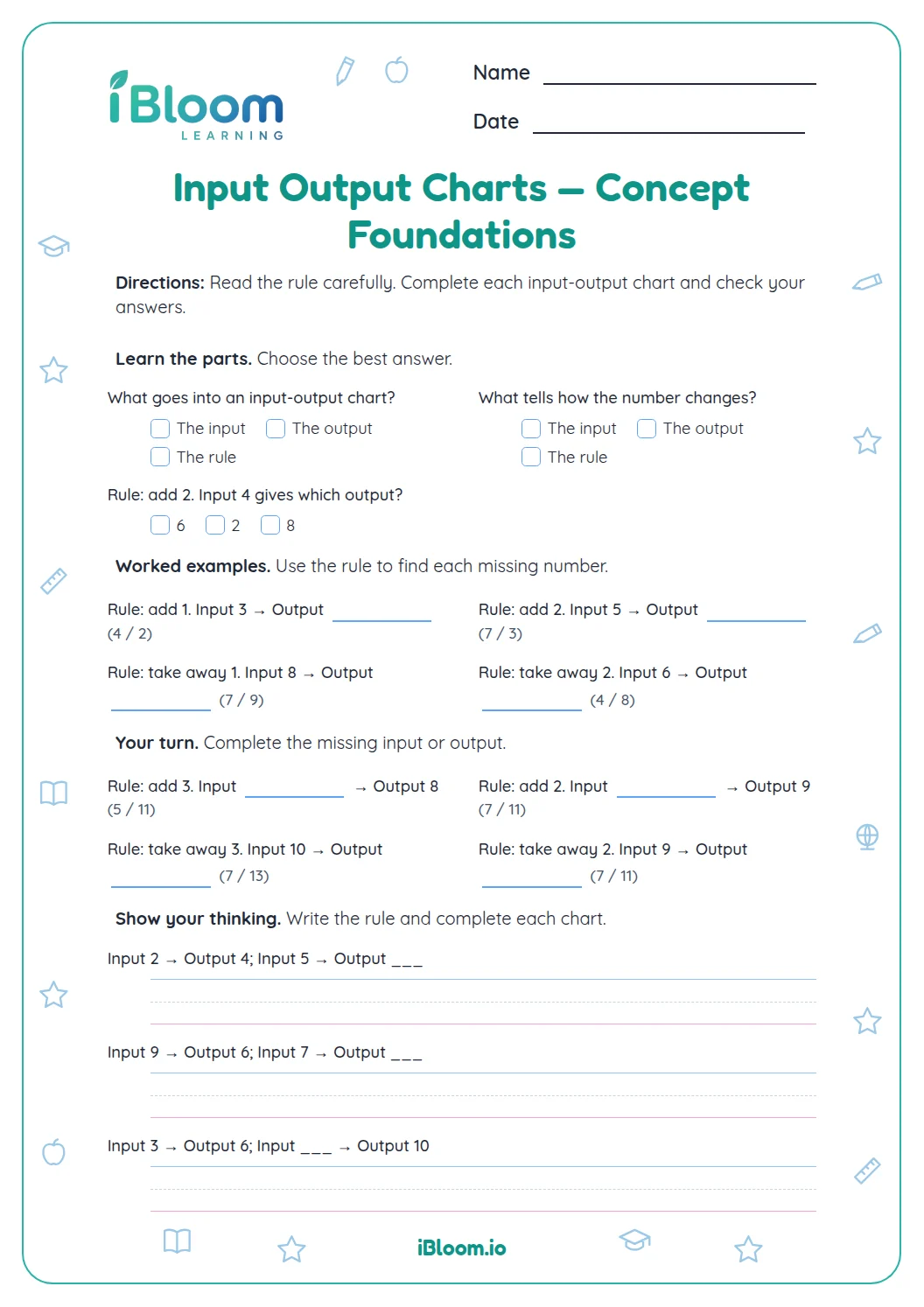
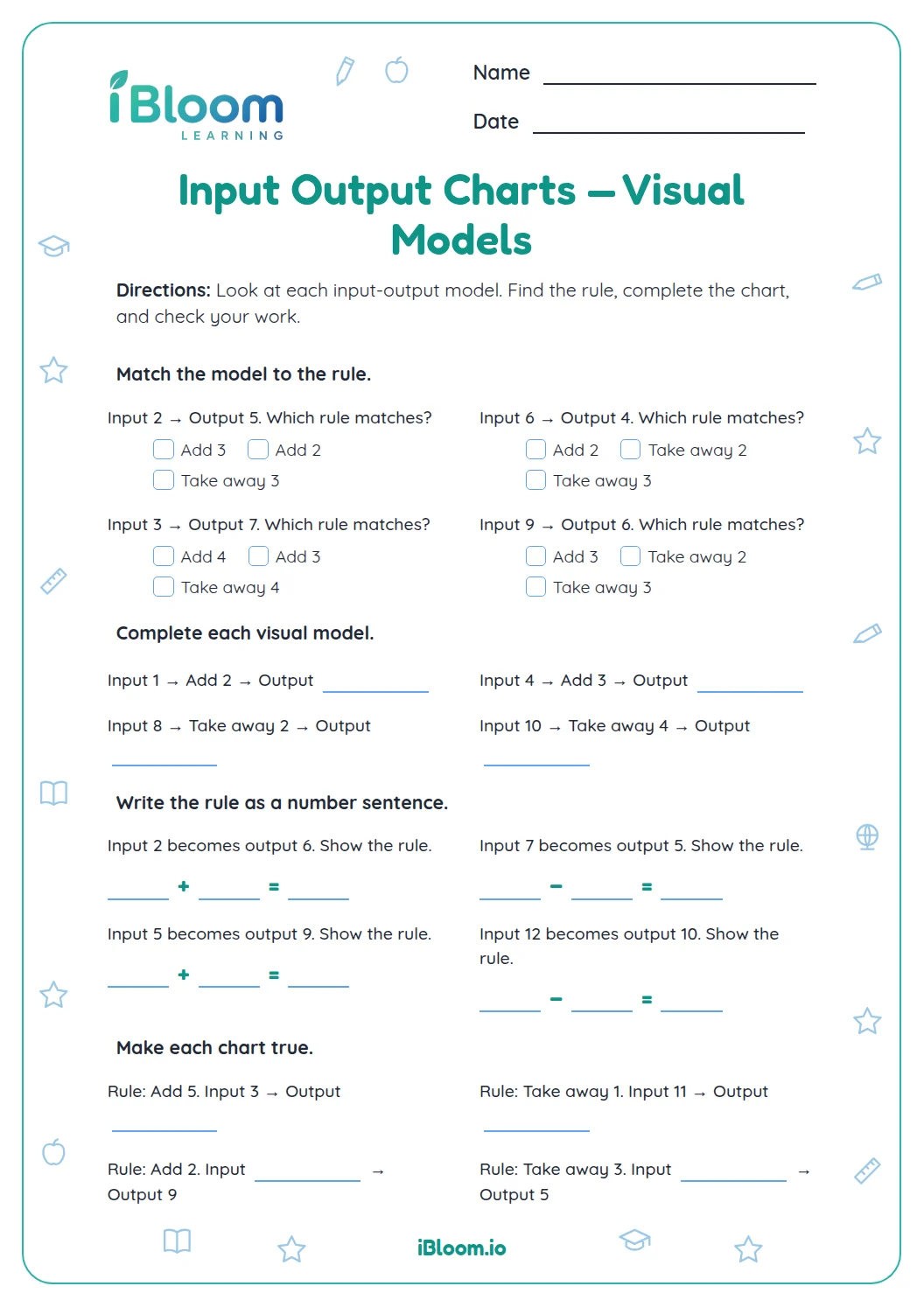
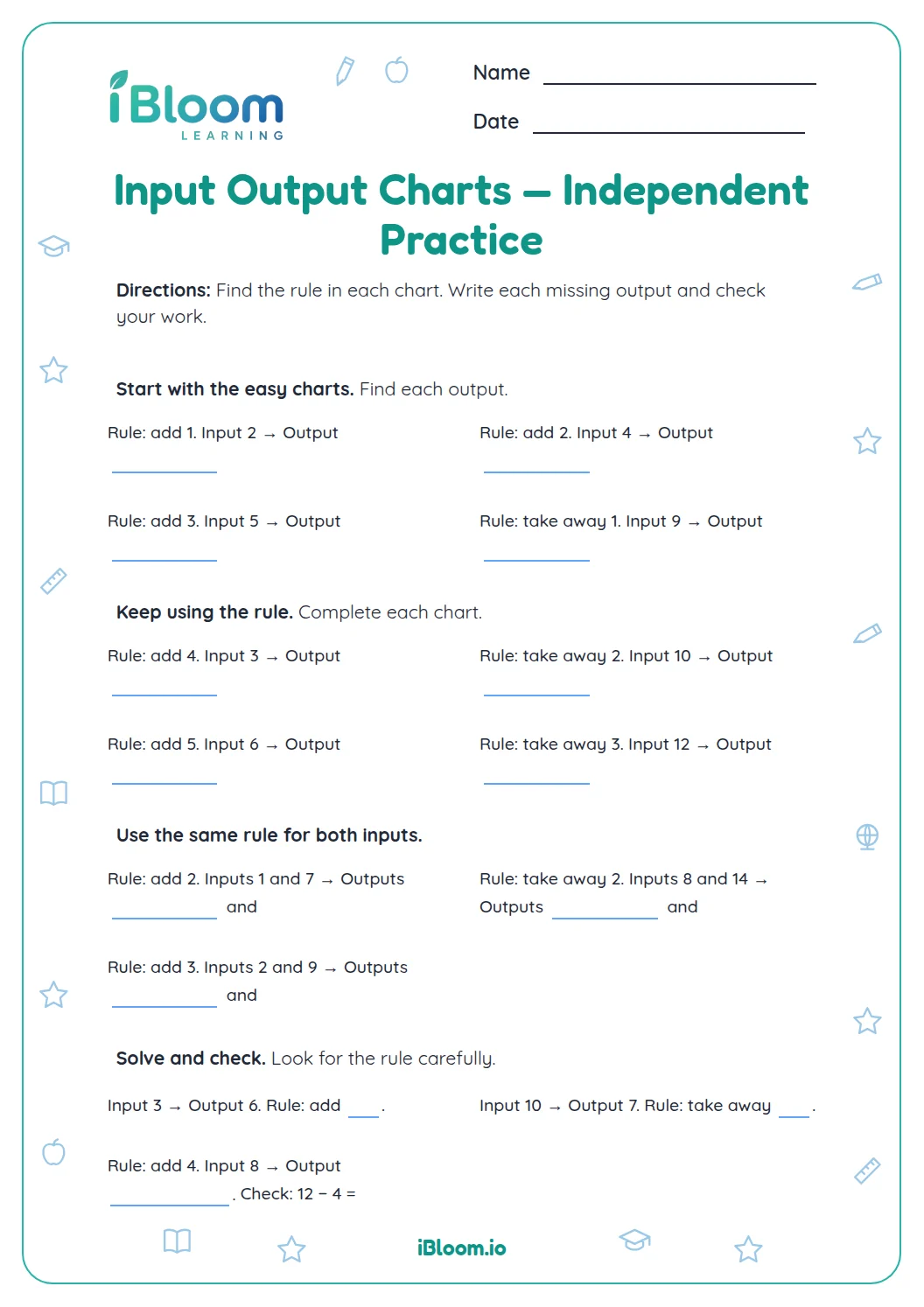
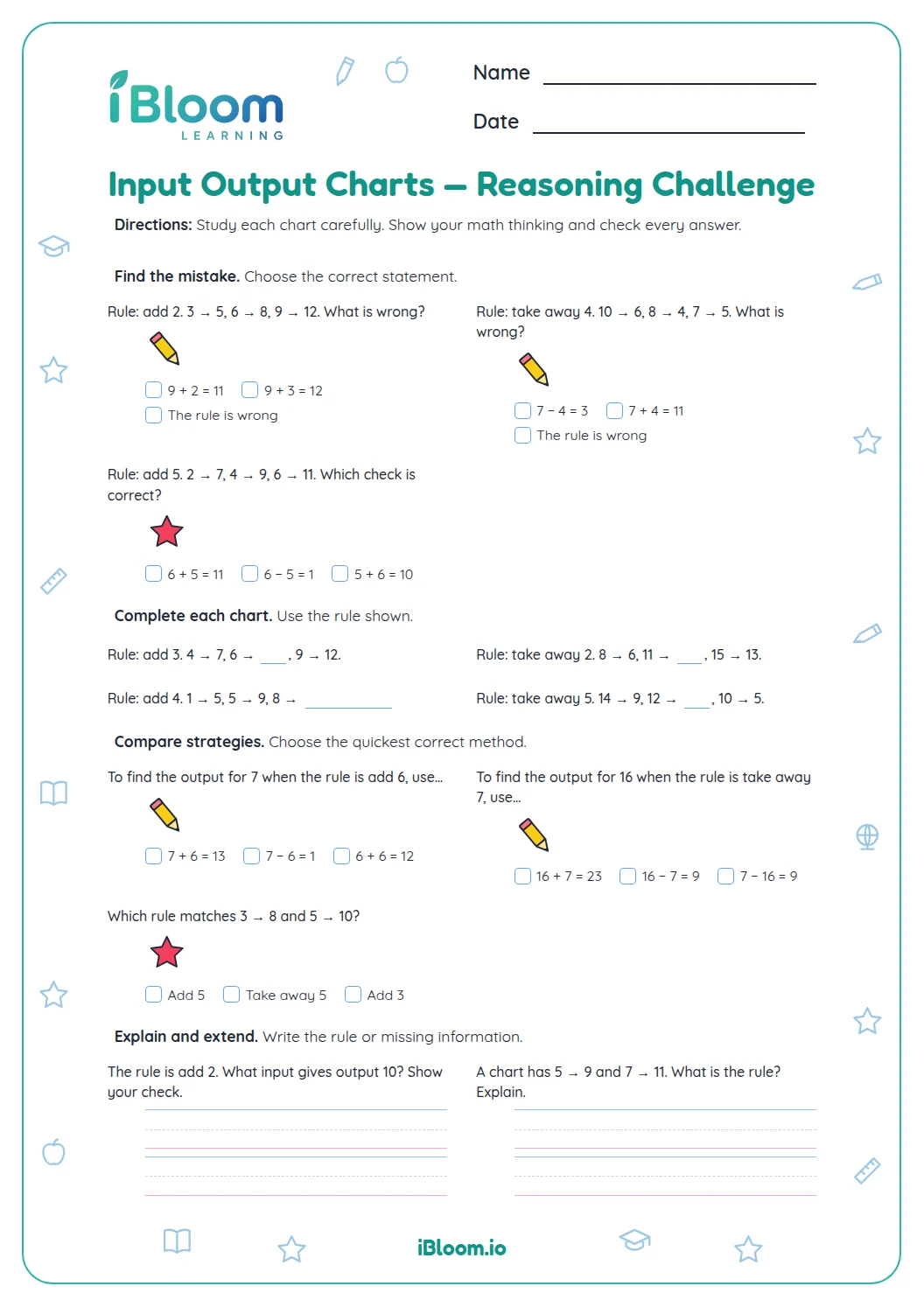
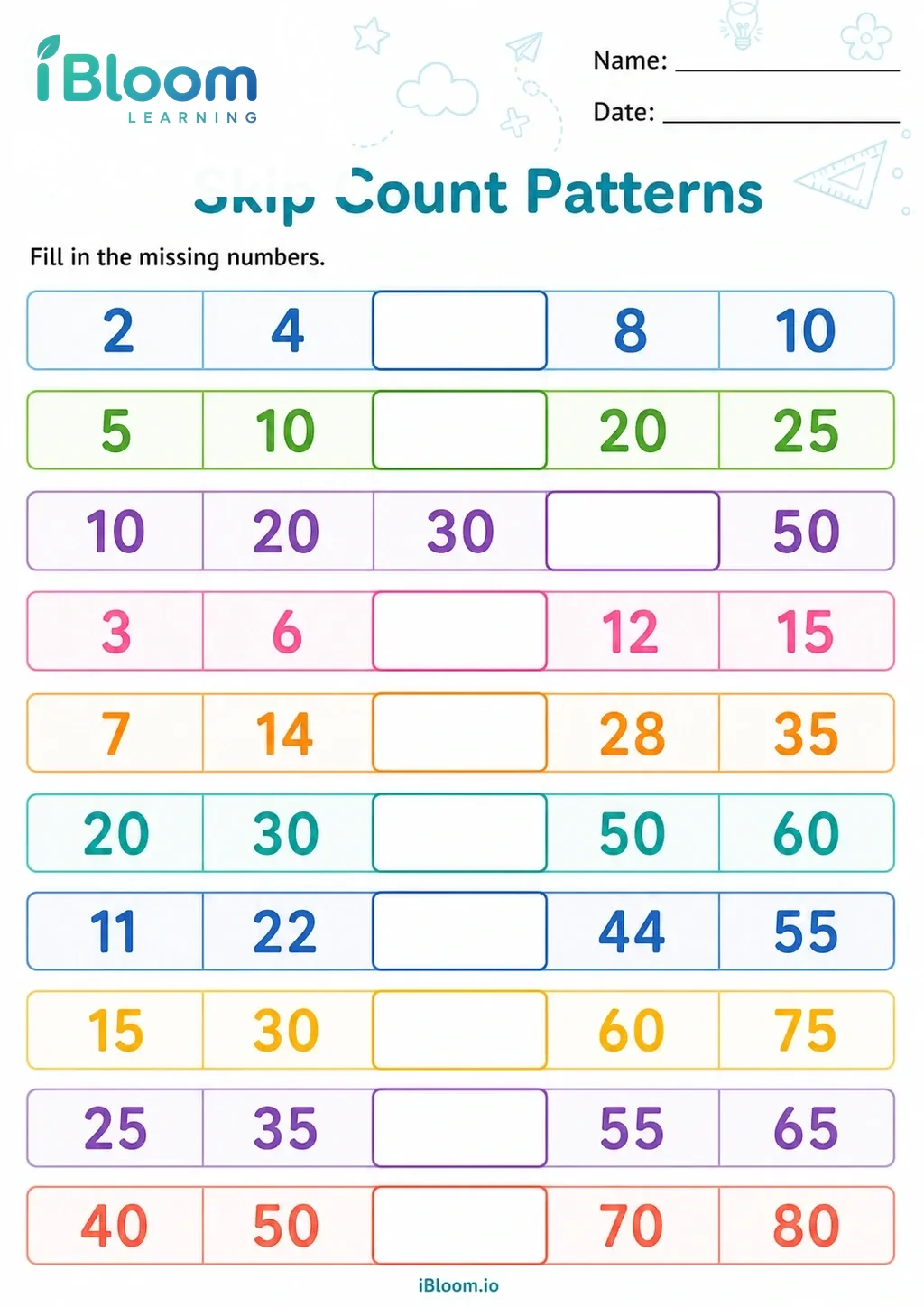
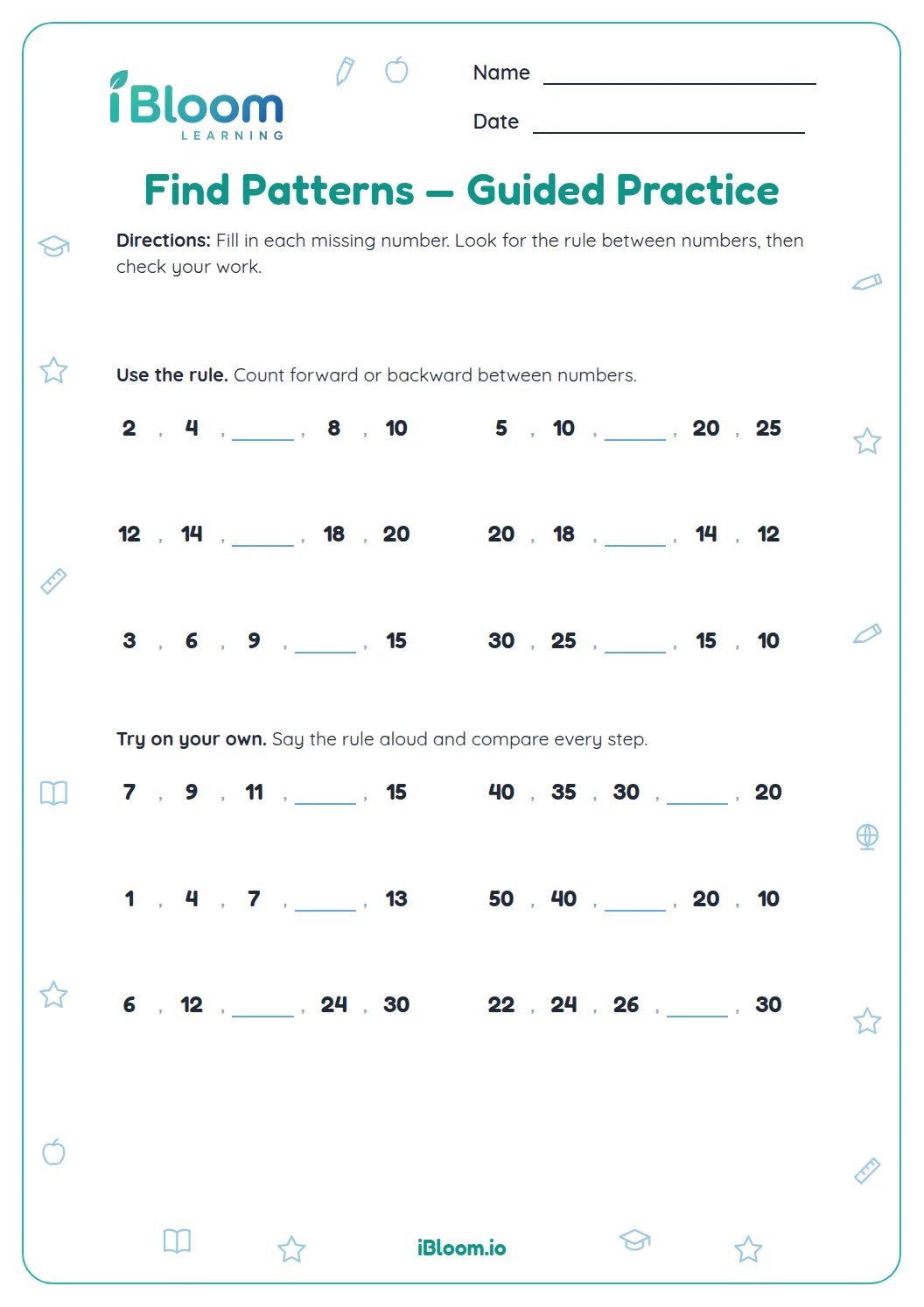
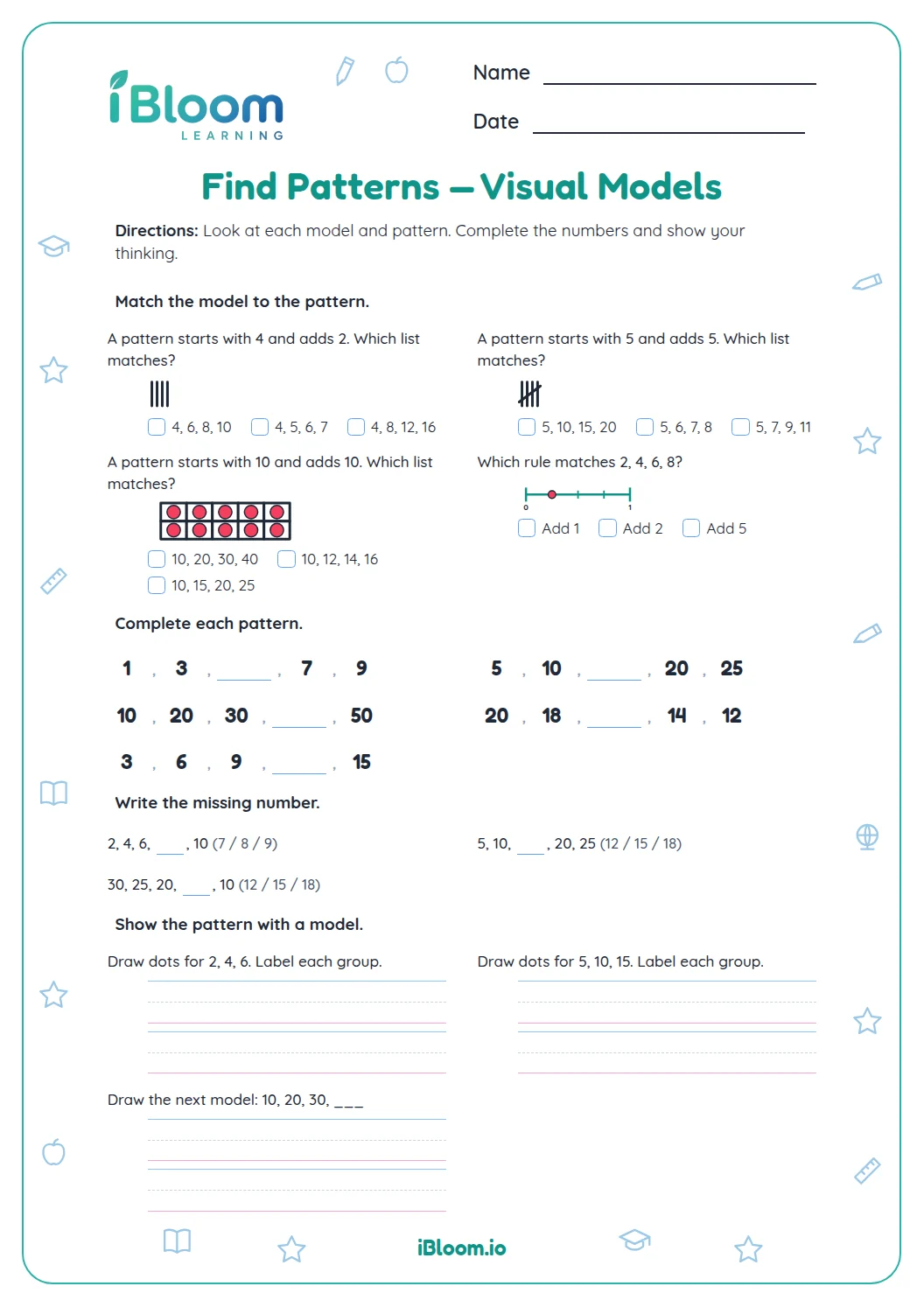
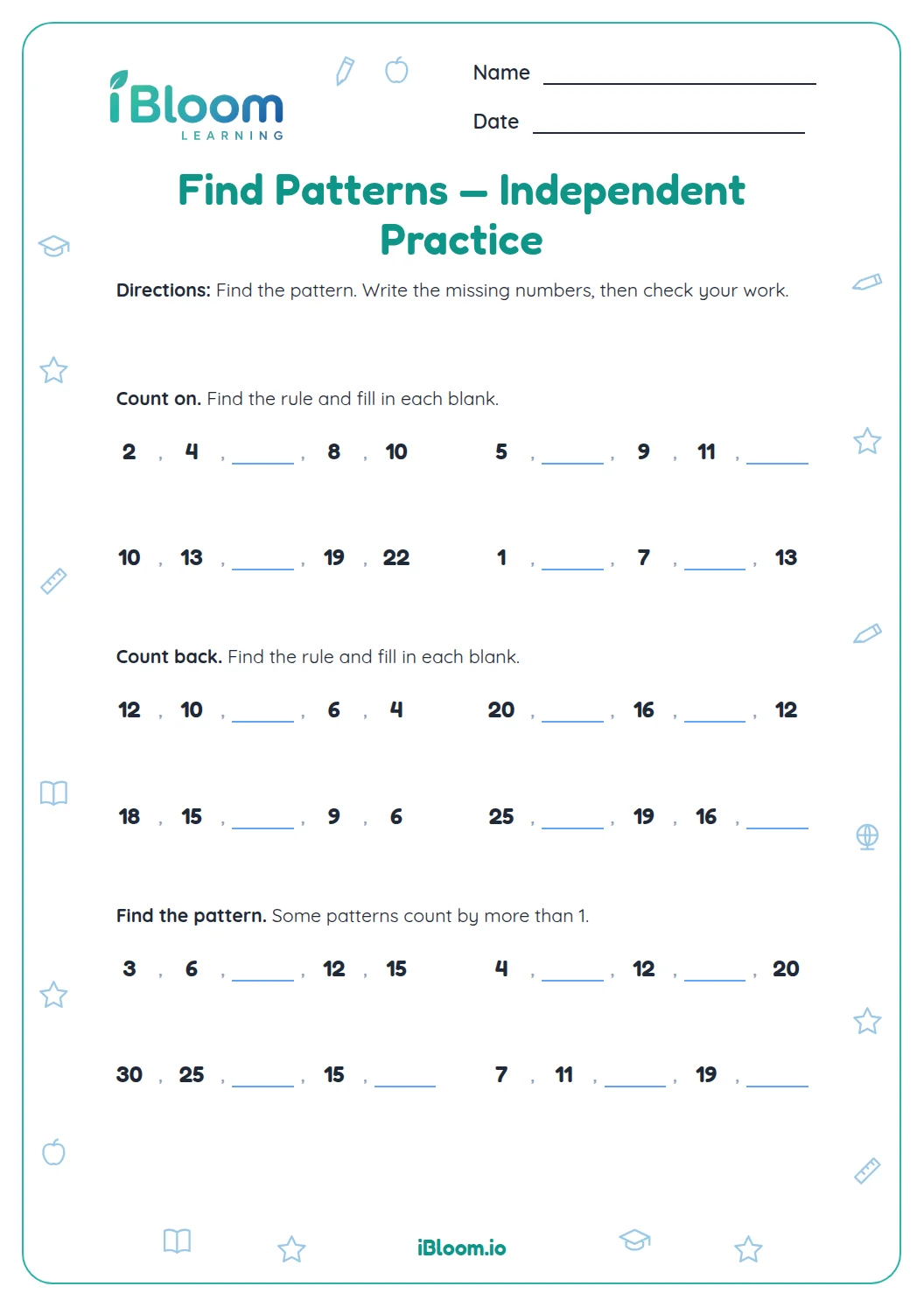
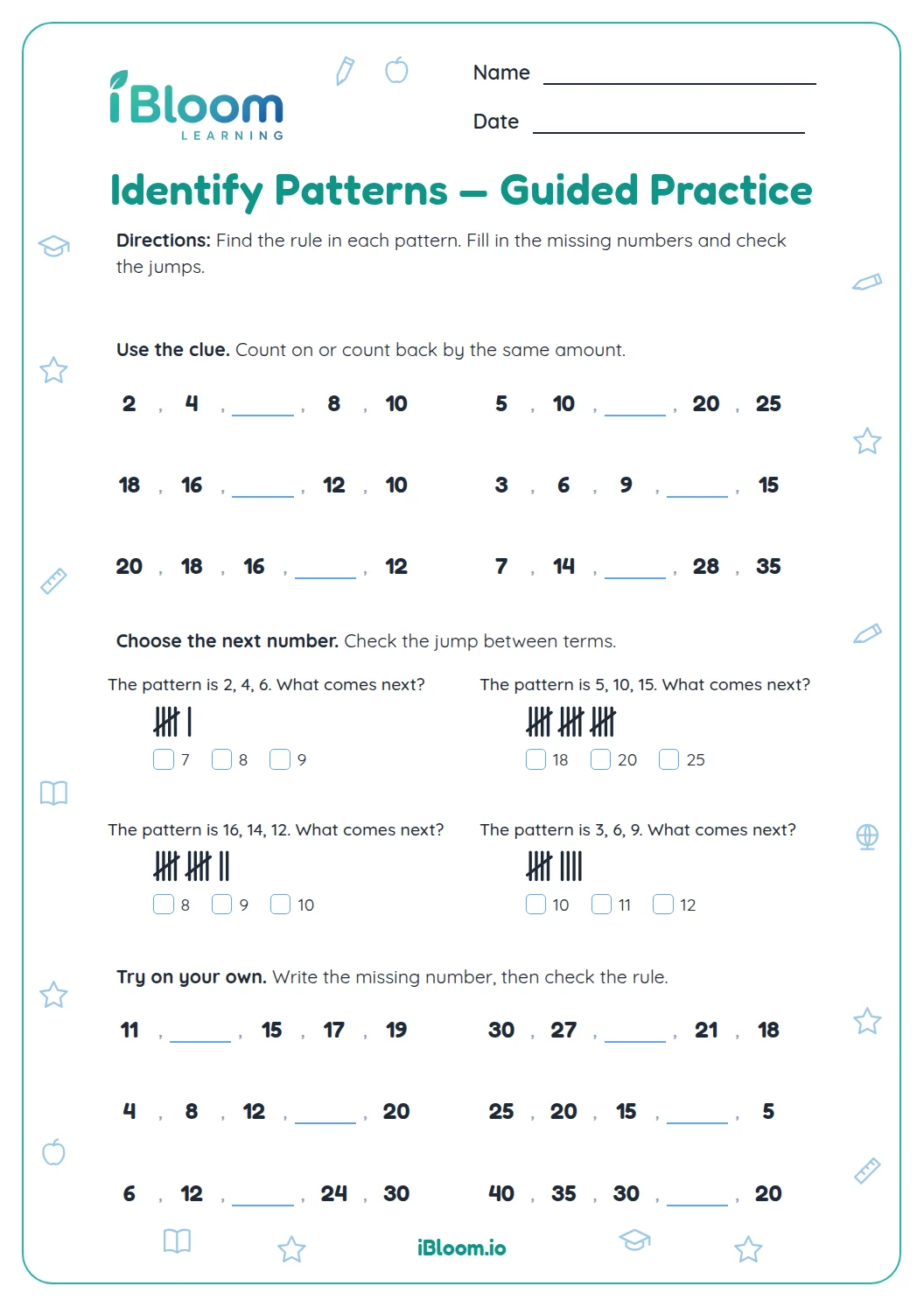
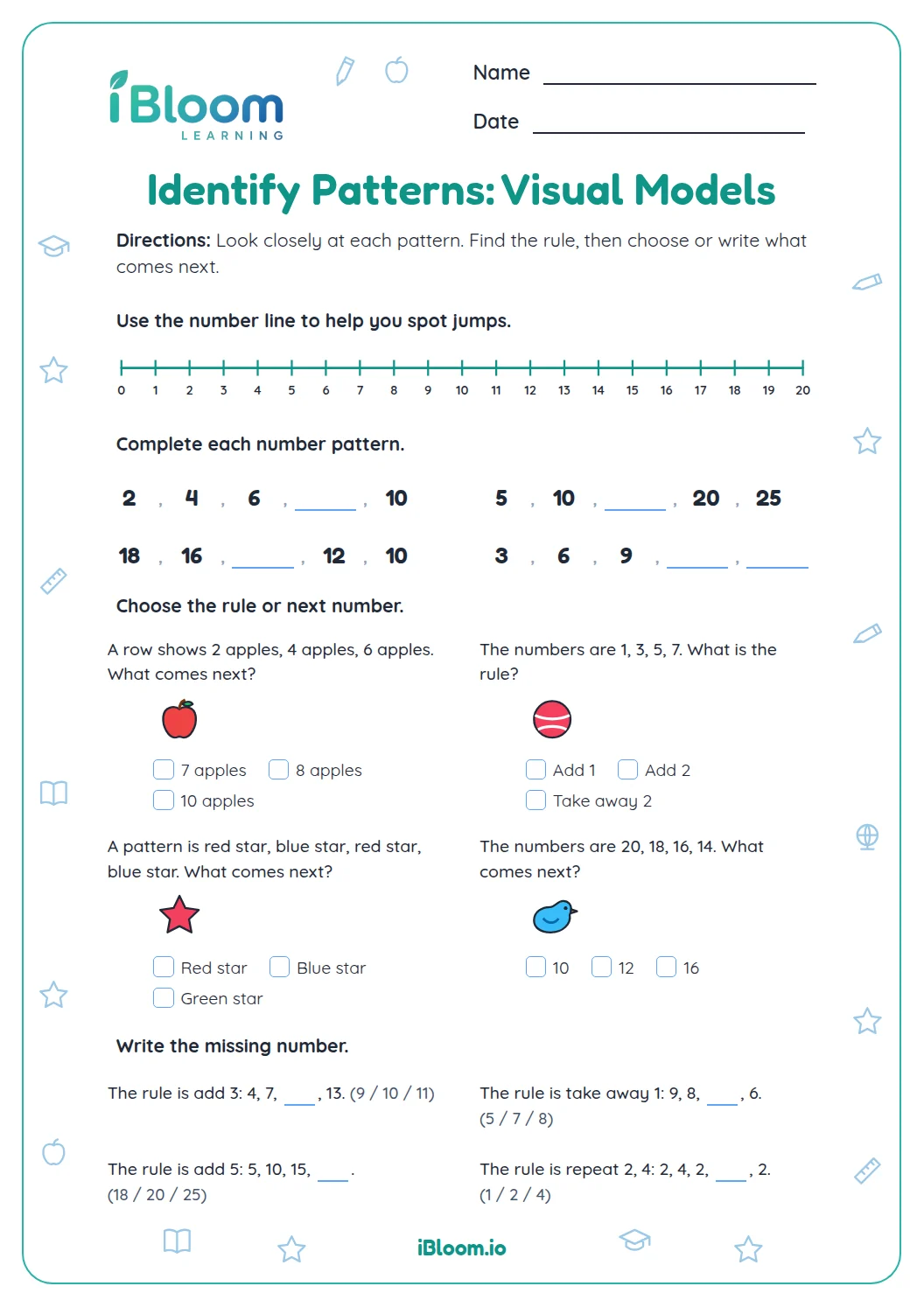
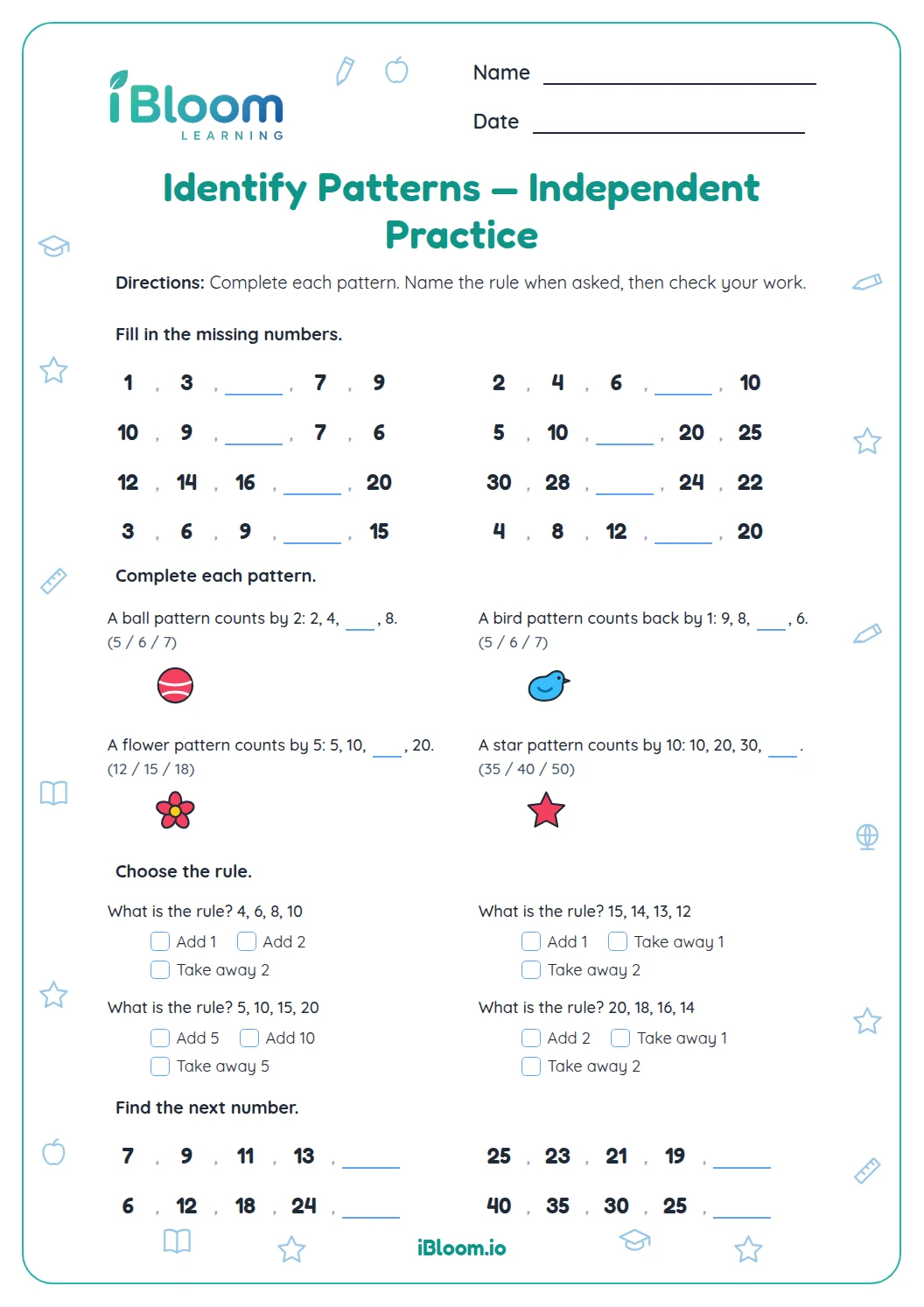
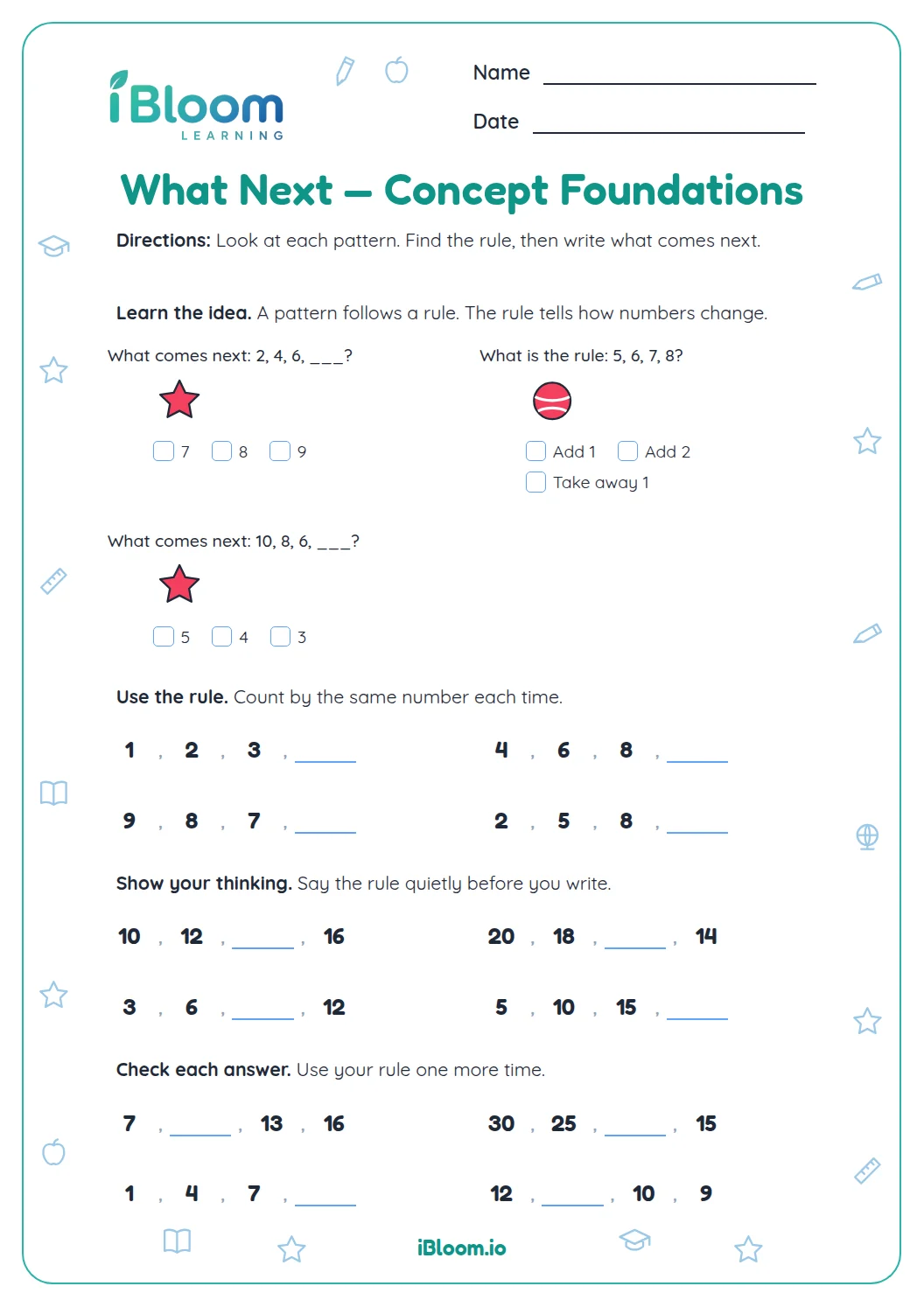
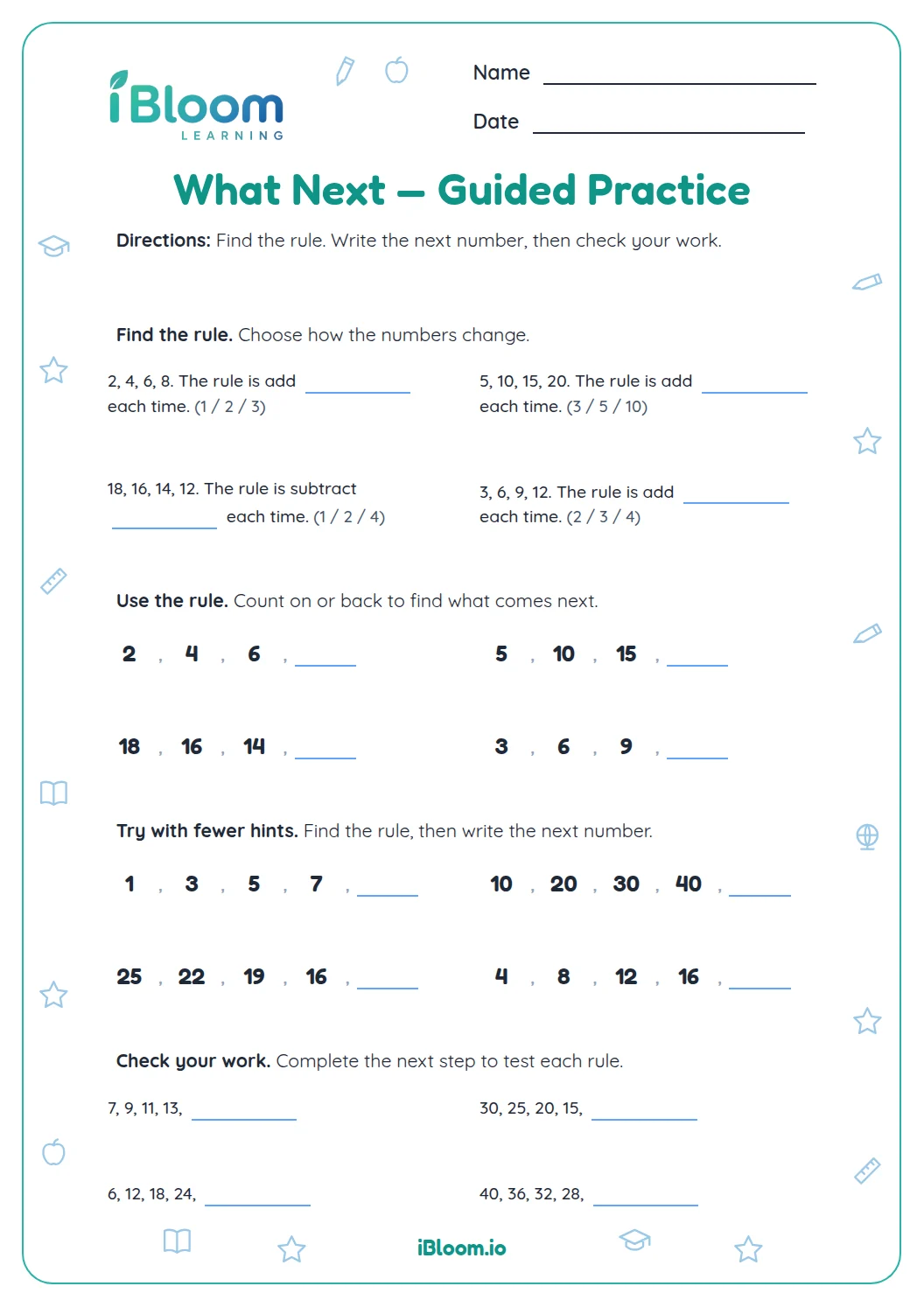
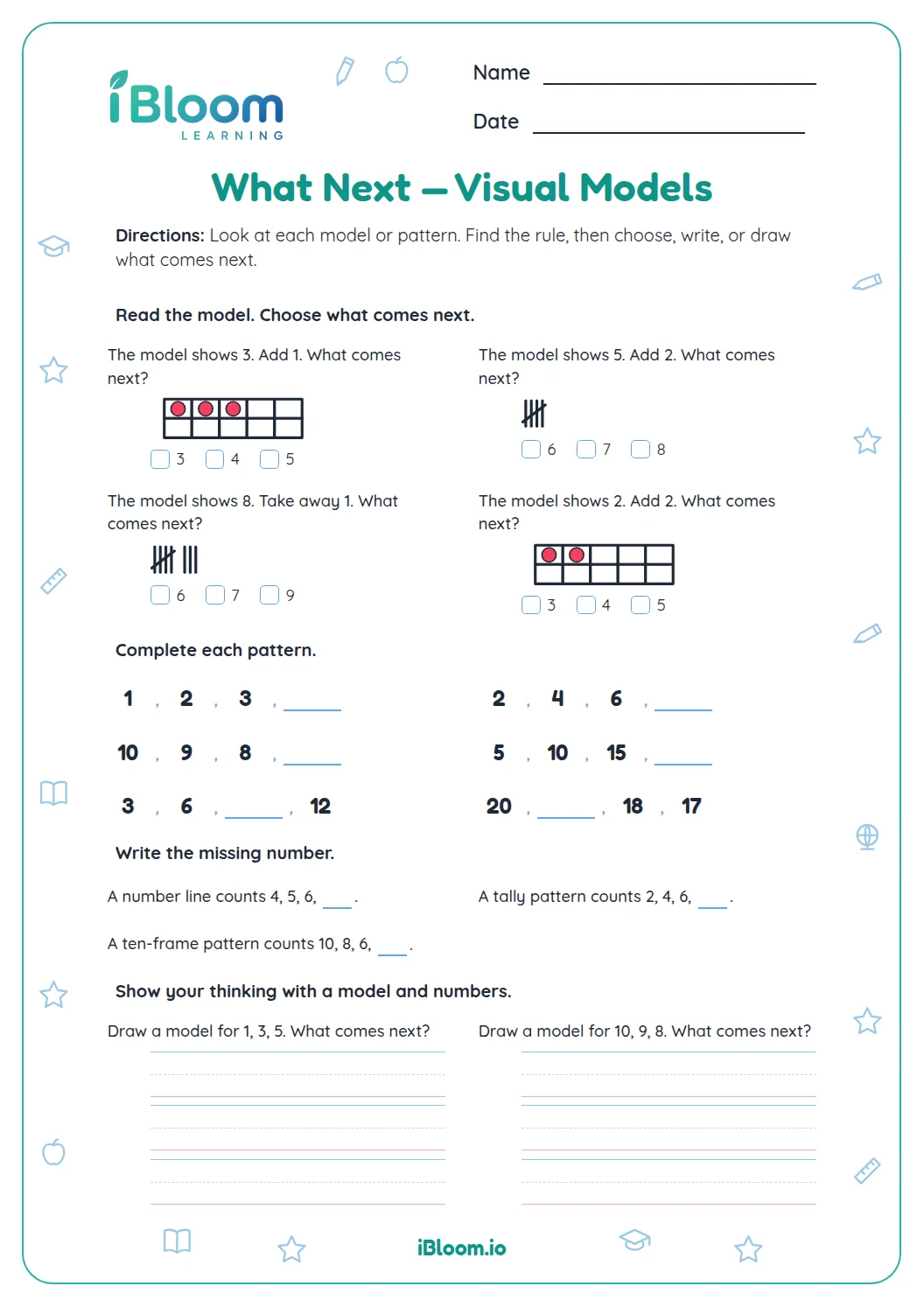
This printable gives Grade 1 students practice using input-output rules in familiar situations. Fourteen concise prompts describe repeated adding or taking away, then ask children to find a matching output. Students identify the change and apply it to a new input or story. The arithmetic connects to CCSS 1.OA.C.6, with calculations within 20. A separate answer key is included.
Aligned to 1.OA.C.6
What does an input-output rule do?
A rule changes each input in the same way to make an output. A story may describe the rule as adding apples to bags, taking crayons from a box, or moving a toy. Track what happens once, then repeat the same change.
- 1Input 3 gives 7, and input 5 gives 9.
- 2Both outputs are 4 more than their inputs, so the rule is +4.
How can a child find the rule?
Compare two input-output pairs. If the output increases by the same amount as the input increases, look for repeated addition. If an amount is removed each time, use subtraction. Check the rule on another pair before applying it.
How do you solve the real-world problems?
Name the input, identify the repeated change, and calculate the matching output. For a take-away story, begin with the starting amount and subtract each change. Keep track of the unit, such as apples, points or inches.
How to use this worksheet
- 1Read the whole story and find the starting input.
- 2Notice the amount added or taken away each time.
- 3Check that the rule fits every number given.
- 4Repeat the rule for the new input or missing value.
- 5Say the answer with its story unit.
Common mistakes and quick fixes
The mistake
Changing the rule partway through a pattern.
The fix
Compare two known pairs and repeat the same change for every input.
The mistake
Adding when the story says an amount is used or taken away.
The fix
Underline action words such as “used,” “left” or “adds.”
The mistake
Giving the number without naming what it counts.
The fix
Include the story unit, such as apples, points or inches.
Common Core alignment
The number operations in these stories practice addition and subtraction within 20.
Add and subtract within 20 using strategies and related facts.
On this sheet: The story patterns use repeated addition or subtraction within 20 to connect inputs with outputs.
Show the official wordingHide the official wording
Add and subtract within 20, demonstrating fluency for addition and subtraction within 10. Use strategies such as counting on; making ten (e.g., 8 + 6 = 8 + 2 + 4 = 10 + 4 = 14); decomposing a number leading to a ten (e.g., 13 - 4 = 13 - 3 - 1 = 10 - 1 = 9); using the relationship between addition and subtraction (e.g., knowing that 8 + 4 = 12, one knows 12 - 8 = 4); and creating equivalent but easier or known sums (e.g., adding 6 + 7 by creating the known equivalent 6 + 6 + 1 = 12 + 1 = 13).
What to practice next
Make more practice
Further reading
Questions parents and teachers ask
What skill does this Grade 1 input-output number patterns worksheet practice?
An input-output rule changes each input in the same way to make its output. For example, in question 5, the rule adds 4: input 3 gives 7, so input 5 gives 9. The printable has 14 short questions that apply these rules in number patterns and familiar situations.
Can my child use the answer key independently?
Yes. The answer key lists the output for all 14 questions, including the story units where they matter. Have your child try each rule first, then compare the result with the key; for a missed answer, check whether the same change was used for every input.
How should we work through the harder questions?
Start by reading the section heading and its short direction together. Work one example aloud, naming the clue or strategy, then let the child continue. When an answer is incorrect, return to the prompt and show the step that leads to a correct result instead of simply copying the key.
How long should this printable take?
Plan for about 15 minutes, with extra time if the child explains each choice or writes a full response. The worksheet is designed for one sitting, but it can also be split at the part break. A short pause between sections can help children check their work carefully.
What can we do after finishing this page?
Ask the child to choose one question and explain how they solved it without looking at the key. Then try another worksheet in the same skill sequence for additional practice. A brief conversation about which clue or step was most useful helps connect the printable to future work.