
About this worksheet
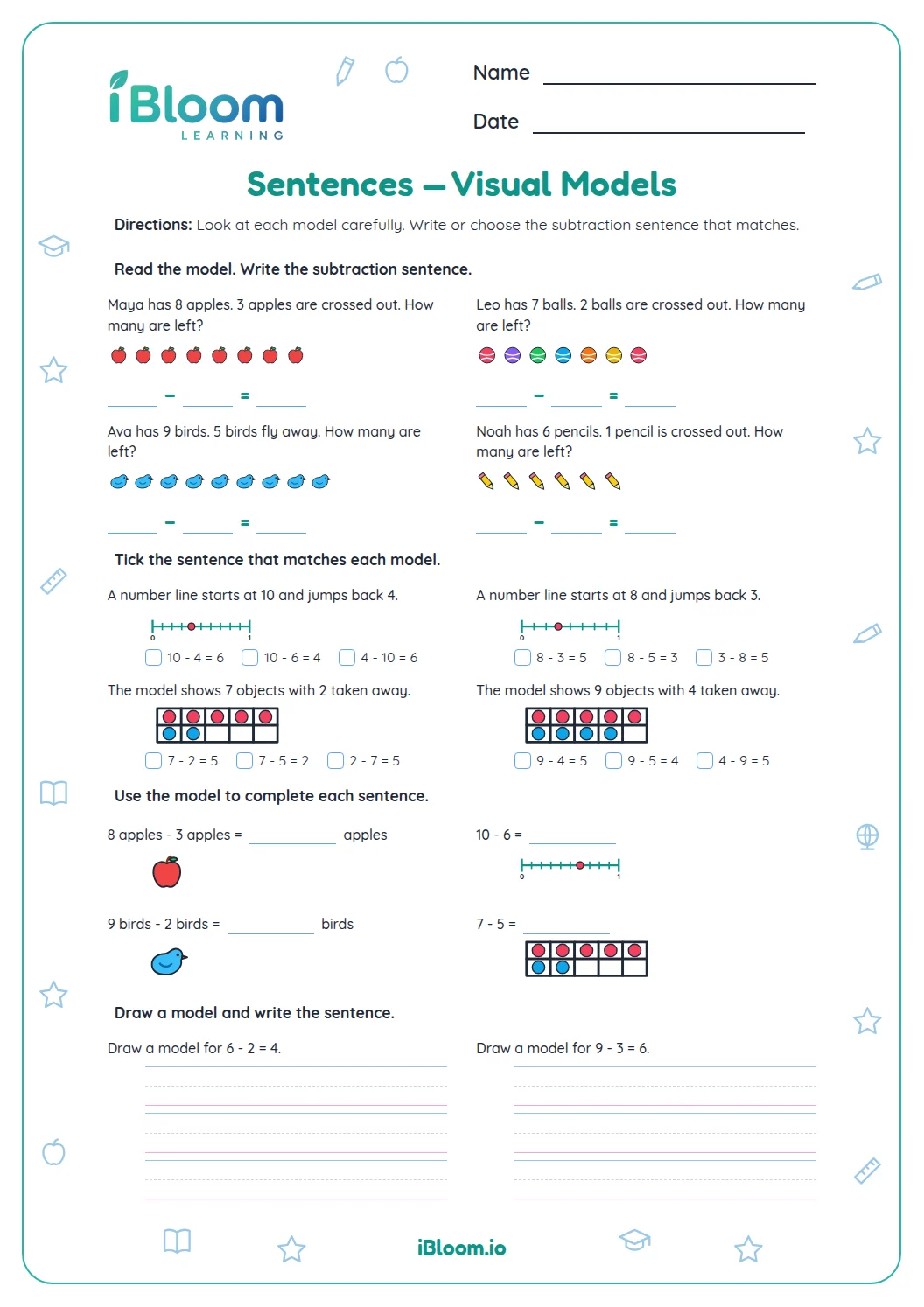
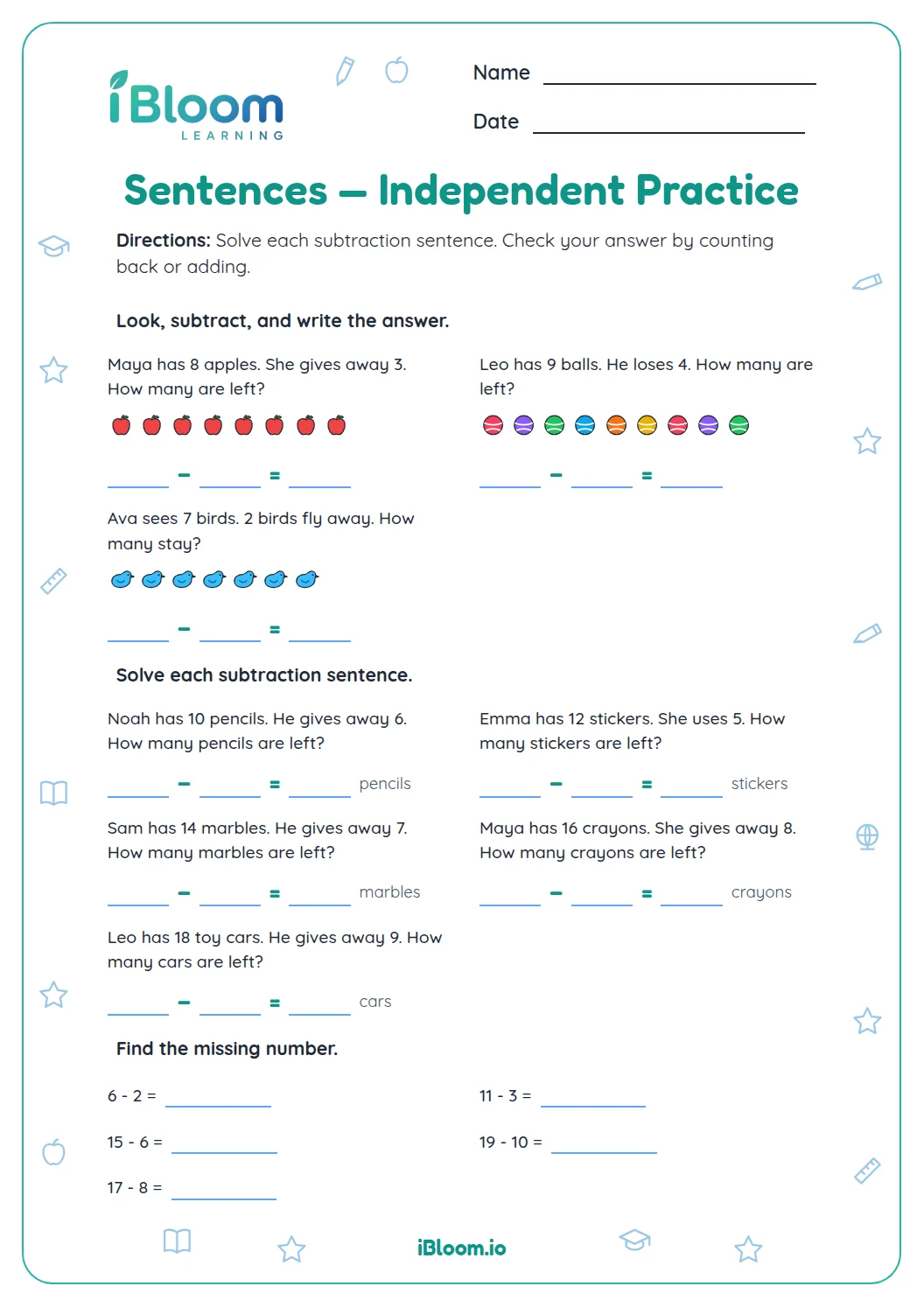
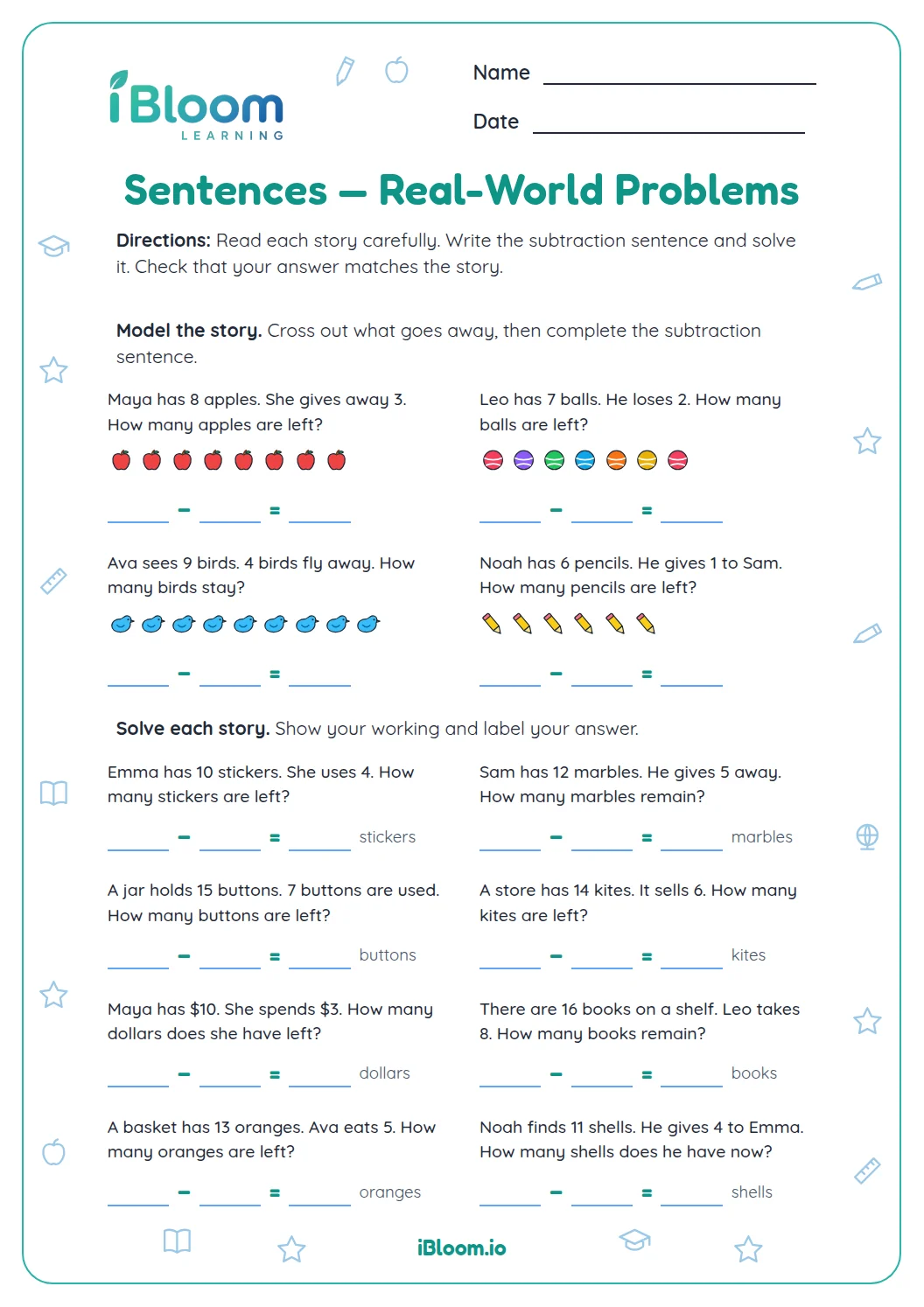
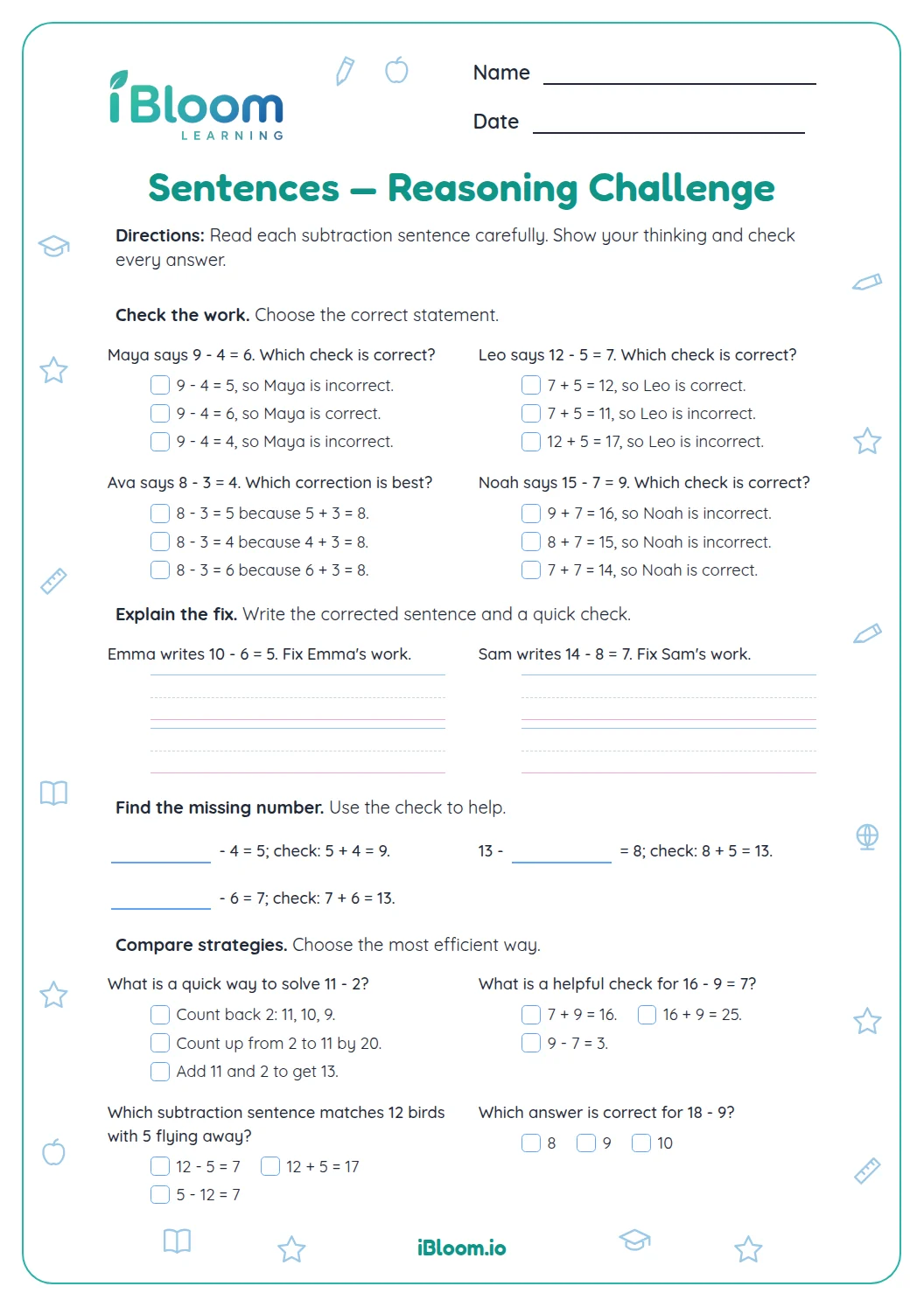
This printable Grade 1 worksheet guides students through subtraction sentences with numbers to 20. The first set includes blanks in different positions so children see the role of the minuend, subtrahend, and difference; the final items use short stories and ask students to write and solve a subtraction equation. The page practices Common Core 1.OA.A.1 and 1.OA.C.6. A separate answer key lists the missing numbers and story-problem answers.
Aligned to 1.OA.A.1
What do the numbers in a subtraction sentence mean?
In 9 − 4 = 5, start with 9, take away 4, and 5 remains. A blank can stand for any part of the equation, so first identify what is missing.
For ___ − 3 = 6, ask what number loses 3 and leaves 6. Counting up from 6 by 3 gives 9.
- 1___ − 3 = 6
- 26 + 3 = 9
- 39 − 3 = 6
How do you turn a story into an equation?
Find the starting amount and the amount taken away. “There are 13 toy cars. 4 roll under the shelf” becomes 13 − 4 = 9. The answer tells how many stay out.
How can addition check subtraction?
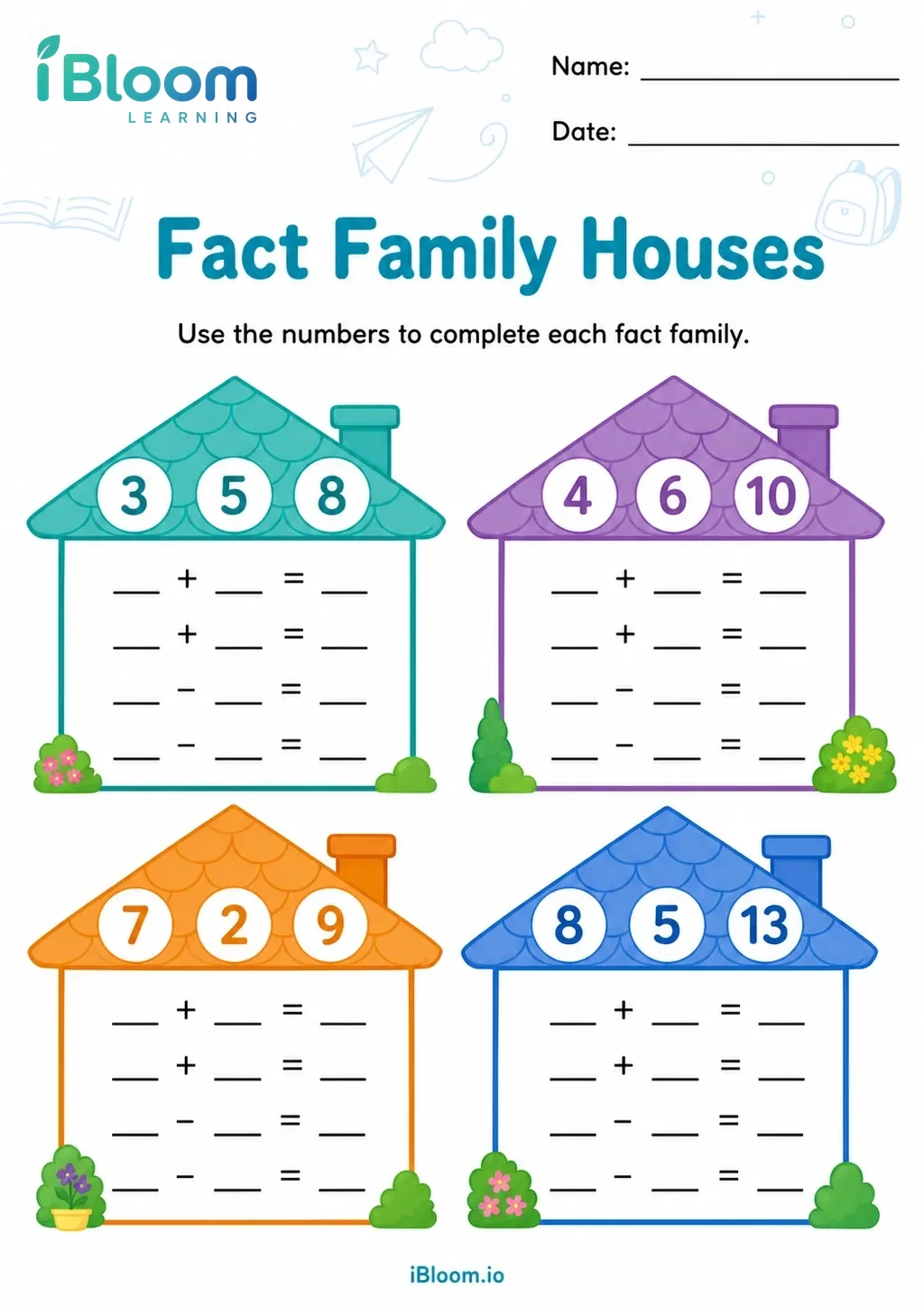
Add the difference and the amount taken away. They should make the starting amount: 9 + 4 = 13.
How to use this worksheet
- 1Read the full equation before solving.
- 2Point to the starting amount and the amount removed.
- 3Use counting back or a related addition fact.
- 4Write the missing number or story equation.
- 5Add to check the subtraction.
Common mistakes and quick fixes
The mistake
Subtract in the wrong direction for a missing start.
The fix
For ___ − 3 = 6, add 6 + 3 to find the start.
The mistake
Use the number removed as the answer.
The fix
Ask how many are left after taking away.
The mistake
Forget what a story asks.
The fix
Underline the starting amount, removed amount, and question.
Curriculum alignment
This worksheet connects focused practice to the listed Common Core skill.
Represent addition and subtraction story situations with equations.
On this sheet: Four story prompts ask students to represent take-from situations with subtraction.
Show the official wordingHide the official wording
Use addition and subtraction within 20 to solve word problems involving situations of adding to, taking from, putting together, taking apart, and comparing, with unknowns in all positions, e.g., by using objects, drawings, and equations with a symbol for the unknown number to represent the problem.
What to practice next
Make more practice
Further reading
Questions parents and teachers ask
What subtraction skills are on this worksheet?
Students complete equations with the answer or a starting number missing, solve four take-away stories, and use addition to check related facts. The numbers stay within 20, matching the Grade 1 practice on this page. Counters or a number line can help model a take-away before writing the equation.
How can a student solve a blank starting number?
Think of the number that makes the equation true. In ___ − 3 = 6, ask what number minus 3 leaves 6; the number is 9. Addition can check it: 6 + 3 = 9. Then subtract 3 to return to 6.
What should a student do in the story problems?
Read what is there at the start and what goes away. Subtract the amount that leaves from the starting amount, then answer with how many remain. For the toy-car story, 13 cars start out and 4 roll under a shelf, so 9 stay out.
How does addition check subtraction?
Add the answer to the amount subtracted. For 12 − 5 = 7, check 7 + 5 = 12. If the sum returns to the starting number, the subtraction fact is consistent. Several final items on the page make this relationship explicit.
Can students use counters or draw a number line?
Yes. Counters, fingers, or a number line can help a student model taking away, especially in the story problems. The printed equations also let students practice writing the subtraction sentence and checking an answer with addition. Encourage the student to explain what each number represents.