



About this worksheet
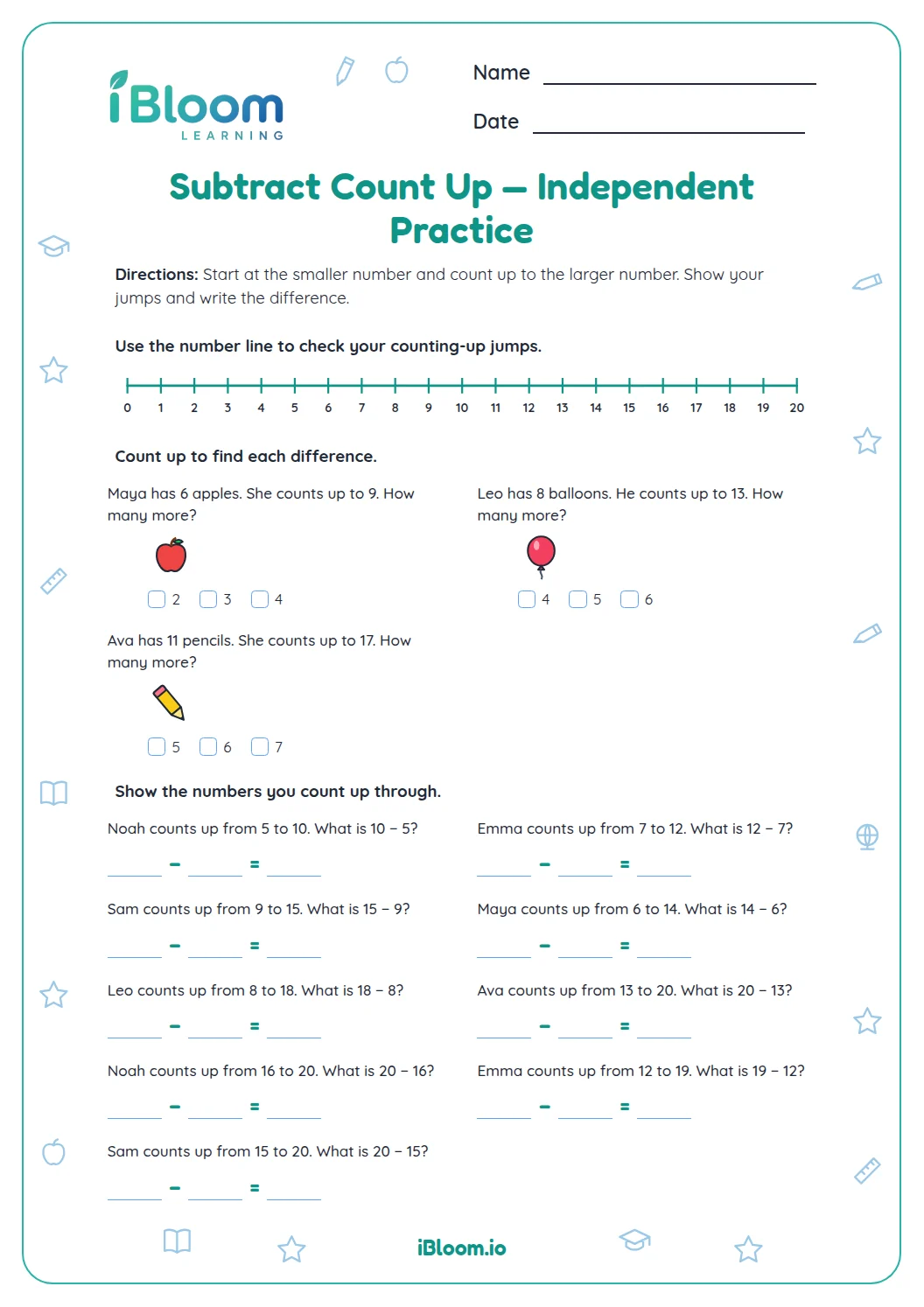
This free printable Grade 1 worksheet focuses on use counting up to find differences. It contains 16 questions in several parts, moving from guided practice to independent work. The examples and directions on the sheet show children how to approach each task, and a separate answer key supports checking after they finish.
How does counting up solve subtraction?
Start at the smaller number and count forward until reaching the larger number. The number of hops is the difference. This strategy is especially useful when the two numbers are close together.
What do the number lines show?
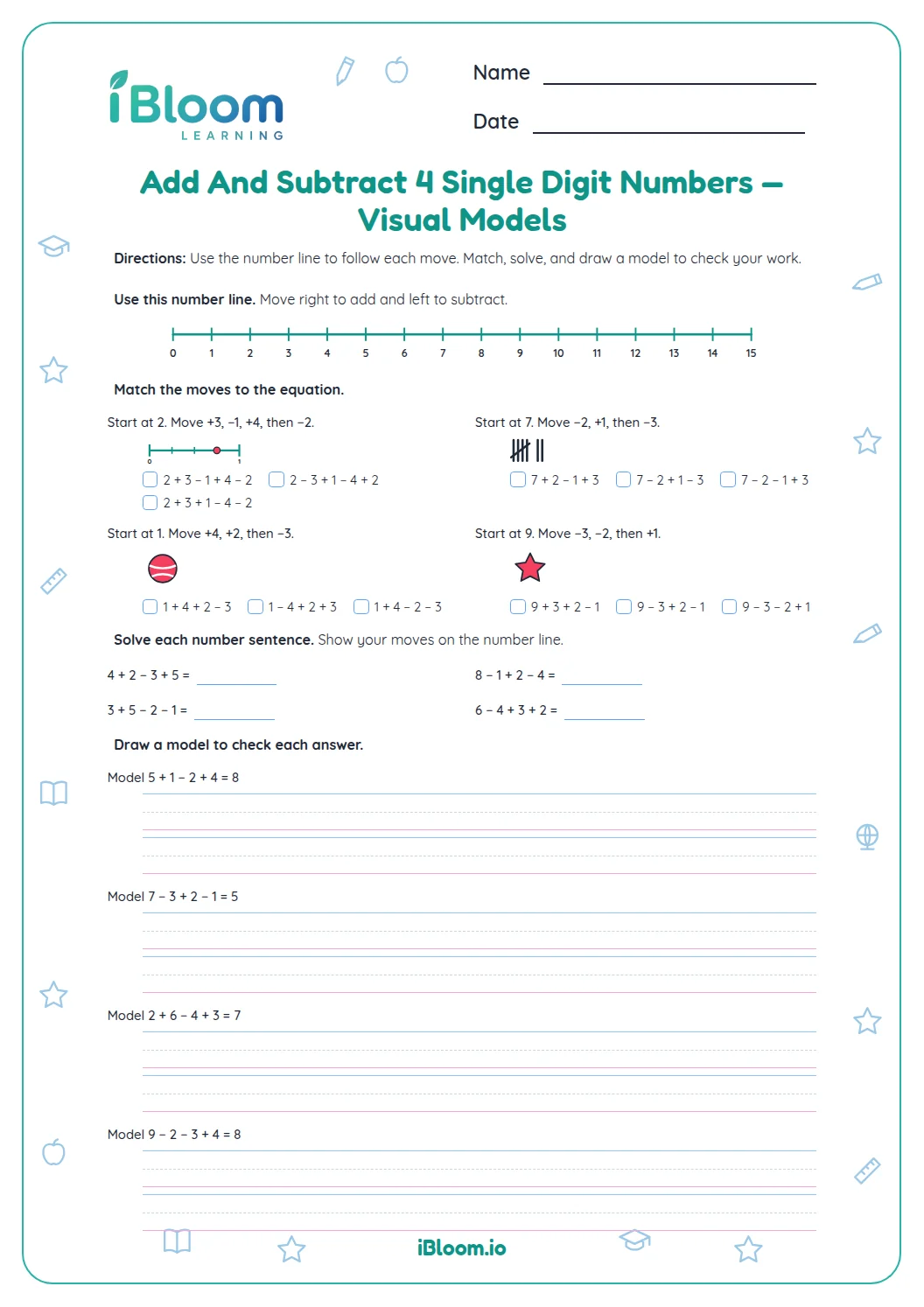
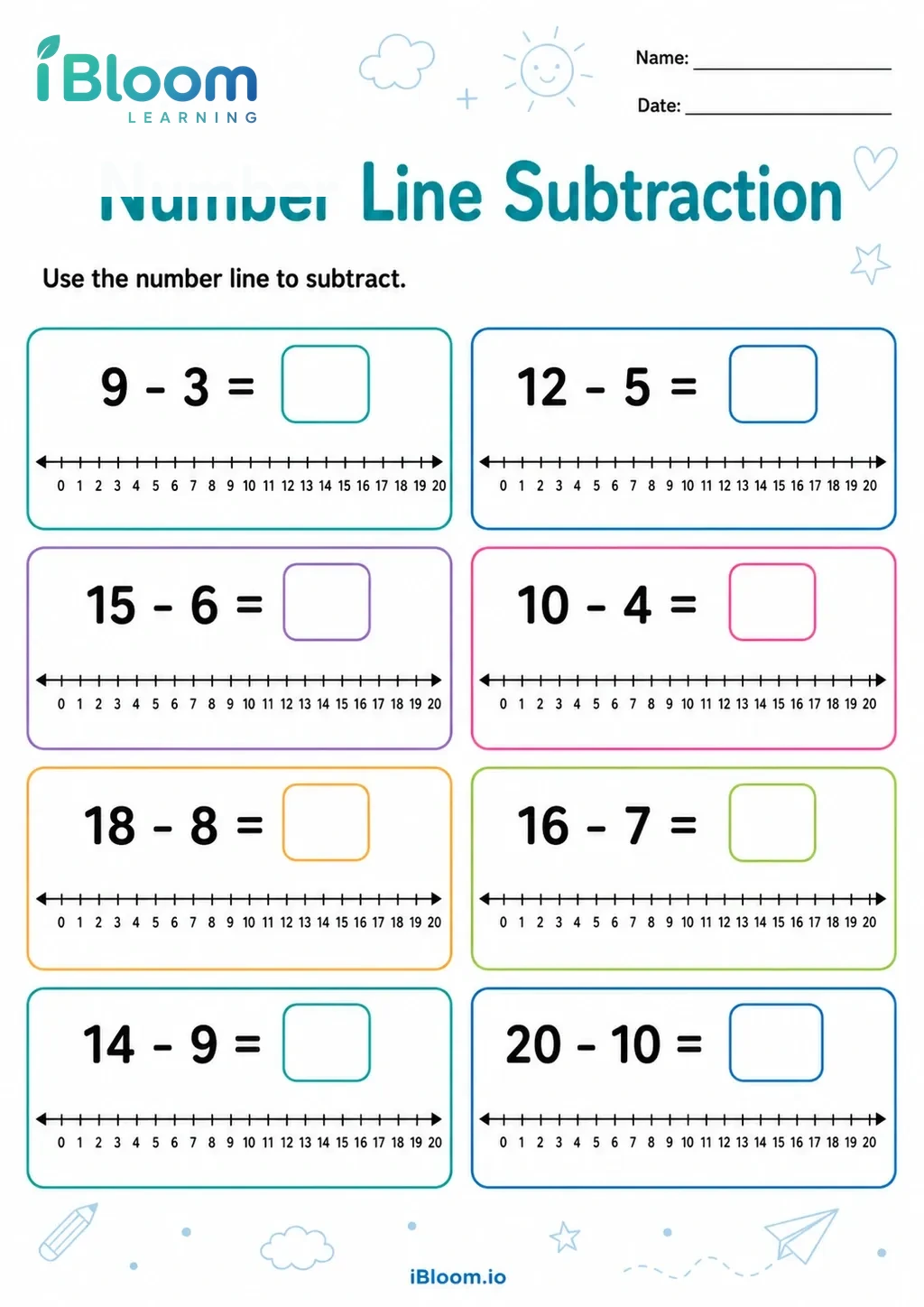
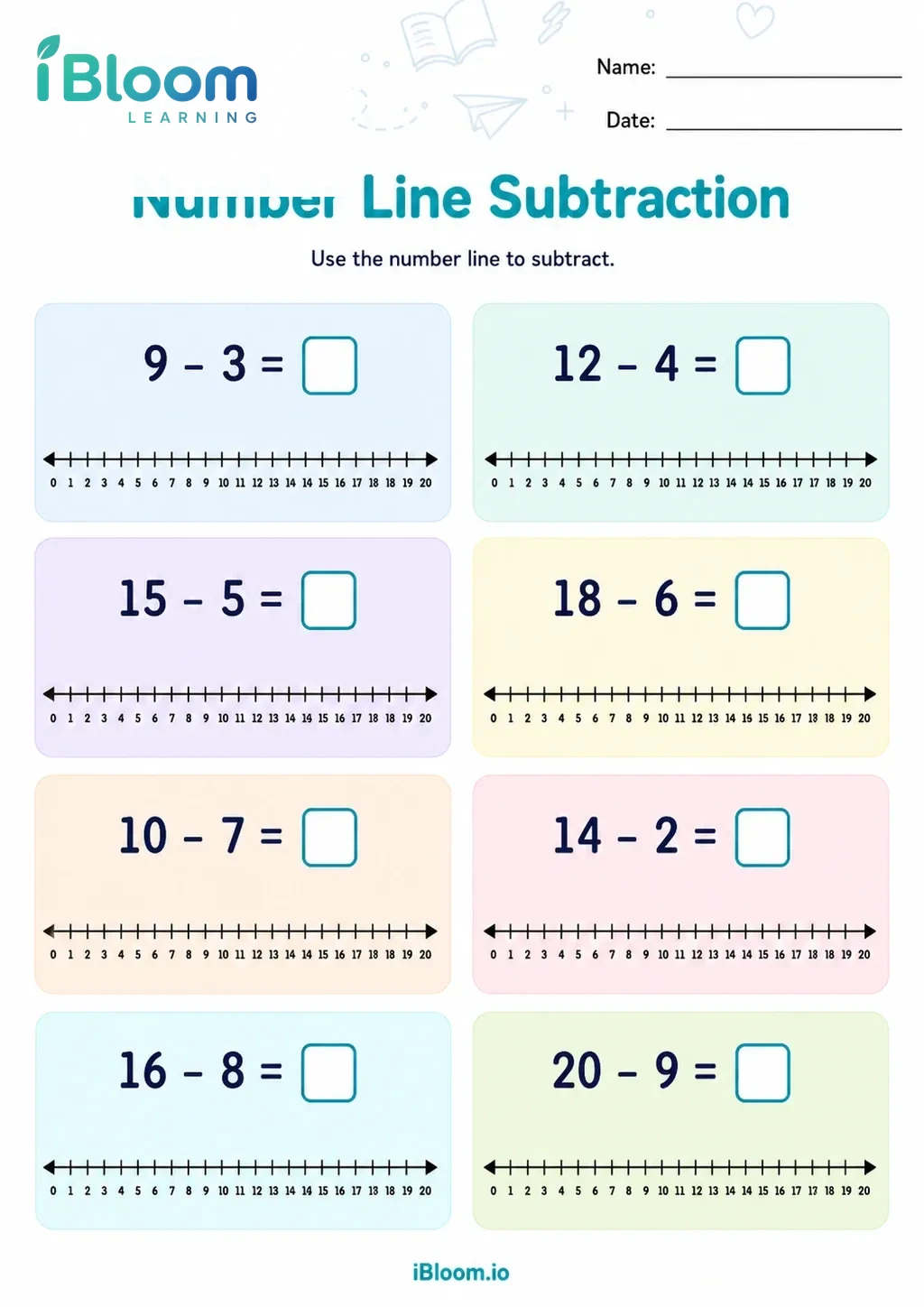
The number lines in Part A start at the smaller number and end at the larger number. Count each unit step to find the difference.
- 1Start at 7 and count to 12.
- 27 → 8 → 9 → 10 → 11 → 12
- 3There are 5 hops, so 12 − 7 = 5.
How can children use the strategy in a story?
For “how many more?” count from the smaller amount up to the larger amount. The hops give the difference.
How to use this worksheet
- 1Read each part’s direction before starting.
- 2Solve the facts or clues in order and show work where space is provided.
- 3Use the operation or text detail that fits the question.
- 4Check the answer key after completing the practice.
Common mistakes and quick fixes
The mistake
Answering quickly without checking the clue or operation.
The fix
Point to the exact word, detail, number or mark that supports the response.
The mistake
Skipping a question that feels unfamiliar.
The fix
Try the next part, then return and use its directions as a reminder.
The mistake
Changing a correct answer after a quick glance.
The fix
Explain the evidence or calculation aloud before making a change.
What to practice next
Questions parents and teachers ask
What does “count up” mean in subtraction?
Begin with the smaller number and count forward to the larger number. The number of steps between them is the difference. For 12 − 7, count 8, 9, 10, 11, 12: five steps, so the answer is 5. The first six questions ask children to count from one marked endpoint to another. They then apply the.
How do the number lines help?
The number lines give a starting value and an ending value. Children count the unit steps from start to end, then record the hop count as the difference. This models the same count-up method used in the worksheet’s equations. The answer key lists the expected difference for each equation and story problem. For story questions, check.
Can children use counting up for “how many more” questions?
Yes. Compare the smaller amount with the larger one by counting forward from the smaller amount. The number of hops tells how many more are needed, as in the sticker question where Maya counts from 8 up to 13. The printed directions and answer key make it easy to review the response after the activity is complete.
How many questions are included?
There are 16 questions in three parts: count-up number lines, subtraction equations, and short story problems. The number line models come first, followed by equations and situations that use the same strategy. The printed directions and answer key make it easy to review the response after the activity is complete.
What is the answer to 12 − 7 using count-up?
Start at 7 and count five steps to reach 12: 8, 9, 10, 11, 12. Therefore 12 − 7 = 5. Children can also check by adding 7 + 5 and confirming that the sum is 12. The printed directions and answer key make it easy to review the response after the activity is complete.