




About this worksheet
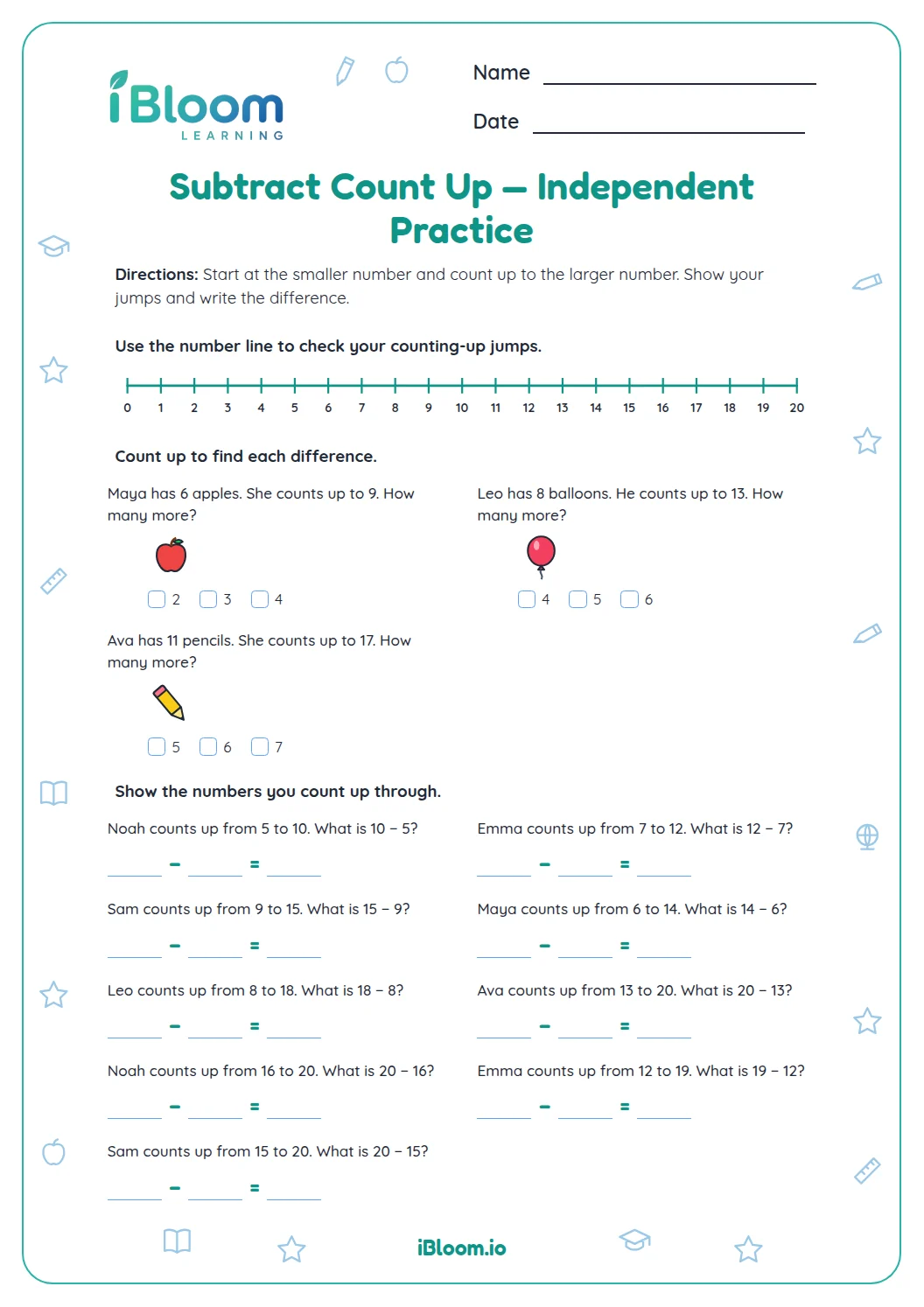
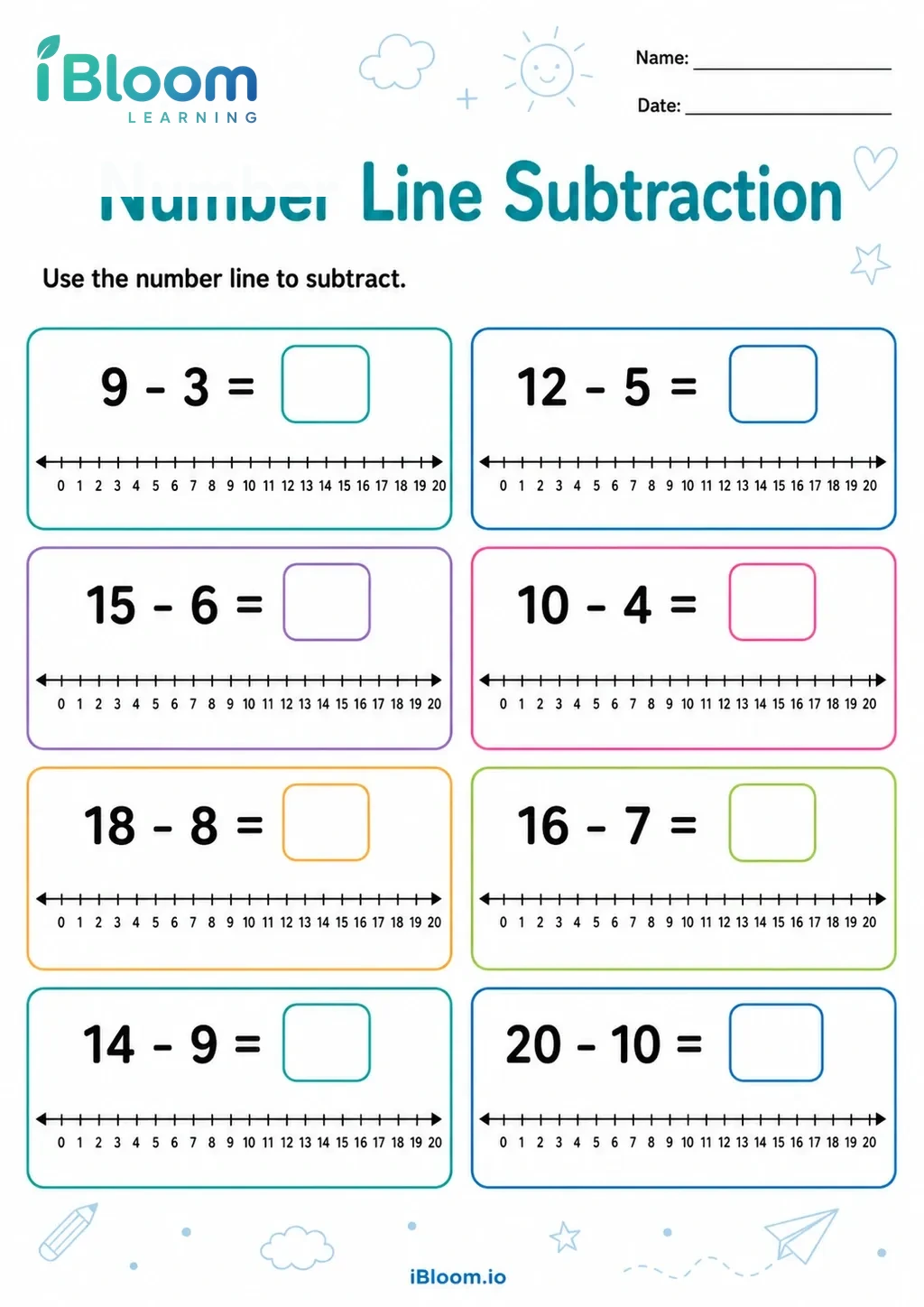
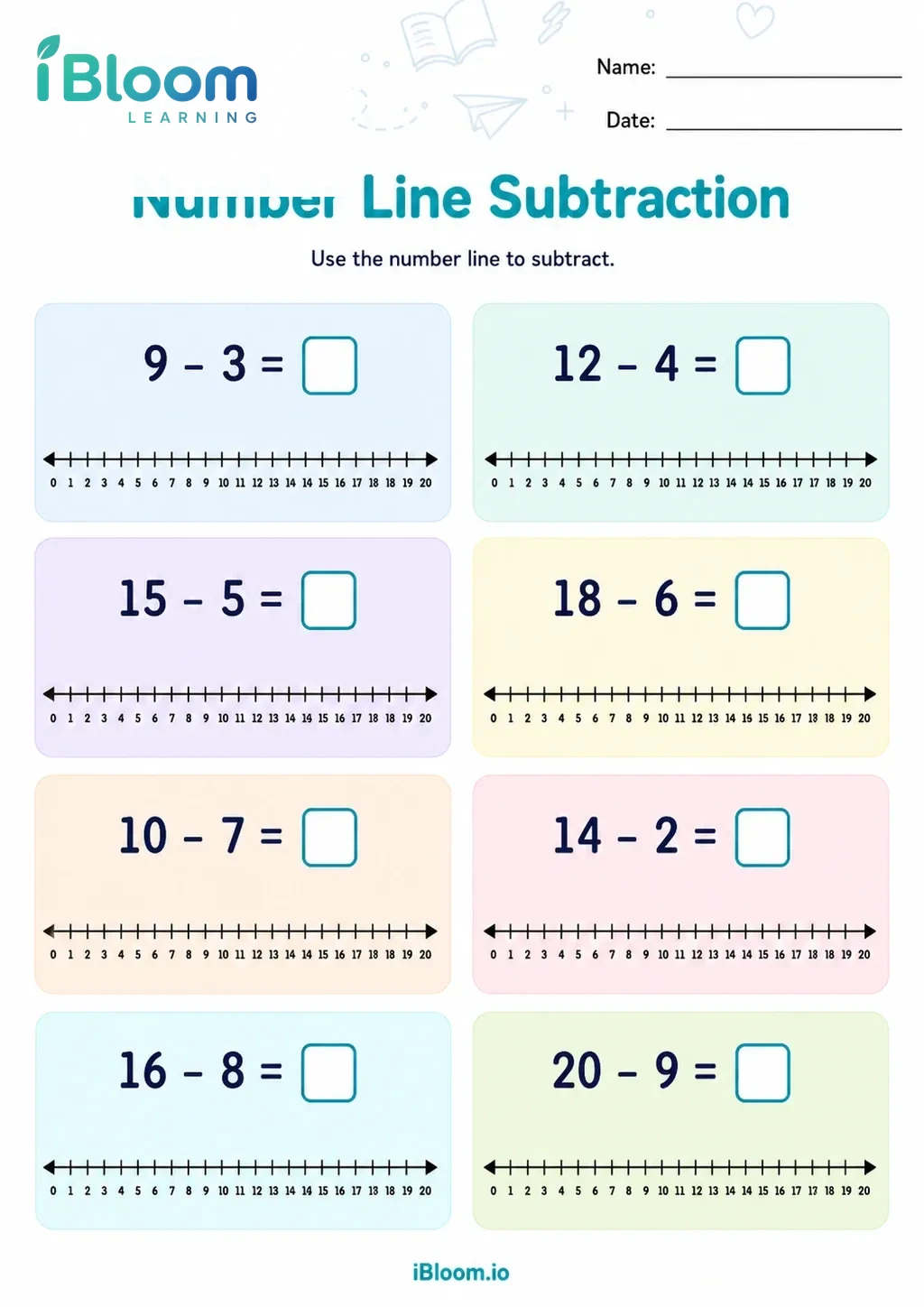
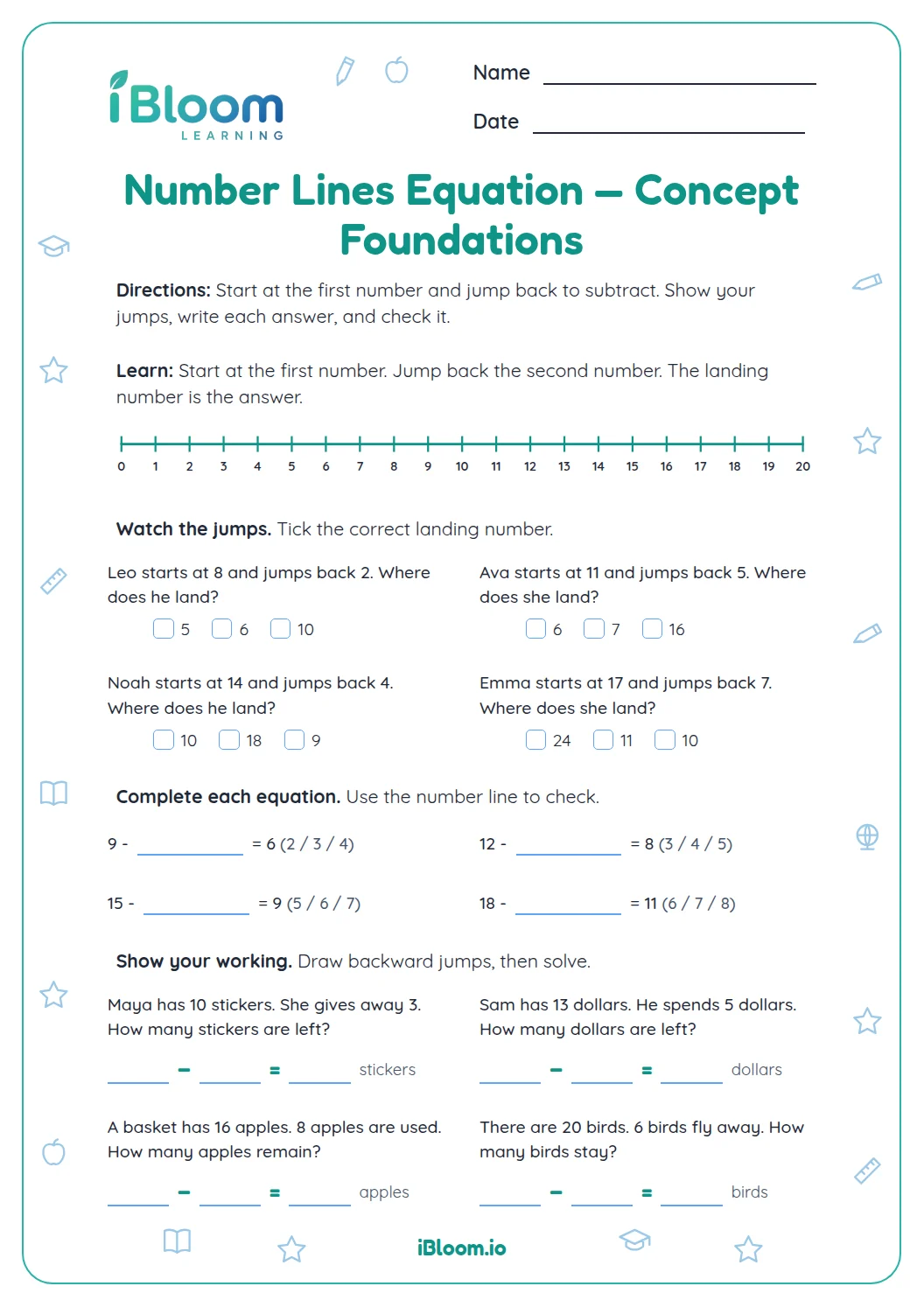
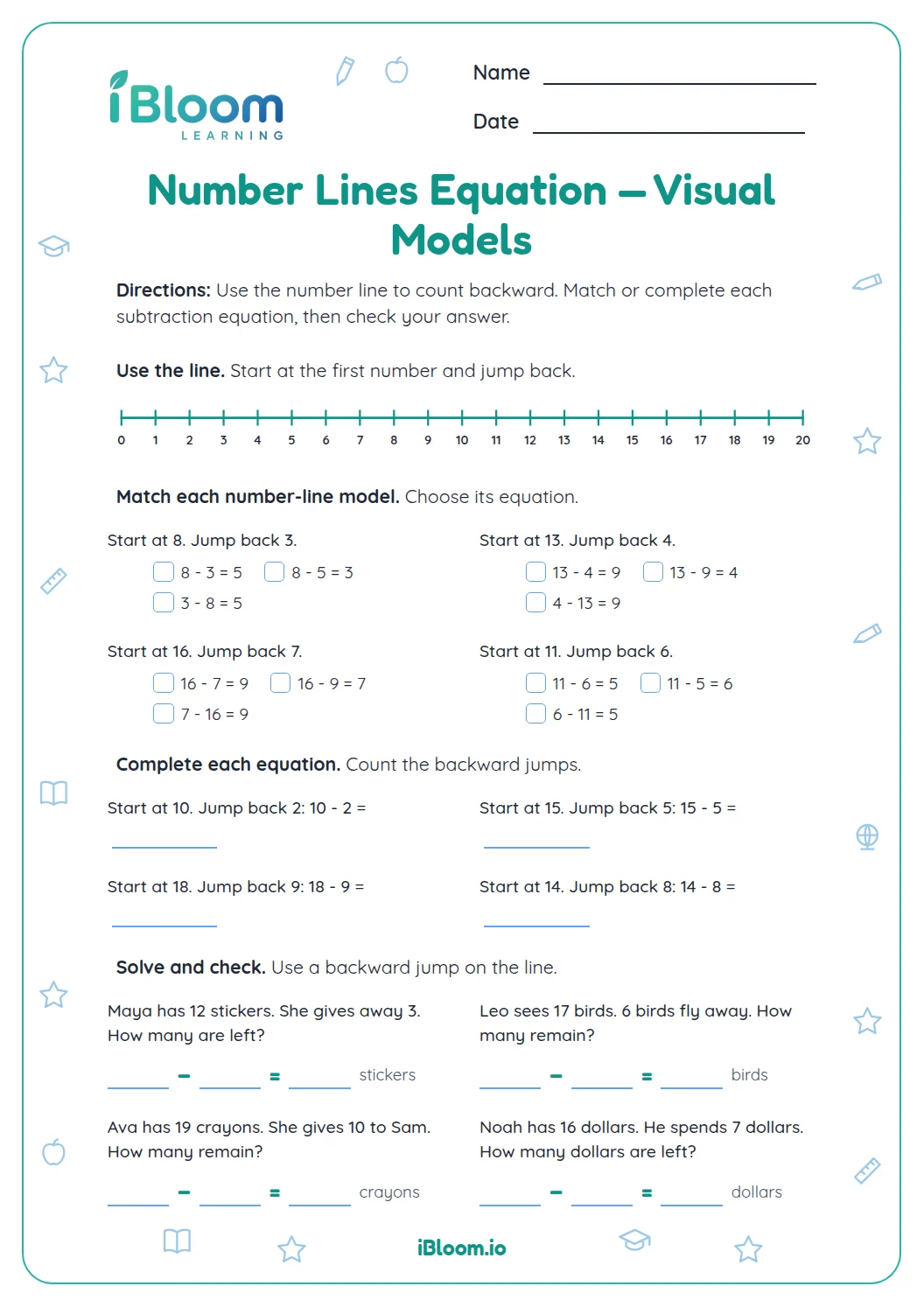
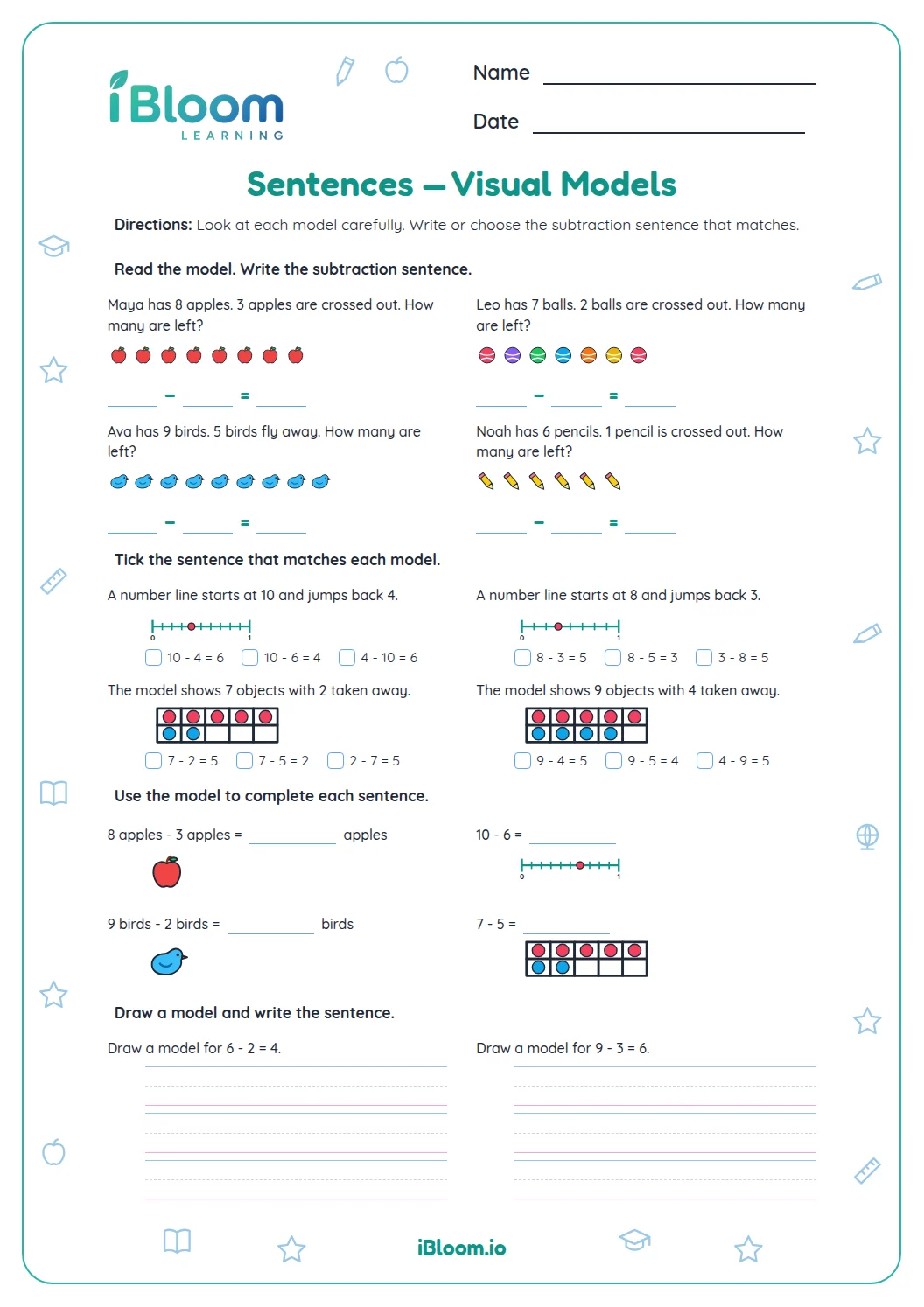
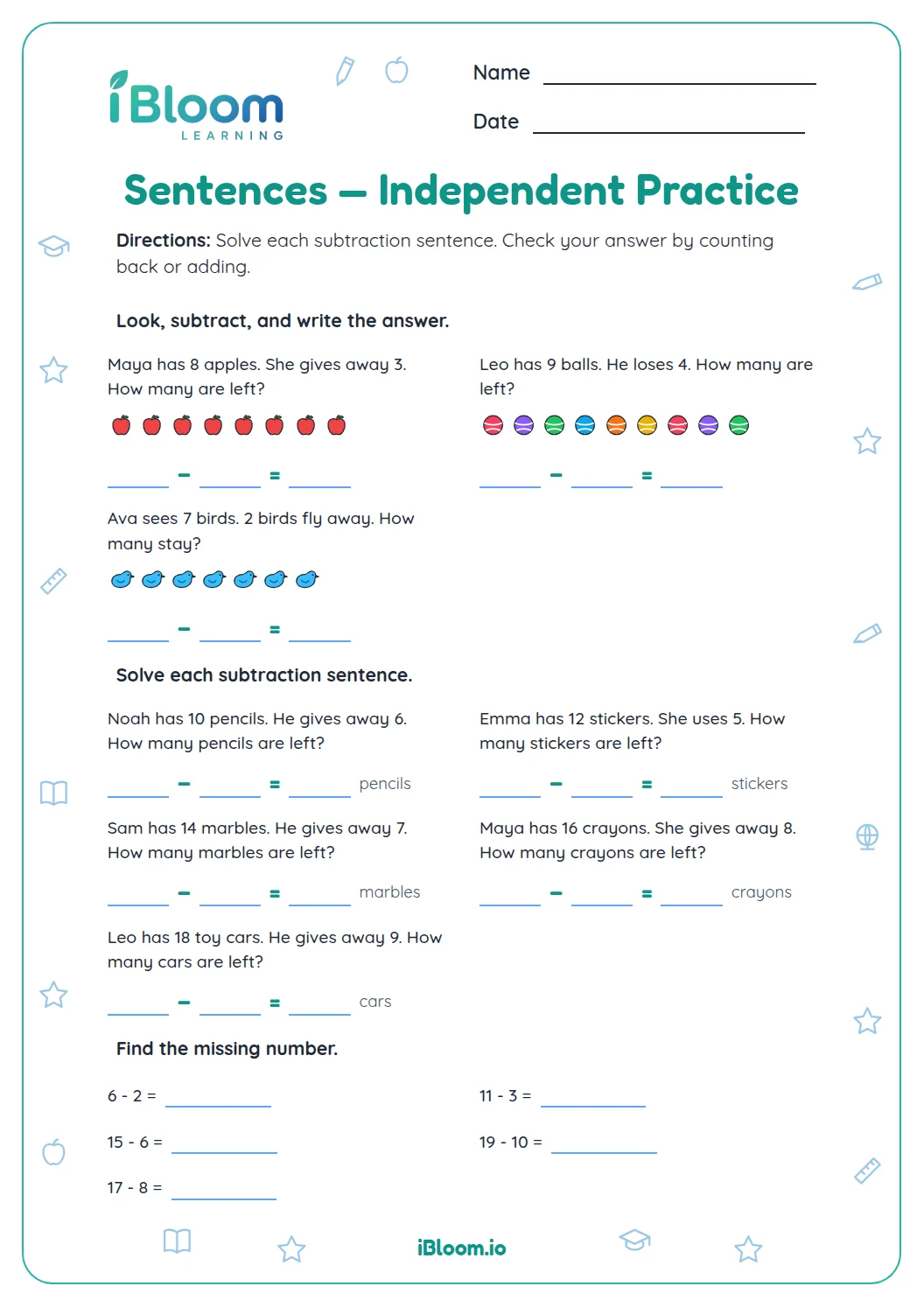
This Grade 1 subtraction worksheet builds the count-up strategy: begin with the number being taken away, count forward to the larger number, and find the number of jumps. Children identify the starting number, connect subtraction to addition, complete missing-addend sentences, and solve short comparison stories. For example, to solve 14 − 9, start at 9 and count five steps to 14. The 17 questions use numbers within 20 and include an answer key. The problems align with Common Core 1.OA.A.1.
Aligned to 1.OA.A.1
What is the count-up strategy?
To find 14 − 9, begin at 9 and count forward: 10, 11, 12, 13, 14. Five jumps reach 14, so the difference is 5. This uses addition to check subtraction.
The opening questions help children identify where to start and connect a subtraction fact to a matching addition sentence. In Question 3, the first number said after 12 is 13.
How does the worksheet build practice?
The missing-addend items give children repeated chances to count forward, and two direct jump questions ask them to count from a named start to a named end. Later story problems use stickers, birds, buttons, pages, cups, and marbles to make the unknown amount clear.
How can children check an answer?
Use the answer as the missing addend. For 11 + 6 = 17, the six jumps from 11 land on 17; that confirms 17 − 11 = 6.
How to use this worksheet
- 1Read the subtraction or story and find the smaller number.
- 2Start counting at that number; say the next number as the first jump.
- 3Stop when you reach the larger number.
- 4Count the jumps and write that as the missing amount.
- 5Check by adding the difference to the smaller number.
What should children check?
The mistake
Counting the starting number as one jump.
The fix
Say “start at 9” first, then count 10 as jump one.
The mistake
Writing the ending number instead of the number of jumps.
The fix
Track each step between the two numbers; the steps, not the endpoint, are the difference.
The mistake
Reversing the addition check.
The fix
Put the smaller number and the difference together; their sum should be the larger number.
Common Core alignment
The questions connect addition and subtraction in Grade 1 situations within 20.
Solve subtraction situations within 20, including unknown amounts.
On this sheet: The word problems ask for missing amounts or differences within 20 and can be represented with addition.
Show the official wordingHide the official wording
Use addition and subtraction within 20 to solve word problems involving situations of adding to, taking from, putting together, taking apart, and comparing, with unknowns in all positions, e.g., by using objects, drawings, and equations with a symbol for the unknown number to represent the problem.
What to practice next
Make more practice
Further reading
Questions parents and teachers ask
Where should my child start counting?
Start on the smaller number, which is the amount being taken away or the amount already there. Count forward from it until reaching the larger number. The number of jumps gives the difference. Have the child name the start, end, and jumps.
Does the worksheet include word problems?
Yes. Six short situations ask about missing amounts, such as how many stickers Maya needs to reach a total of 17. The answer key gives the difference for each story. Use the key to check each story difference. Have the child count each step aloud while checking.
How can we check a count-up answer?
Add the difference to the smaller number. If the result is the larger number, the count-up work matches the subtraction fact. For example, 9 + 5 = 14 checks 14 − 9 = 5. Add the difference back to the starting amount.
Are the problems appropriate for Grade 1?
All numbers and differences stay within 20. The questions use short sentences and focus on addition and subtraction situations children can represent with a number sentence. Let the child mark each jump while counting. Have the child count each step aloud while checking.
How many questions are on the sheet?
There are 17 questions across three parts: choosing the strategy, finding missing amounts, and solving short word problems with working space. Ask the child to explain how many more are needed. Have the child count each step aloud while checking.
Is there an answer key?
Yes. The answer key is printed separately and includes each choice or numeric response. For the word problems, children can also write their own addition check. Check that the answer and unit match the story. Have the child count each step aloud while checking.