


About this worksheet
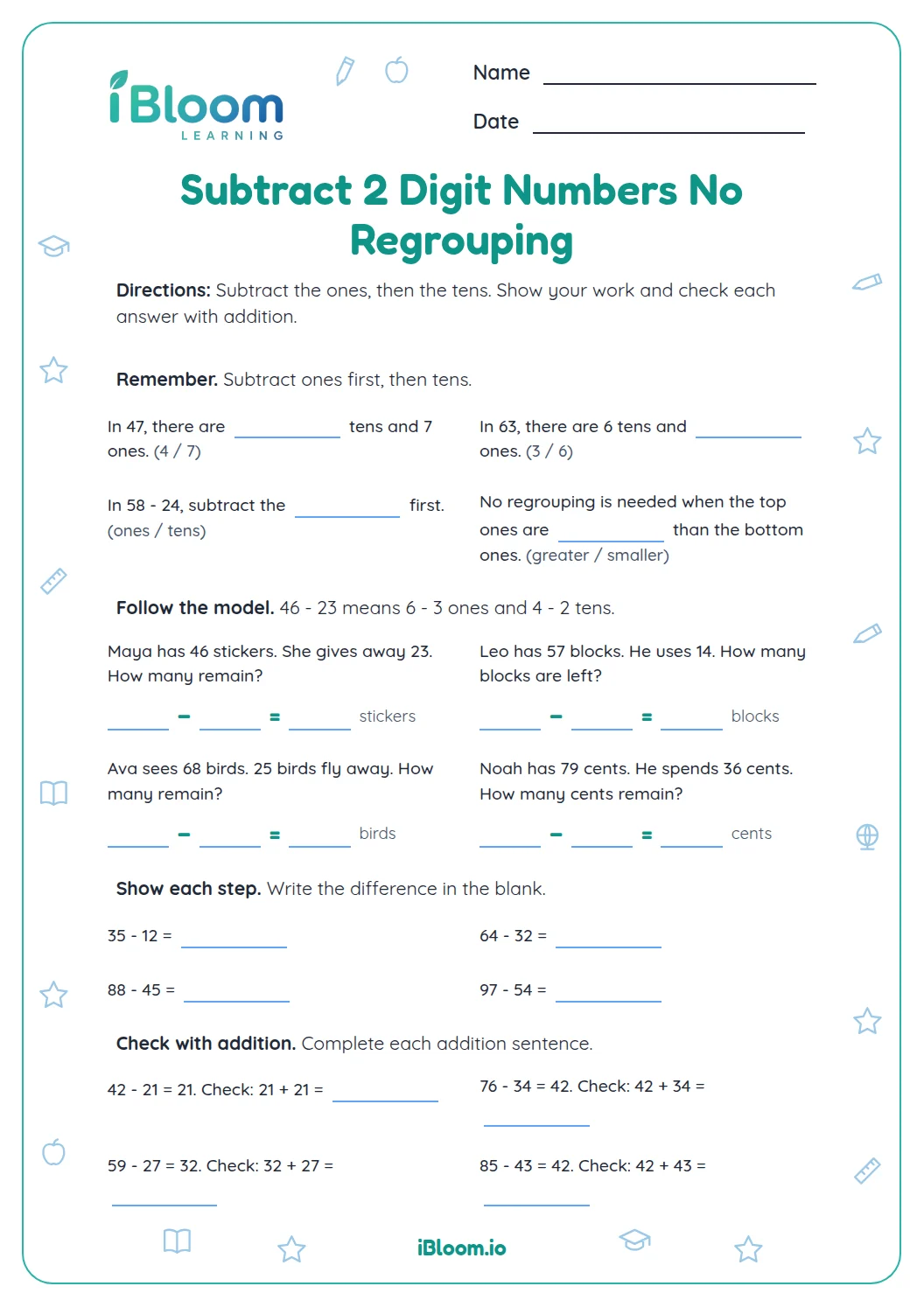
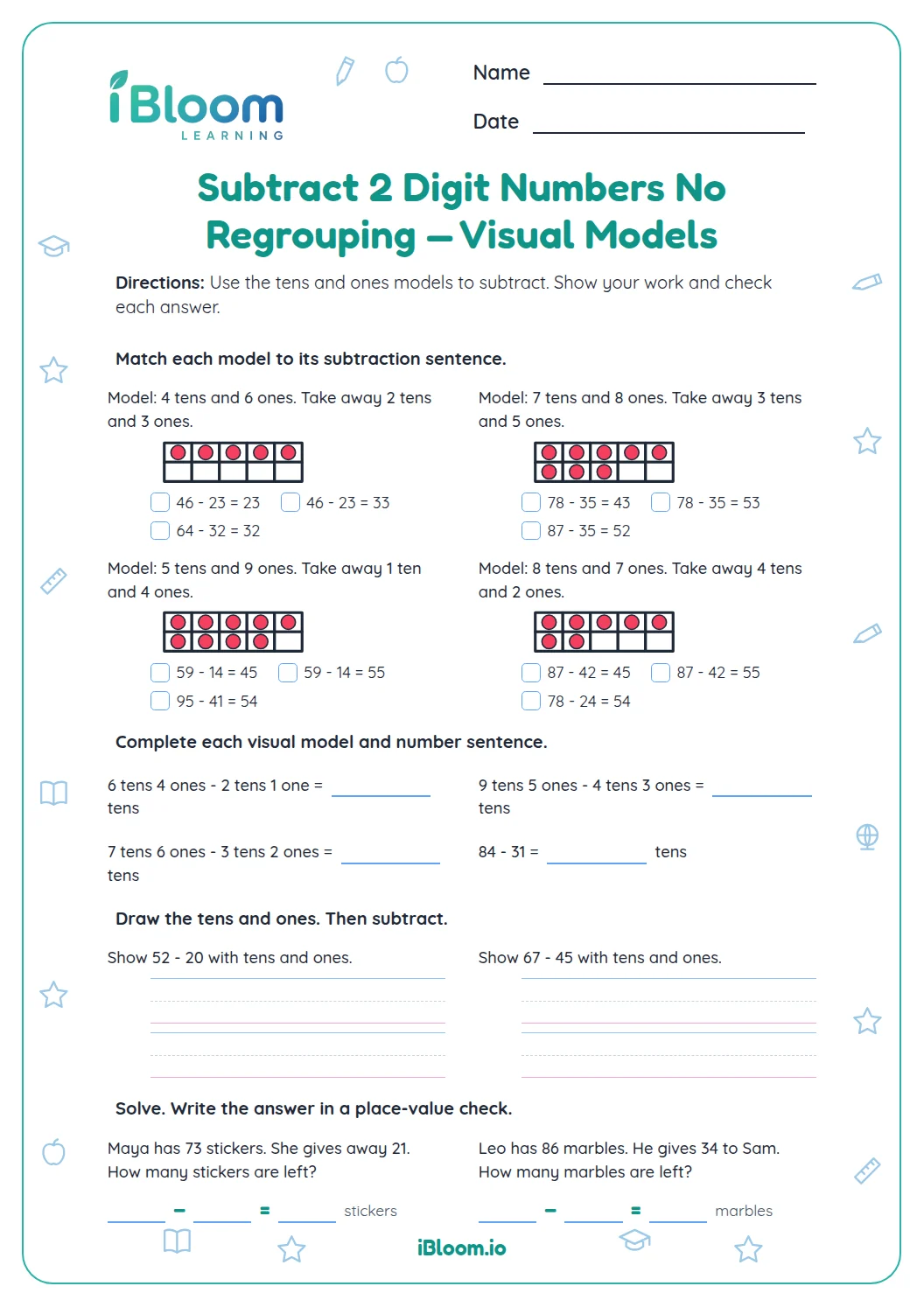
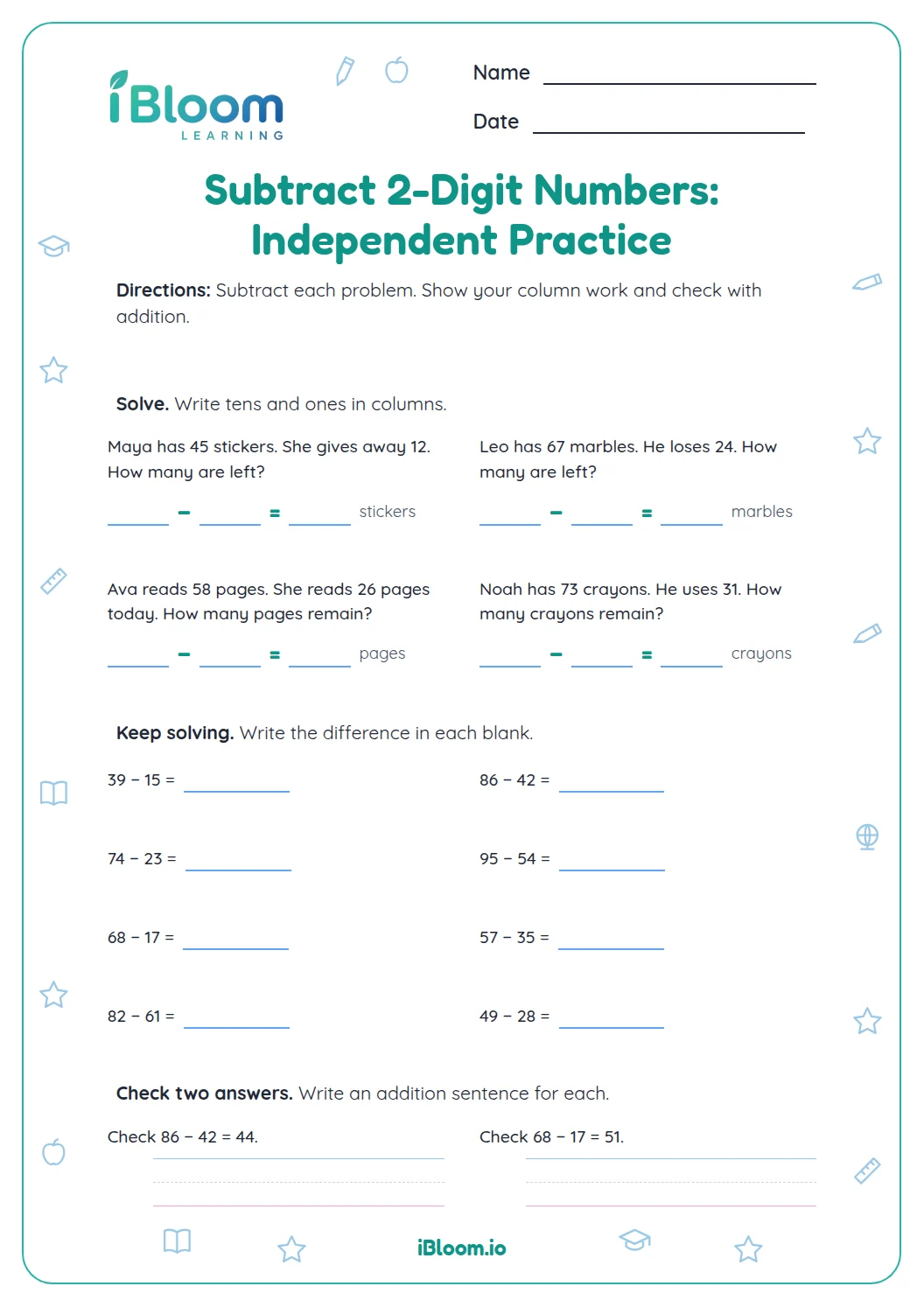
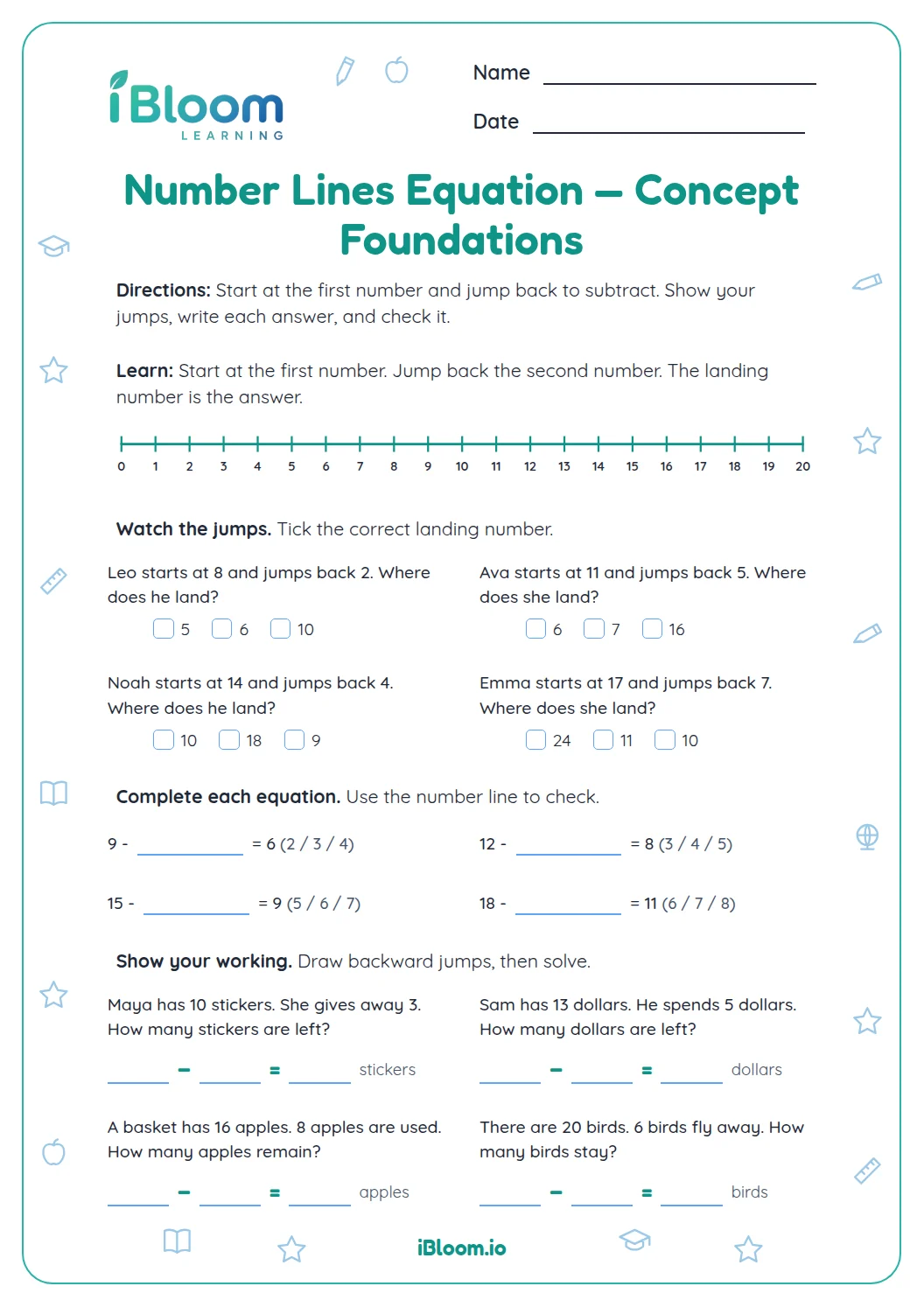
This Grade 1 worksheet gives 14 two-digit subtraction stories with a missing number and no regrouping. Learners find an unknown amount taken away or a missing starting amount, then check the story equation. A separate answer key is included.
Aligned to 1.NBT.C.6
How do I find an unknown amount?
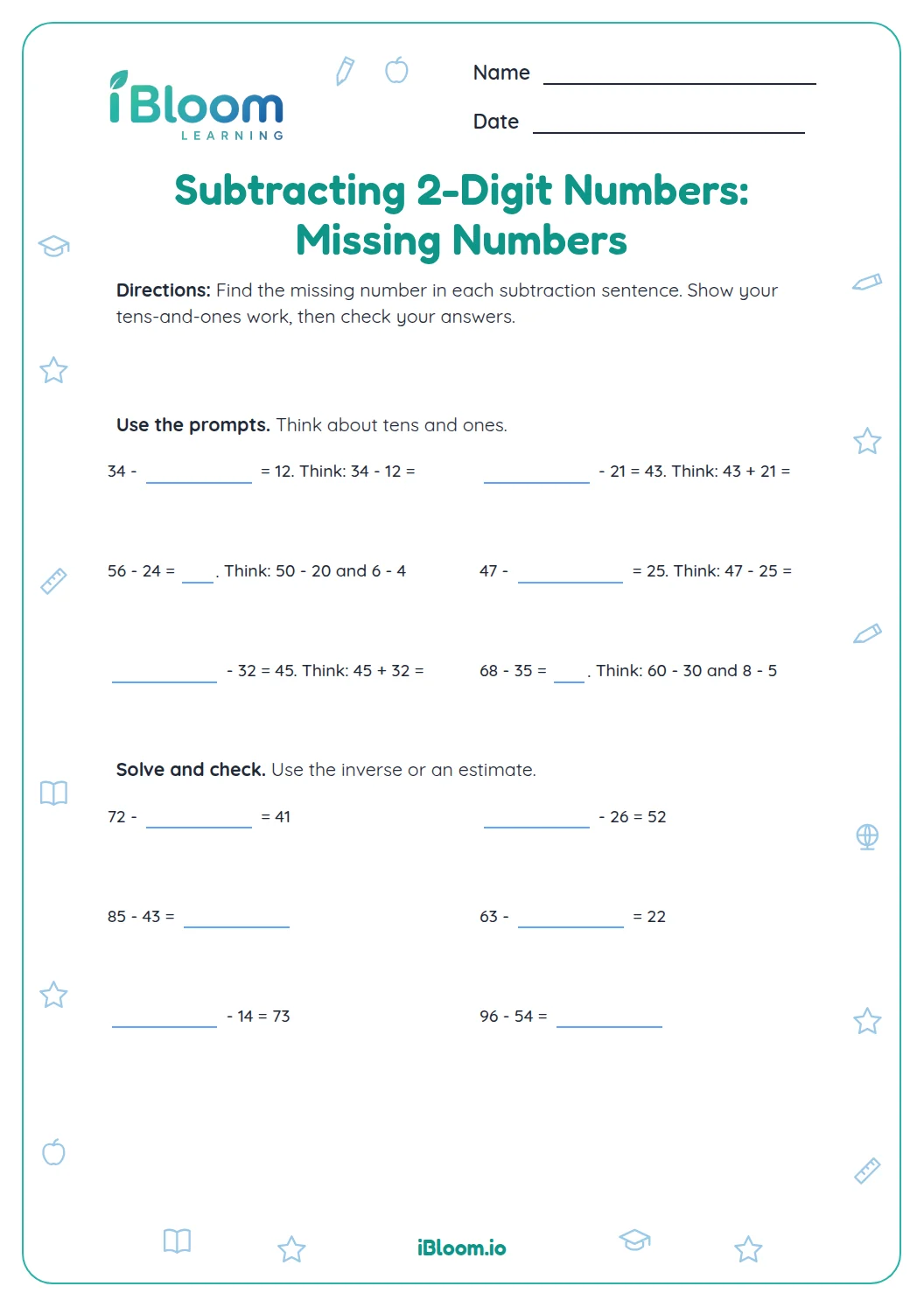
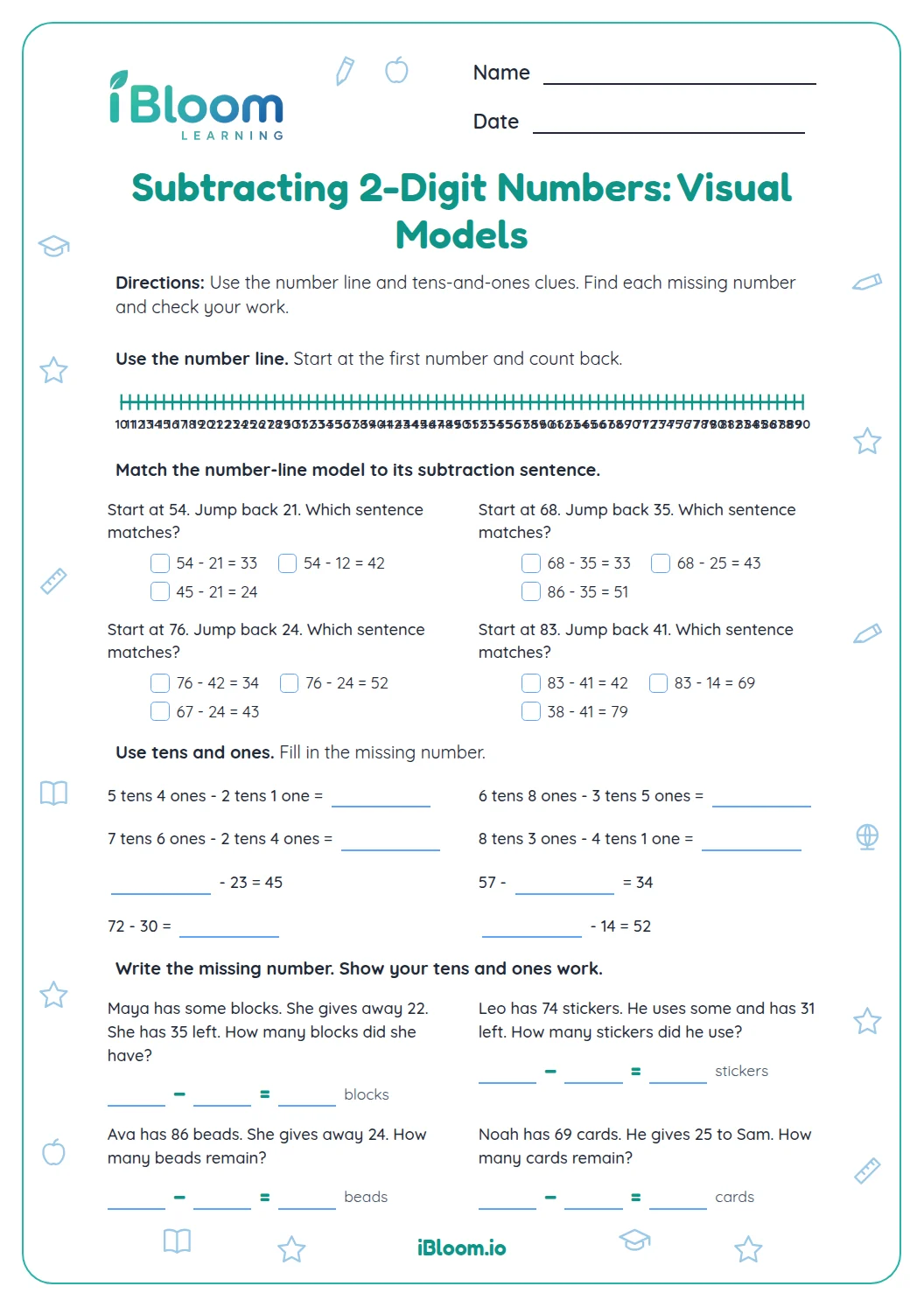
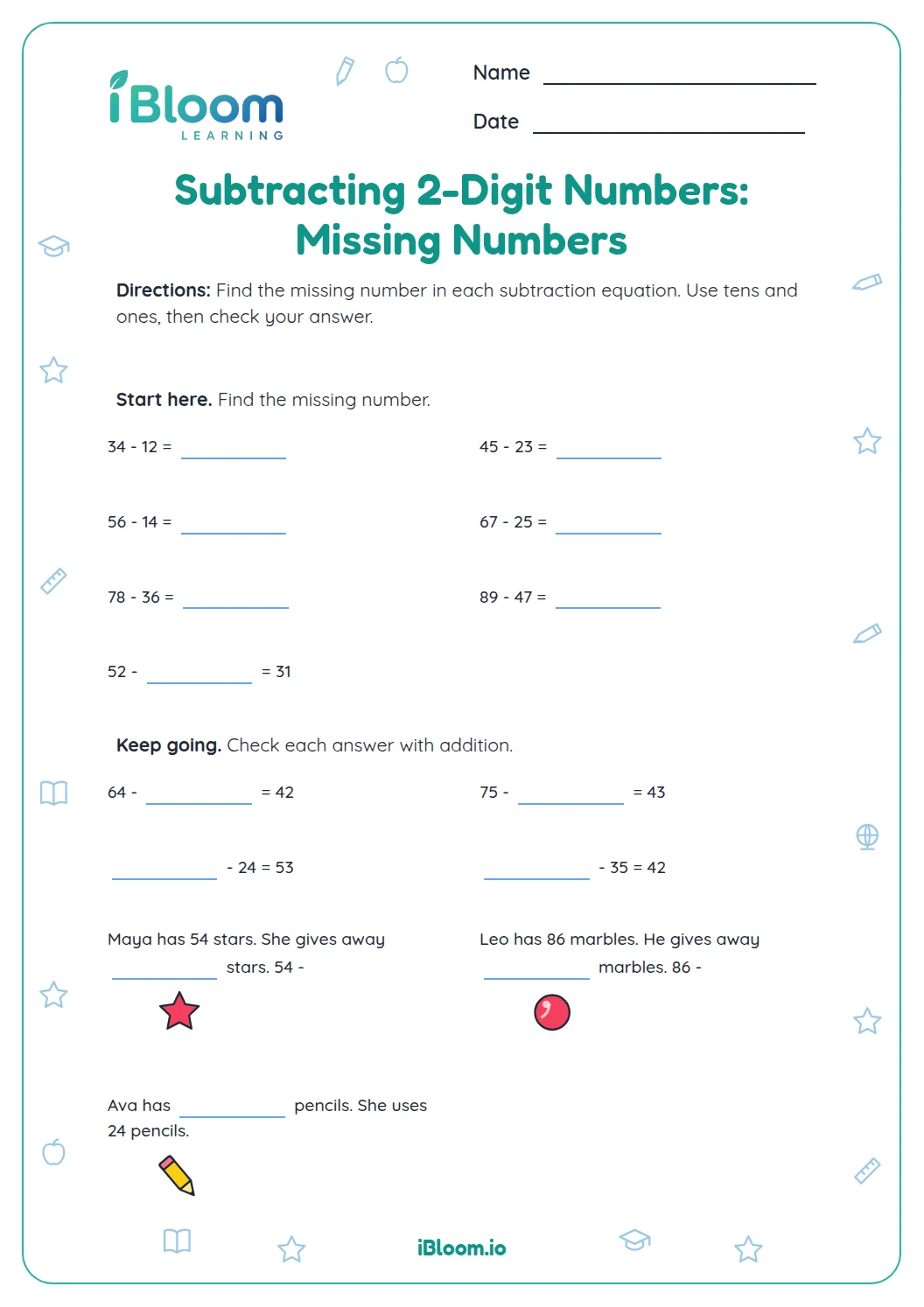
Use the story to decide what is missing. If a shelf had 48 books and 26 remained after some were checked out, write 48 − ___ = 26. The missing amount is 22 books.
What if the starting amount is missing?
Add the amount taken away to the amount that remains. For ___ − 24 = 53, the starting amount is 24 + 53 = 77.
How can I check my answer?
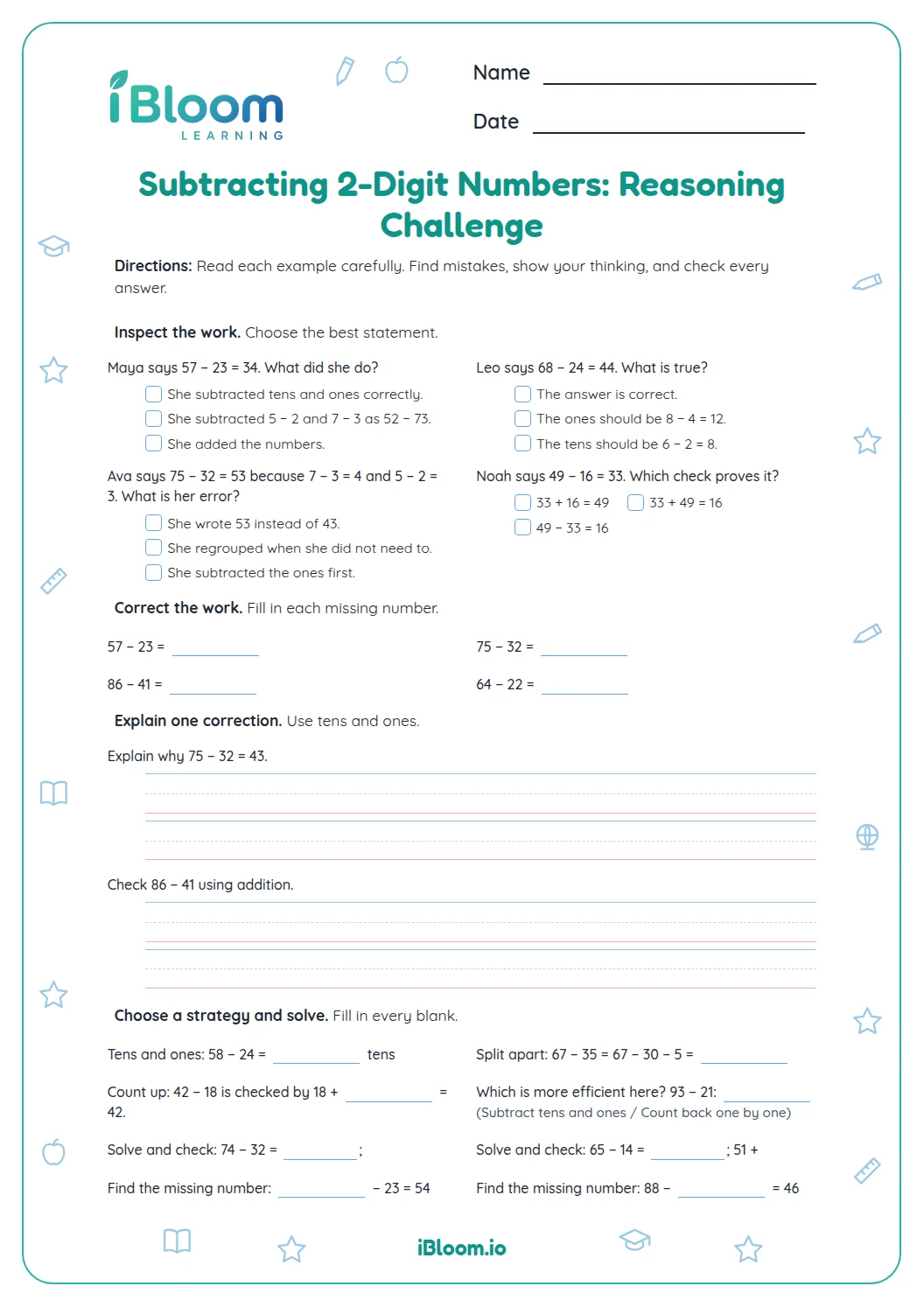
Put the answer back in the subtraction equation. For 48 − 22 = 26, subtracting the amount borrowed leaves the stated number of books.
How to use this worksheet
- 1Read the story and identify the starting amount, change, and result.
- 2Decide which amount is unknown.
- 3Complete the subtraction equation.
- 4Subtract tens and ones without regrouping, or use the related addition fact.
- 5Check that the answer makes the story true.
Common mistakes and quick fixes
The mistake
Subtracting the remaining amount from the wrong number.
The fix
Label the total, the amount removed, and what remains.
The mistake
Treating the unknown starting amount like an unknown amount taken away.
The fix
For ___ − part = result, add the part and result.
The mistake
Ignoring the story unit in the answer.
The fix
Write books, balls, tickets, or the unit named in the problem.
Learners model two-digit subtraction situations with equations.
Learners use place value and addition relationships to solve two-digit subtraction equations.
On this sheet:
Show the official wordingHide the official wording
Subtract multiples of 10 in the range 10-90 from multiples of 10 in the range 10-90 (positive or zero differences), using concrete models or drawings and strategies based on place value, properties of operations, and/or the relationship between addition and subtraction; relate the strategy to a written method and explain the reasoning used.
What to practice next
Make more practice
Further reading
Questions parents and teachers ask
What does a missing number in subtraction represent?
A missing number may be the amount taken away or the starting total. Read the story and match each known amount to its role before solving the equation. On this sheet, 12 questions find the amount taken away and two find the starting amount.
How do I solve 48 − ___ = 26?
Find the difference between 48 and 26: 48 − 26 = 22. The missing amount is 22 books, and checking 48 − 22 leaves the 26 books stated in the story. This uses the same missing-subtrahend structure as the first worksheet question.
How can I find a missing starting number?
Use addition to combine the amount removed and the amount that remains. For ___ − 24 = 53, add 24 and 53 to find that the starting total was 77 pencils. Question 6 uses this missing-start structure in a familiar story problem.
Does this worksheet require regrouping?
The worksheet problems are selected so the two-digit subtraction can be solved without regrouping. Learners focus on reading the story, identifying the unknown amount, and completing the equation. The answer key lists each result with its story unit.
How many questions and pages are included?
There are 14 story questions across four worksheet pages, with a separate answer key. Twelve ask for a missing amount taken away; two ask for the starting total. Stories use familiar objects such as books, passengers, flowers, and tickets.