



About this worksheet
This Grade 1 worksheet helps children find a missing number in subtraction equations with whole tens. Across 14 questions, students find a missing starting number, missing amount taken away, or missing difference, then apply the same thinking to short stories and check one incorrect answer. The answer key includes the equations and story answers. The practice connects to Common Core 1.NBT.C.6, which focuses on subtracting multiples of ten and using place value or the relationship between addition and subtraction.
Aligned to 1.NBT.C.6
How do you find the missing number?
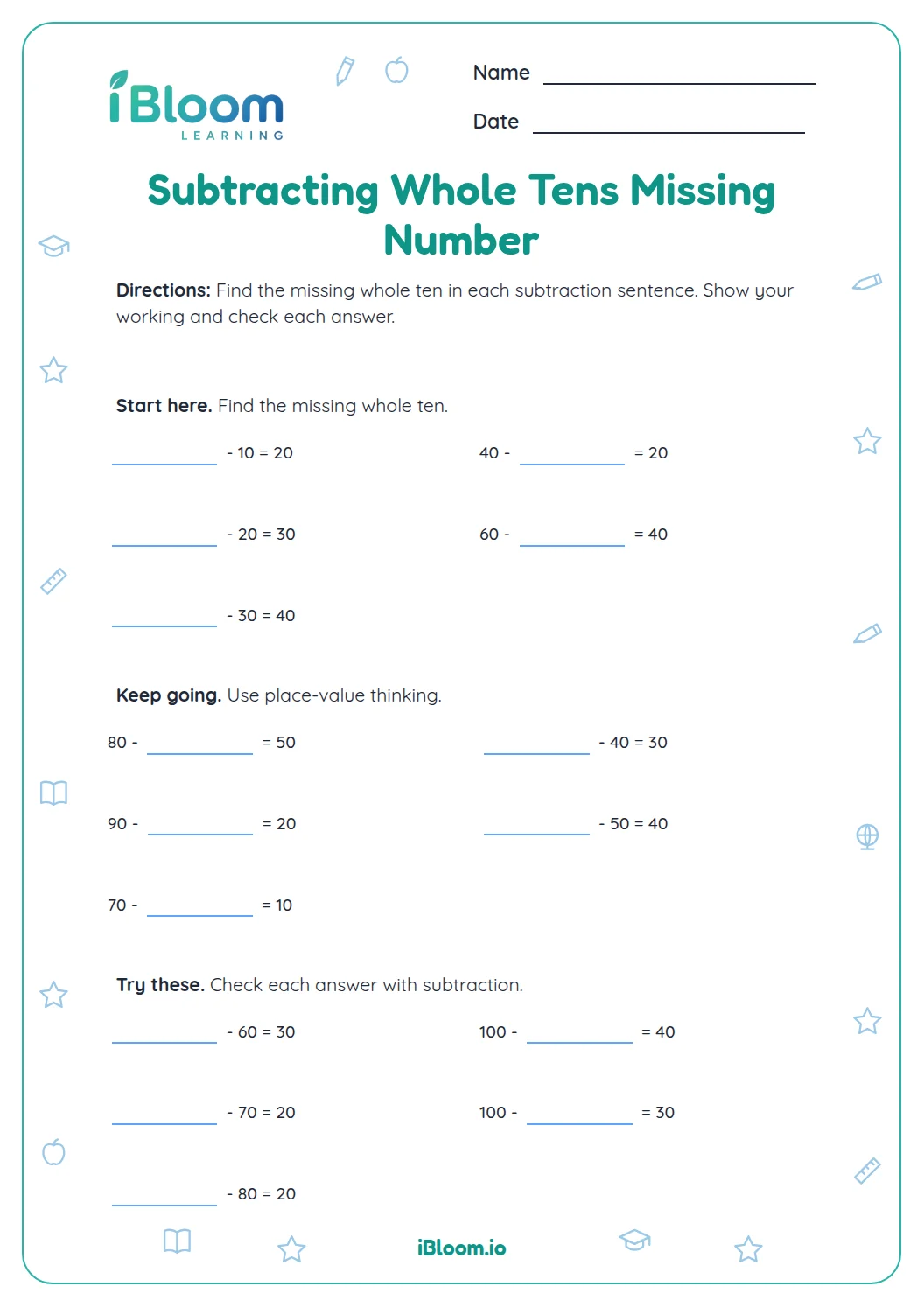
Look at which part of the subtraction equation is missing. If the starting number is missing, add the amount taken away to the difference. If the amount taken away is missing, add the difference to that amount.
- 1___ − 30 = 40 → 40 + 30 = 70, so the missing number is 70.
How does place value help?
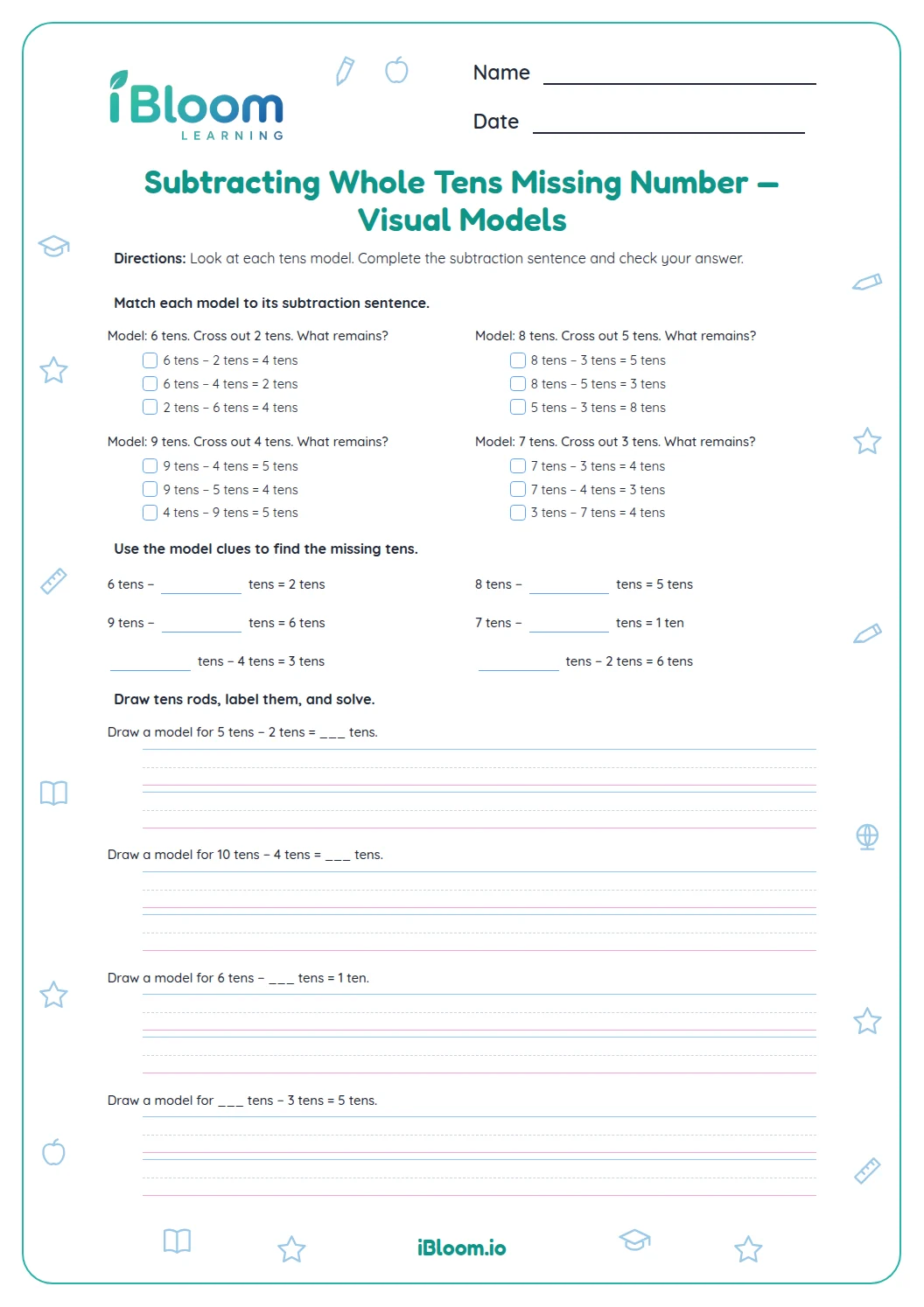
Whole tens are groups of ten. You can think in tens: 8 tens minus 3 tens leaves 5 tens, so 80 − 30 = 50. The digit in the tens place changes while the ones digit remains zero.
- 180 − 30 = ___ → 8 tens − 3 tens = 5 tens → 50.
How can you check a story answer?
Name what the number counts, write a subtraction equation from the story, and use addition to check whether the result returns to the starting amount.
How to use this worksheet
- 1Circle the number that is missing: the start, the amount taken away, or the difference.
- 2Think in tens rather than counting individual ones.
- 3Use addition to find a missing starting number or missing amount taken away.
- 4For story problems, write an equation and label the answer with what it counts.
- 5Check by adding the difference and the amount taken away.
What should students check?
The mistake
Mistake: subtracting the digits in the wrong direction.
The fix
Use the equation or its related addition fact to identify the missing part.
The mistake
Mistake: answering 5 instead of 50.
The fix
Count tens and include the zero.
The mistake
Mistake: solving a story but omitting what the answer counts.
The fix
Add the item name after the number.
Common Core alignment
The questions give students direct practice with the listed skill.
Subtract multiples of ten from multiples of ten and explain the place value strategy.
On this sheet: Students find an unknown ten in subtraction equations, solve related stories, and use addition to check.
Show the official wordingHide the official wording
Subtract multiples of 10 in the range 10-90 from multiples of 10 in the range 10-90 (positive or zero differences), using concrete models or drawings and strategies based on place value, properties of operations, and/or the relationship between addition and subtraction; relate the strategy to a written method and explain the reasoning used.
What to practice next
Make more practice
Further reading
Questions parents and teachers ask
What numbers appear in these subtraction equations?
The equations use whole tens from 10 to 90, and the differences are positive or zero. Students work with groups of ten, so the ones digit stays zero. This keeps attention on tens rather than single units. This keeps attention on tens rather than single units.
How can addition help find a missing amount taken away?
Use the difference and missing amount together to make the starting number. For 70 − ___ = 30, ask what number added to 30 makes 70. Four tens are missing, so the answer is 40. Check by adding 40 to 30 and confirming the sum is 70.
How can a child find a missing starting number?
Add the amount taken away to the difference. If ___ − 20 = 50, then 50 + 20 = 70, so the starting number was 70. Substitute it in the original equation to check. Substitute it in the equation to check the starting amount.
What should a student write for a story problem?
Write an equation that matches the story, solve for the missing number, and label what it counts. “40 markers” makes clear that the answer is a quantity of markers, not just a number. A labeled answer names the quantity found in the story problem.
How do tens help with a subtraction error?
Think of each whole ten as one group. Eight tens minus three tens leaves five tens, so 80 − 30 = 50. This catches an answer such as 60, which does not match the tens left. Count tens to see why 60 does not match the groups left.