


About this worksheet
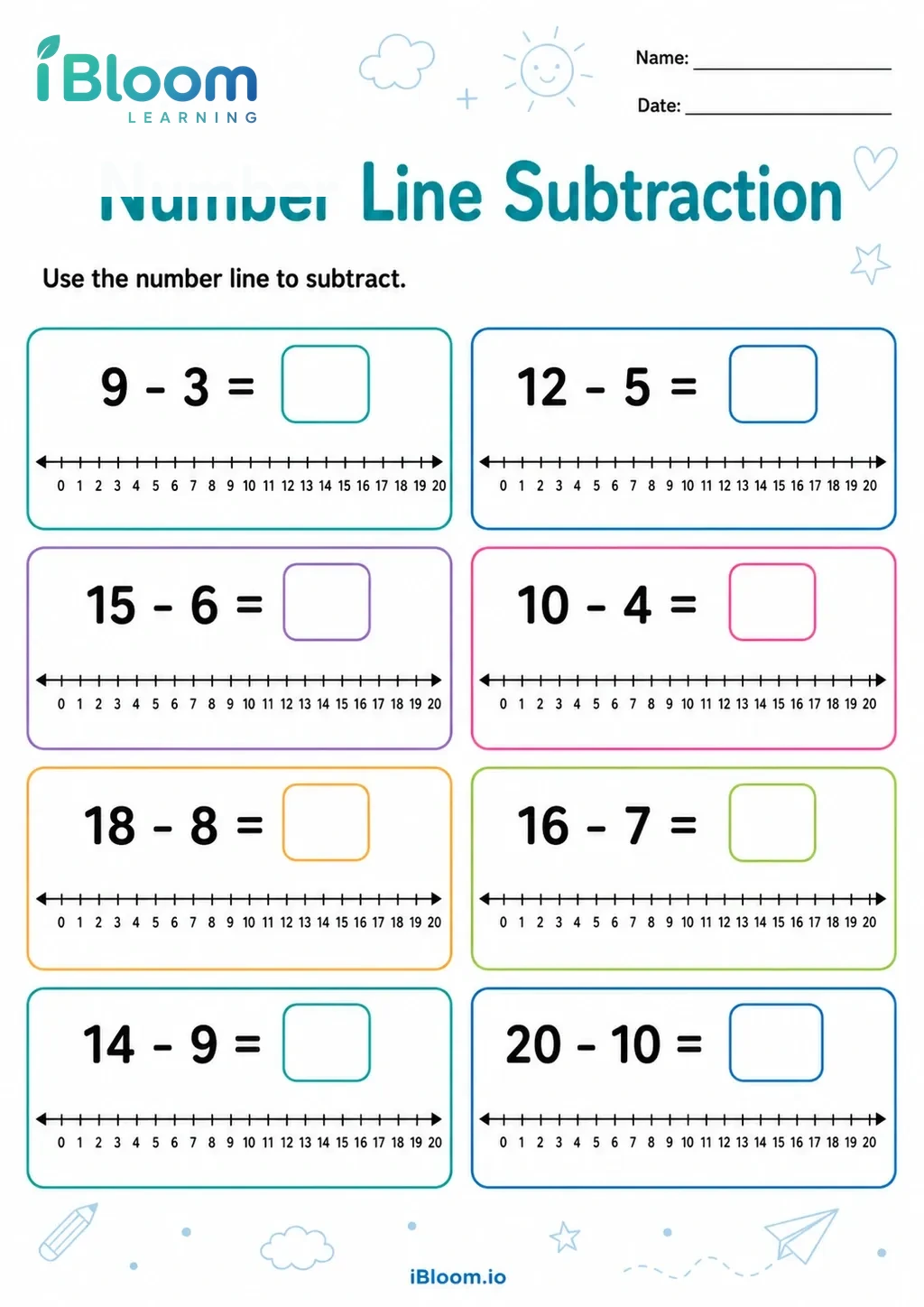
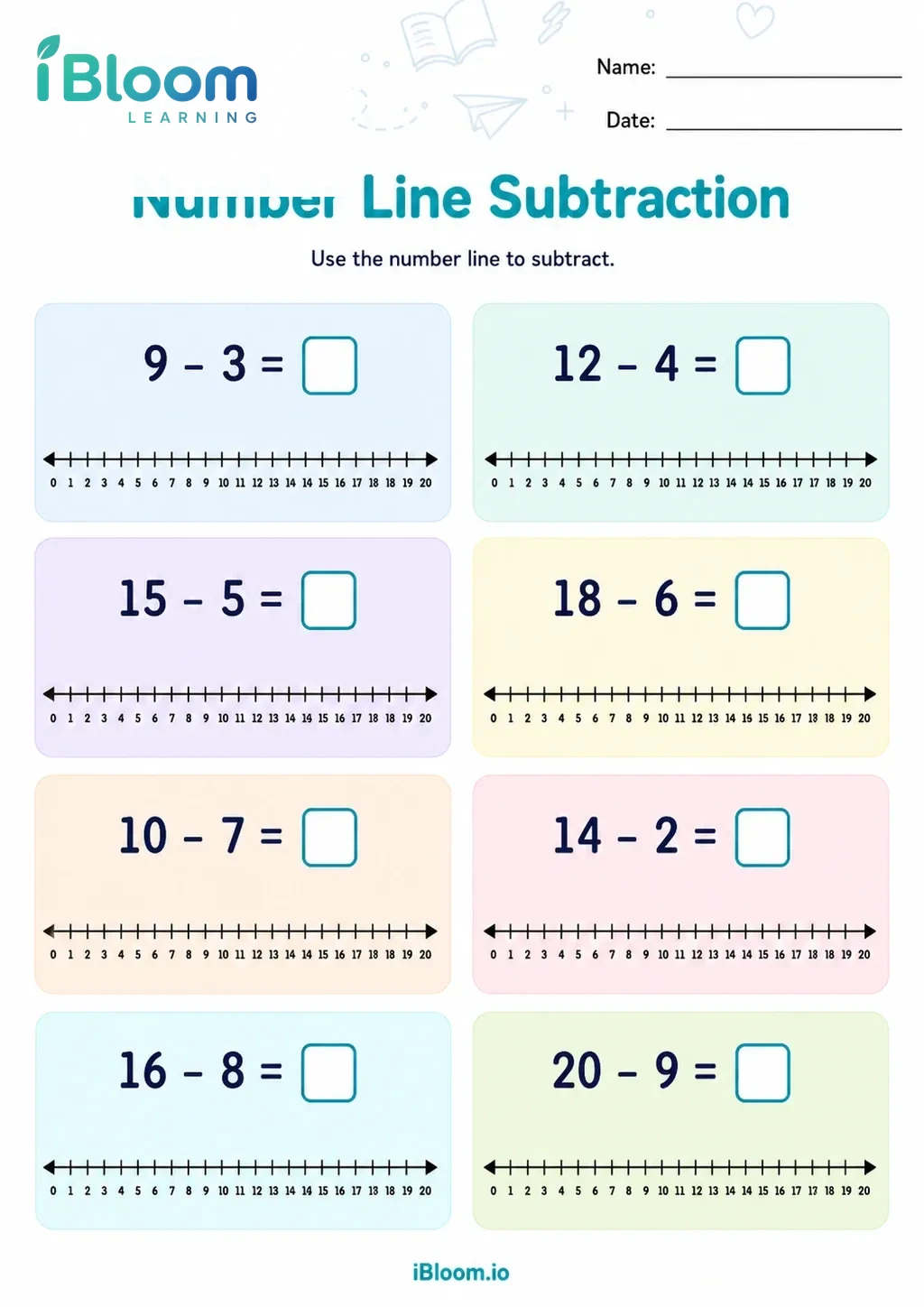
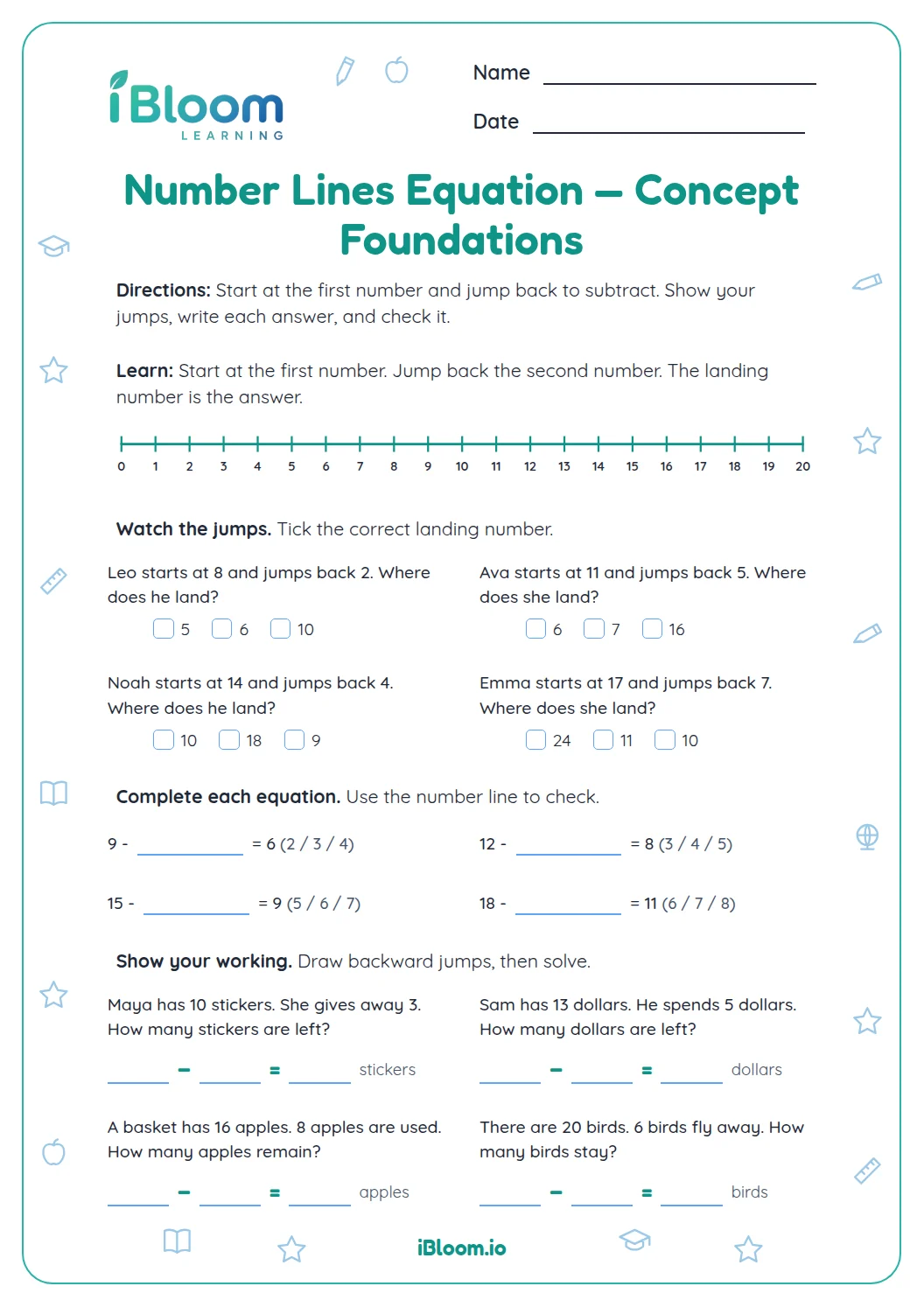
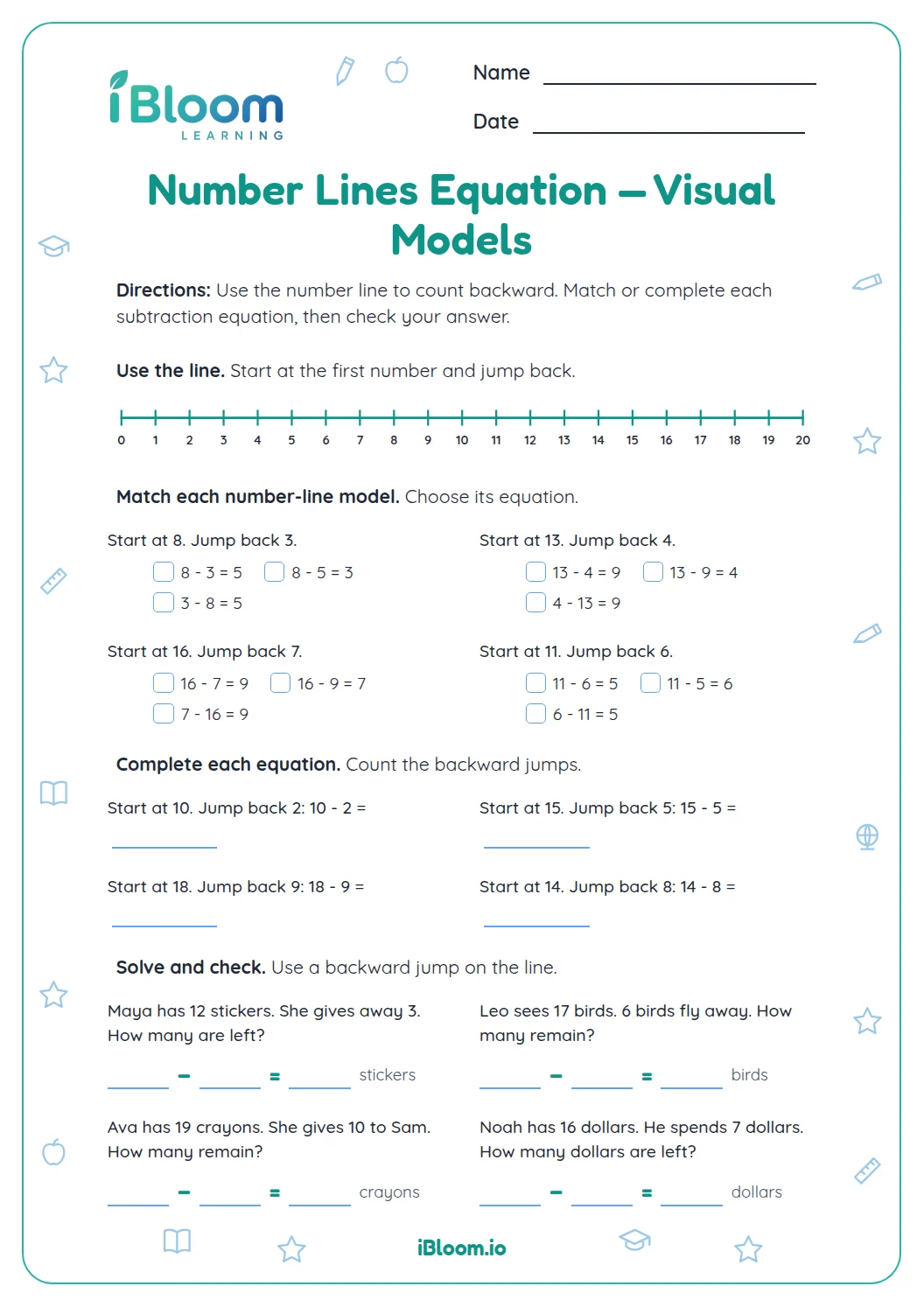
This free printable Grade 1 worksheet gives students 16 subtraction problems with answers within 20. Part A builds fluency with subtraction facts. Part B uses short take-away stories so children connect the action to an equation and a difference. The page aligns with 1.OA.C.6, which asks students to add and subtract within 20 using strategies such as counting back and the relationship between addition and subtraction. An answer key is included.
Aligned to 1.OA.C.6
How can students solve each subtraction fact?
Part A has eight number sentences. Students may count back, use a known fact or think about the related addition fact. For 12 − 5, counting back five steps from 12 gives 7.
How can a story become a subtraction equation?
Part B describes a starting amount and an amount taken away. In the sticker story, 13 stickers start in the collection and 4 are given away, so 13 − 4 = 9 stickers remain.
What should students check before finishing?
Check that the answer is smaller than the starting number in a take-away problem. Then reread the story to make sure the answer tells how many remain, not how many were taken away.
How to use this worksheet
- 1Read the subtraction sentence or story.
- 2Find the starting number.
- 3Count back or use a related addition fact.
- 4For a story, write a subtraction equation.
- 5Check that the difference makes sense in the story.
Common mistakes and quick fixes
The mistake
Subtracting the larger number from the smaller number.
The fix
Start with the amount the story gives first, then take away.
The mistake
Writing how many were taken instead of how many remain.
The fix
Reread the question and answer what is left.
The mistake
Counting the starting number as the first backward step.
The fix
Say the starting number, then count back one number for each step.
Curriculum alignment
This standard describes the skill practiced on this worksheet.
Build fluency by subtracting within 20.
On this sheet: Every equation asks students to subtract whole numbers within 20.
Show the official wordingHide the official wording
Add and subtract within 20, demonstrating fluency for addition and subtraction within 10. Use strategies such as counting on; making ten (e.g., 8 + 6 = 8 + 2 + 4 = 10 + 4 = 14); decomposing a number leading to a ten (e.g., 13 - 4 = 13 - 3 - 1 = 10 - 1 = 9); using the relationship between addition and subtraction (e.g., knowing that 8 + 4 = 12, one knows 12 - 8 = 4); and creating equivalent but easier or known sums (e.g., adding 6 + 7 by creating the known equivalent 6 + 6 + 1 = 12 + 1 = 13).
What to practice next
Make more practice
Further reading
Questions parents and teachers ask
How many problems are on the page?
There are 16 problems in two parts: eight subtraction facts and eight take-away stories. Each story gives a starting amount and tells how many are removed. The separate key lists the difference for every number sentence and story.
What strategies can a first grader use?
A student can count back, use a known subtraction fact, or think of the related addition fact. For 12 − 5, counting back five from 12 gives 7; the related fact 7 + 5 = 12 checks the result.
Do the story problems require an equation?
Yes. The directions ask students to write an equation and solve each story. For the sticker question, 13 − 4 = 9 shows the starting amount, the stickers given away, and the number left. The equation is one way to show the action in the story.
Is an answer key provided?
Yes. The separate answer key lists the difference for each fact and story problem. For a story, check that the answer tells how many remain after the stated amount is taken away. The stories use amounts no greater than 20.
Can students use this for independent practice?
After an adult models one fact and one take-away story, a student can try the remaining questions independently. Use the key to check the results, then ask the student to explain how one story became a subtraction equation.