





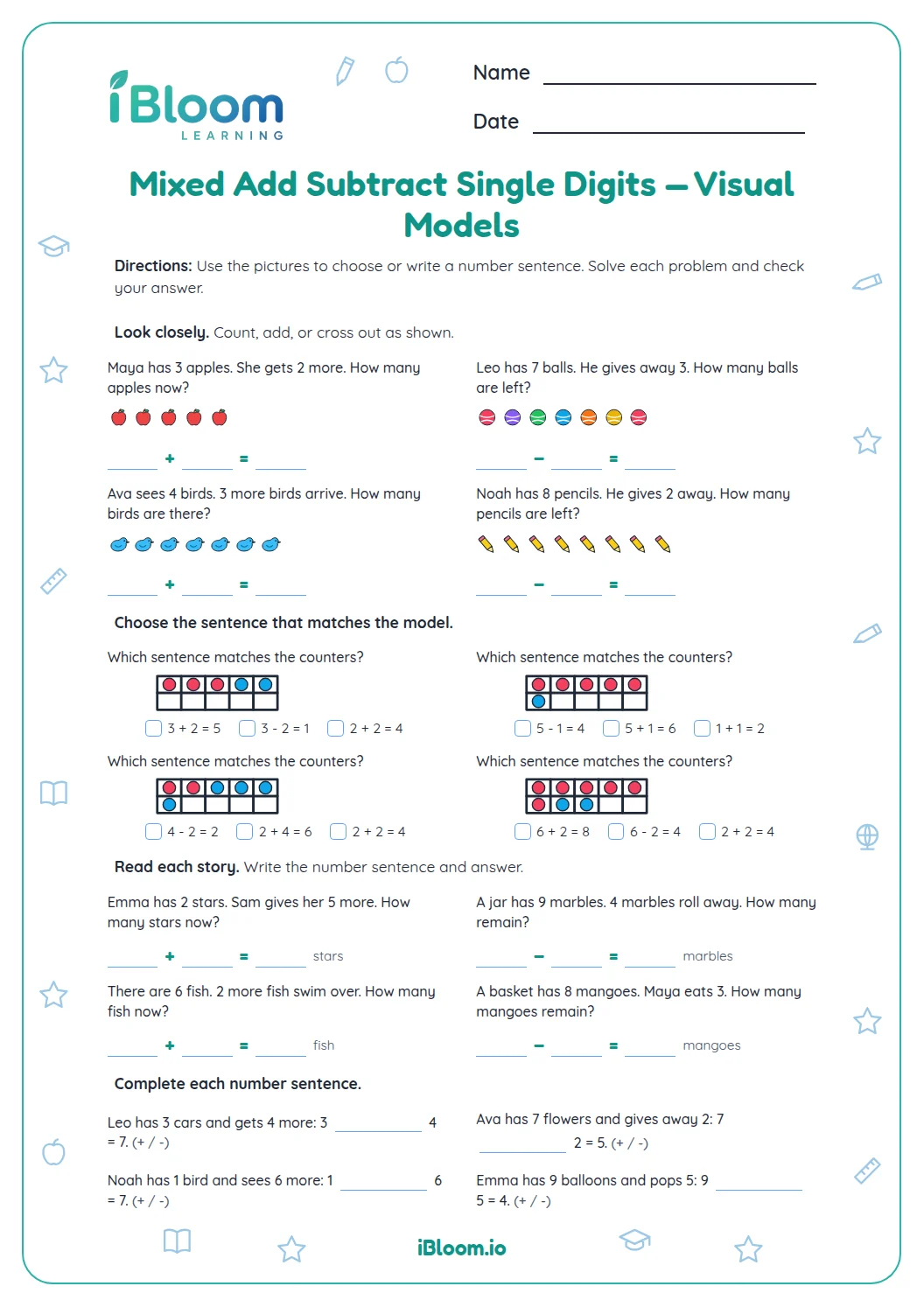
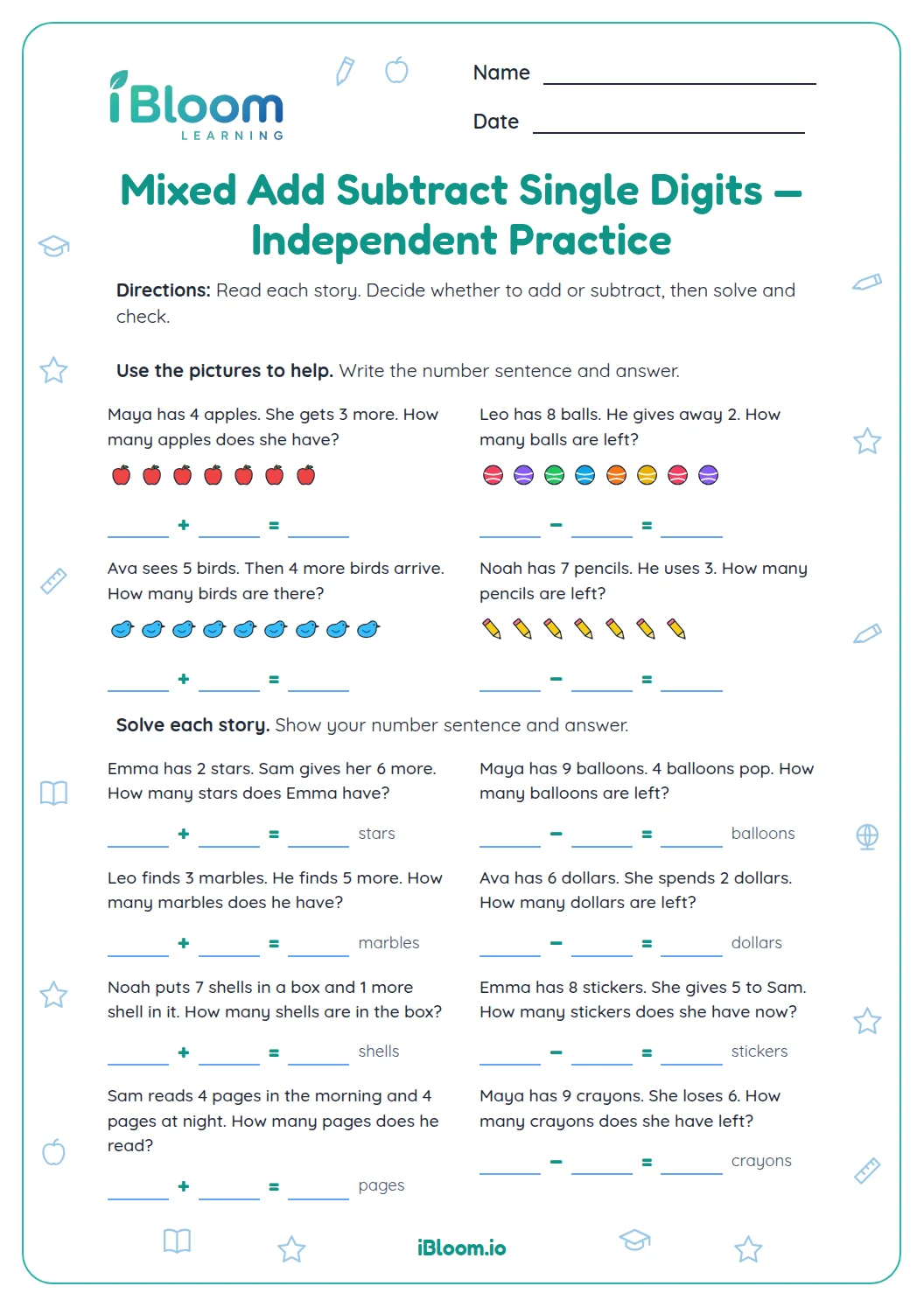
About this worksheet
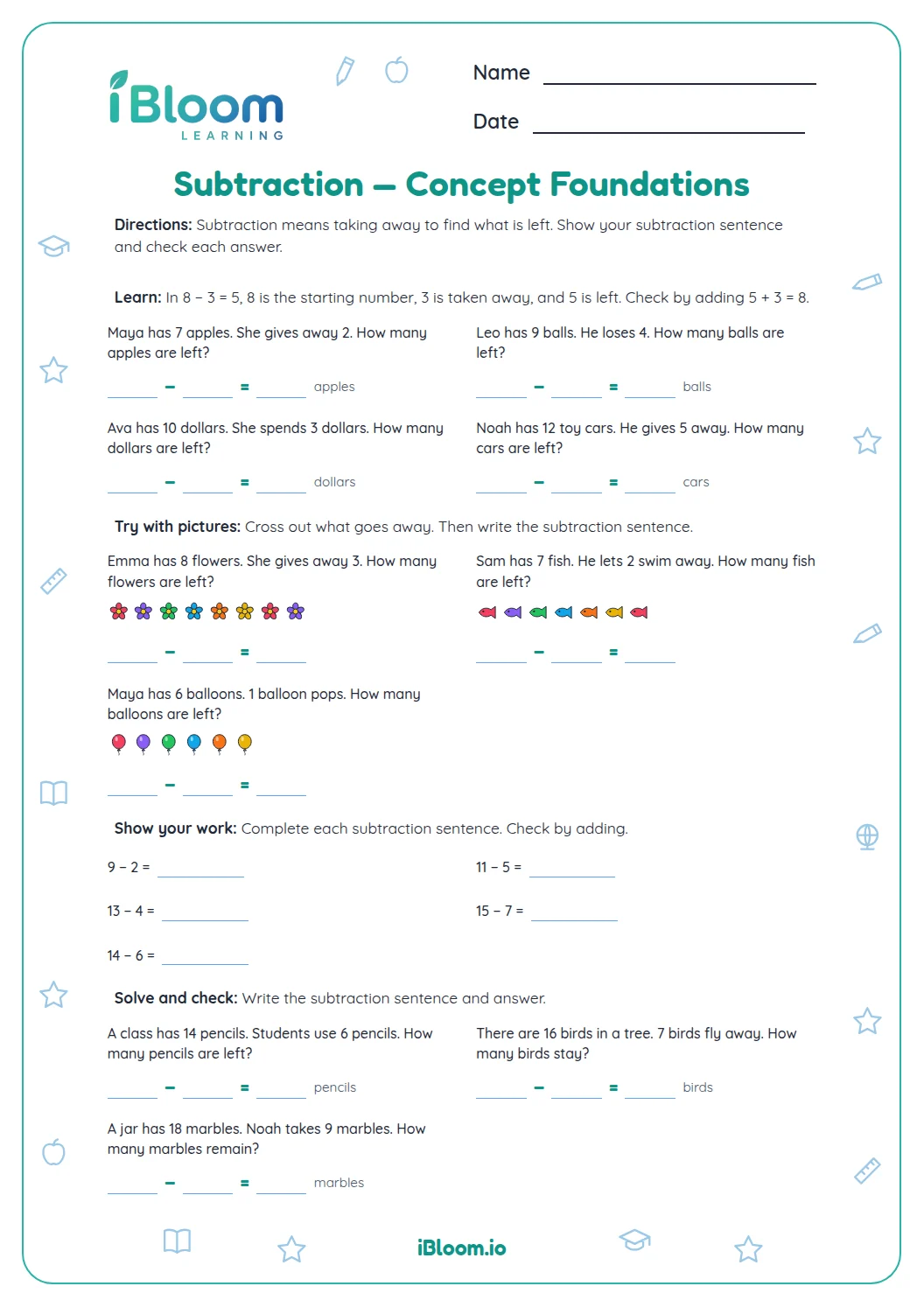
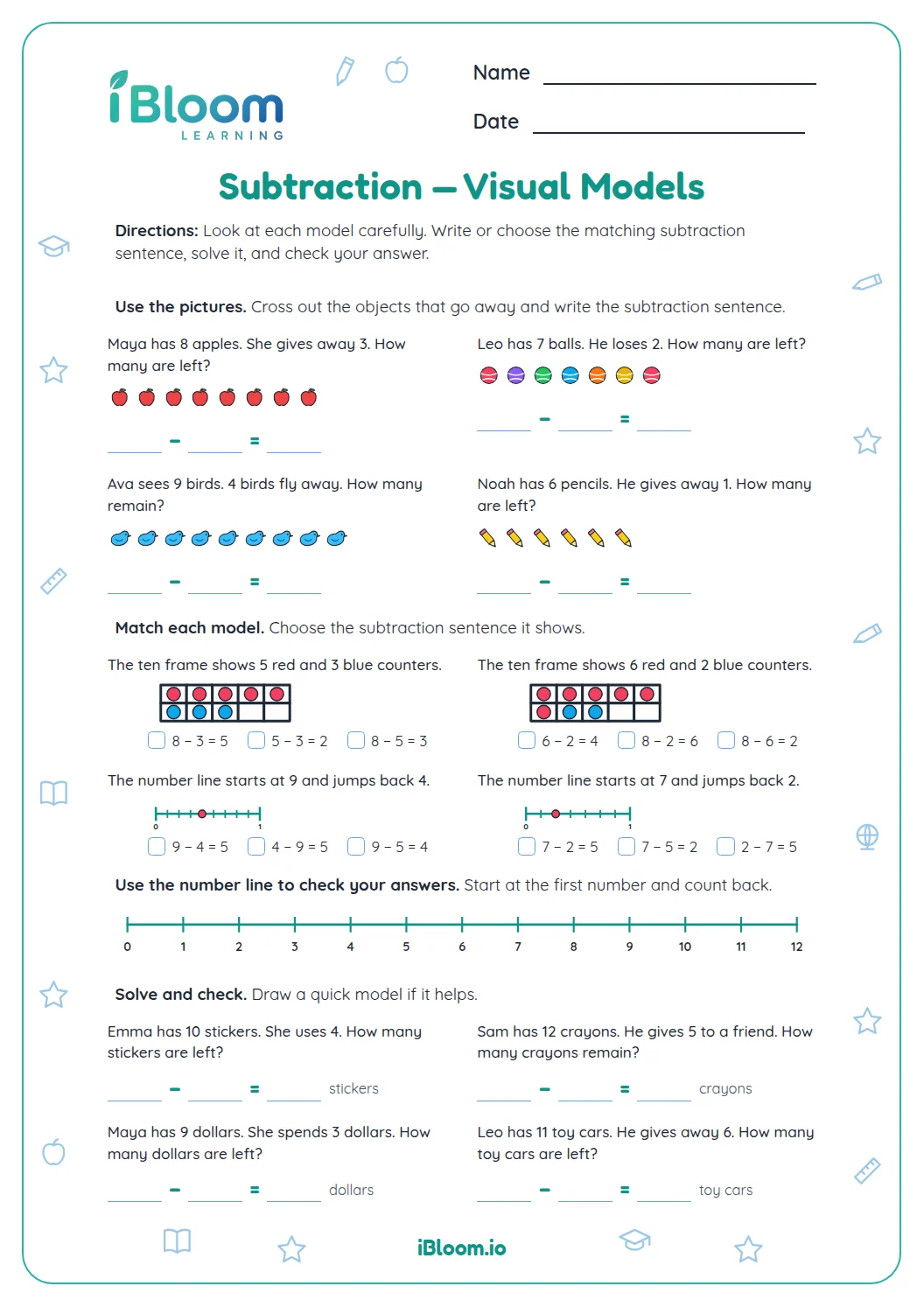
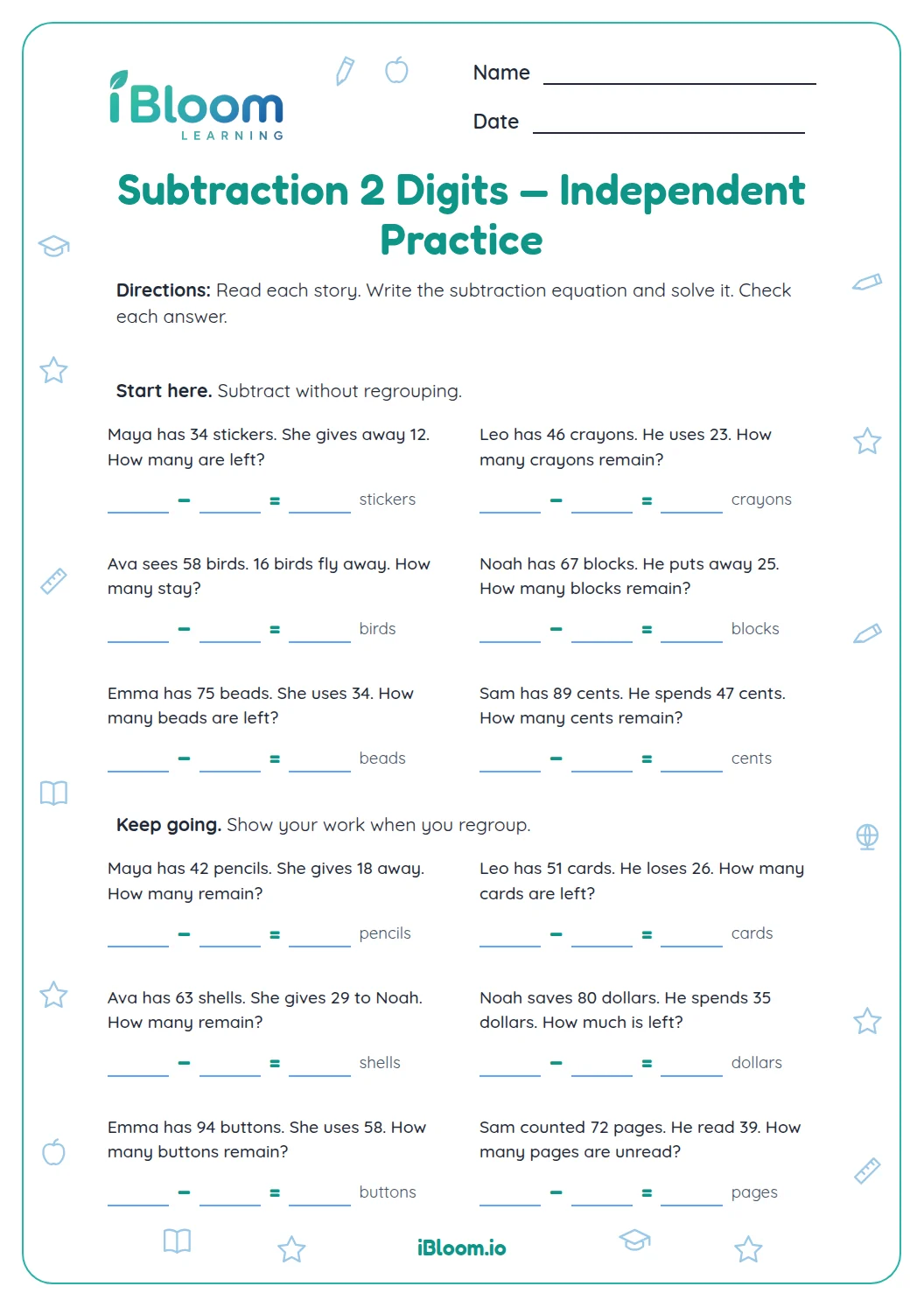
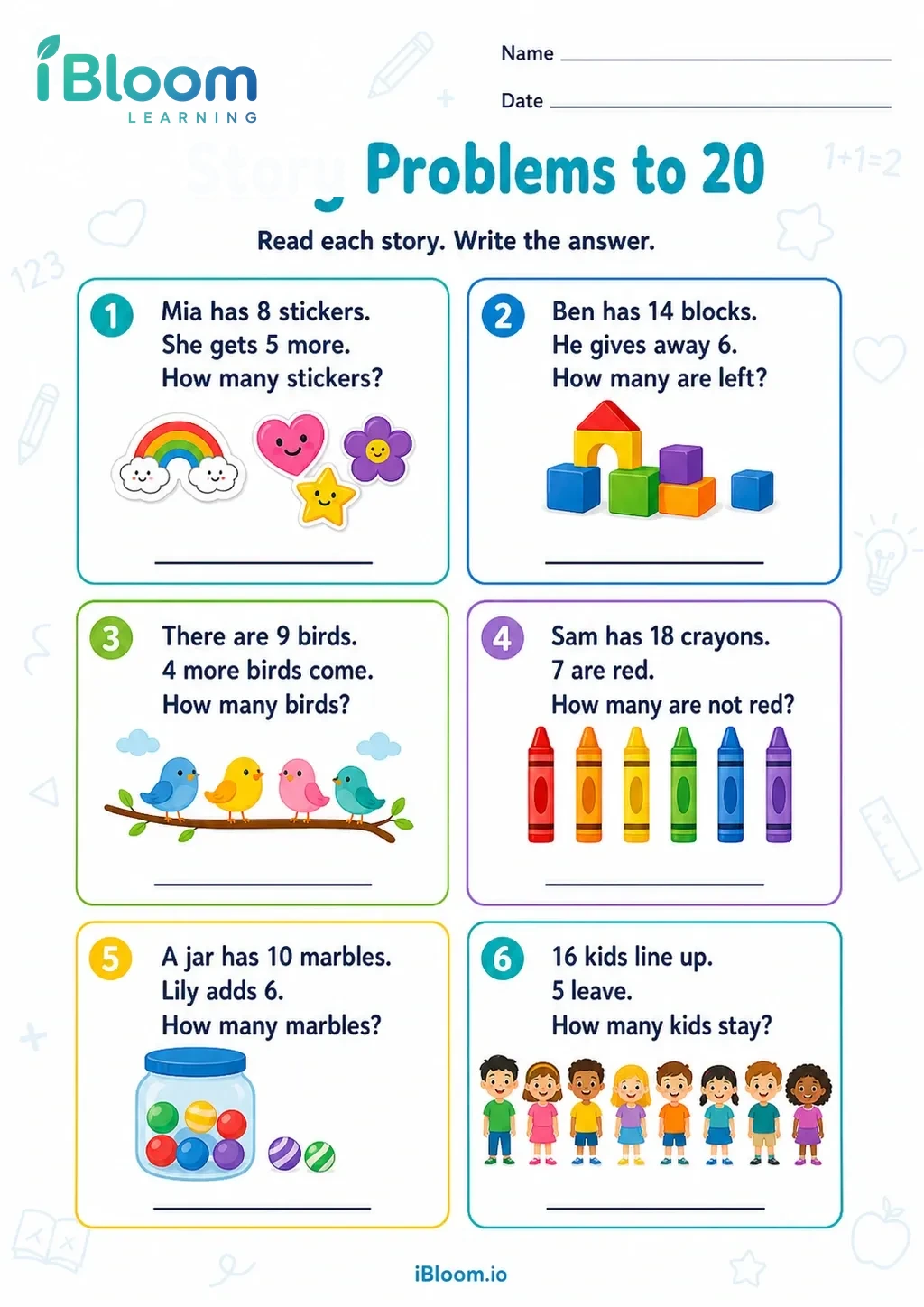
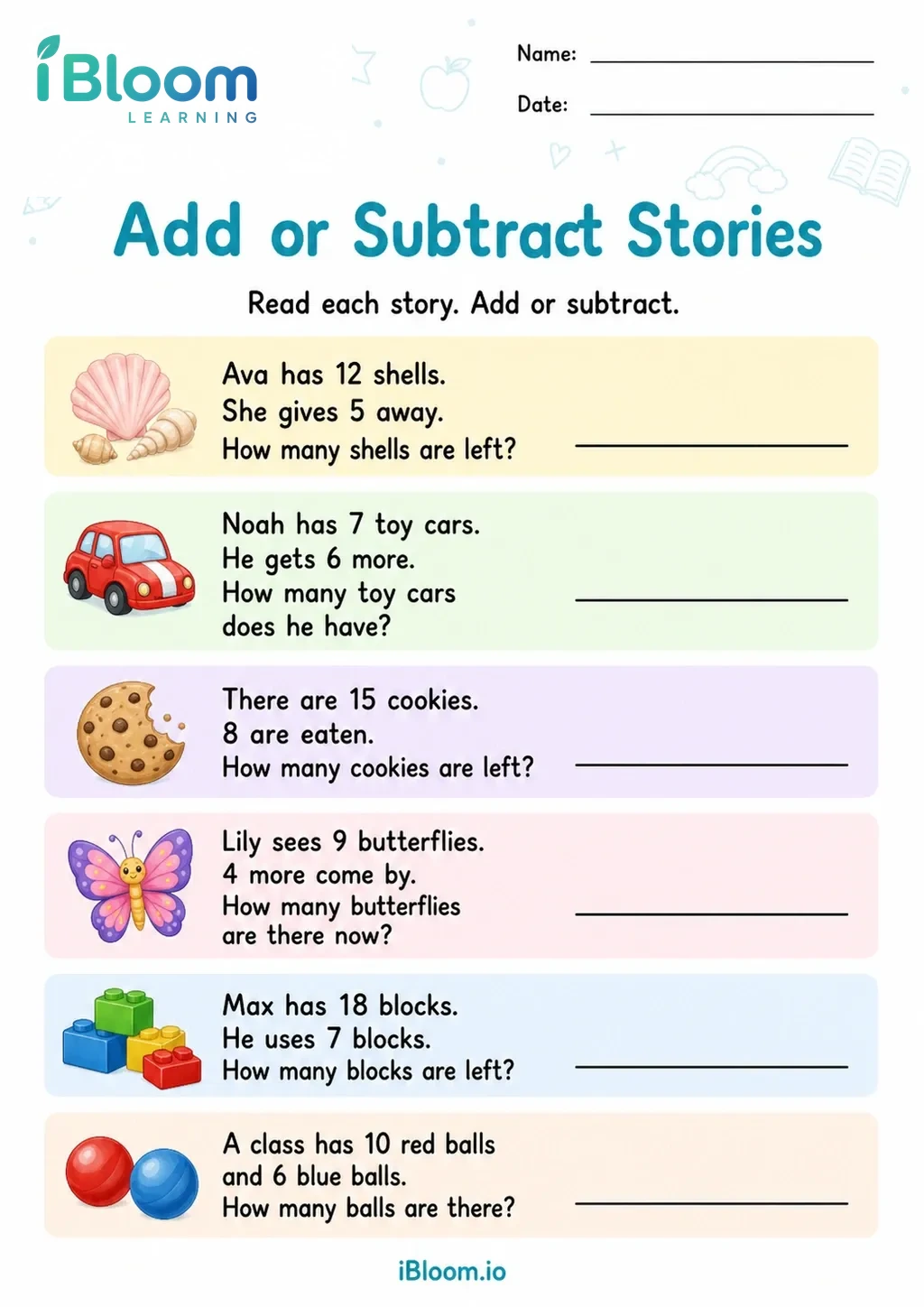
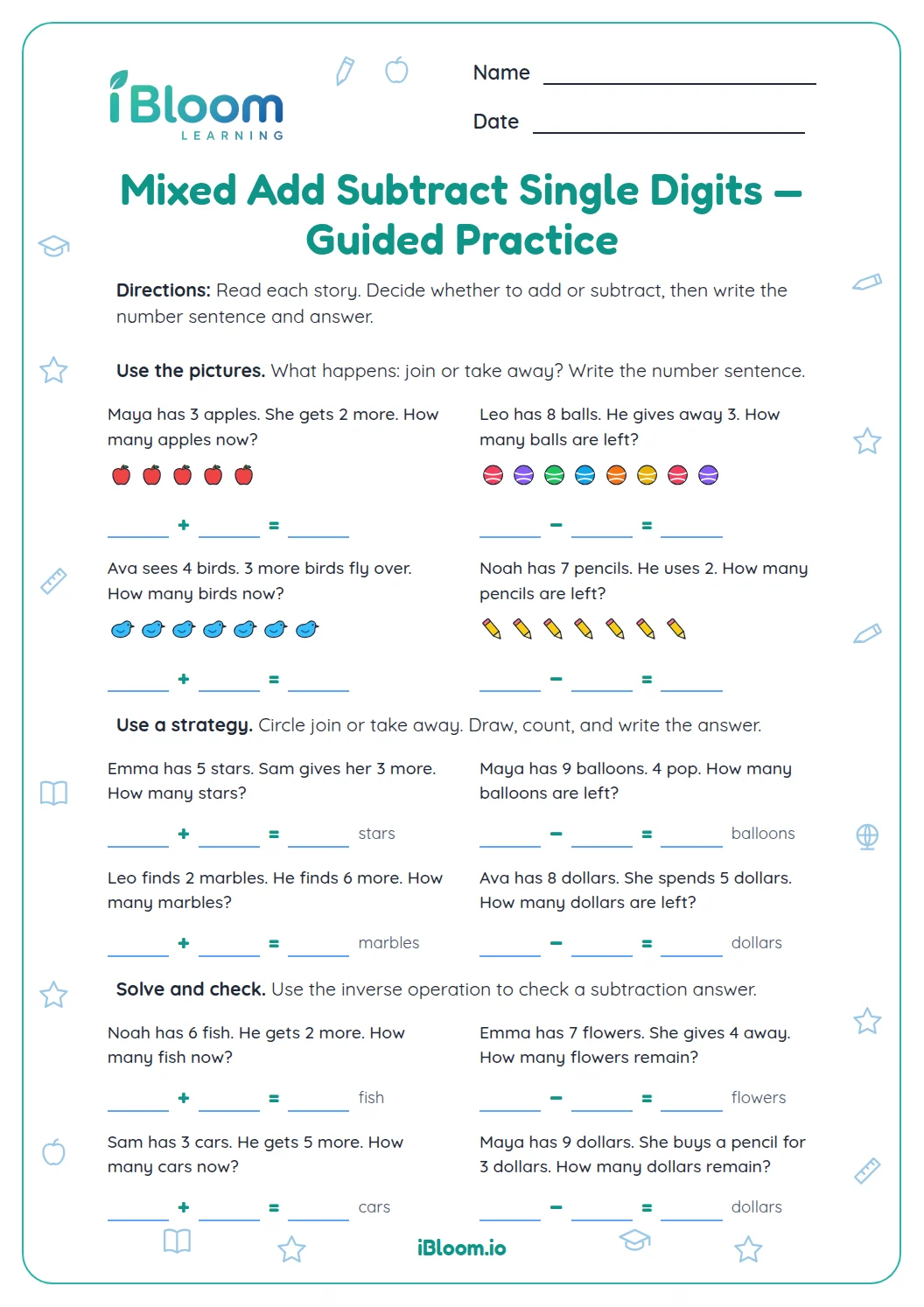
This free Grade 1 printable gives children practice reasoning through subtraction stories within 20. The three-page worksheet includes eight short stories, four missing-number sentences, and four questions about choosing or checking a strategy. It targets Common Core 1.OA.A.1 and includes a separate answer key.
Aligned to 1.OA.A.1
How can a subtraction story help find what remains?
This free Grade 1 printable gives children practice reasoning through subtraction stories within 20. The three-page worksheet includes eight short stories, four missing-number sentences, and four questions about choosing or checking a strategy. It targets Common Core 1.OA.A.1 and includes a separate answer key.
- 114 apples − 6 apples = 8 apples
- 2Check: 8 + 6 = 14
What will learners practice?
Sixteen questions cover subtraction stories within 20, missing-number sentences, and strategy checks. The worksheet and its answer key are each three pages.
How can I use the answer key?
Check each answer after the learner completes the page. For written responses, use the sample as a guide; other clear answers that meet the prompt are valid.
How to use this worksheet
- 1Read the story and underline the starting amount.
- 2Mark what is taken away or what amount is missing.
- 3Write a subtraction sentence before calculating.
- 4Use a count-back or make-a-ten strategy.
- 5Check by adding the answer to the amount taken away.
Common mistakes and quick fixes
The mistake
Subtracting the smaller number from the larger number without reading the story.
The fix
Name the starting amount first, then show what changes.
The mistake
Giving the number taken away when the question asks how many remain.
The fix
Reread the final question and label the answer.
The mistake
Writing a number that does not make the equation true.
The fix
Add the answer and the subtracted amount to check.
Common Core alignment
This worksheet practices subtraction situations within 20.
Solve take-away and missing-part stories within 20.
On this sheet:
Show the official wordingHide the official wording
Use addition and subtraction within 20 to solve word problems involving situations of adding to, taking from, putting together, taking apart, and comparing, with unknowns in all positions, e.g., by using objects, drawings, and equations with a symbol for the unknown number to represent the problem.
What to practice next
Make more practice
Further reading
Questions parents and teachers ask
What does this worksheet practice?
The 16 questions focus on subtraction within 20. Learners solve eight stories, complete four missing-number sentences, and consider four strategy checks. A separate answer key provides results so an adult can review calculations and discuss a child’s method. The story wording determines which amount is the start.
How do children know when to subtract?
Look for a starting amount and a change that takes some away. The story may ask how many remain or how many were given away. Naming the starting amount first helps children match the story to a subtraction sentence before they calculate.
Can first graders solve a missing starting number?
Yes. For ___ − 7 = 6, add 6 and 7 to find the starting amount, 13. A child can also count from 6 up to 13 and see that 7 were taken away. Both approaches check the same relationship.
What is the answer to 14 minus 6?
14 − 6 = 8. One way is to count back six steps from 14: 13, 12, 11, 10, 9, 8. The answer key lists this result along with the story answers and reasoning choices, making it easy to check the completed sheet.
How long should this worksheet take?
Plan about 25 minutes for 16 questions, including time to write subtraction sentences for the word problems. The three worksheet pages can be completed in one sitting or split into shorter sessions, with the separate answer key used afterward.
Does the answer key allow another strategy?
Yes. The number answer must be correct, but a learner can solve by counting back, making a ten, or drawing a simple model. The key gives concise answers; it does not require one particular method when the prompt accepts a correct result.