








About this worksheet
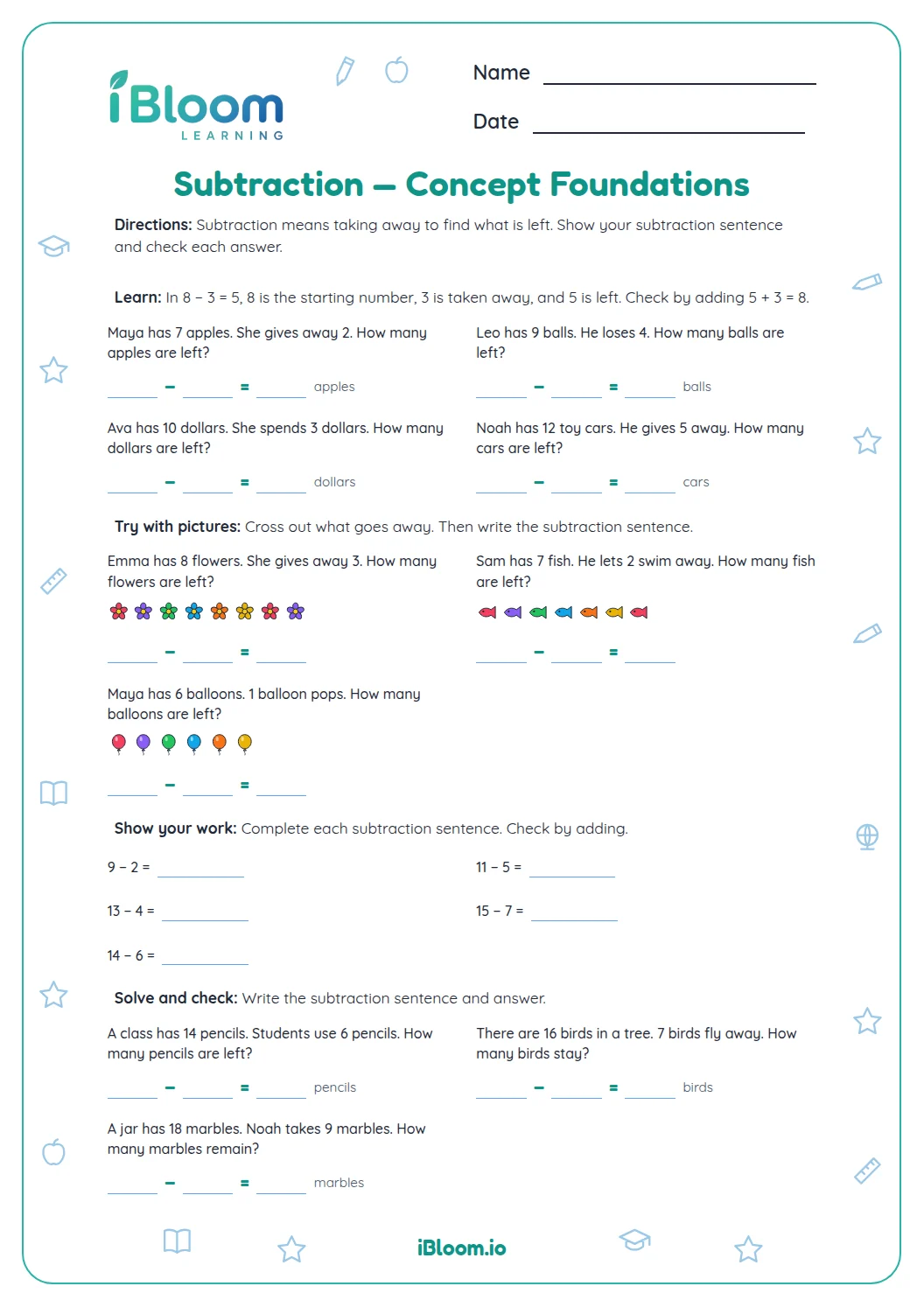
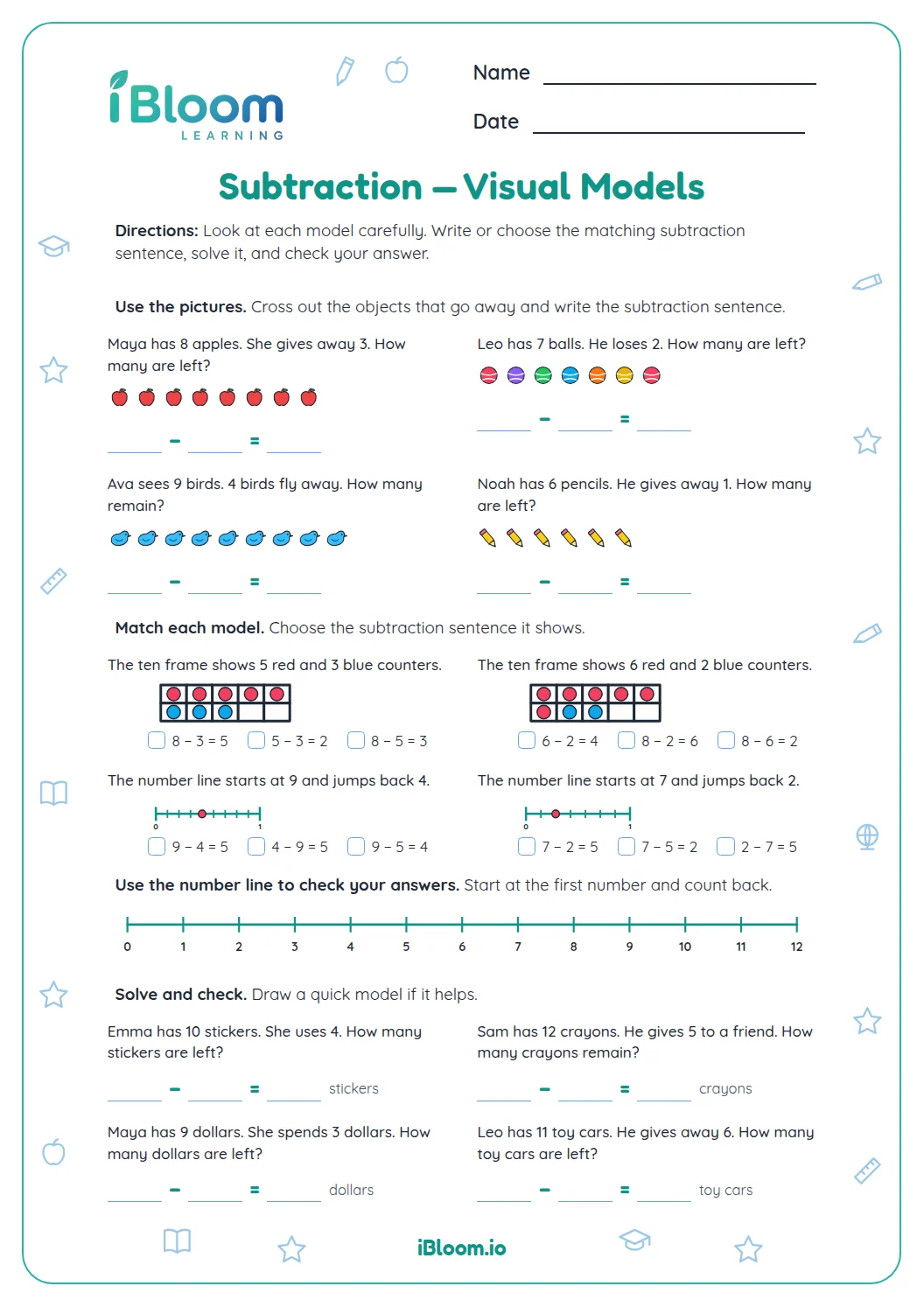
This free Grade 1 worksheet helps children turn real-world subtraction stories into equations. The 14 questions use clear take-away situations and one comparison story, with familiar objects and amounts within 20. Children write a subtraction equation for each problem, solve, and check the result with a separate answer key. The worksheet practices Common Core 1.OA.A.1 through taking-from and comparison problems.
Aligned to 1.OA.A.1
How do take-away stories show subtraction?
Read the starting amount and the amount that leaves, then subtract to find what remains.
- 1Maya has 8 apples and gives away 3.
- 28 − 3 = 5 apples
How do you turn a story into an equation?
Use the starting amount as the first number and the amount taken away as the second. In “12 stickers, 5 used,” write 12 − 5 = 7.
What does a comparison story ask?
A “more than” question asks for the difference between two groups. If there are 14 fish and 6 more fish than turtles, subtract 6 from 14 to find 8 turtles.
How to use this worksheet
- 1Read the full story once.
- 2Find the starting amount and what changes.
- 3Choose subtraction to represent what changes in the story.
- 4Write a subtraction equation and solve it.
- 5For a comparison, subtract the smaller amount from the larger one.
Common mistakes and quick fixes
The mistake
Giving the amount taken away as the answer
The fix
Ask what is left after the change, then count or subtract.
The mistake
Subtracting in the wrong order
The fix
Start with the amount the story gives first.
The mistake
Treating “6 more fish than turtles” as 14 + 6
The fix
Use the difference: the larger group has 6 more, so find 14 − 6.
Curriculum alignment
Solve addition and subtraction story problems within 20.
On this sheet: Each item describes a taking-from or compare situation within 20.
Show the official wordingHide the official wording
Use addition and subtraction within 20 to solve word problems involving situations of adding to, taking from, putting together, taking apart, and comparing, with unknowns in all positions, e.g., by using objects, drawings, and equations with a symbol for the unknown number to represent the problem.
What to practice next
Make more practice
Further reading
Questions parents and teachers ask
Should my child write an equation for each story?
Yes. The directions ask children to write a subtraction equation and solve every story. Writing the equation connects the words to the number sentence and gives a clear step to check with the answer key. For example, 12 stickers with 5 used becomes 12 − 5 = 7.
What should a child notice in a take-away story?
Find the amount at the start and the number that leaves, is used, or is put away. Subtract the change from the starting amount to find what remains. For example, 15 toy cars with 7 given away leaves 8 cars. The story wording identifies the subtraction action.
Are the numbers appropriate for Grade 1?
Yes. Each starting amount is 20 or less, and every difference is within 20. Stories use whole-number amounts and familiar objects. Children can solve by counting back, drawing their own marks, or recalling a subtraction fact. The answer key lists each result for a quick check.
What does “more than” mean in the fish story?
The story says there are 14 fish and 6 more fish than turtles. That makes the turtle group smaller by 6, so subtract 6 from 14. There are 8 turtles. Rereading which group has more helps children choose the correct order.
What is included in the answer key?
The separate key lists the result for each of the 14 items. It includes answers for the take-away and comparison stories, with the subtraction results shown clearly. Ask your child to explain what the difference means in the story, not only read the numeral.