



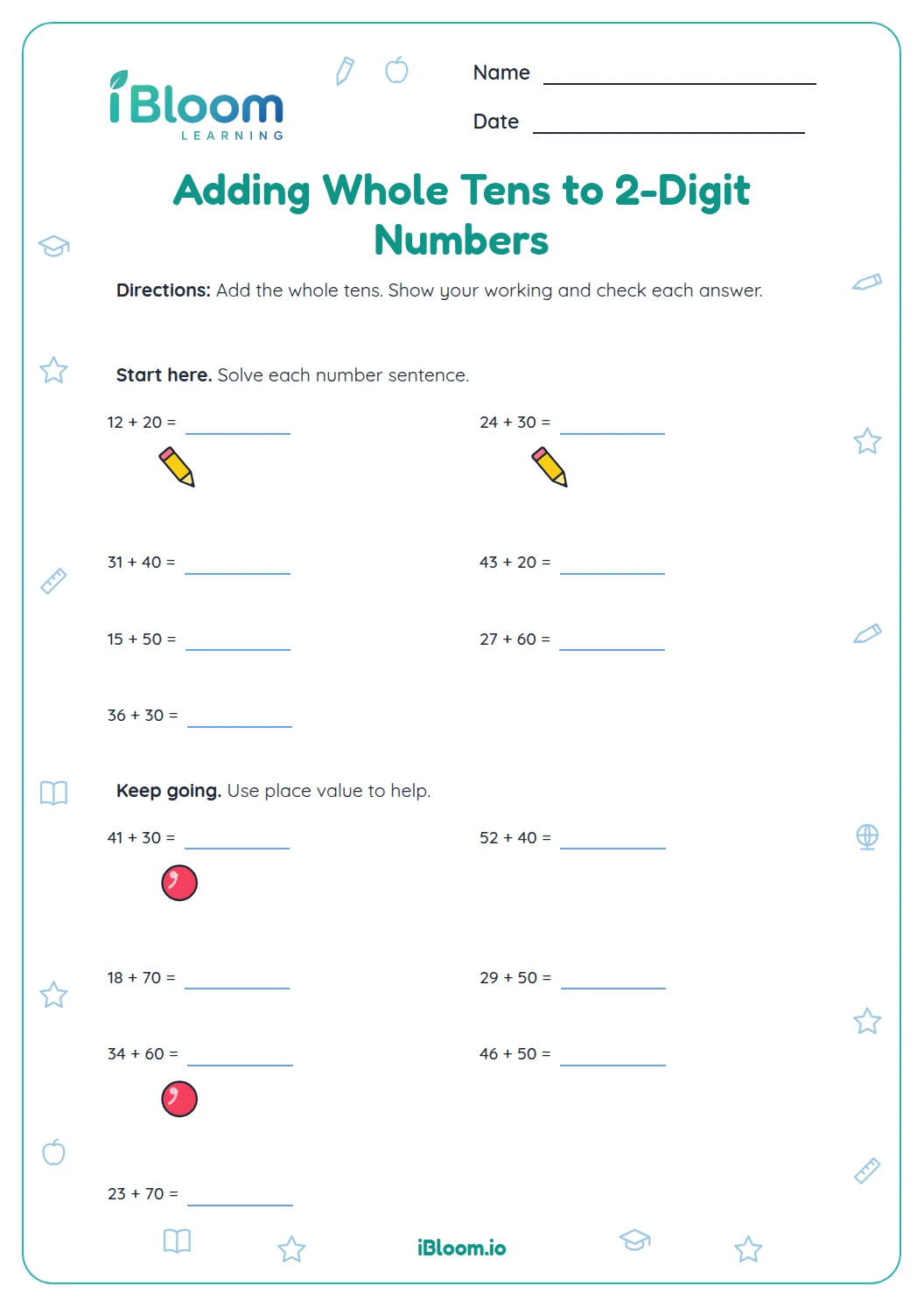
About this worksheet
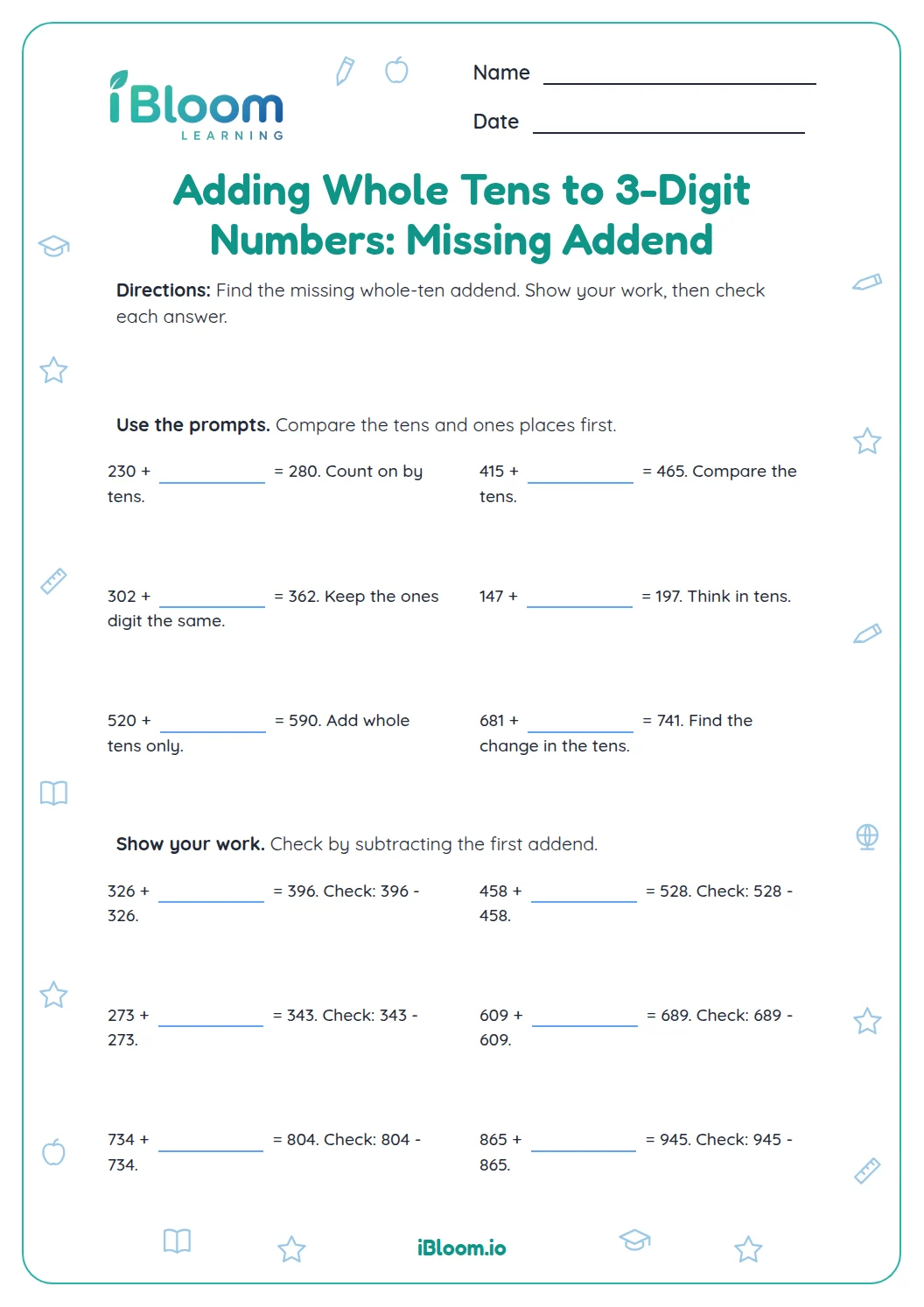
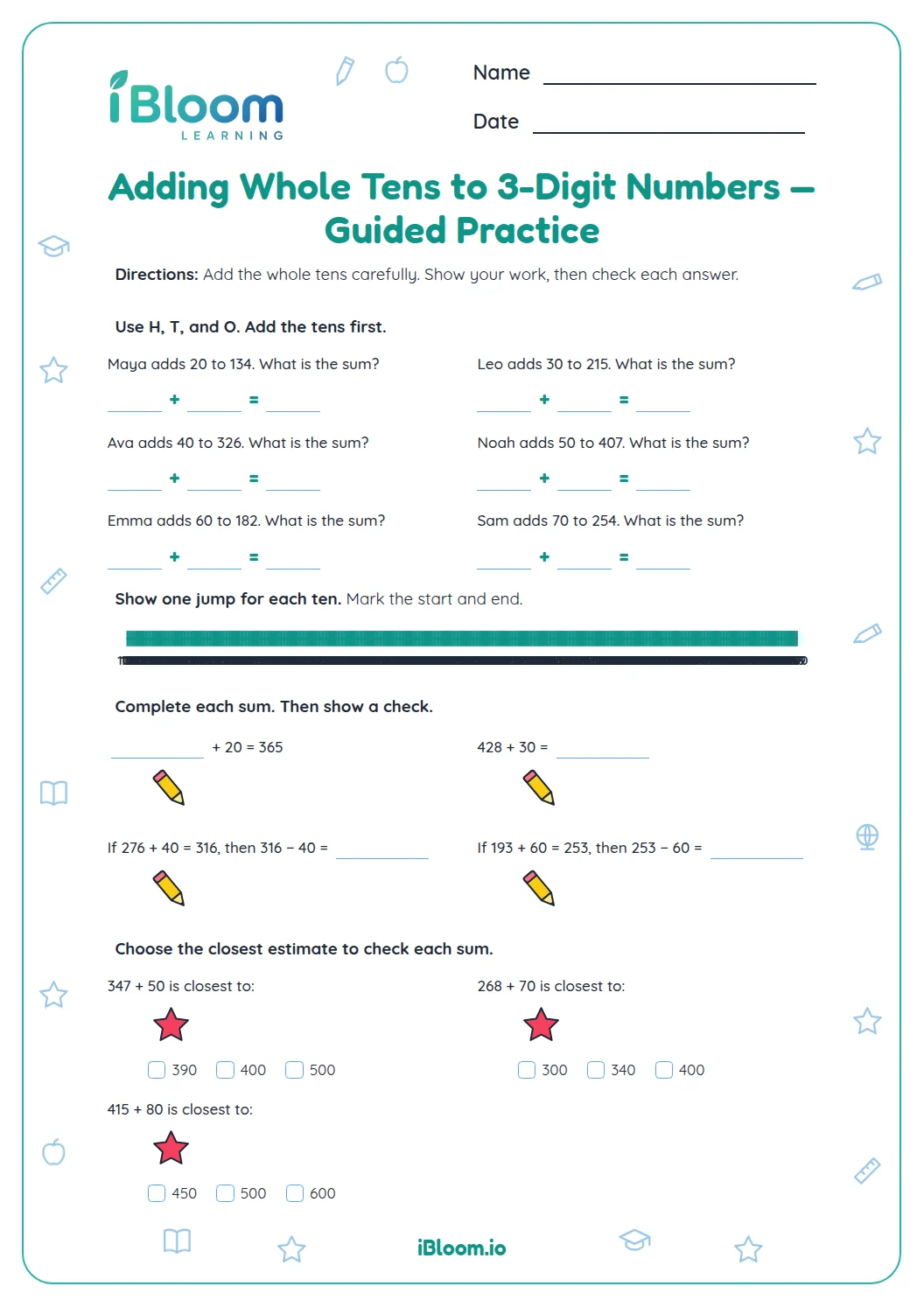
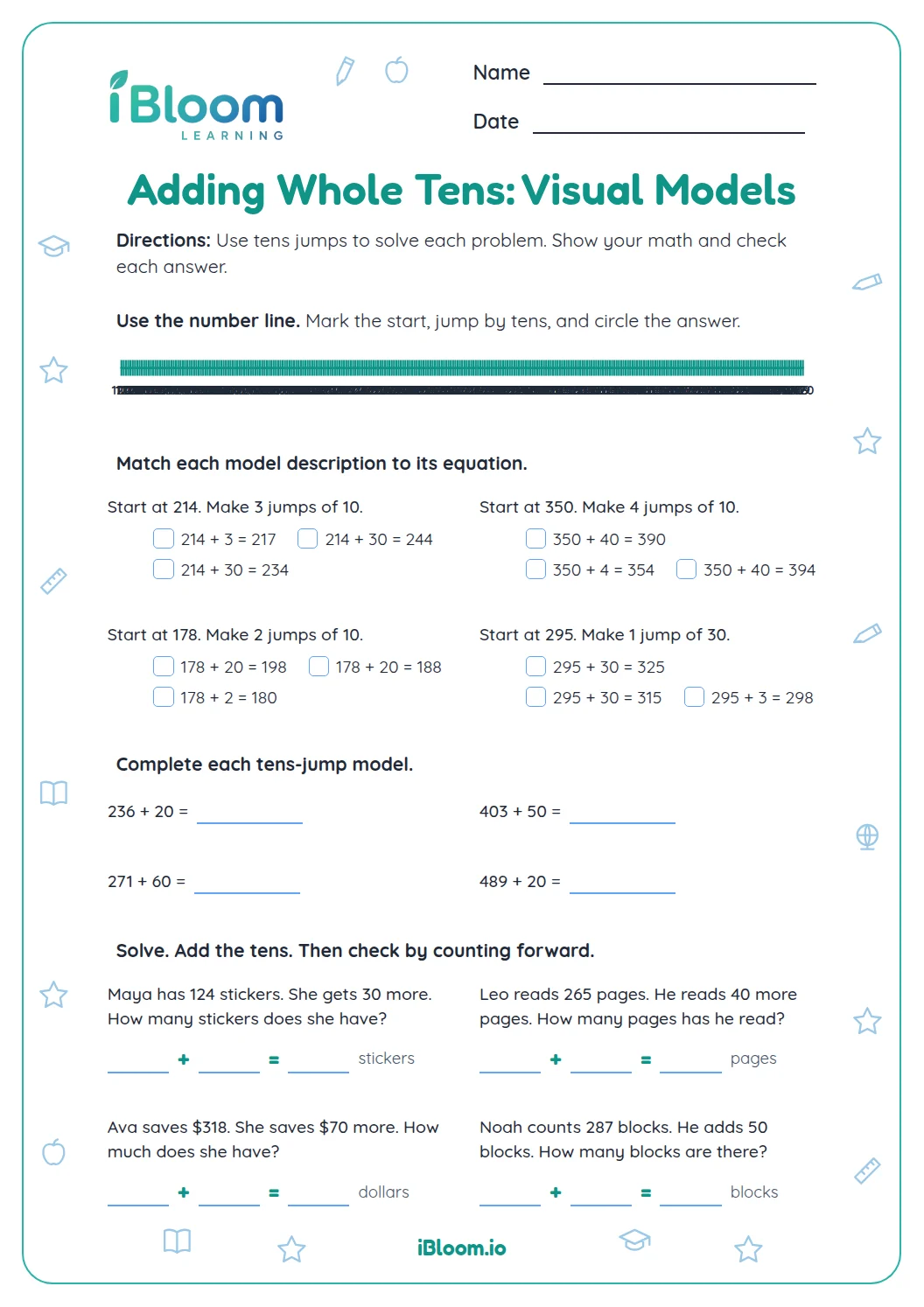
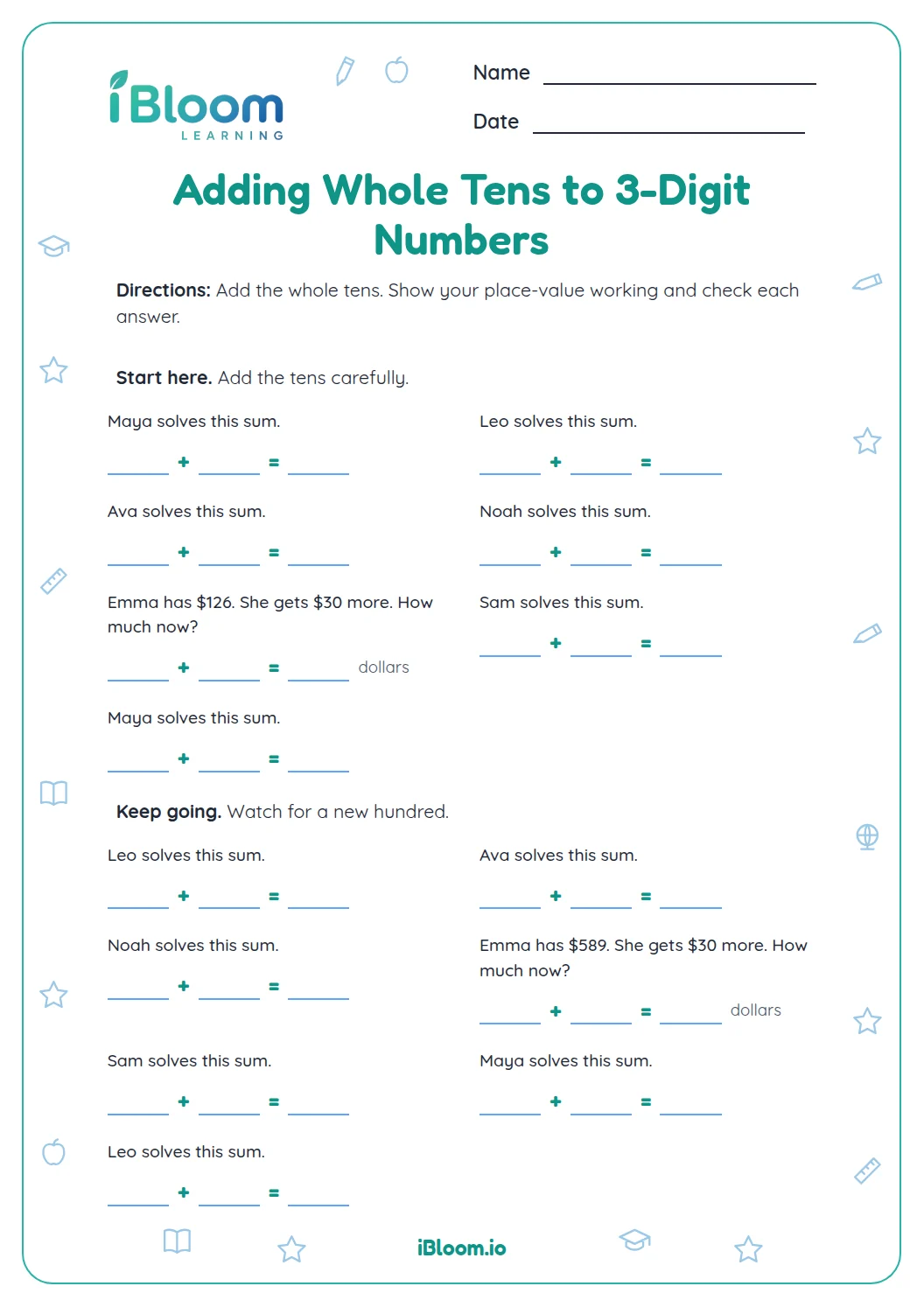
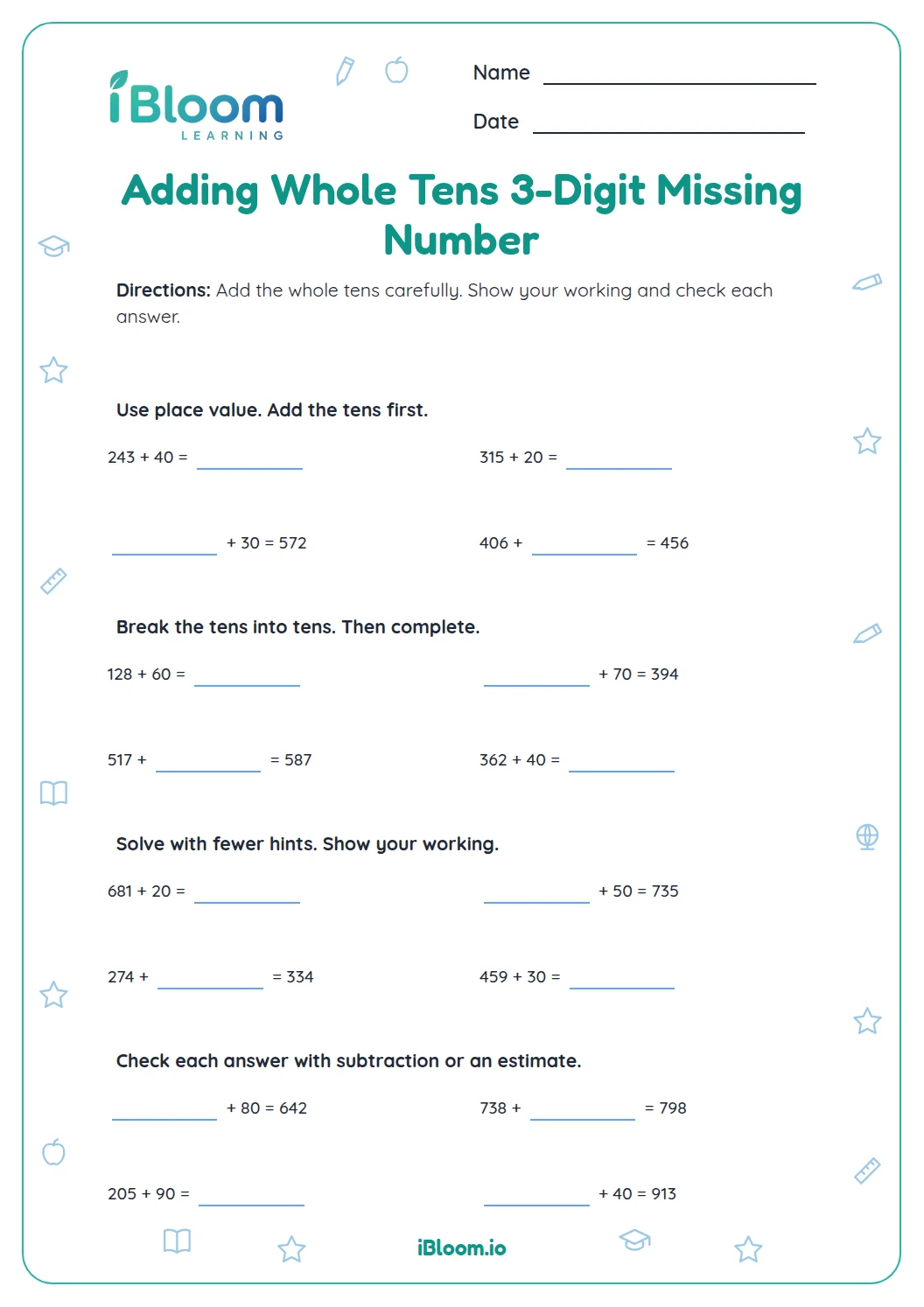
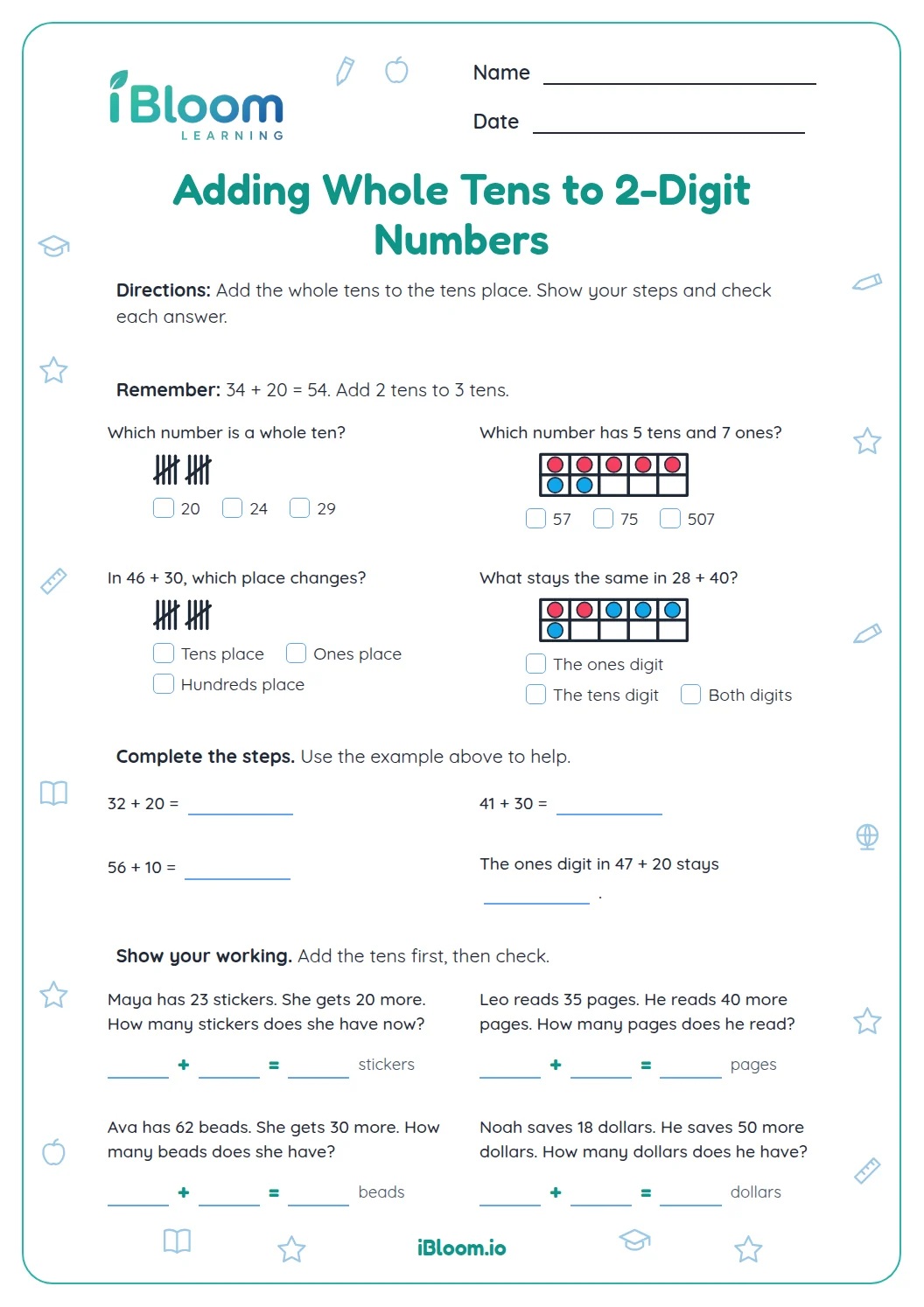
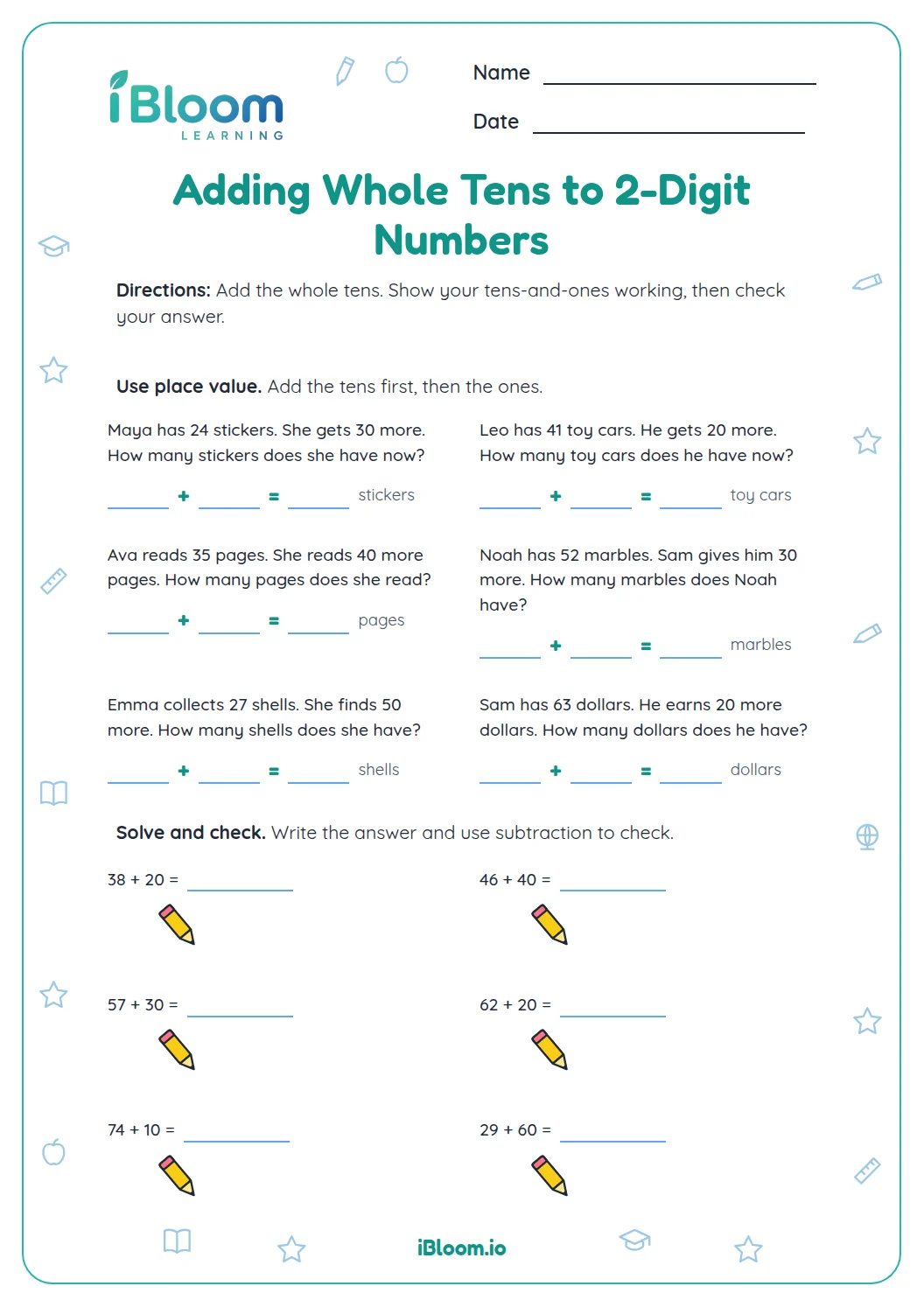
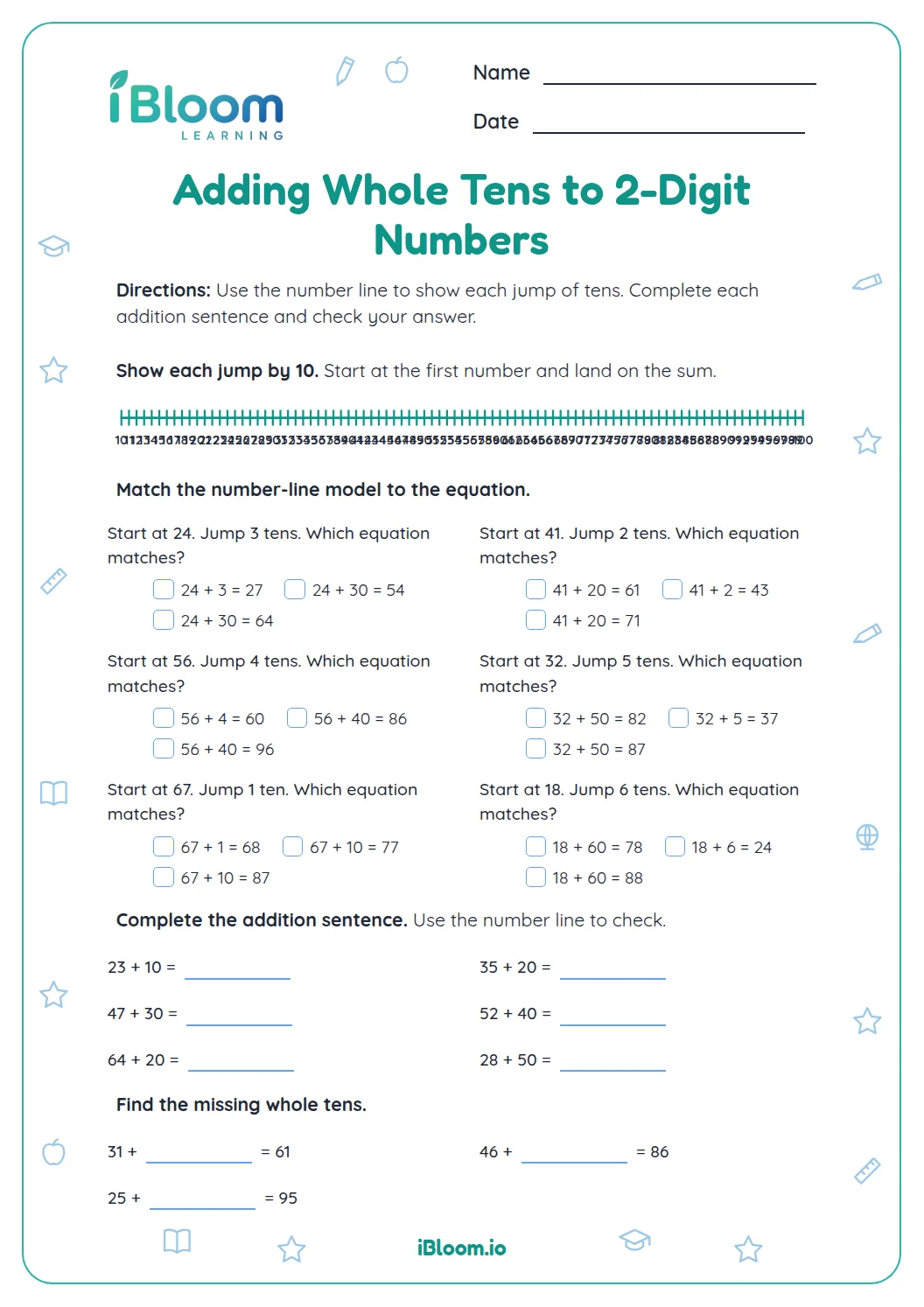
This free Grade 2 math worksheet gives 16 problems about adding whole tens to three-digit numbers when the addend is missing. Two equations pair with base-ten block drawings, ten build fluency with number sentences, and four word problems connect the skill to totals. Children can subtract the known addend from the sum to check each answer. It practices CCSS 2.NBT.B.7 and includes a separate answer key.
Aligned to 2.NBT.B.7
What do the base-ten models show?
Part A uses blocks to represent the three-digit starting number in two equations. The missing addend is a whole number of tens, so compare the represented starting number with the sum to find the added tens.
- Read each starting number from the blocks
- Compare it with the sum
- Find the tens that were added
How can subtraction find the missing addend?
Addition and subtraction are related. If a + ? = total, subtract a from total. In 237 + ? = 277, 277 − 237 = 40, so the missing addend is 40.
- 1237 + ___ = 277
- 2Subtract the known addend: 277 − 237.
- 3277 − 200 = 77; 77 − 37 = 40.
- 4The missing whole tens are 40.
How can you check the answer?
Add the missing tens back to the starting number. If the result matches the sum, the equation is balanced. Then check that the missing addend ends in zero, as the directions require.
What should I do with the word problems?
Find the starting amount and the final total. The question asks how much was added, so subtract the starting amount from the total. Include the unit or object in your response when it helps make the answer clear.
How to use this worksheet
- 1Read the starting number and the total.
- 2Subtract the starting number from the total.
- 3Check that the answer is a multiple of ten.
- 4Add it back to confirm the total.
- 5For a story problem, label what the number counts.
- 6Compare each result with the answer key.
Common mistakes and quick fixes
The mistake
Subtracting the total from the starting number.
The fix
Use total − starting amount to find what was added.
The mistake
Changing the ones digit while adding whole tens.
The fix
Whole tens change the tens place; the hundreds and ones stay fixed unless the tens regroup.
The mistake
Giving a difference that is not a whole ten.
The fix
Check whether the missing addend ends in zero.
Common Core alignment
The equations use place-value strategies to add within 1,000 and find an unknown addend.
Use place-value strategies to add within 1,000 and connect strategies to equations.
On this sheet: The worksheet uses base-ten drawings and subtraction to find missing tens in three-digit addition.
Show the official wordingHide the official wording
Add and subtract within 1000, using concrete models or drawings and strategies based on place value, properties of operations, and/or the relationship between addition and subtraction; relate the strategy to a written method. Understand that in adding or subtracting three-digit numbers, one adds or subtracts hundreds and hundreds, tens and tens, ones and ones; and sometimes it is necessary to compose or decompose tens or hundreds.
What to practice next
Make more practice
Further reading
Questions parents and teachers ask
What does missing addend mean?
The missing addend is the number that must be added to a known number to reach the total. In 237 + ___ = 277, subtract 237 from 277 to find 40. The worksheet uses whole tens as the missing addend in every question.
How many questions are included?
There are 16 questions across three parts: two equations with base-ten block drawings, ten number sentences, and four short word problems. The answer key lists each missing addend. The story questions use books, points, apples, and cans as familiar contexts.
Why can subtraction help with addition?
Addition and subtraction undo each other. When the total and one addend are known, subtract the known addend from the total to find the other addend. Adding that result back is a quick way to check the equation. The check also confirms that the answer is the missing part of the total.
What do the block drawings represent?
The base-ten drawings show the hundreds, tens, and ones in the starting number. Children compare the number with the sum to determine how many tens were added. These models make the place-value change visible before the independent problems. Point to each block type and say its value before writing the answer.
How long does this worksheet take?
Plan about 20 minutes for the 16 problems, including the four word problems. Children can show a subtraction check beside each equation or use addition to verify that the missing tens bring the starting number to the total. If a child needs more time, solve one model together before continuing independently.