

About this worksheet
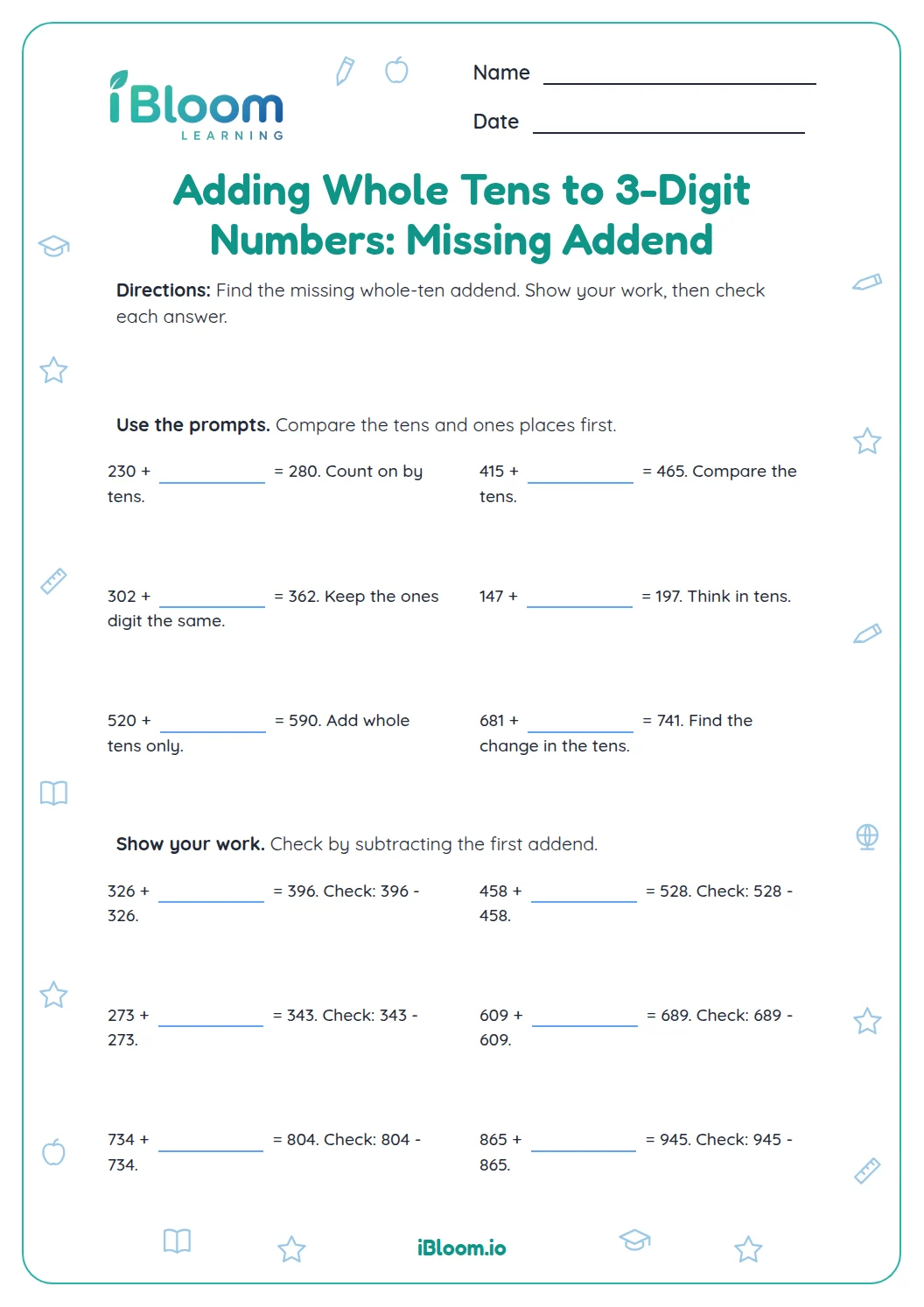
This Grade 2 worksheet focuses on addition equations with a missing whole-ten addend. In Part A, students read a base-ten model of the total and compare it with the known addend. Part B applies the same idea in equations and everyday situations. Every missing addend is a multiple of ten, and the totals stay within 1,000.
Aligned to 2.NBT.B.7
How do base-ten blocks help?
Hundreds blocks, tens rods, and ones cubes show the total in place-value groups. Comparing the total with the starting number helps students see how many tens were added. The ones stay the same because the missing addend is a whole number of tens.
Why can subtraction find the missing addend?
Addition and subtraction are related. In an equation such as 347 + ___ = 587, subtract the known addend from the total: 587 − 347 = 240. Then check by adding 347 + 240.
A three-step strategy
- 1Read the total shown by the blocks or written in the equation.
- 2Subtract the known 3-digit number from the total.
- 3Check that the answer ends in zero and that addition returns the total.
- 4For a story problem, label the missing amount with the object being counted.
Common missing-addend slips
The mistake
Subtracting the total from the known addend.
The fix
Start with the total, then take away the known amount.
The mistake
Writing a ones digit in the missing addend even though it must be whole tens.
The fix
Check that the answer is a multiple of ten and that the ones digit in the total matches the starting number.
Common Core alignment
This page practices adding and subtracting within 1,000 using place-value understanding.
Add and subtract within 1,000 using models and place-value strategies.
On this sheet: Students use base-ten drawings and subtraction to find a missing whole-ten addend.
Show the official wordingHide the official wording
Add and subtract within 1000, using concrete models or drawings and strategies based on place value, properties of operations, and/or the relationship between addition and subtraction.
What to practice next
Make more practice
Further reading
Questions parents and teachers ask
Why does the missing addend end in zero?
Each unknown addend is a whole number of tens, so it ends in zero. Subtract the known addend from the total, then check that adding the result returns the total shown in the equation and base-ten drawing. Ask the student to name the clue or operation that supports the choice, then check the completed sentence or equation against the.
How do base-ten pictures support this skill?
The blocks show a total grouped into hundreds, tens, and ones. Students compare that total with the starting number to find how many tens were added. The pictures make place value visible while the equation records the relationship. Ask the student to name the clue or operation that supports the choice, then check the completed sentence or equation against.
How can subtraction find a missing addend?
Subtract the known addend from the total. For example, 587 − 347 = 240, so 240 is the missing number in 347 + ___ = 587. Add 347 and 240 afterward to check that the sum is 587. Ask the student to name the clue or operation that supports the choice, then check the completed sentence or equation against.
What should students check after finding the number?
Add the known number and the missing tens. The sum should match the total in the equation. Also check that the answer is a whole number of tens, because the worksheet practices adding tens rather than ones. The same check works for every equation on the page.
How many missing-addend questions are there?
The worksheet has 14 questions in two parts. Every equation adds a whole number of tens to a three-digit number, and each item includes a base-ten drawing of its total. Ask the student to name the clue or operation that supports the choice, then check the completed sentence or equation against the key. This quick check connects the answer.