




About this worksheet
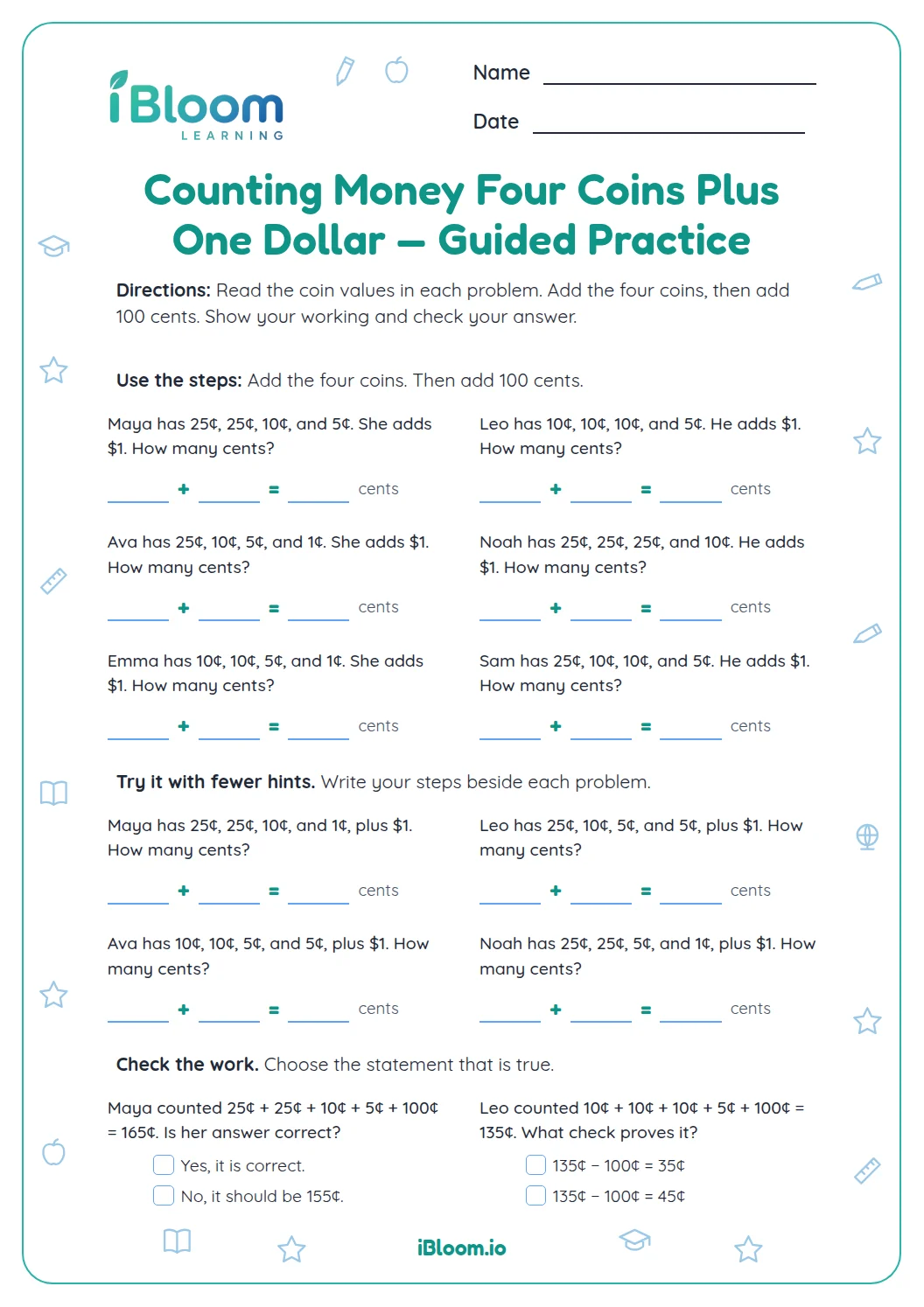
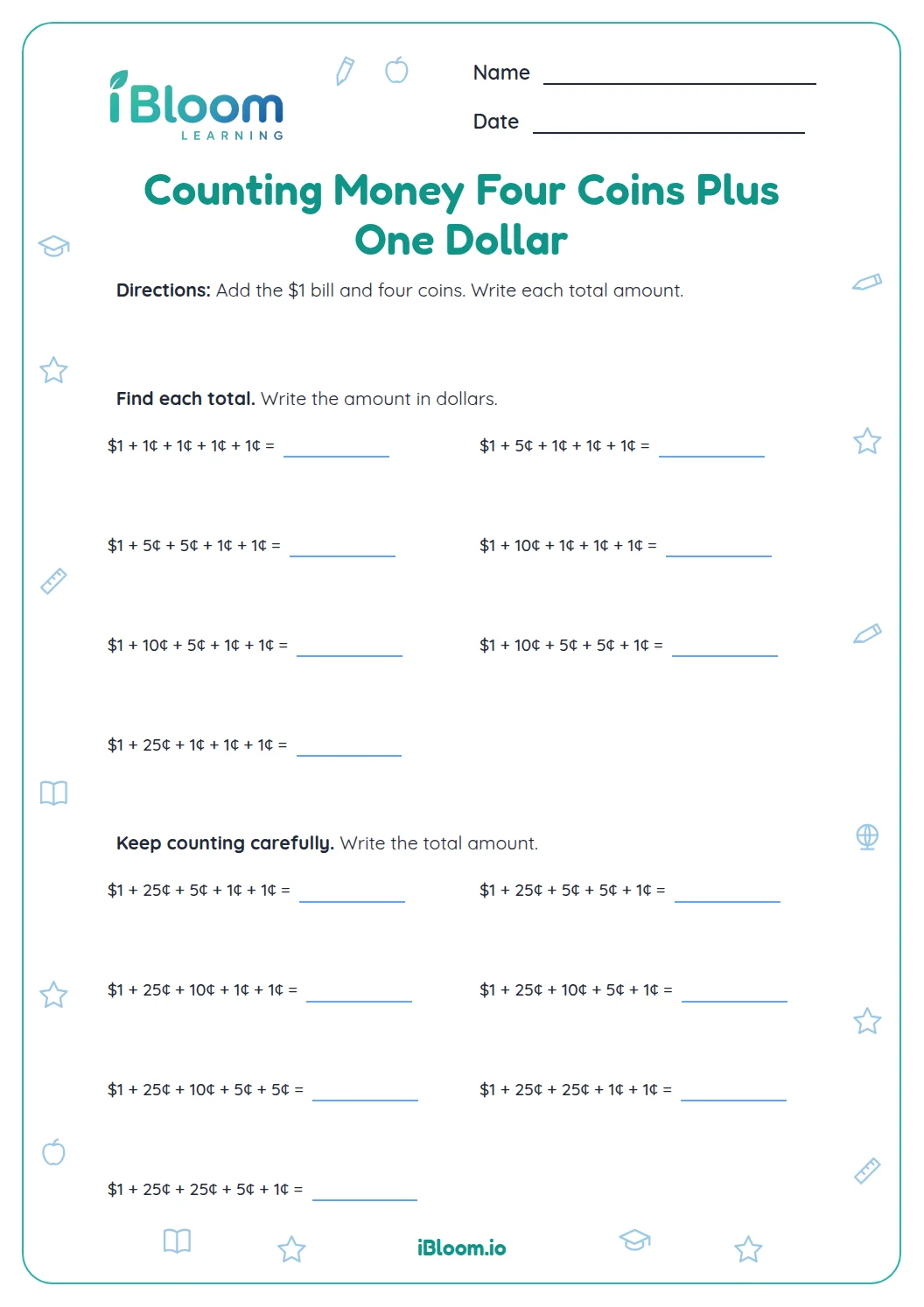
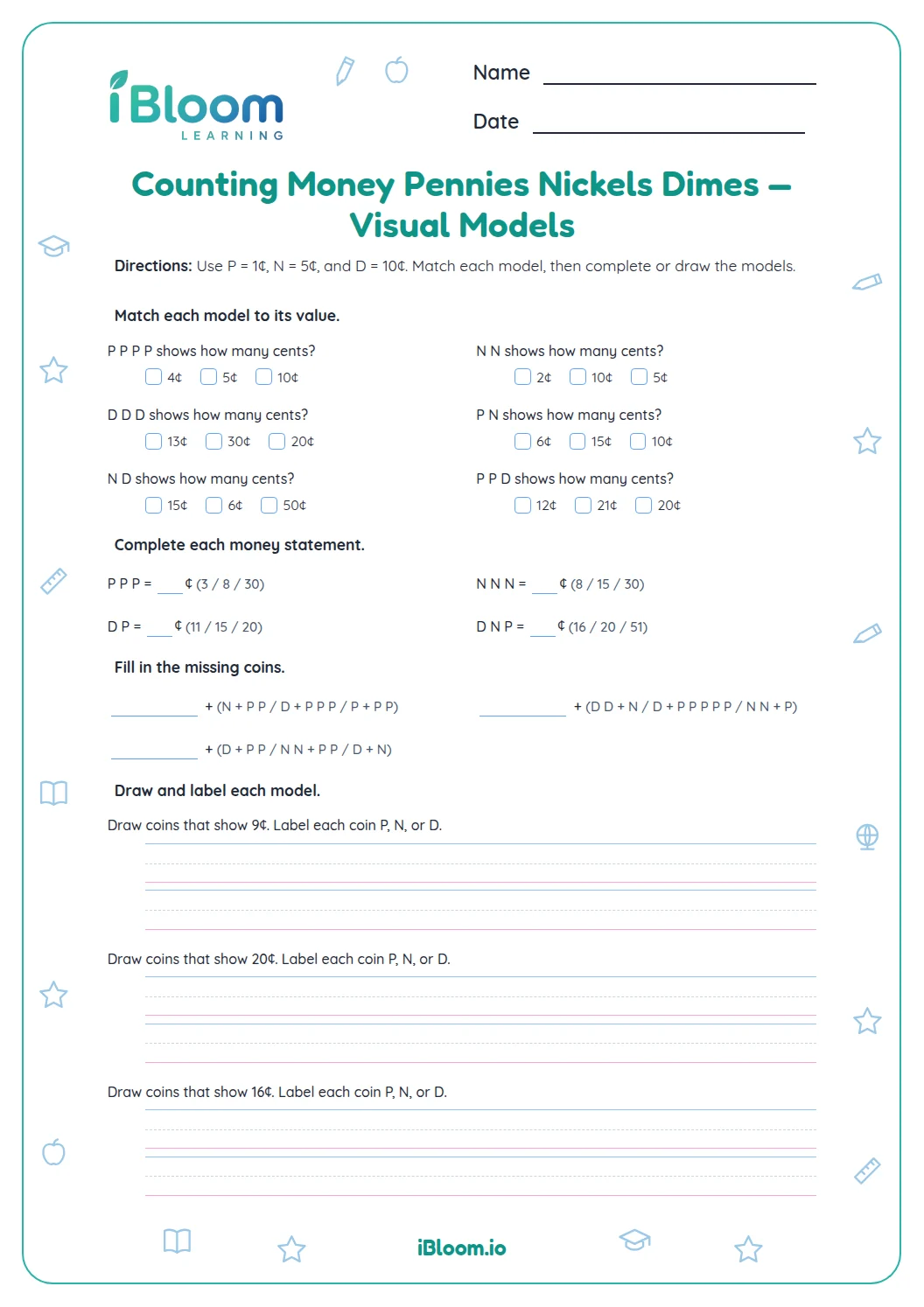
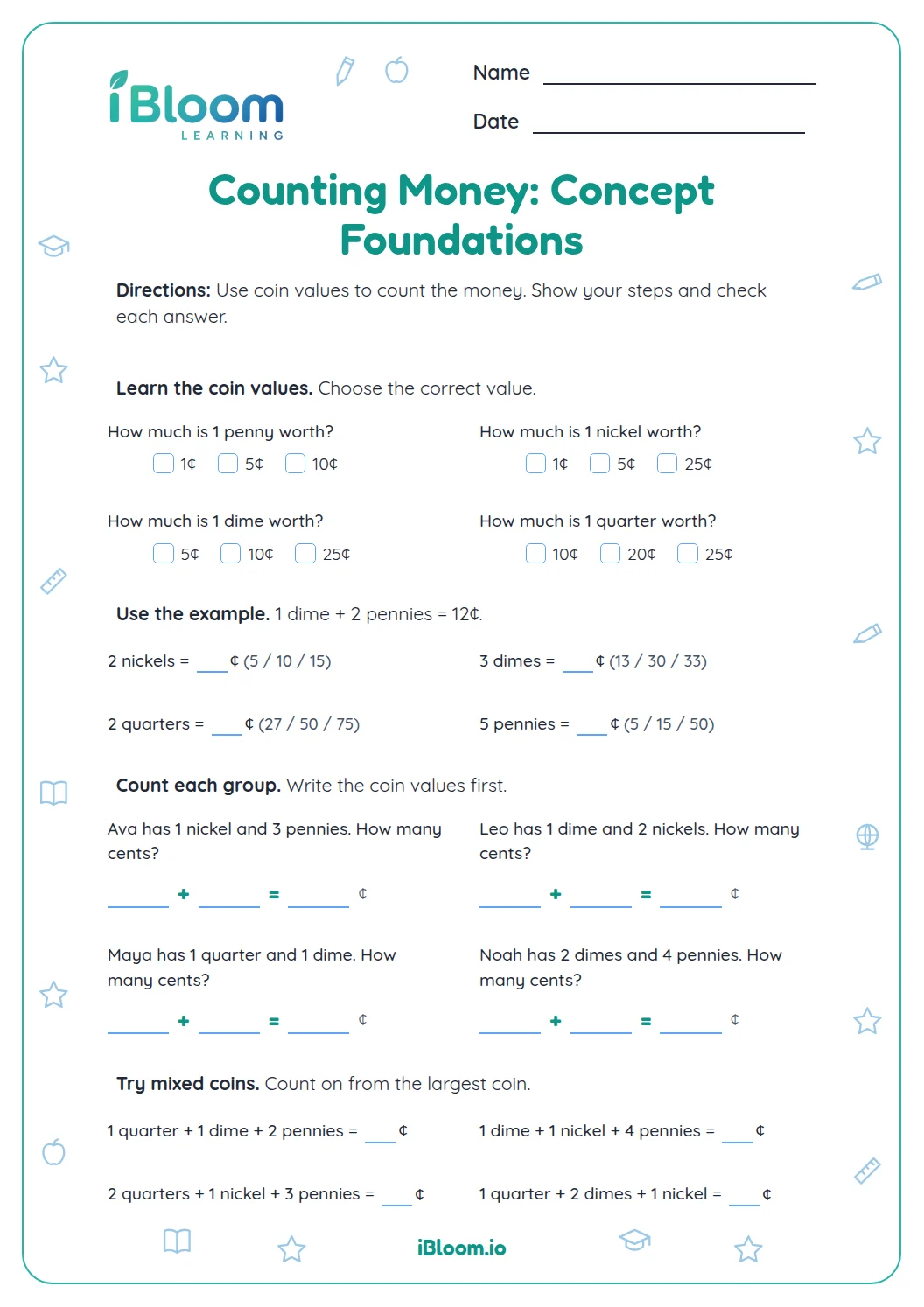
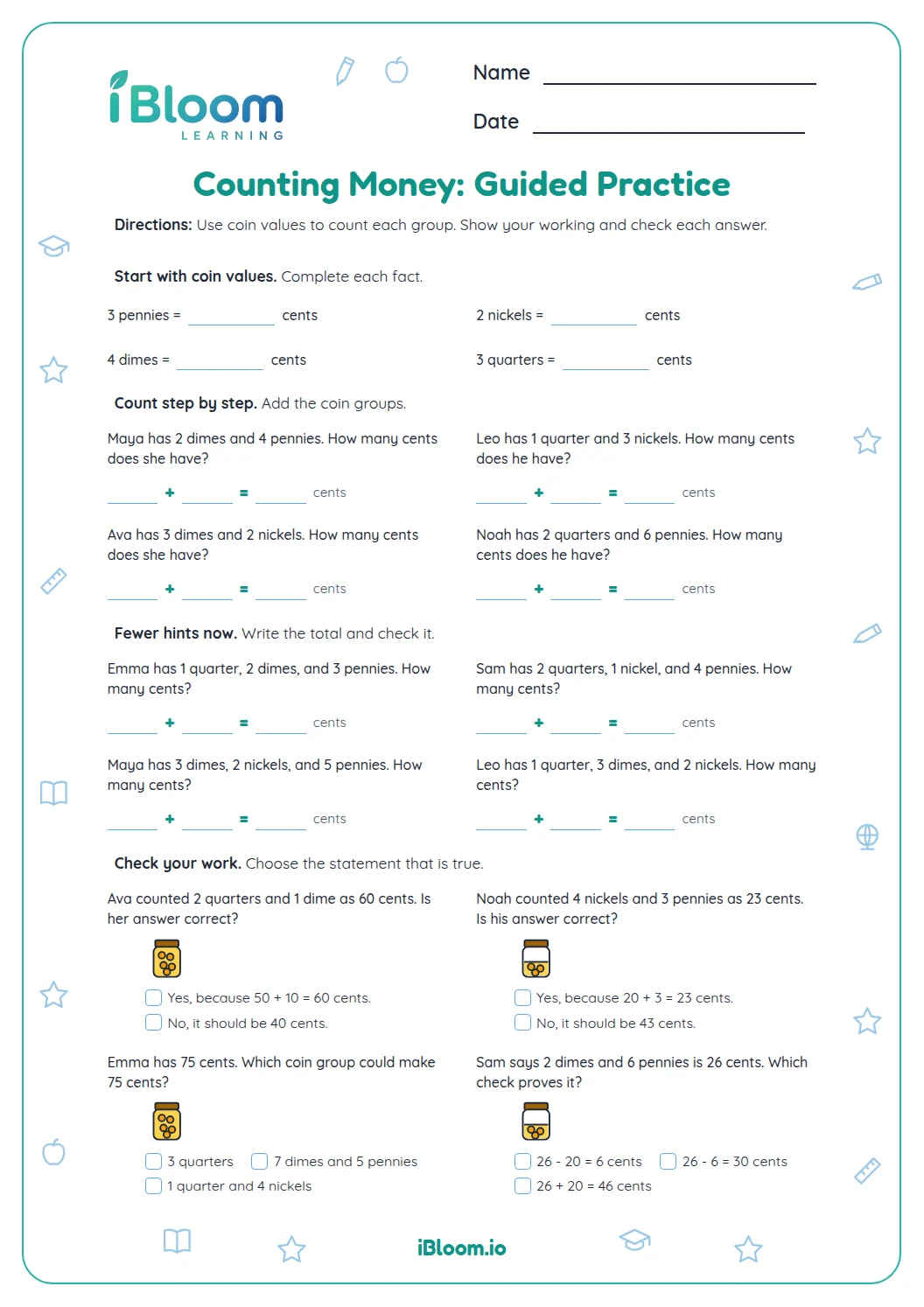
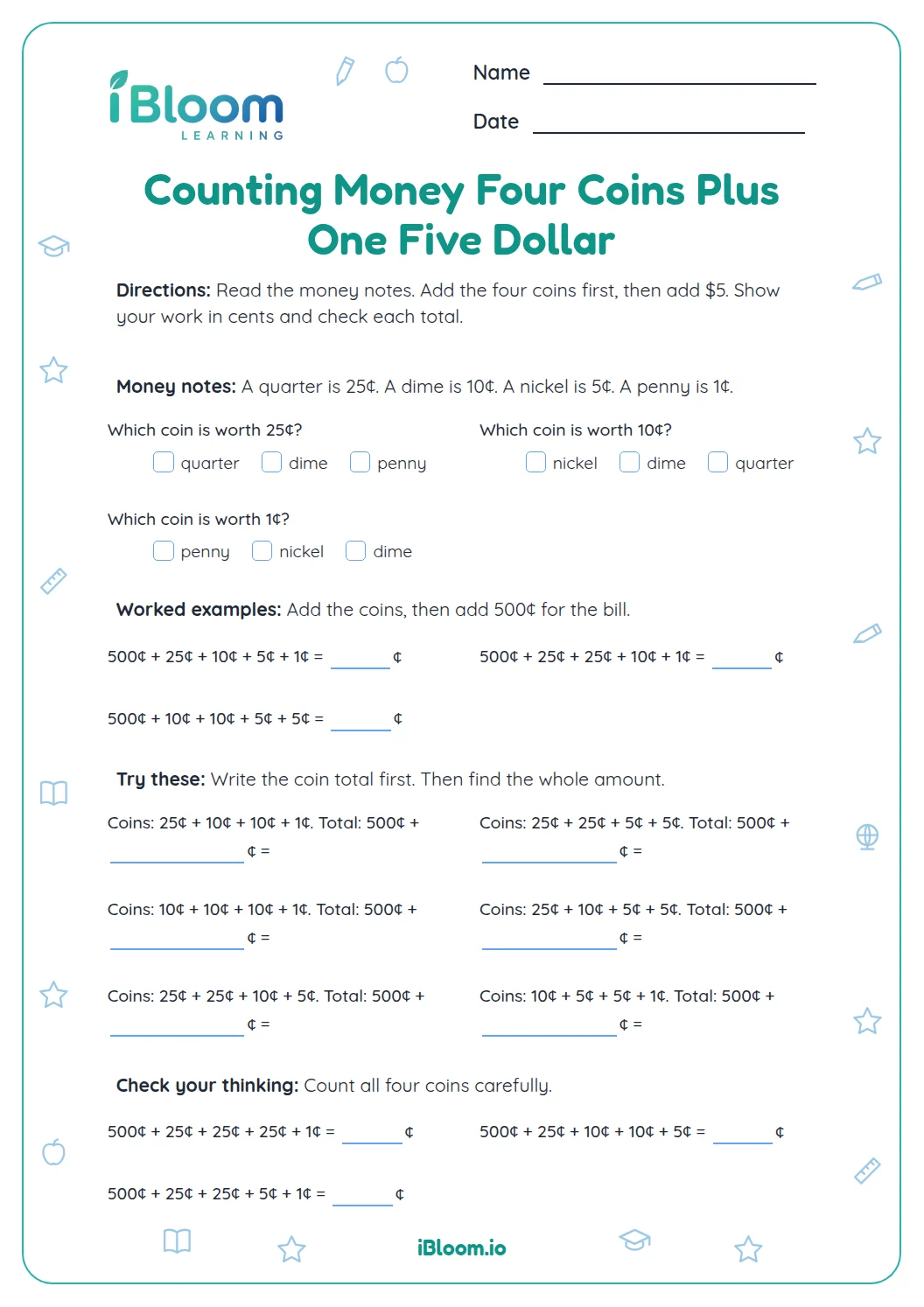
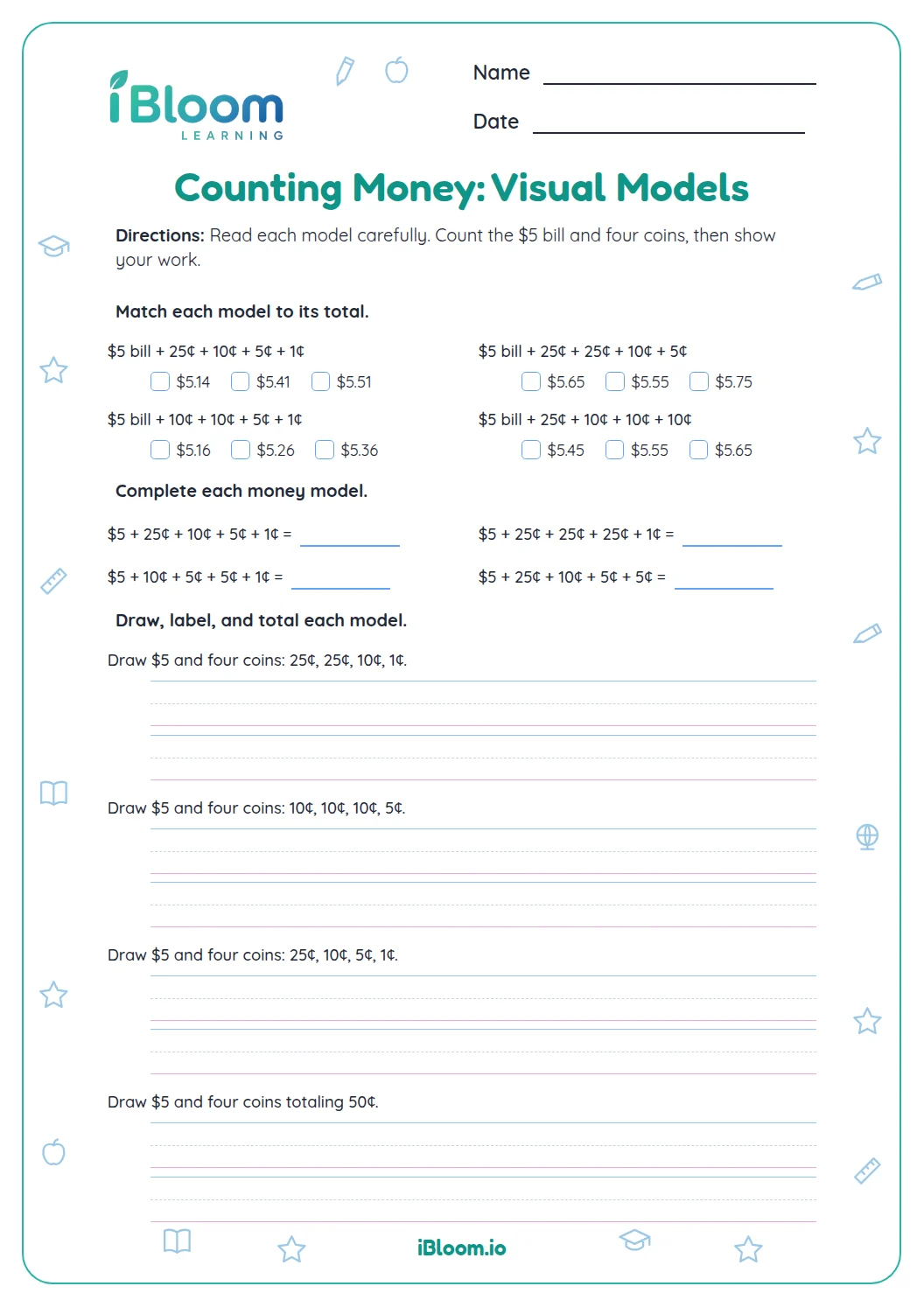
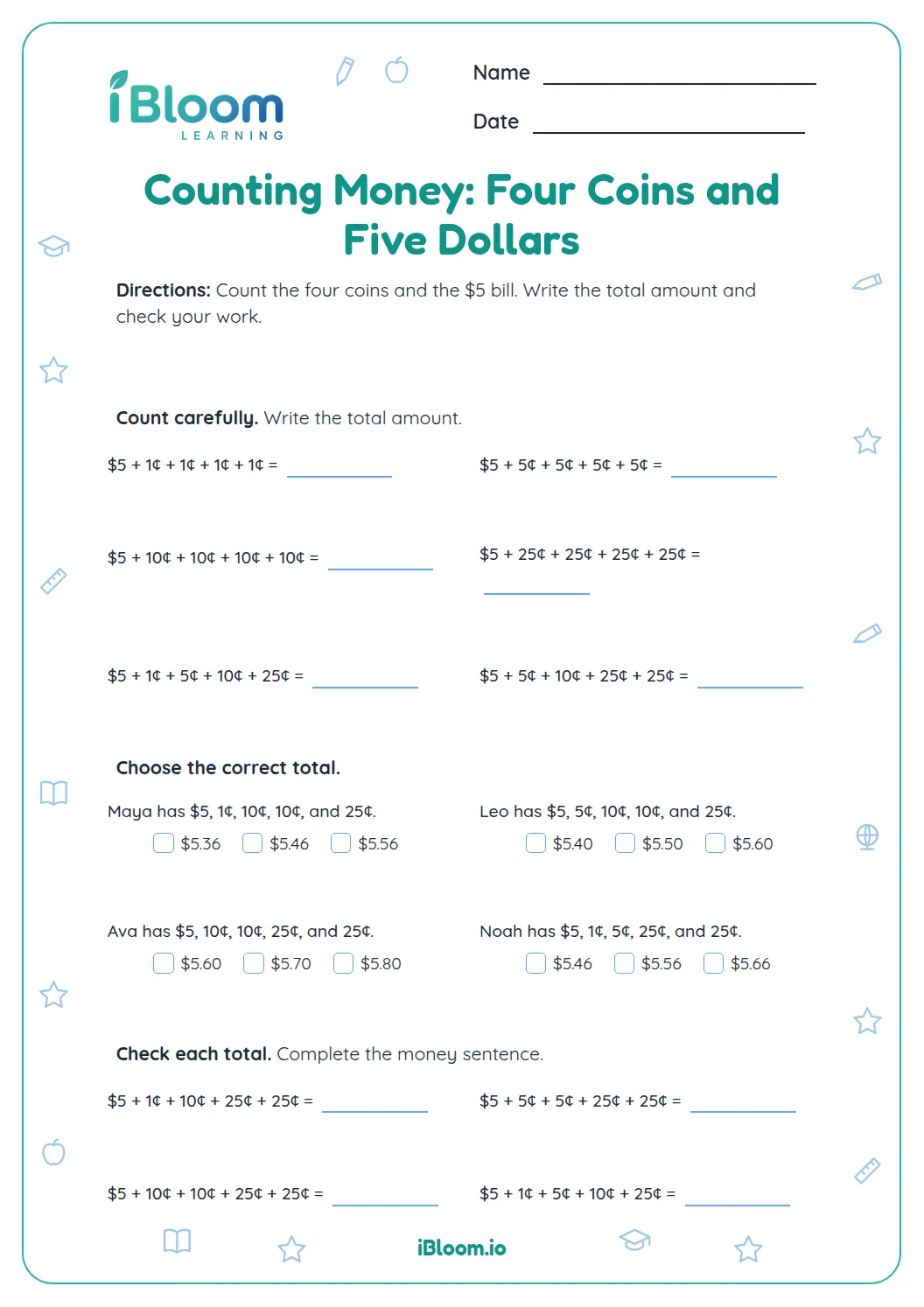
This free Grade 2 worksheet builds a counting routine for a dollar bill and US coins. Children first identify the values of a penny, nickel, dime, and quarter, then count four different groups of four coins with one dollar. Four short money stories finish the practice, including a total that reaches two dollars. The 12 questions practice Common Core 2.MD.C.8 by connecting coin values, dollar bills, and the $ and ¢ symbols. Coin drawings support the first two parts, and a separate answer key gives every value and total.
Aligned to 2.MD.C.8
Which coin values does my child need?
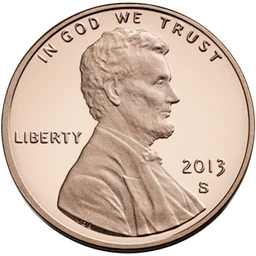
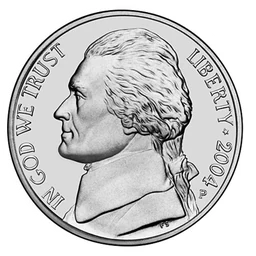
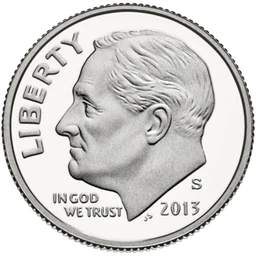
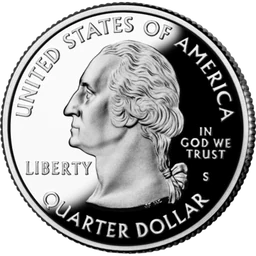
A penny is worth 1¢, a nickel 5¢, a dime 10¢, and a quarter 25¢. Part A pairs each coin drawing with three possible values. Ask your child to name the coin before choosing its value; the dime is smaller than the nickel but worth more.
Keep a real or play coin beside each drawing if your child needs help recognizing it. Say both the name and value aloud, then point to the matching cents symbol.
How does one dollar become $1.41?
Question 5 has one of each coin. Count the largest value first: 25, 35, 40, 41 cents. The dollar adds 100 cents, making 141 cents altogether. Written in dollars and cents, that amount is $1.41.
- 125¢ + 10¢ + 5¢ + 1¢ = 41¢
- 2$1 = 100¢
- 3100¢ + 41¢ = 141¢
- 4$1 + 41¢ = $1.41
How does the practice build across the sheet?
Part A has four coin-value choices. Part B has four drawings, each with four coins, and asks children to add one dollar and fill in the total. The dollar is named in the prompt, so children must include it as well as the pictured coins.
Part C has four stories with space for a number sentence. They use a dollar with four pennies, four nickels, four dimes, or four quarters. The last story makes $2.00 because four quarters are another whole dollar.
How to use this worksheet
- 1Review the four coin names and values using Part A.
- 2Count question 5 together, starting with the quarter and ending with the penny.
- 3Add 100¢ for the dollar, then read $1.41 aloud as one dollar and forty-one cents.
- 4Let your child finish the remaining totals and write a number sentence for each story.
- 5Use the key to check both the amount and its money symbol.
Mistakes to check together
The mistake
Counting each coin as one cent.
The fix
Name its value before adding: a quarter adds 25¢, even though it is one coin.
The mistake
Writing $1.4 for one dollar and four cents.
The fix
Keep two places for cents: four cents is 04, so write $1.04.
The mistake
Leaving out the dollar and answering 41¢ for question 5.
The fix
Write $1 beside the coin subtotal before combining them.
Common Core alignment
Count US coins with a dollar bill and write money amounts with $ and ¢.
On this sheet: Count US coins with a dollar bill and write money amounts with $ and ¢.
Show the official wordingHide the official wording
Solve word problems involving dollar bills, quarters, dimes, nickels, and pennies, using $ and ¢ symbols appropriately. Example: If you have 2 dimes and 3 pennies, how many cents do you have?
What to practice next
Make more practice
Further reading
Questions parents and teachers ask
Does every total include one dollar?
Every total in Part B includes one dollar. Part A checks the penny, nickel, dime, and quarter values children need for those totals. Four questions show the coins, and four short money stories ask students to combine the stated coins with a dollar bill.
Why are there two digits after the decimal point?
The two digits show the cents in a dollar amount. In question 9, four pennies add four cents to one dollar, so the answer is $1.04. The zero holds the tens-of-cents place; writing $1.40 would mean one dollar and forty cents.
Should we use real coins with this sheet?
Real or play coins can help children connect the drawings to familiar objects. Match each coin to Part A, say its value, and then build the four-coin groups in Part B. After counting the coins, place a dollar bill beside them and include it in the total.
How can four coins bring the total to two dollars?
Four quarters are worth one dollar, so adding the dollar bill makes two dollars. This is the situation in question 12. Count the quarters as 25, 50, 75, and 100 cents, then combine that 100¢ with the bill’s 100¢ and write $2.00.
What does the answer key show?
The separate answer key gives all 14 fill-in answers: six coin values and eight totals. Use it to check the final amount, then ask your child to explain one count aloud. For a missed total, rebuild the coin group, add the dollar, and count the cents once more.