


About this worksheet
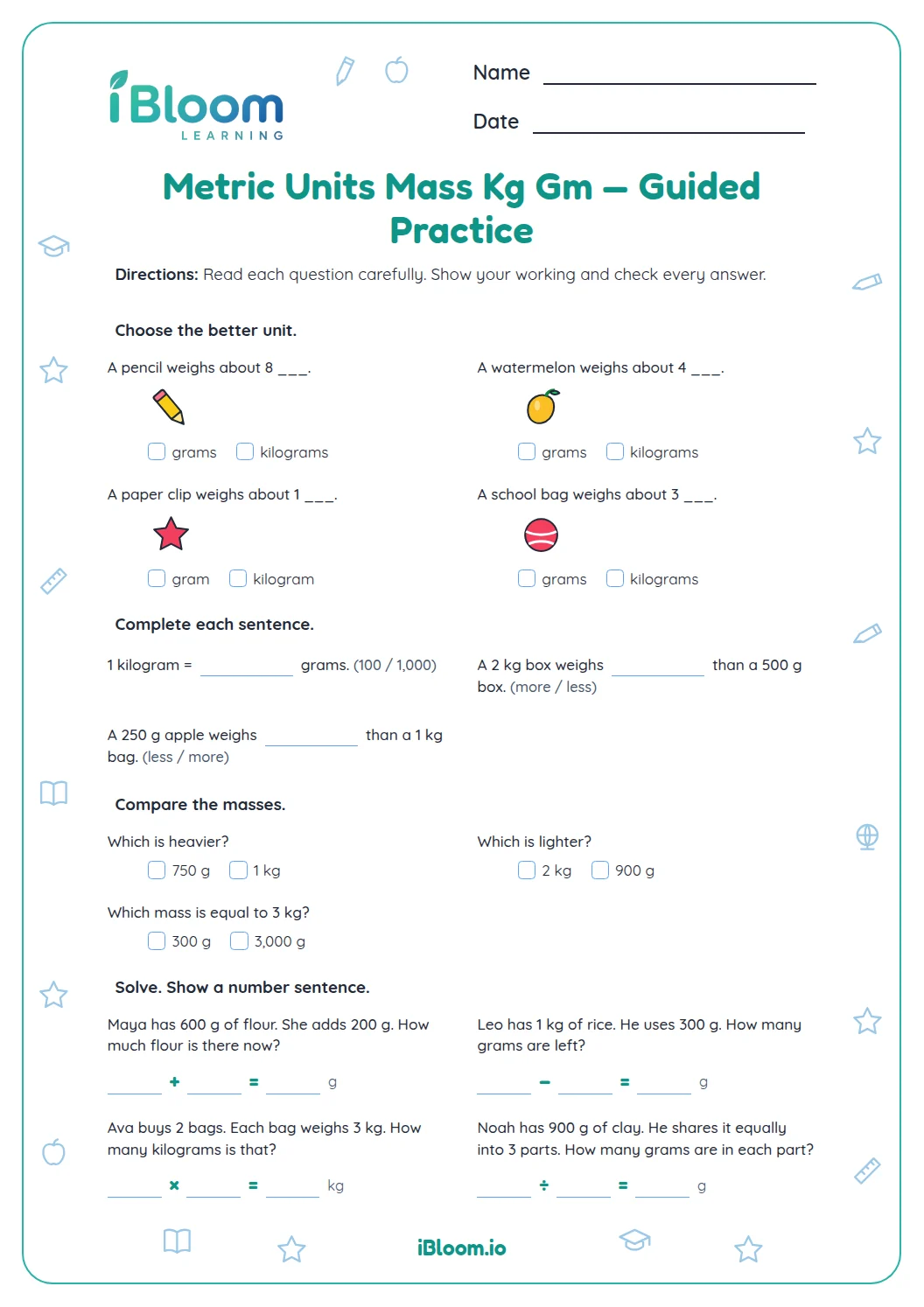
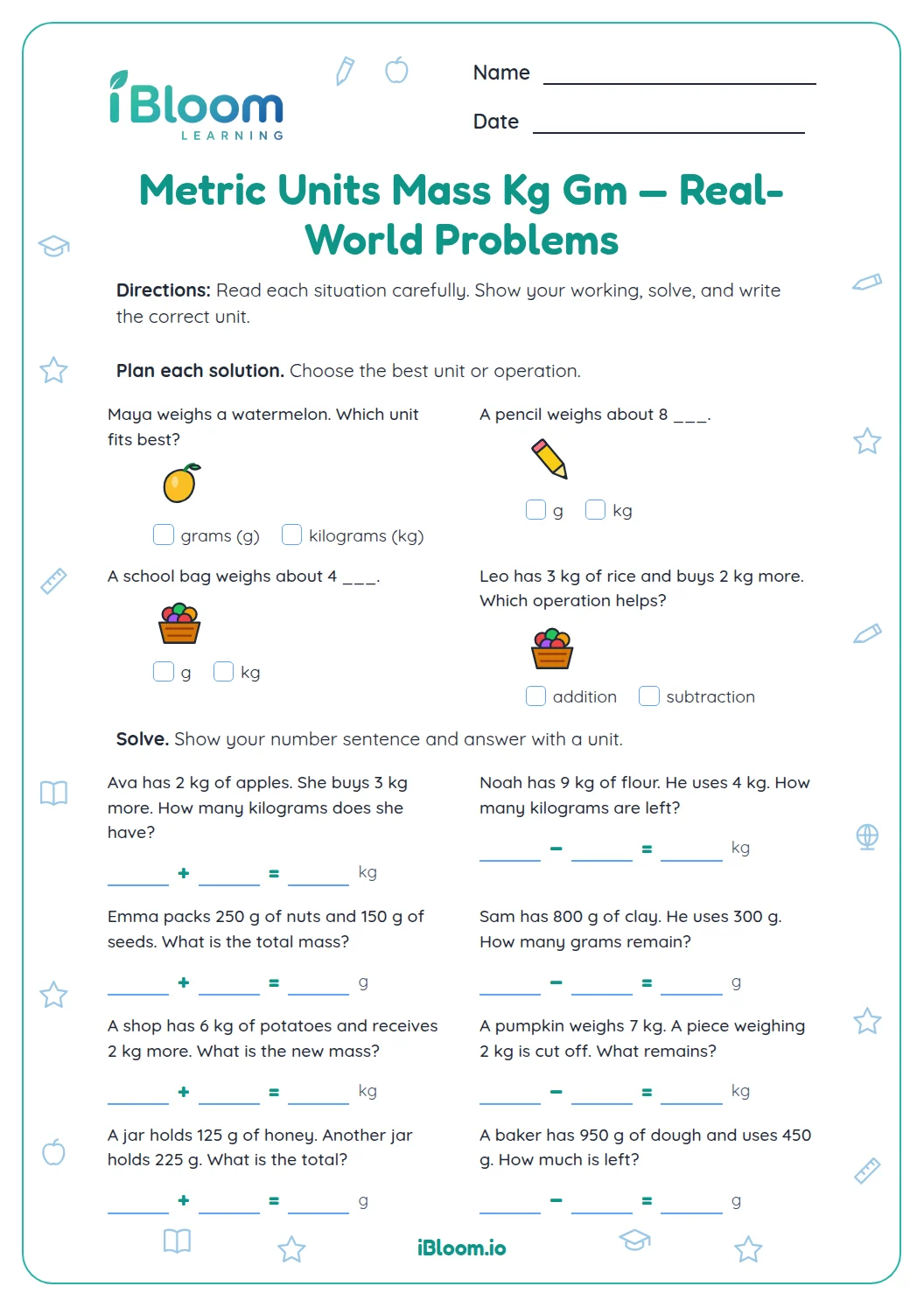
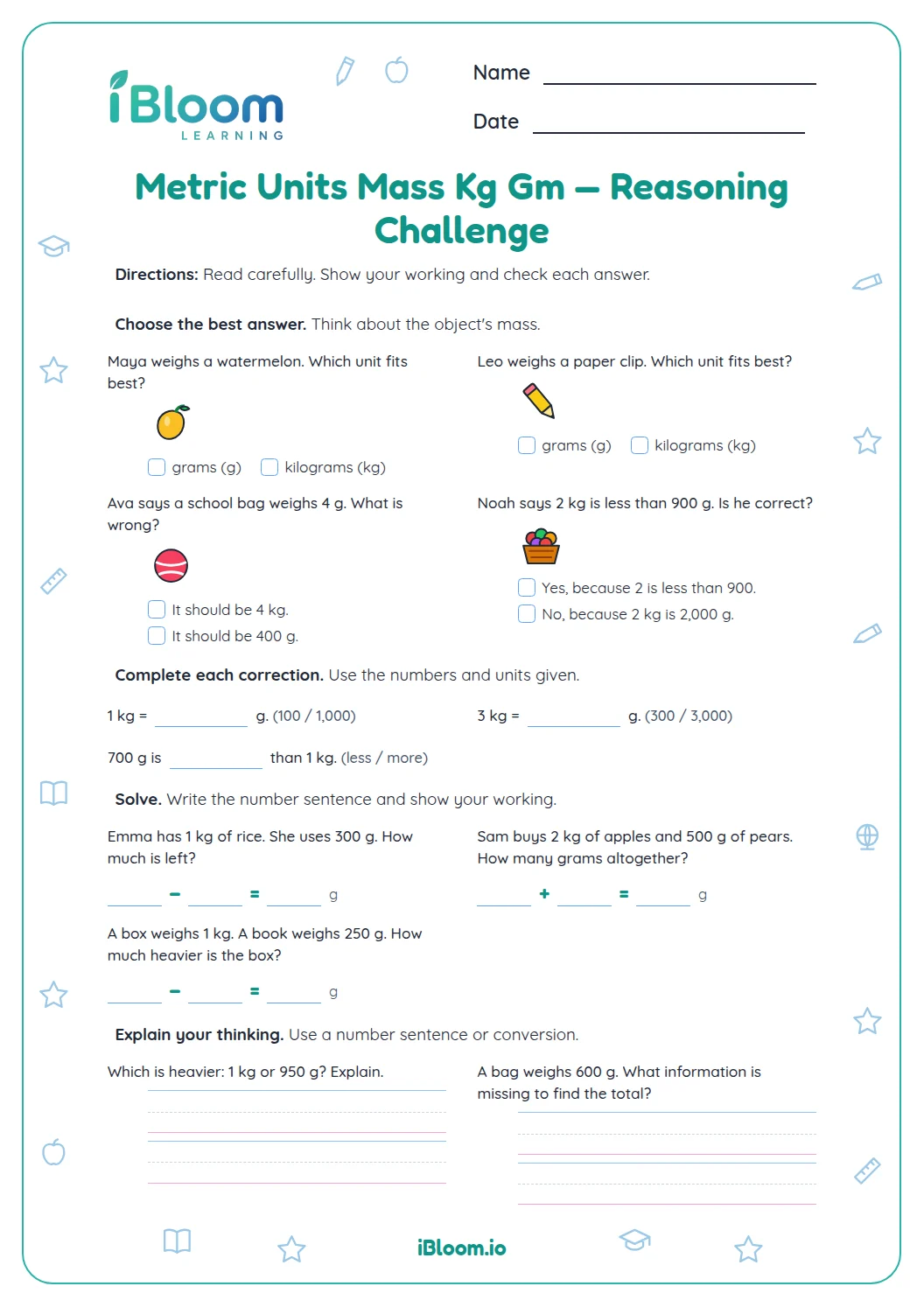
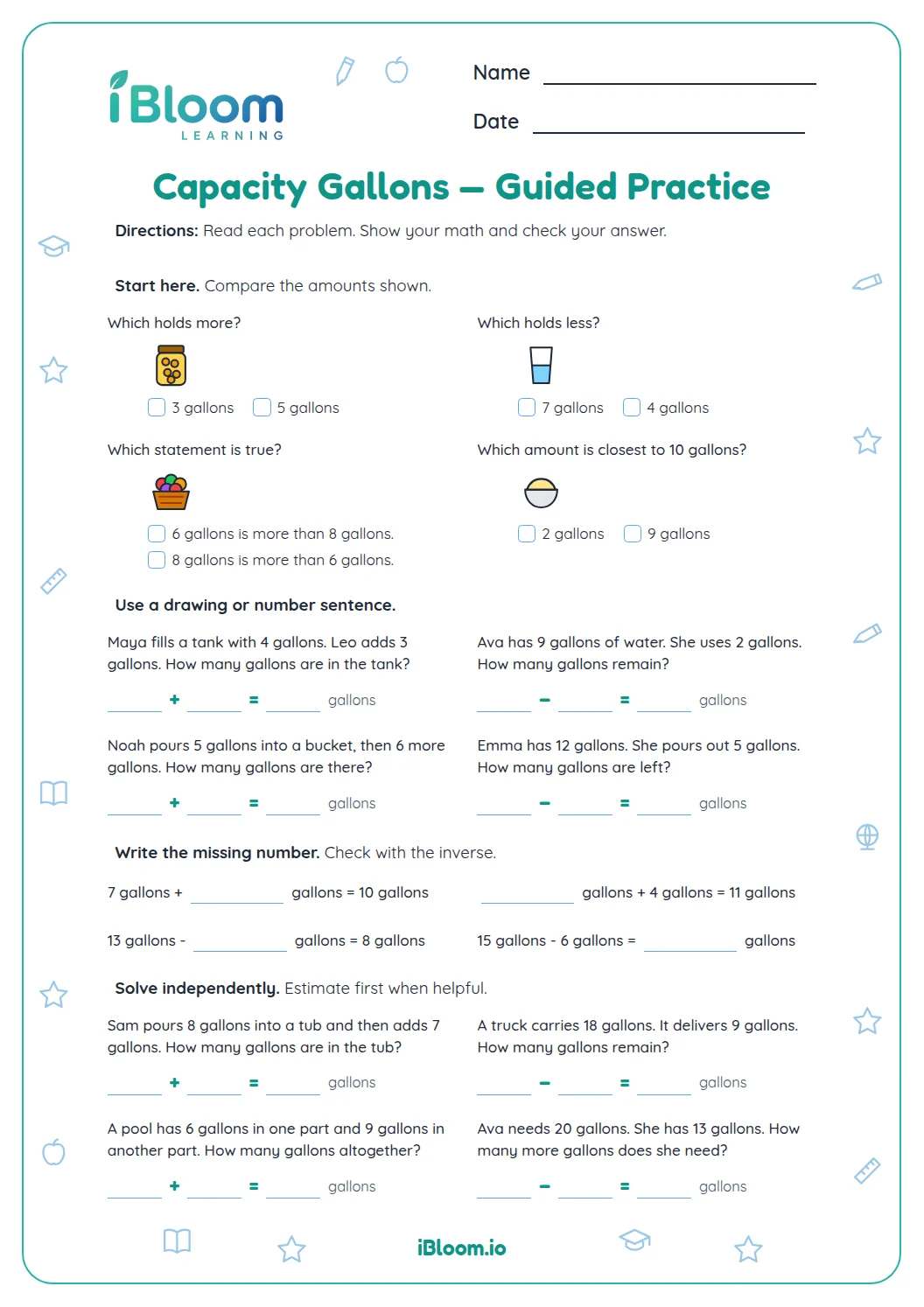
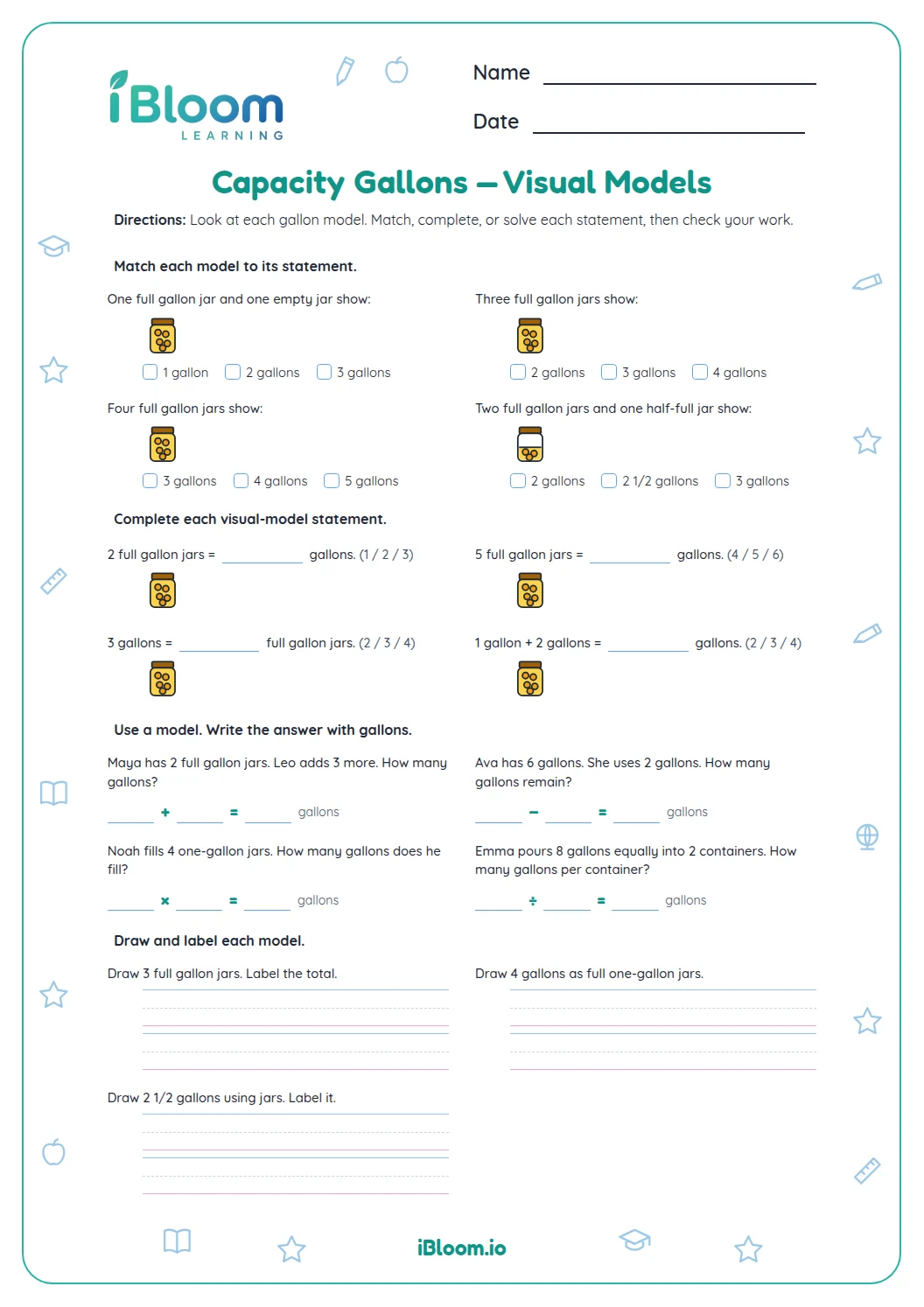
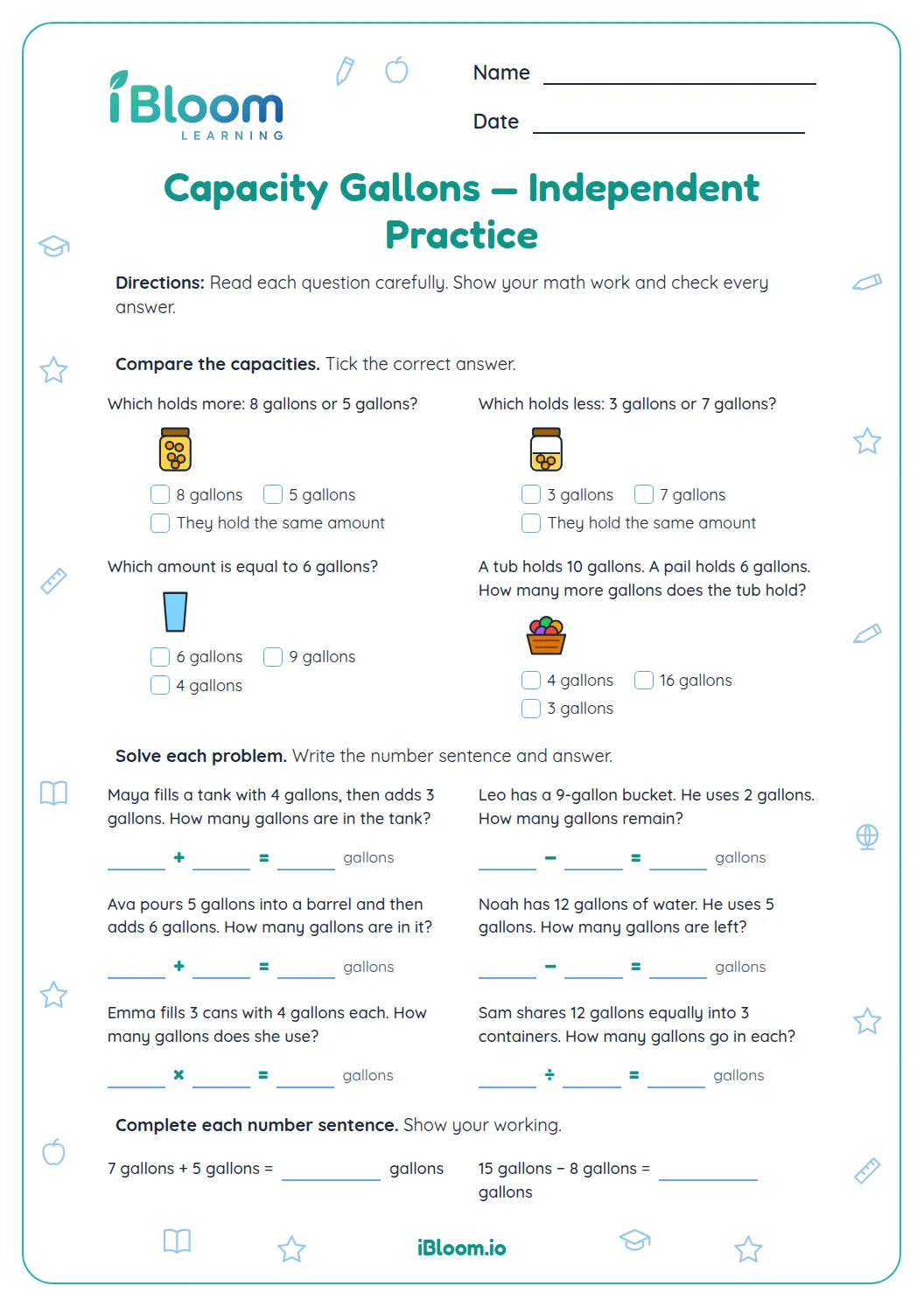
This Grade 2 printable introduces mass in grams and kilograms through familiar benchmarks and number relationships. Learners choose sensible units, use 1 kg = 1,000 g, split kilograms into equal groups, combine or compare masses, and reason about what is close to 1 kilogram. The 16 questions include a separate answer key with sample models for drawing prompts. Pictures of familiar objects and one drawing prompt asks for two models.
When should learners use grams or kilograms?
Use grams for a very light object such as a paper clip and kilograms for a heavy bag of rice. The worksheet also asks which of two masses is heavier or sensible for a strawberry.
- 1A paper clip has a mass close to 1 gram or 1 kilogram?
- 2A gram is the sensible choice for a paper clip.
How are kilograms and grams related?
One kilogram is 1,000 grams. Learners use this fact to convert 1 kg and 2 kg, and to express 1,500 g as 1 kg 500 g.
How do models show equal groups of mass?
The questions split 1 kg into two or four equal bags, balance it with 250 g weights, and combine or compare masses. One drawing prompt asks learners to represent 1 kg as equal parts and show 2 kg in a place-value model.
What is on the worksheet and key?
There are 16 questions across three worksheet pages. The answer key provides the conversions, comparisons, and sample descriptions for open modeling prompts.
How to use this worksheet
- 1Read the object or mass amount before choosing a unit.
- 2Remember that 1 kg equals 1,000 g.
- 3Convert kilograms to grams by multiplying by 1,000.
- 4For equal groups, divide the total grams by the number of groups.
- 5Compare amounts in the same unit when possible.
- 6Check the answer key and describe any drawn model.
Common mistakes and quick fixes
The mistake
Choosing kilograms for a tiny object such as a paper clip.
The fix
Use grams for light objects and kilograms for heavier masses.
The mistake
Writing 100 instead of 1,000 grams for 1 kilogram.
The fix
Recall the conversion: 1 kg = 1,000 g.
The mistake
Splitting 1 kg into four groups but dividing by two.
The fix
Convert to 1,000 g, then divide by the number of equal groups.
What to practice next
Make more practice
Questions parents and teachers ask
How many grams are in one kilogram?
One kilogram equals 1,000 grams. Several questions use this relationship directly, including converting 2 kg to grams and expressing 1,500 g as kilograms and remaining grams. Learners also use the conversion to reason about equal groups and compare amounts.
What objects help explain grams and kilograms?
The worksheet uses a paper clip as an example of an object with a small mass and a large bag of rice as a heavier object. Other picture prompts include familiar objects such as a pencil, fruit basket, and box. These examples help children choose sensible units.
Does the worksheet include visual models?
Yes. Pictures of a pencil, a bag of rice, and a strawberry support the unit choices. One draw prompt asks children to show 1 kg as two equal parts and 2 kg as grams in a place-value model. The answer key describes what a correct model may show.
How do equal groups connect to kilograms?
First express 1 kg as 1,000 g, then share those grams equally. Two equal groups contain 500 g each, and four equal groups contain 250 g each. The worksheet practices this reasoning with bags and with weights that balance a 1 kg scale.
How many questions and pages are included?
The printable includes 16 questions across three worksheet pages, plus a separate answer key. It covers unit choice, kilogram-to-gram conversions, comparisons, and equal groups. Print all worksheet pages so learners can see the full set of prompts and models.