





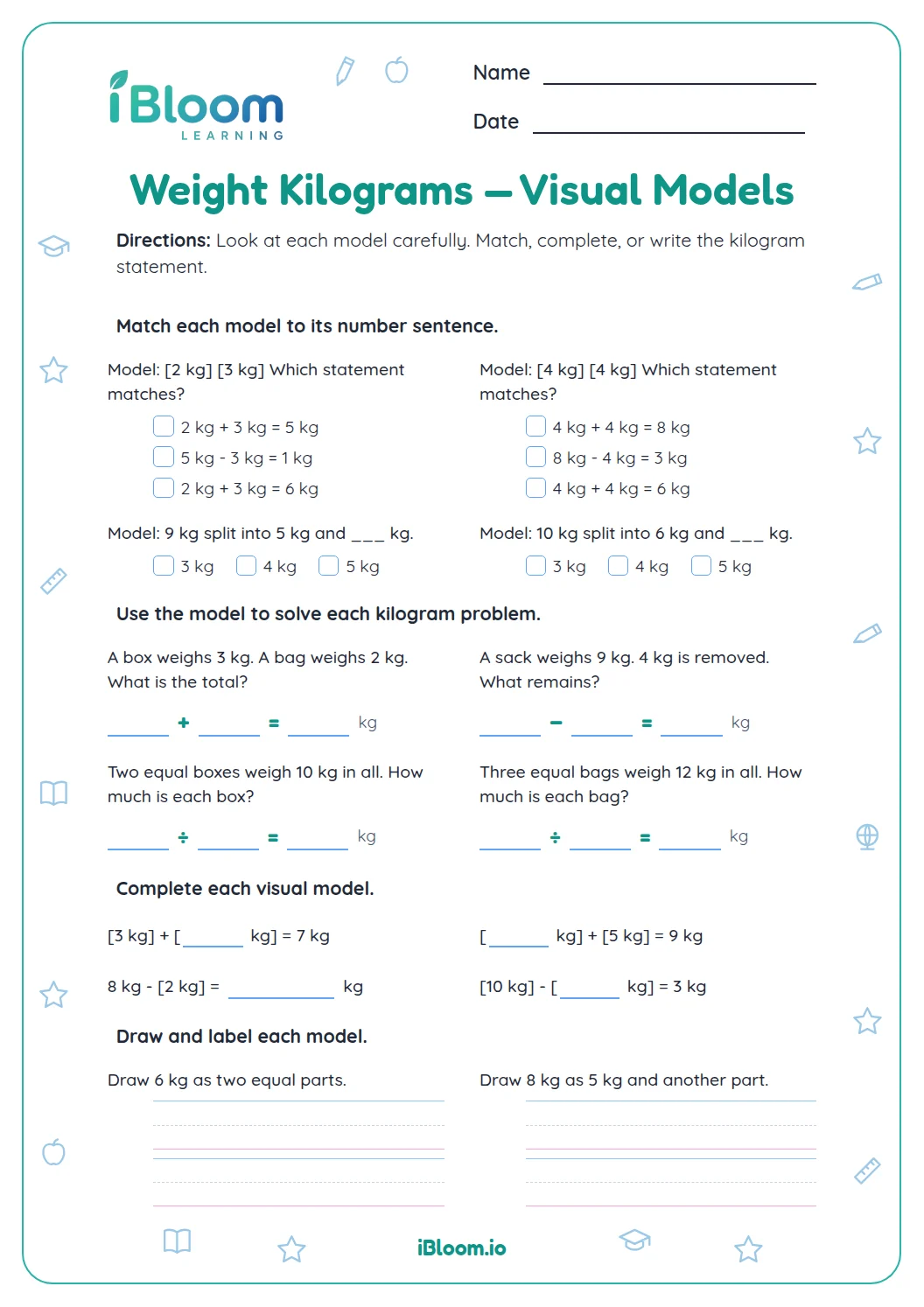
About this worksheet
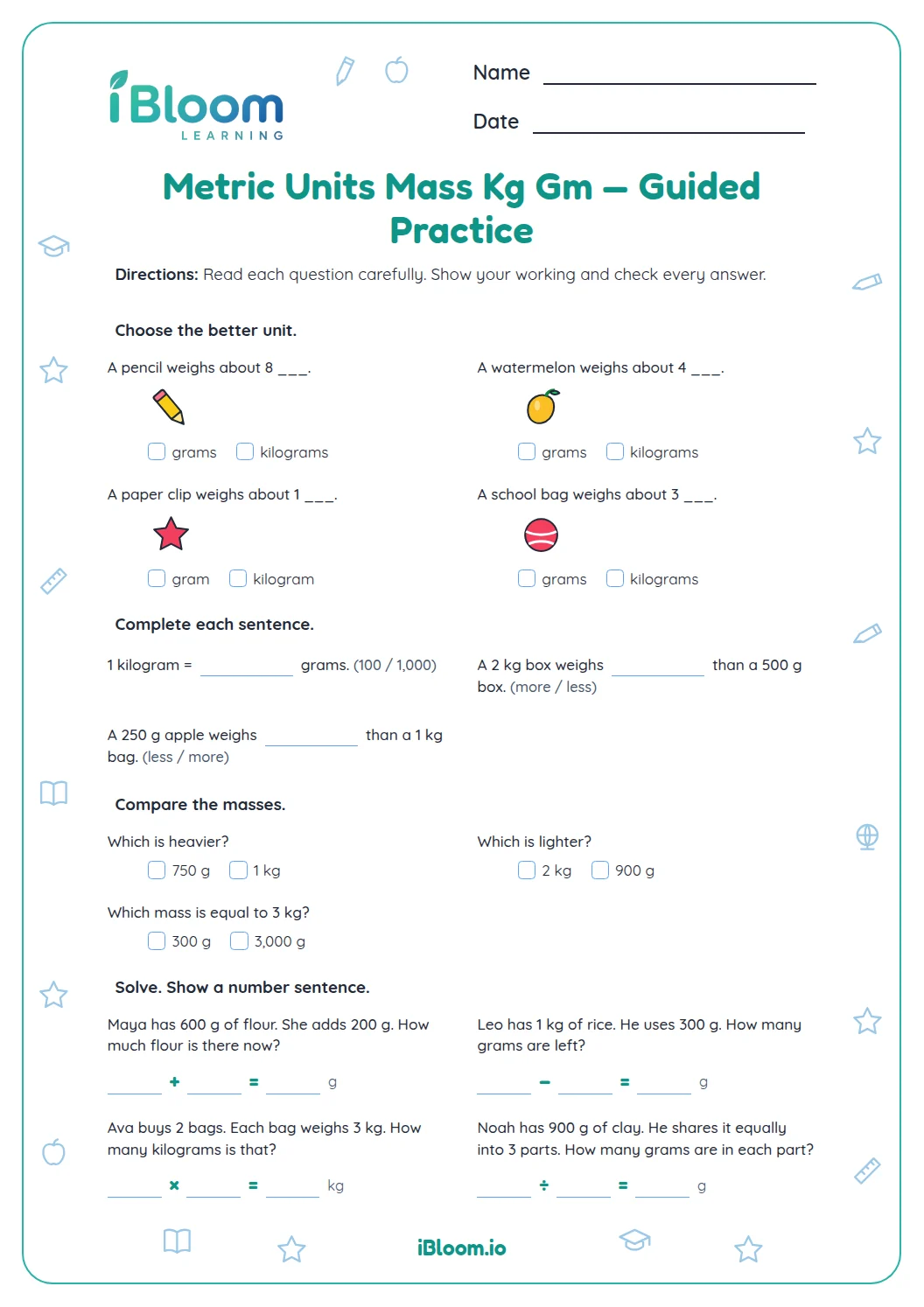
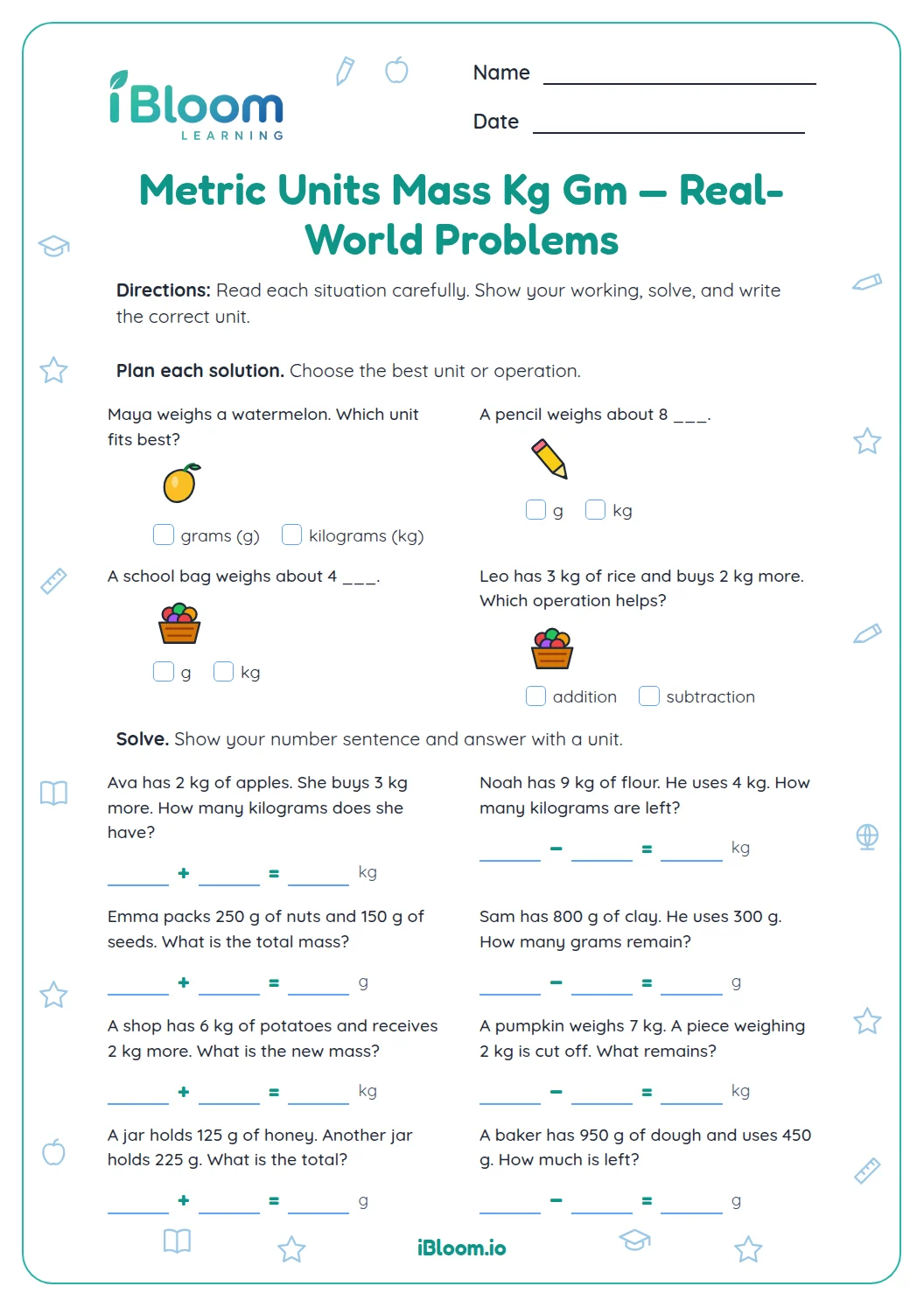
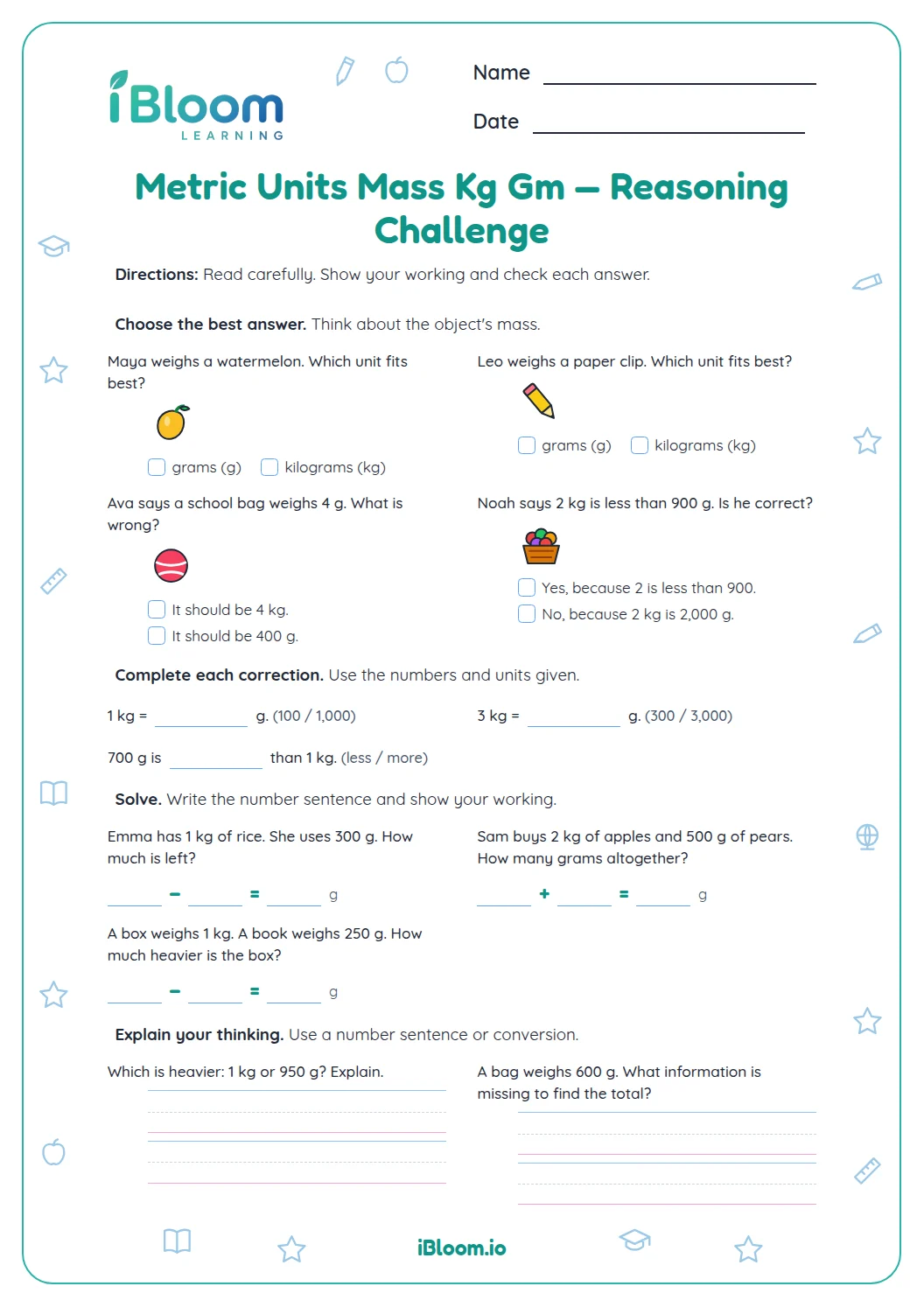
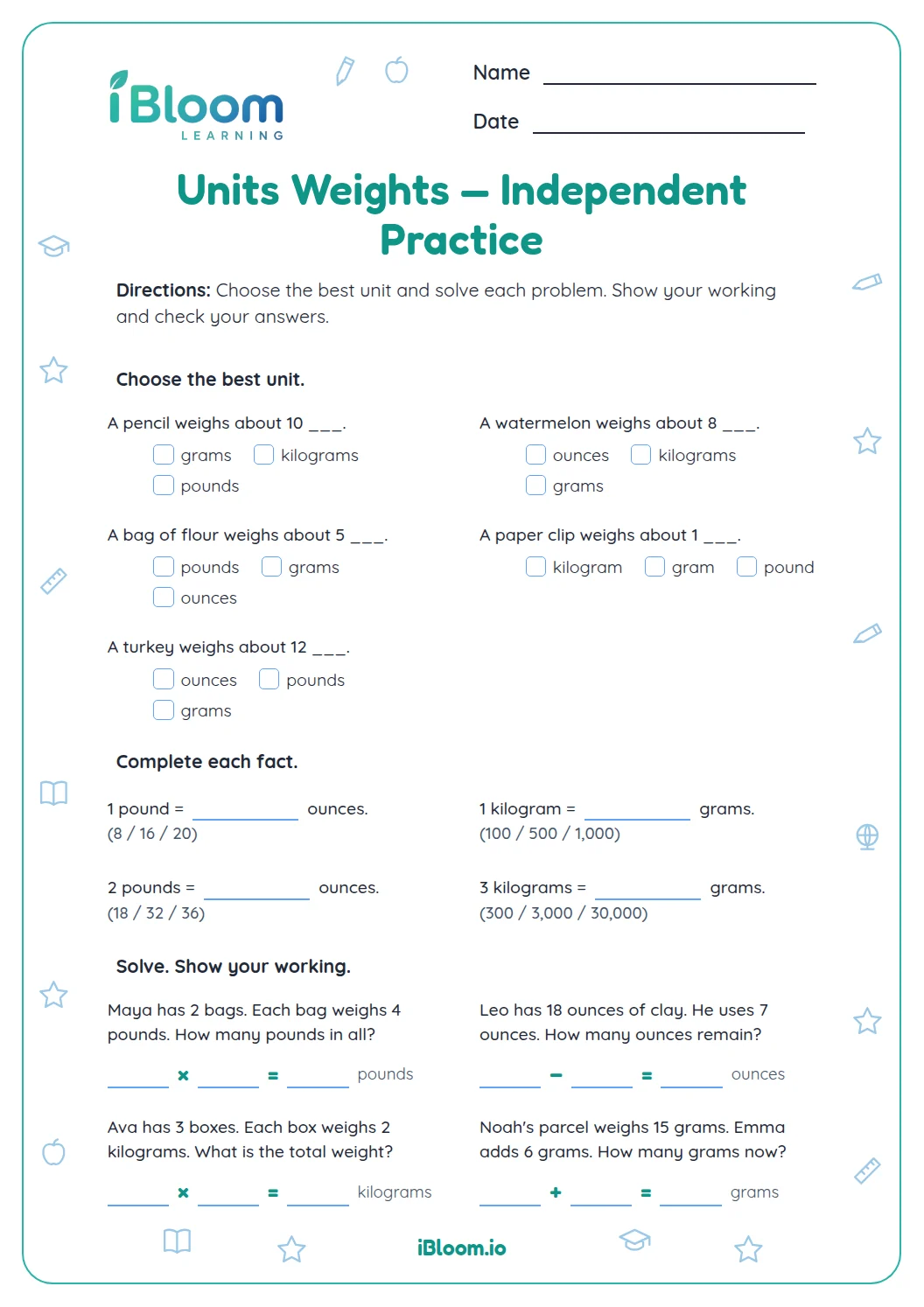
This independent-practice worksheet helps children work with metric mass units named in the page title. Five illustrated objects prompt a choice between grams and kilograms. Children then use the benchmark 1 kilogram = 1,000 grams, compare amounts, and solve six short addition or subtraction problems with like units. The answer key includes units with each answer. The unit relationship aligns with CCSS 4.MD.A.1, which names kilograms and grams.
Aligned to 4.MD.A.1
When is a mass measured in grams or kilograms?
Grams are a useful unit for small masses, such as a pencil or small rock. Kilograms are useful for larger masses, such as a backpack or watermelon. The best unit depends on the object and the amount being described.
What is the relationship between kilograms and grams?
One kilogram equals 1,000 grams. This benchmark helps compare measures in the two units and gives a reference for thinking about a kilogram.
- 1Which amount equals 1 kilogram?
- 2Recall that one kilogram contains 1,000 grams.
- 3Answer: 1000 g.
How can children solve a mass word problem?
For a mass word problem, identify the unit and decide whether mass is added or removed. Calculate with like units, then select the answer with the correct amount and unit. For example, subtract 250 g from 750 g to find the flour remaining.
- 1Emma uses 250 g from 750 g of flour. How many grams remain?
- 2Subtract: 750 − 250 = 500.
- 3Choose 500 g.
What kinds of practice appear here?
The worksheet begins with five object-and-unit choices, then checks a kilogram benchmark, mass comparisons, and reasonable estimates. Six multiple-choice word problems use addition or subtraction with amounts already in the same unit.
How to use this worksheet
- 1Read the object or situation and note the unit.
- 2Use 1 kg = 1,000 g when comparing the two units.
- 3For a comparison, check both the number and unit before deciding.
- 4For a story problem, calculate and select the matching amount and unit.
- 5Check the answer key for both the amount and the unit.
Common mistakes and quick fixes
The mistake
Choosing kilograms for a tiny object.
The fix
Use grams for small masses such as a paper clip or marble.
The mistake
Comparing only the number and ignoring the unit.
The fix
Remember that 1 kg is 1,000 g before comparing a kilogram amount with grams.
The mistake
Adding or subtracting different units as if they matched.
The fix
Check that the amounts use the same unit before calculating; choose an answer with the matching unit.
Common Core alignment
The worksheet practices the named metric mass relationship between kilograms and grams.
Relate kilograms to grams and express a simple mass in a smaller unit.
On this sheet: The unit choice and 1 kg = 1,000 g items practice relative size and a kilogram-to-gram equivalent.
Show the official wordingHide the official wording
Know relative sizes of measurement units within one system of units including km, m, cm; kg, g; lb, oz.; l, ml; hr, min, sec. Within a single system of measurement, express measurements in a larger unit in terms of a smaller unit. Record measurement equivalents in a two-column table. For example, know that 1 ft is 12 times as long as 1 in. Express the length of a 4 ft snake as 48 in. Generate a conversion table for feet and inches listing the number pairs (1, 12), (2, 24), (3, 36), ...
What to practice next
Make more practice
Further reading
Questions parents and teachers ask
What is the difference between grams and kilograms?
A gram is a smaller metric mass unit, and a kilogram is larger. One kilogram equals 1,000 grams. On this sheet, children choose a sensible unit for familiar objects and use that benchmark to compare kilogram and gram amounts.
Which objects are measured in grams?
Small objects, such as a paper clip or marble, are sensibly described in grams. Larger objects such as a backpack or watermelon are more reasonably described in kilograms. The worksheet asks children to make these unit choices from familiar examples.
Can my Grade 2 child do unit conversions?
This page asks children to use the simple benchmark, 1 kilogram = 1,000 grams, because kilograms and grams are named in the worksheet topic. The six calculation questions add or subtract amounts already written in the same unit, and the child selects the result.
Why should children write the unit in each answer?
The number alone does not say what was measured. Adding 2 kg and 3 kg gives 5 kg, while adding 900 g and 100 g gives 1,000 g. Each answer choice includes its unit, and children select the amount that matches their calculation.
What is in the answer key?
The separate key marks the unit choices and comparisons, gives the kilogram benchmark, and shows the results of all six word problems with their units. For example, 750 g − 250 g equals 500 g. Children can check both the amount and the unit.