Free printable practice
Metric Units Mass Kg Gm Practice Activities
Grade 2 worksheets for choosing and comparing kilograms and grams as metric units of mass in everyday measurement situations.
Free printable worksheet PDFs
Preview every available page, then download the free worksheet PDF for home, homeschool, tutoring, or classroom practice.
Preview the exact activity before downloading it.
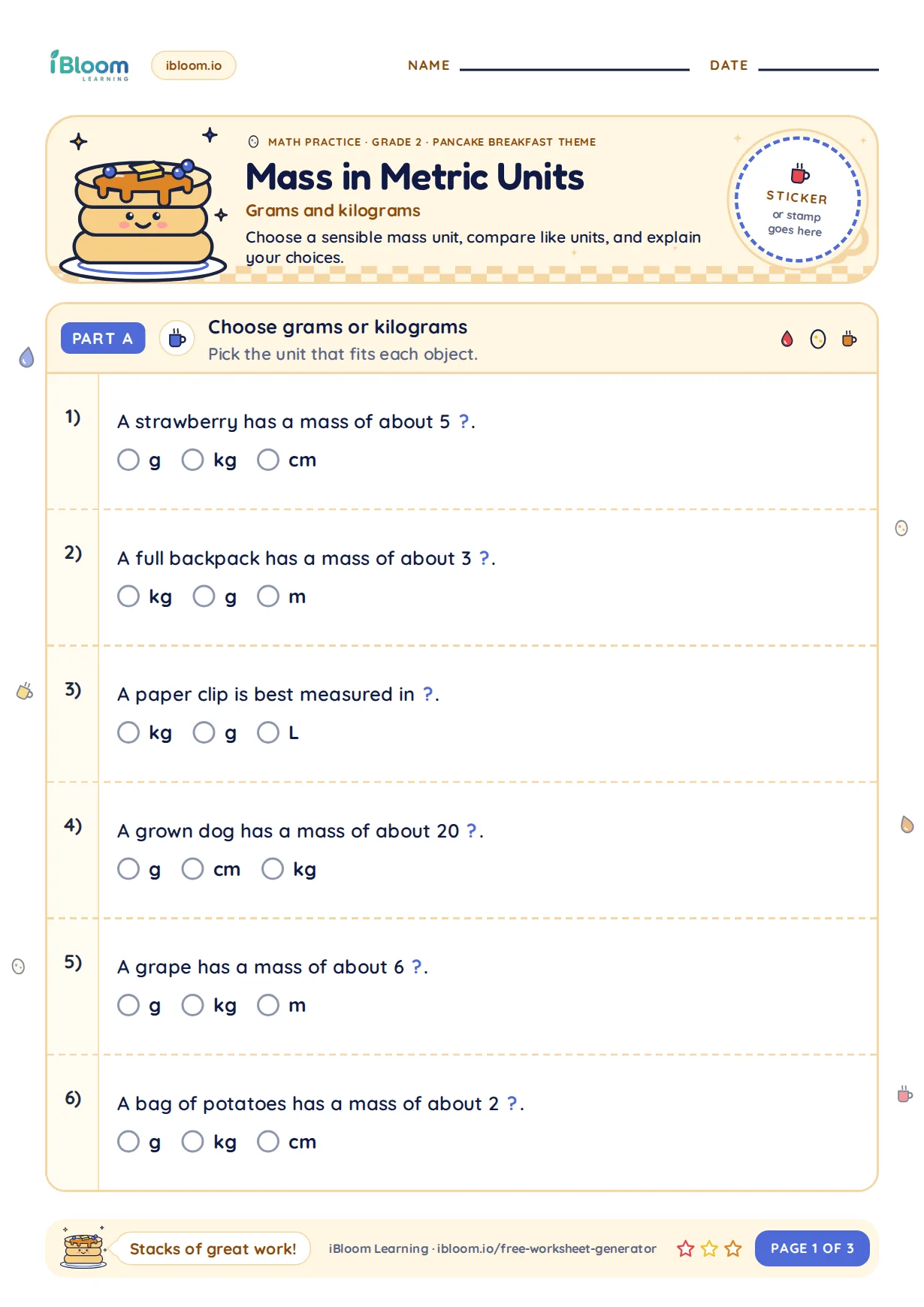 Metric Units Mass Kg Gm — Concept FoundationsGrade 2 worksheets for choosing and comparing kilograms and grams as metric units of mass in everyday measurement situations. This Grade 2 foundations worksheet adds concise teaching notes, worked examples, and supported first attempts.Grade 2Free PDF preview
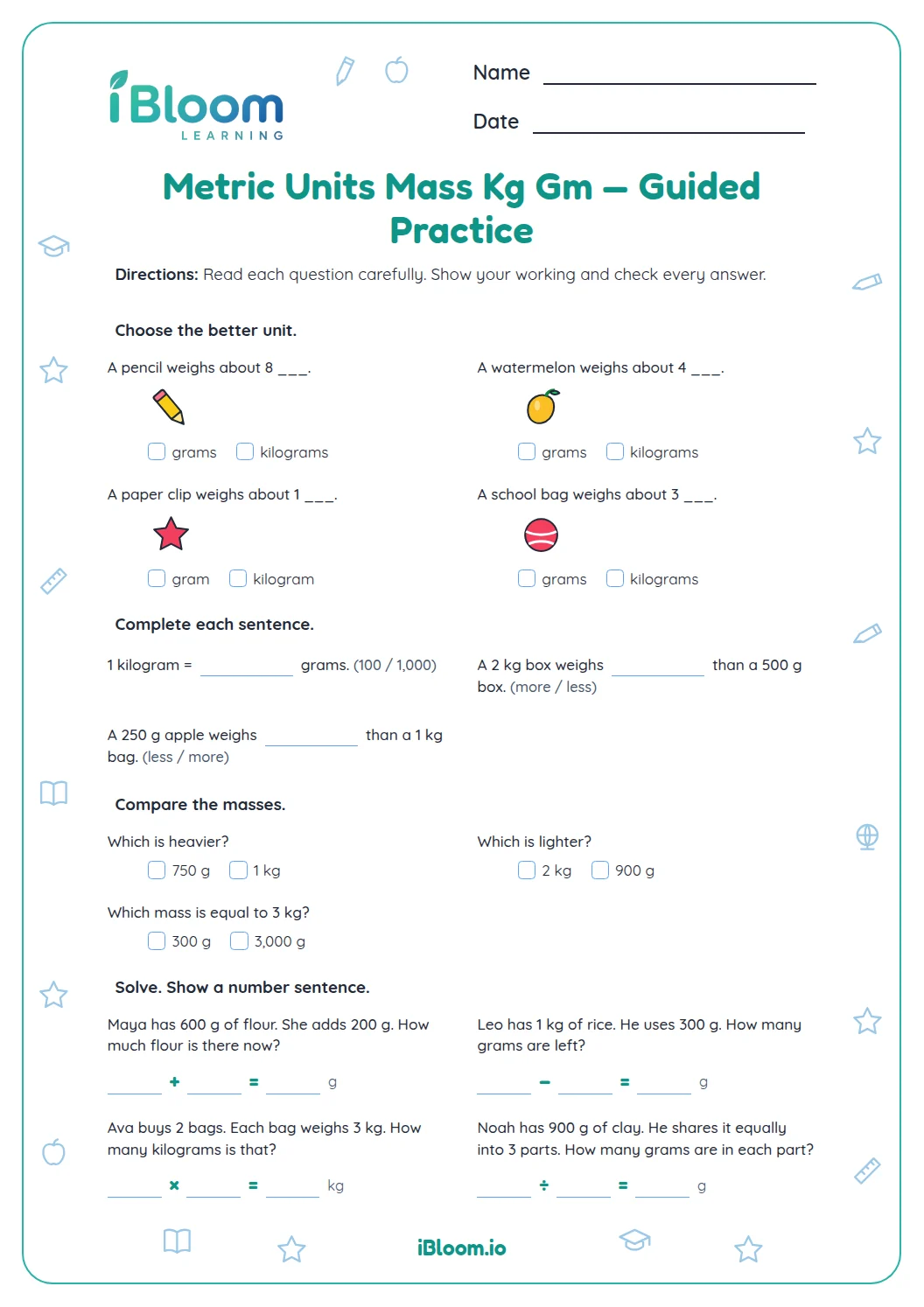 Metric Units Mass Kg Gm — Guided PracticeGrade 2 worksheets for choosing and comparing kilograms and grams as metric units of mass in everyday measurement situations. This Grade 2 guided-practice worksheet progresses from prompts and checkpoints to independent questions.Grade 2Free PDF preview6 pages
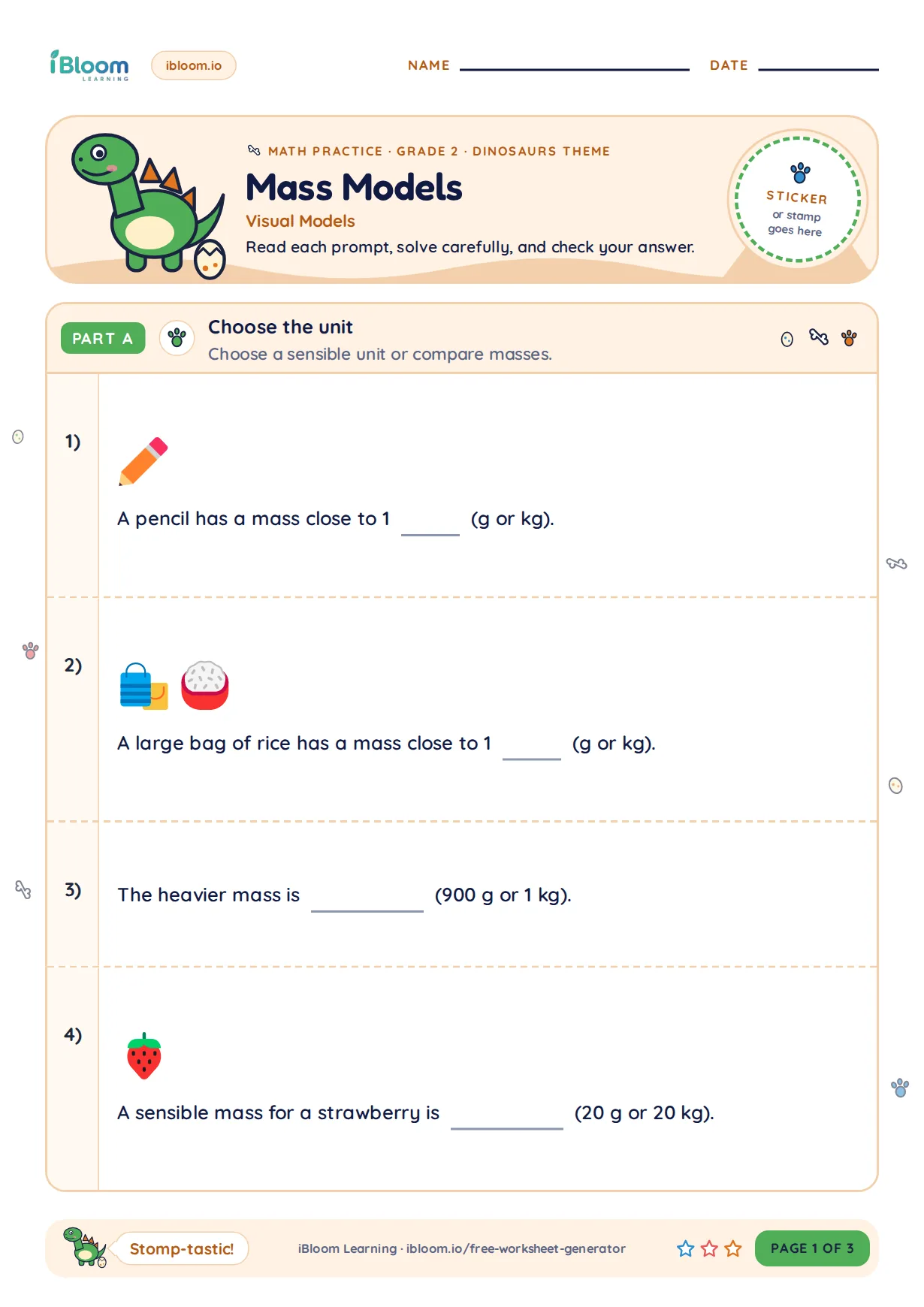 Metric Units Mass Kg Gm — Visual ModelsGrade 2 worksheets for choosing and comparing kilograms and grams as metric units of mass in everyday measurement situations. This Grade 2 visual-model worksheet connects suitable diagrams, tables, number lines, or place-value models to mathematical notation.Grade 2Free PDF preview4 pages
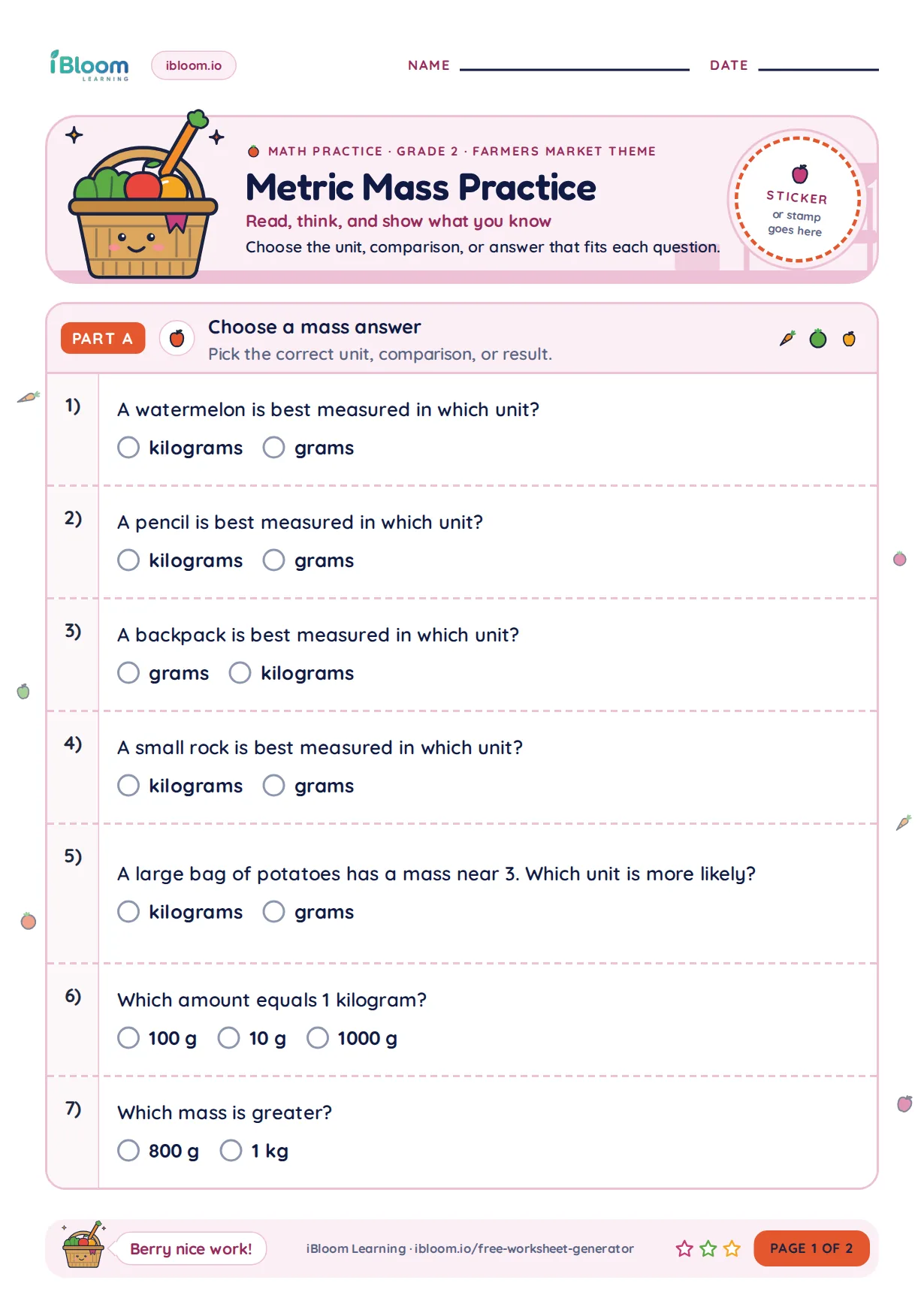 Metric Units Mass Kg Gm — Independent PracticeGrade 2 worksheets for choosing and comparing kilograms and grams as metric units of mass in everyday measurement situations. This Grade 2 independent-practice worksheet provides a balanced sequence of accurate, grade-level exercises.Grade 2Free PDF preview
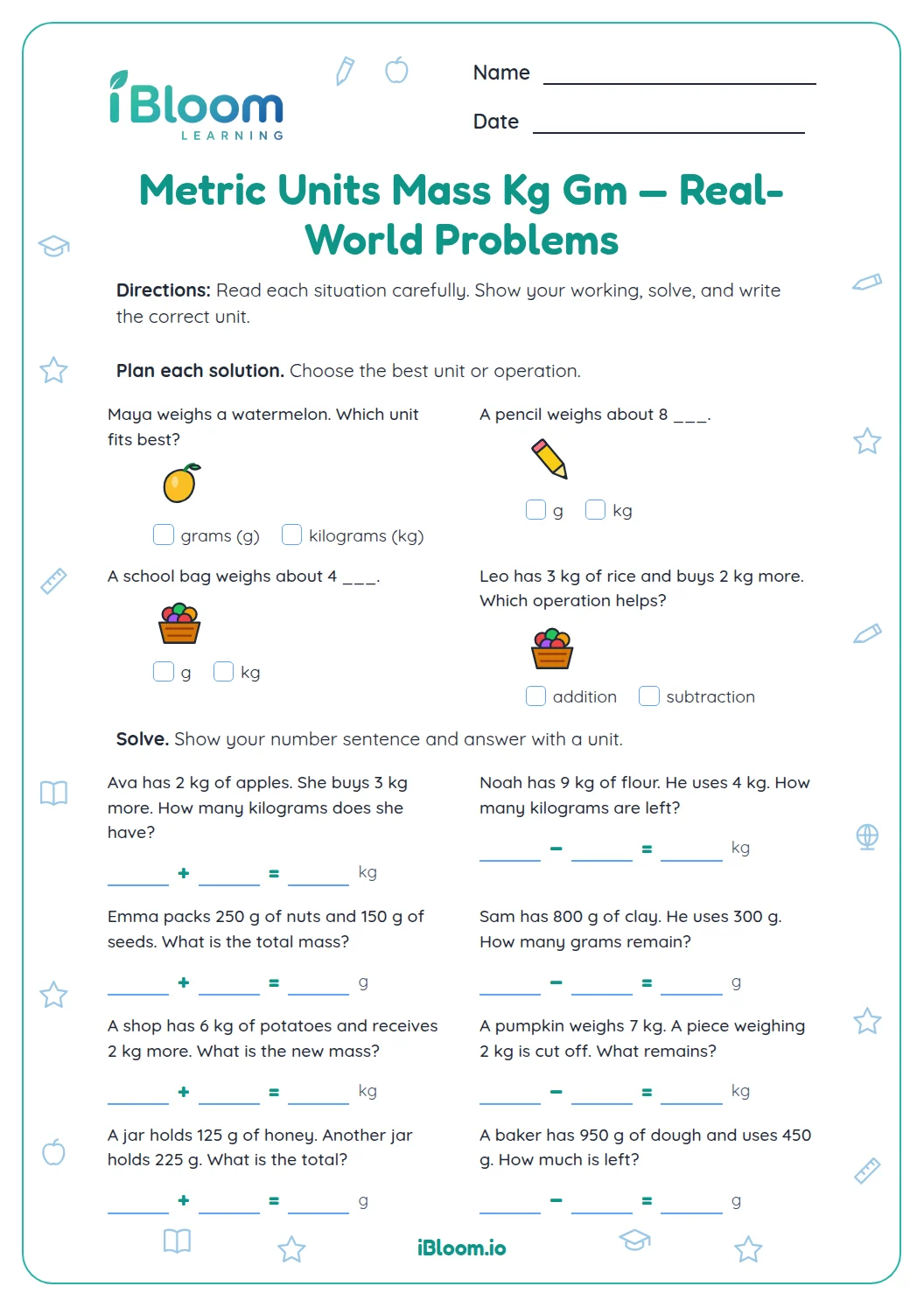 Metric Units Mass Kg Gm — Real-World ProblemsGrade 2 worksheets for choosing and comparing kilograms and grams as metric units of mass in everyday measurement situations. This Grade 2 application worksheet uses realistic one-step and multi-step situations with room to model and solve.Grade 2Free PDF preview
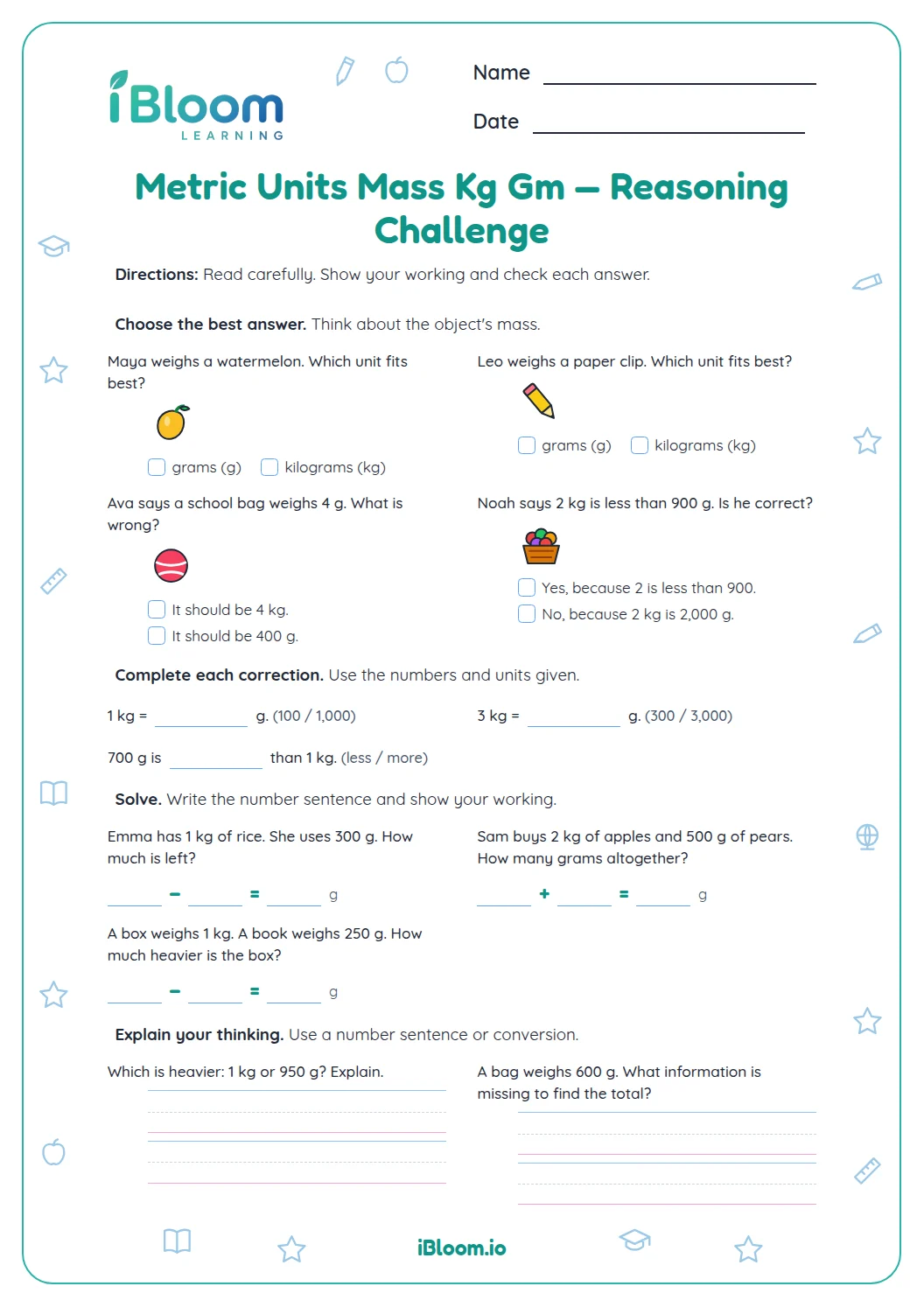 Metric Units Mass Kg Gm — Reasoning ChallengeGrade 2 worksheets for choosing and comparing kilograms and grams as metric units of mass in everyday measurement situations. This Grade 2 reasoning worksheet combines error analysis, strategy comparison, missing information, and a gentle extension.Grade 2Free PDF preview
Practice that builds confidence
Building a Sense of Metric Mass
These Grade 2 metric mass worksheets help children understand when to measure in kilograms and when to measure in grams. Students practise connecting the units to real objects, such as a bag of rice, a book, an apple, or a paper clip, so the ideas feel concrete instead of memorized.
The printable activities include unit choice, simple comparisons, labeling, and reasoning about heavier and lighter objects using kg and g. Children build measurement vocabulary while learning that kilograms are used for heavier things and grams are used for lighter things.
Mass tells how heavy an object is. In Grade 2, children do not need complex conversions; they need a strong feel for the two common metric units. A kilogram, written kg, is useful for heavier everyday objects. A gram, written g, is useful for much lighter objects. These worksheets guide students to match objects with sensible units and to talk about mass using words such as heavier, lighter, measure, estimate, kilogram, and gram.
How the Practice Progresses
The collection begins with familiar object examples so children can decide whether kg or g makes sense. From there, students compare objects, read short measurement statements, and choose appropriate labels. A question might ask whether a watermelon is better measured in kilograms or grams, or whether a pencil is likely to have a mass of a few grams or several kilograms. This progression helps students move from guessing to using reasoning.
A Simple Parent Routine
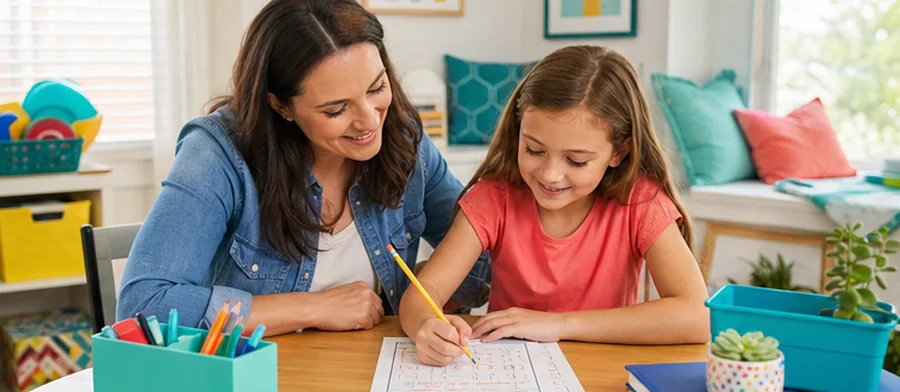
At home, place four objects on a table: for example, a spoon, an apple, a backpack, and a bag of flour. Ask your child to sort them into “probably grams” and “probably kilograms.” Then read one worksheet item together and ask, “Is this object light enough for grams, or heavy enough for kilograms?” If you have a kitchen scale or bathroom scale, let your child see the unit shown and connect the number to the object.
Classroom Uses for Teachers
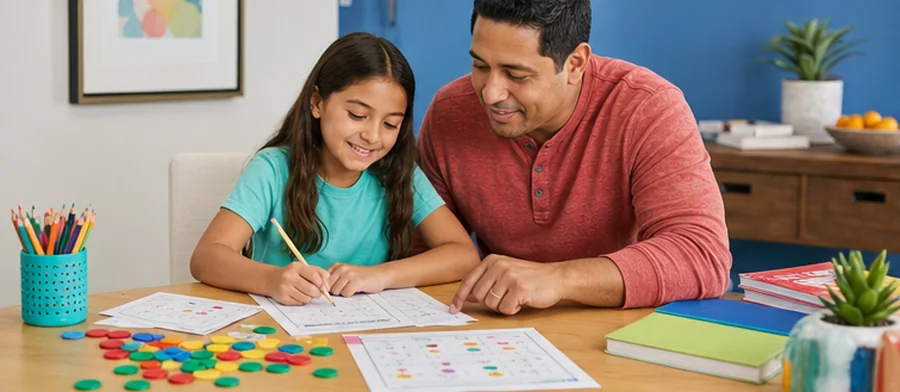
Teachers can use these pages during measurement centers, small-group review, or independent practice after a hands-on weighing lesson. They also work well as a quick check for whether students understand unit choice before introducing more formal measuring tools. Pairing a worksheet with real classroom objects, such as erasers, water bottles, books, and lunch boxes, makes the written practice more meaningful.
Common Errors to Watch For
Some children think a bigger object is always heavier, so they may choose kg only because something looks large. Others confuse the abbreviations and write gm instead of g, or use kilograms for every object because the word sounds more familiar. Encourage students to pause and imagine lifting the object. A feather, coin, or crayon is usually measured in grams; a child, chair, or full school bag is usually measured in kilograms.
Free printable PDF download
Use this Grade 2 metric mass kg g worksheet page to preview the activity, print it, or download it as a PDF for quick practice. It works well for homework, homeschool lessons, tutoring, morning work, revision, and classroom centers.
Answers and answer key support
After the child completes the worksheet independently, parents and teachers can use the answer support or answer key information to check the work, review mistakes, and choose the next practice step.
Why iBloom Worksheets Help
iBloom worksheets keep the focus on one clear Grade 2 skill: choosing and using kg and g sensibly. The activities use everyday examples, repeated vocabulary, and visual decision-making so children build practical measurement judgment. Child-friendly strategy: “Think lift first—tiny and light means grams, heavy to carry means kilograms.”
Helpful answers
Frequently asked questions
What do Grade 2 students practise in these kg and g worksheets?
They practise choosing the sensible metric unit for mass, using kilograms for heavier objects and grams for lighter objects, while comparing and describing everyday items.
Do these worksheets require converting kilograms to grams?
No. The focus is on understanding and selecting the correct unit, not on formal conversion between kg and g.
How can I explain the difference between a kilogram and a gram to my child?
Use real objects. A paper clip, coin, or pencil is measured in grams, while a backpack, bag of rice, or child is measured in kilograms.
Are these worksheets useful without a weighing scale?
Yes. Children can complete the pages by reasoning from familiar objects, though using a kitchen or bathroom scale can make the ideas more concrete.
What mistake should I watch for when my child writes the units?
Students may mix up the abbreviations. Kilogram is written kg, and gram is written g. In science and math contexts, g is the standard symbol for gram.
Is this Grade 2 metric mass kg g worksheet free?
Yes. You can preview it for free and use the printable worksheet for home or classroom practice.
Can I download this Grade 2 metric mass kg g worksheet as a PDF?
Yes. Use the worksheet download option to save a printable PDF, or print the worksheet directly from the page.
Does this Grade 2 metric mass kg g worksheet include answers or an answer key?
When the activity has fixed answers, iBloom includes answer support so parents and teachers can check the completed worksheet.