



About this worksheet
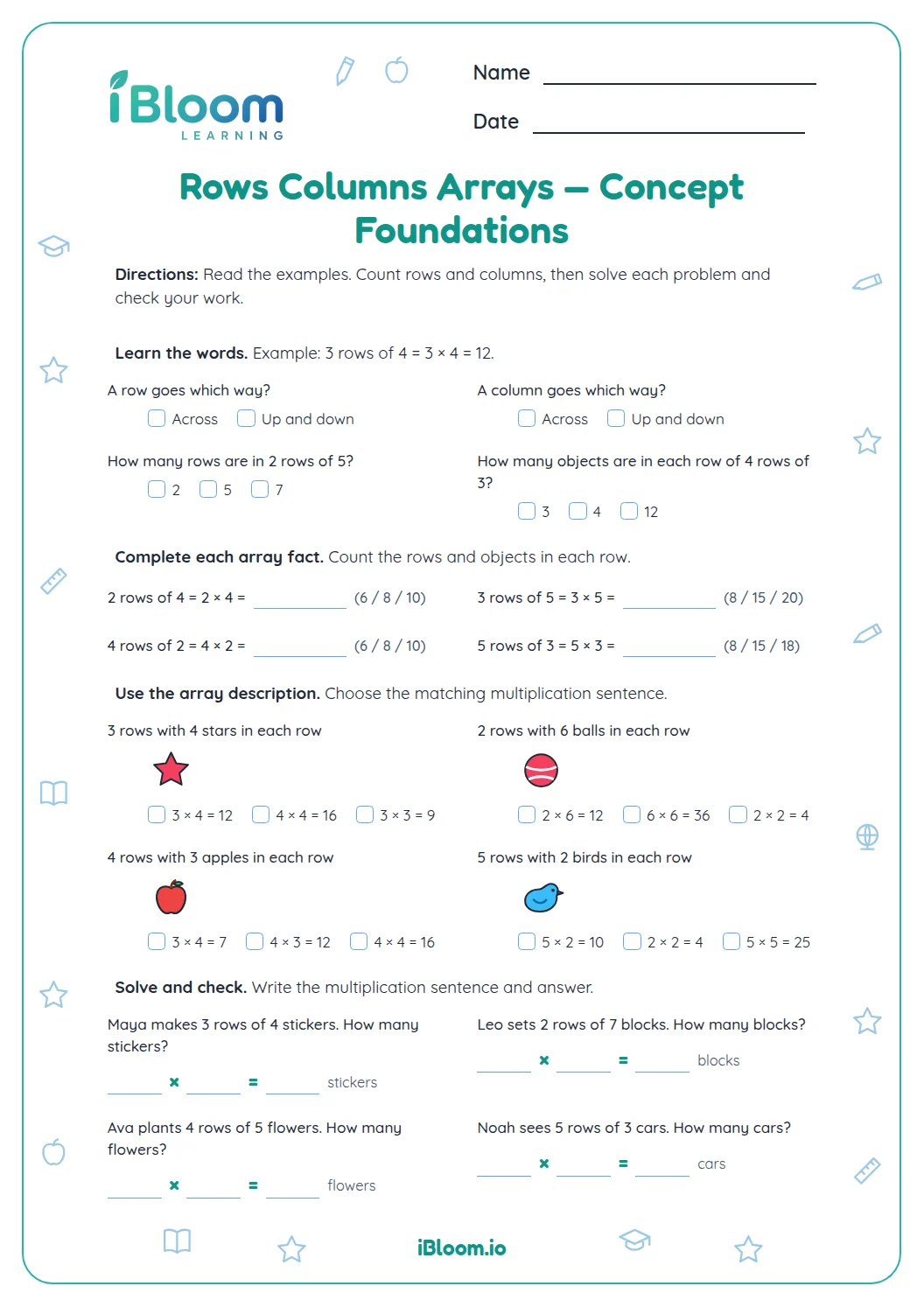
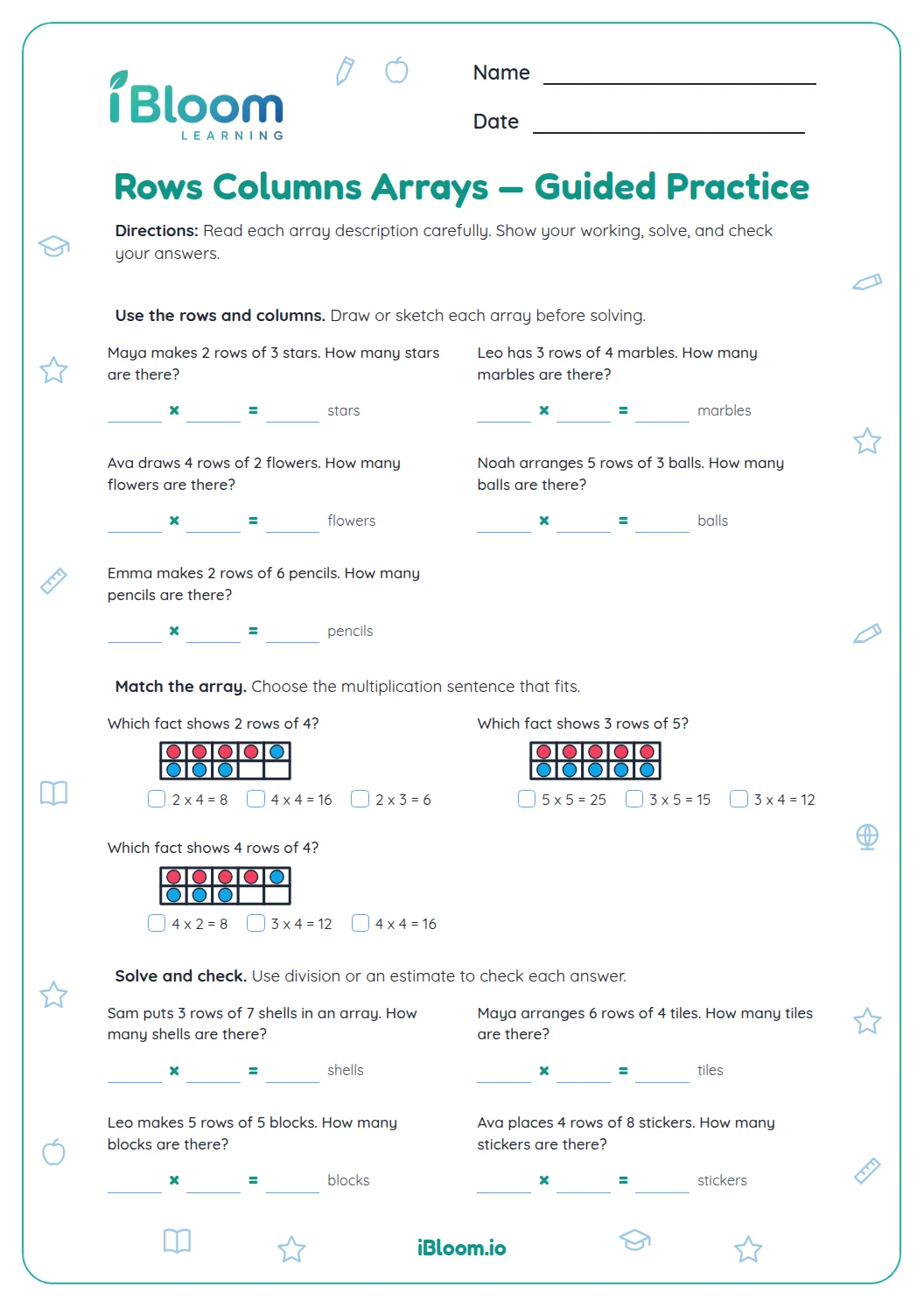
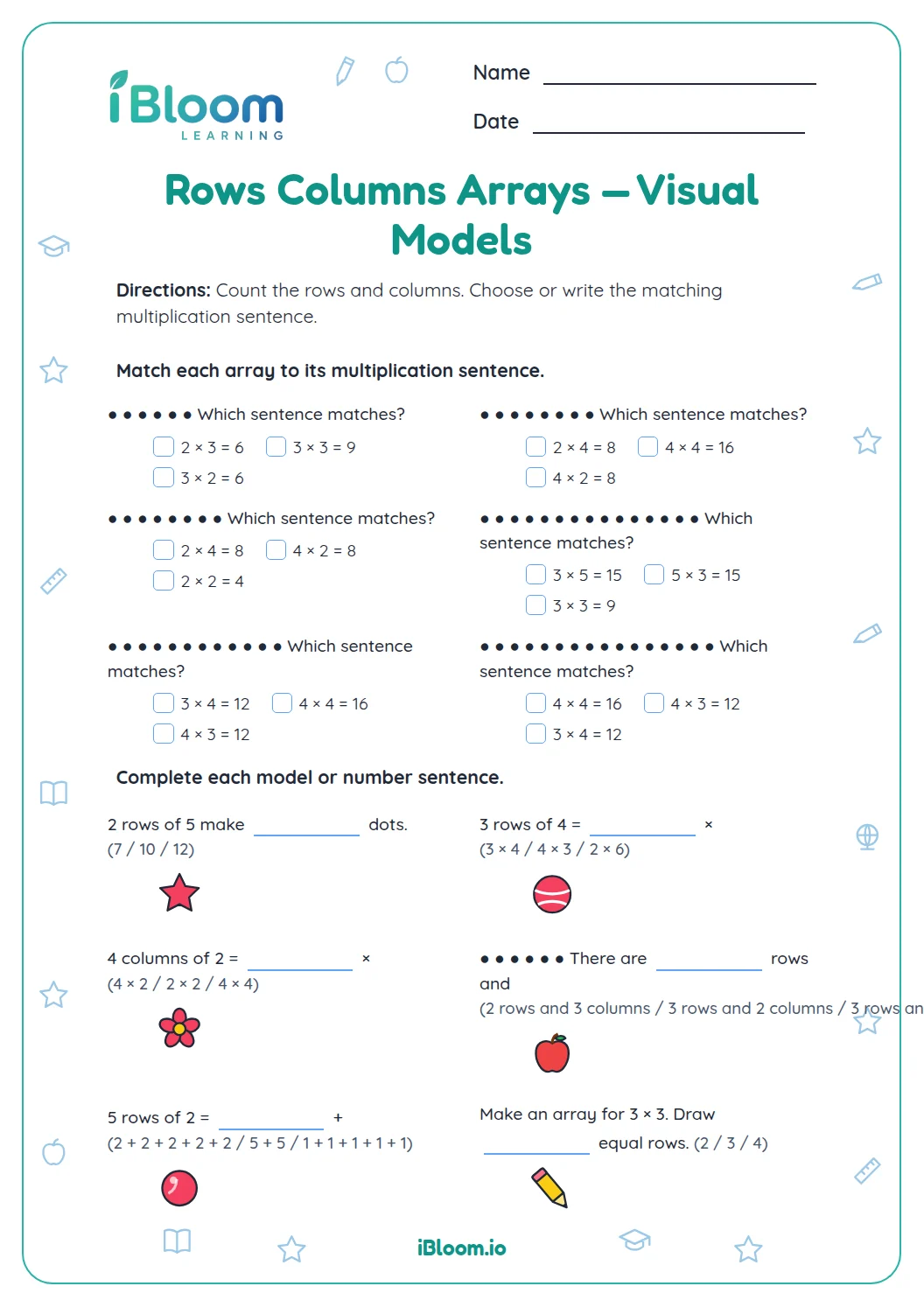
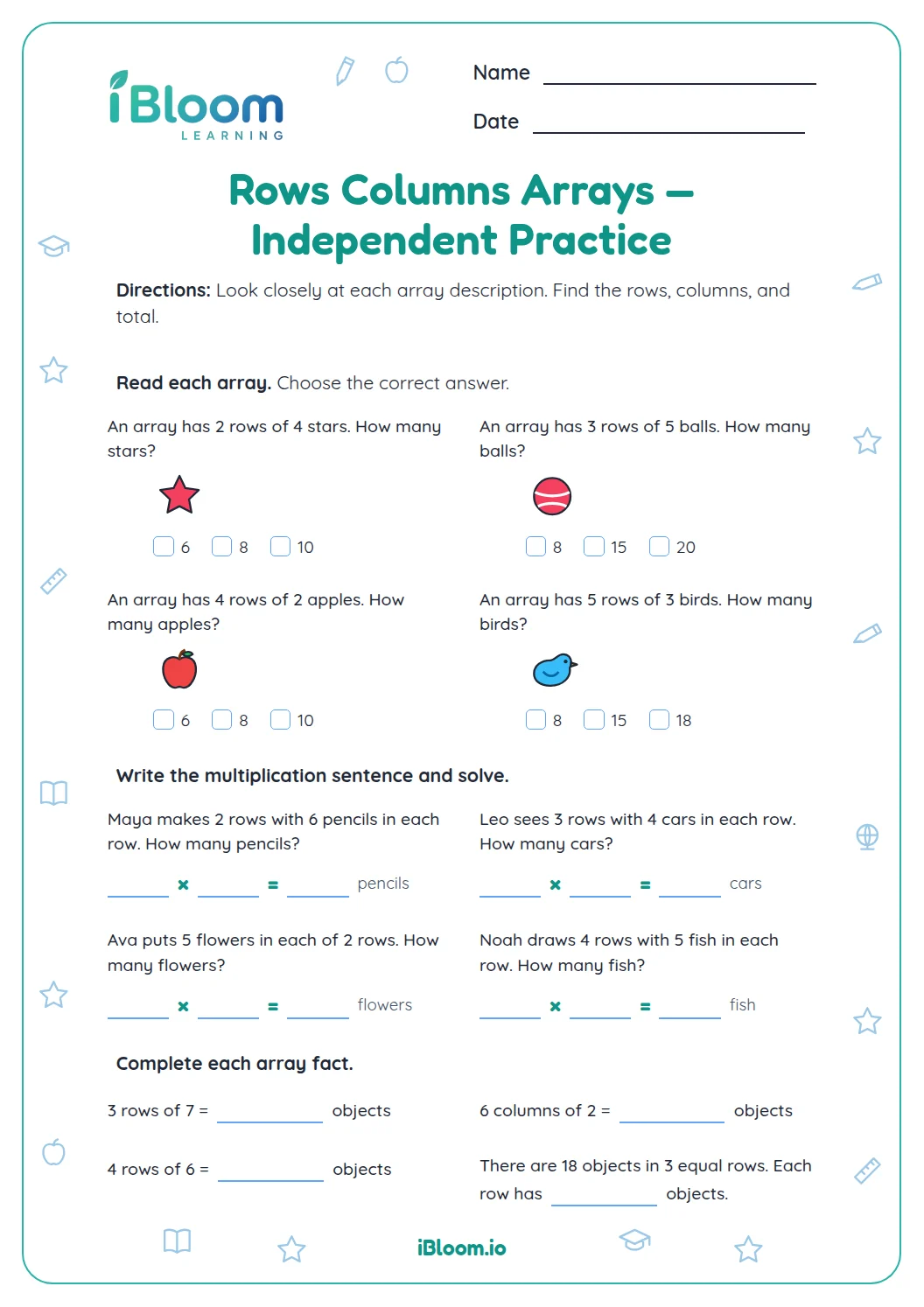
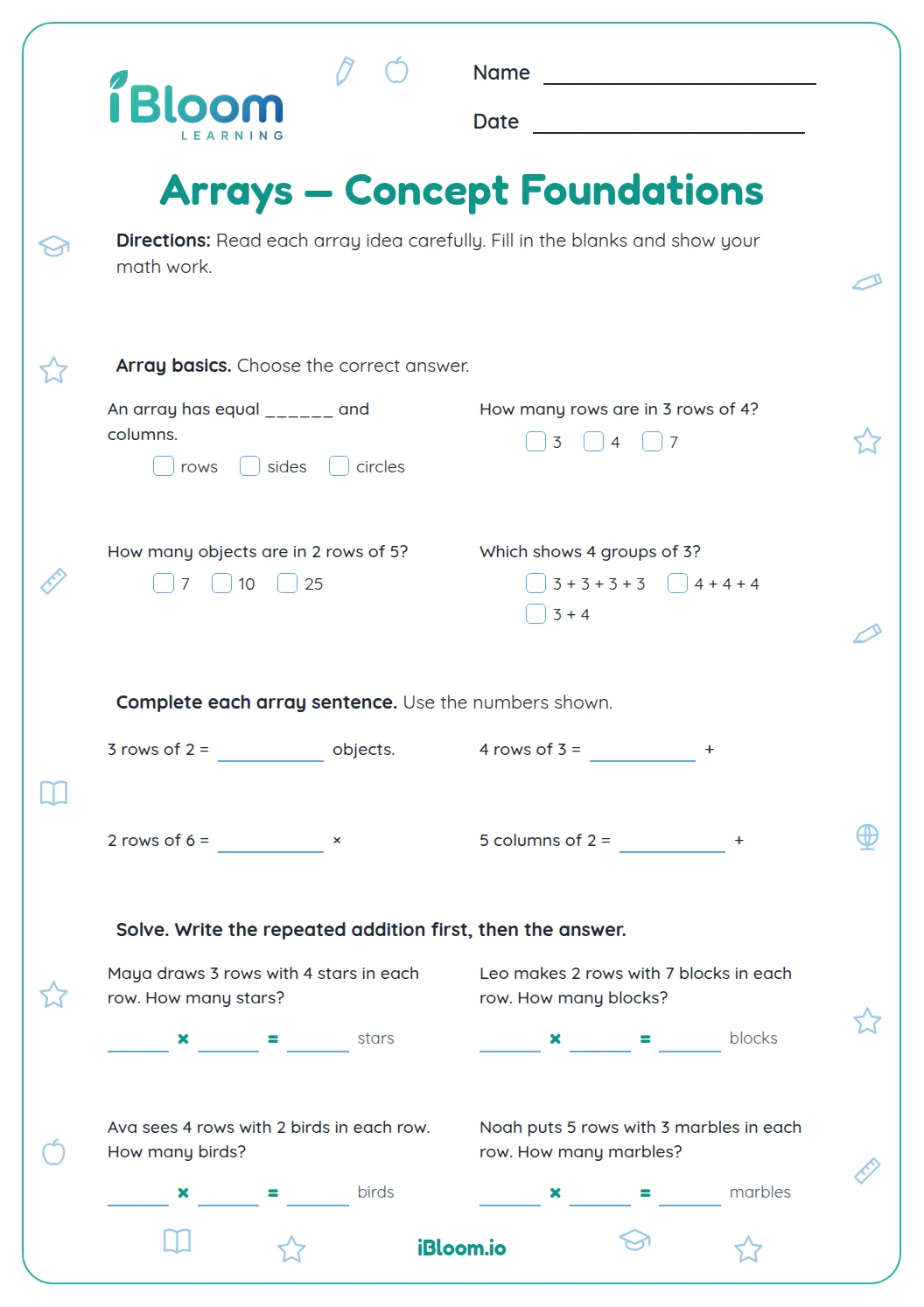
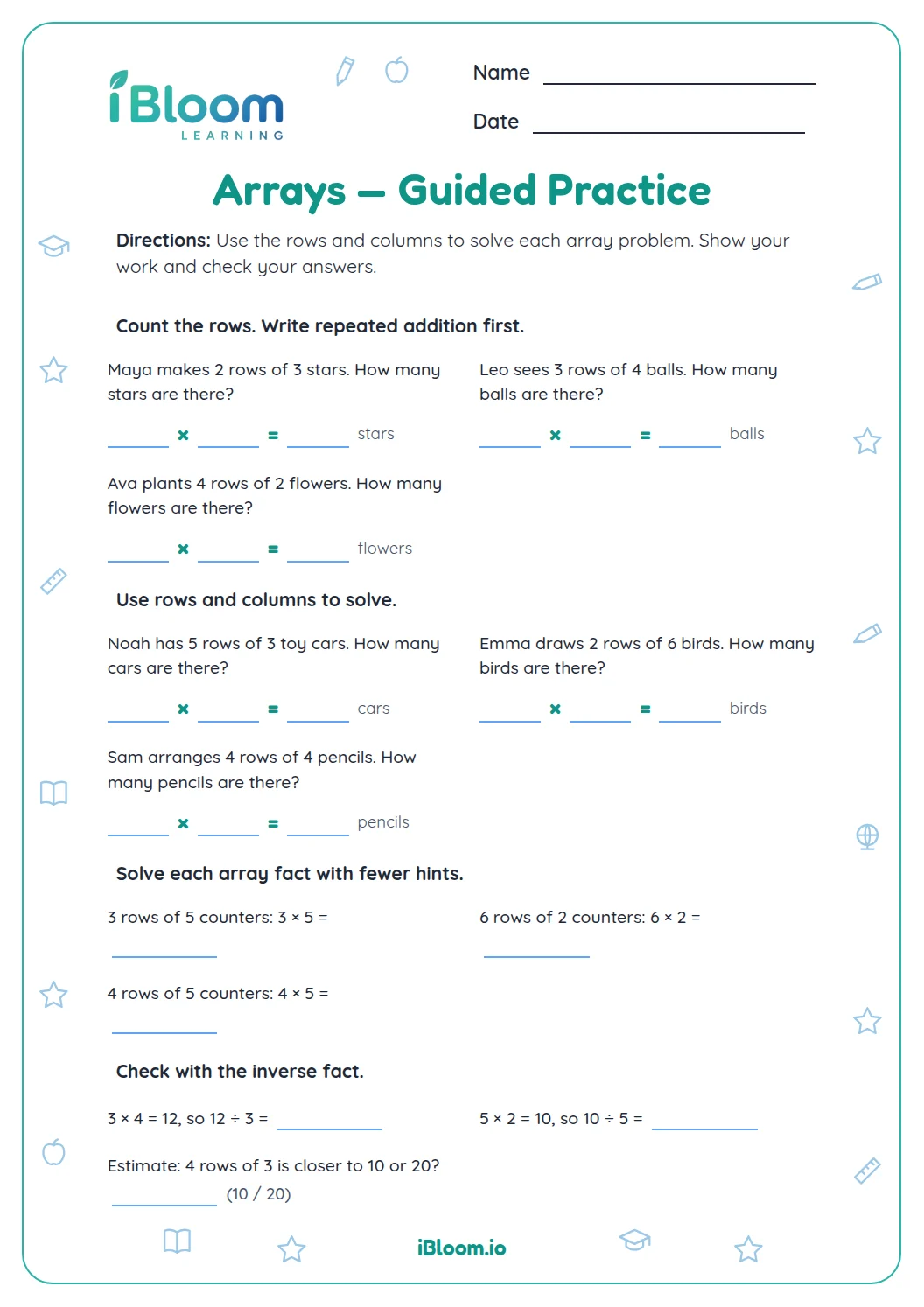
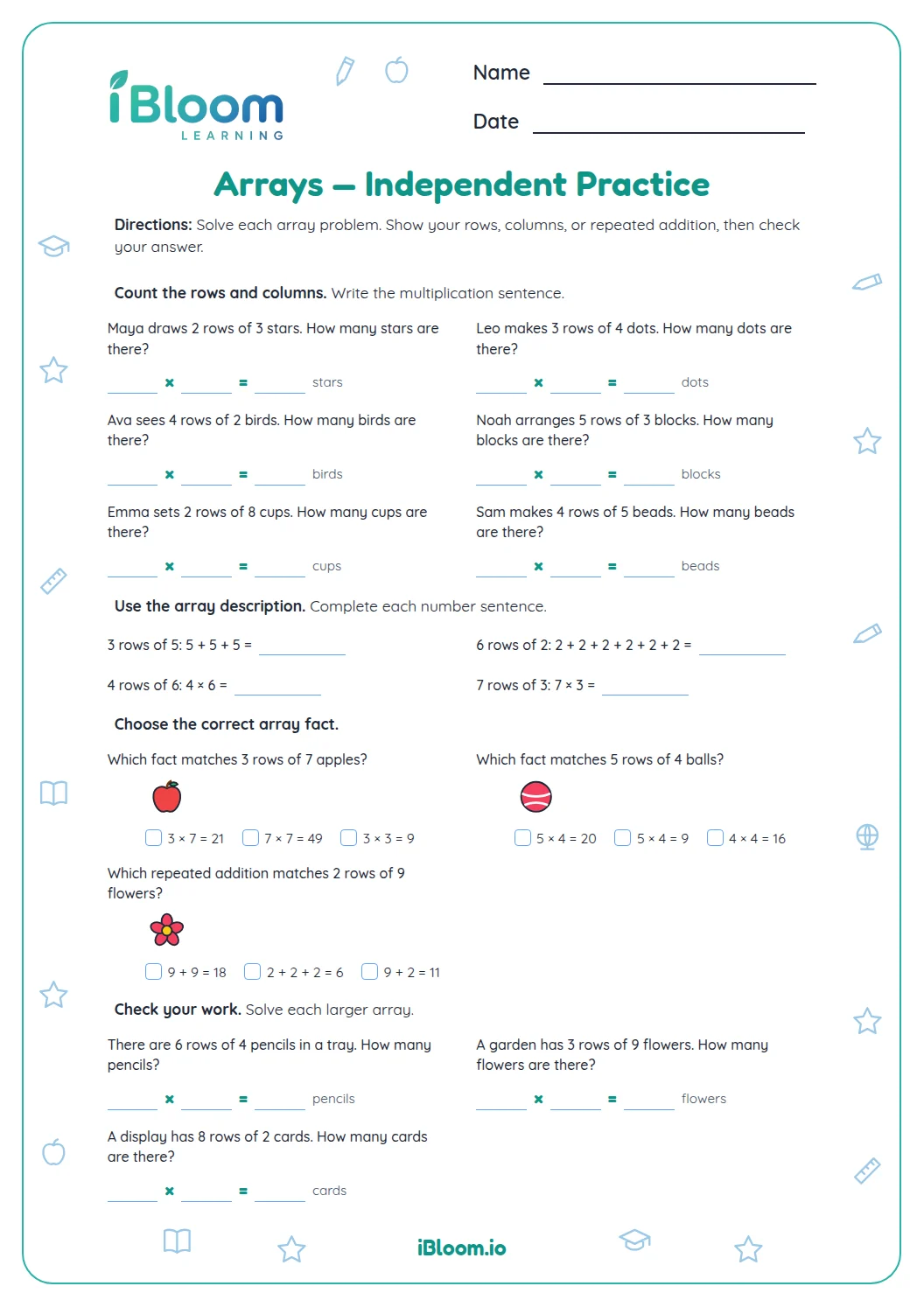
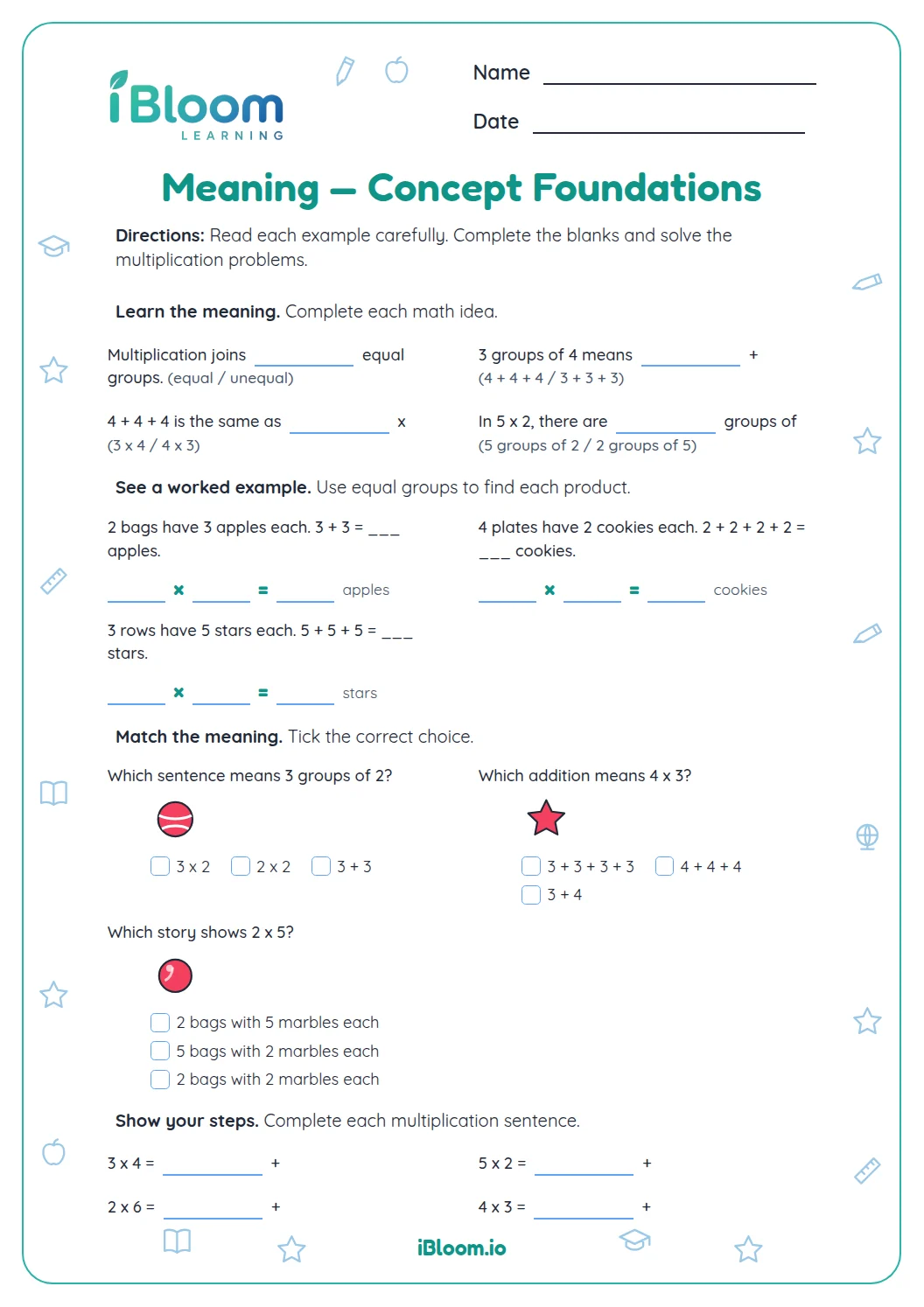
This free printable Grade 2 math worksheet turns trays, shelves and garden rows into addition problems. Students read four pictured arrays, choose two row sums and two column sums, and write addition equations for four everyday arrangements. Question 1 also asks them to name the rows and columns. Every array has at most five rows and five columns. The twelve questions practice Common Core 2.OA.C.4: finding totals in rectangular arrays and expressing them as sums of equal addends. A separate answer key supplies the counts, selected sums and equations.
Aligned to 2.OA.C.4
How are rows different from columns?
A row runs across from left to right. A column runs down from top to bottom. In an array, every row has the same number of objects, and every column has the same number too.
For question 1, move a finger across each row of four apples. The two rows make 4 + 4. Moving down each column would make four groups of two; both ways count eight apples.
How do students turn an array into addition?
Count the objects in one row, then write that number once for each row. The sum is the total number of objects. Keep the row count separate from the number of objects in a row.
- 12 rows of 4 apples; 4 columns of 2 apples
- 2By rows: 4 + 4 = 8
- 3By columns: 2 + 2 + 2 + 2 = 8
- 4Answer: 2 rows, 4 columns; 8 apples
What changes across the three parts?
Part A provides four drawings so children can follow the rows and columns with a finger. Part B asks for two sums that count by rows and two that count by columns. Each question names the direction to use, so students must check which groups the addends represent.
Part C asks children to write equations from short stories. Question 11 gives six pots and two equal rows, so students work backward to find three pots in each row.
How to use this worksheet
- 1Trace one row and one column in the first apple array.
- 2Add the objects in equal rows to finish Part A.
- 3For Part B, read rows or columns carefully, then choose one equal addend for each requested group.
- 4Write a complete equation for each Part C story.
- 5Check each sum against the number of rows and the number in each row.
Mistakes to notice and repair
The mistake
Adding the row count and column count, such as 3 + 4 for three rows of four.
The fix
Use one 4 for each row: 4 + 4 + 4.
The mistake
Choosing 3 + 3 + 3 + 3 when asked to count three rows of four.
The fix
That sum counts by columns. The question asks for the three rows: 4 + 4 + 4.
The mistake
Writing only 16 for the chair story.
The fix
Include the equation requested: 4 + 4 + 4 + 4 = 16.
Common Core alignment
Use rows and columns to add equal groups and find totals up to 25.
On this sheet: Students read arrays, choose row and column sums, and write addition equations for everyday arrangements.
Show the official wordingHide the official wording
Use addition to find the total number of objects arranged in rectangular arrays with up to 5 rows and up to 5 columns; write an equation to express the total as a sum of equal addends.
What to practice next
Make more practice
Further reading
Questions parents and teachers ask
Do children need multiplication facts for this sheet?
Children can solve every question with addition and equal groups. The drawings in Part A support counting one row at a time, and Parts B and C explicitly use addition sentences. For example, three rows of five cookies become 5 + 5 + 5 = 15.
How large are the arrays on this worksheet?
Every arrangement has at most five rows and five columns. The largest is the classroom with five rows of five desks, giving 25 desks. The first pictured array has two rows of four apples, so children begin with a smaller arrangement before working through the stories.
Why can two sums give the same total in Part B?
Rows and columns can give the same total, but each question names which way to count. Three rows of four give 4 + 4 + 4. Four columns of three give 3 + 3 + 3 + 3. Both total twelve; choose the sum matching the requested direction.
How should my child solve the six-pot question?
Share the six pots equally between two rows. Each row gets three, so the equation is 3 + 3 = 6. Your child can arrange six counters in two rows before writing. Check that both rows have the same number and that all six counters are used.
What does the answer key include?
The key gives the rows, columns and total for the apples, the other pictured totals, four correct row or column sums, and an addition equation for each story. Check the addends as well as the total: each addend should count one group in the direction requested.