



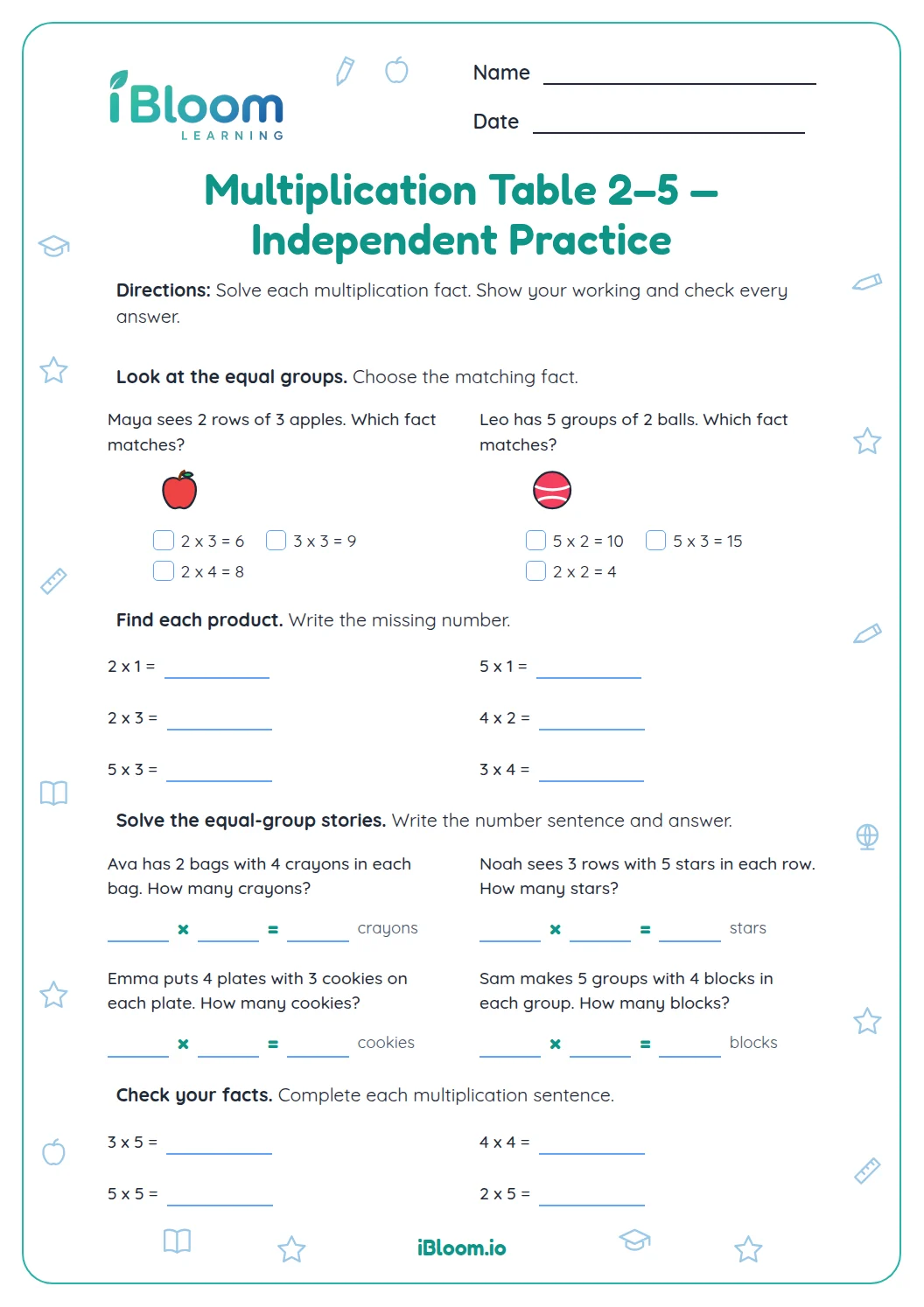
About this worksheet
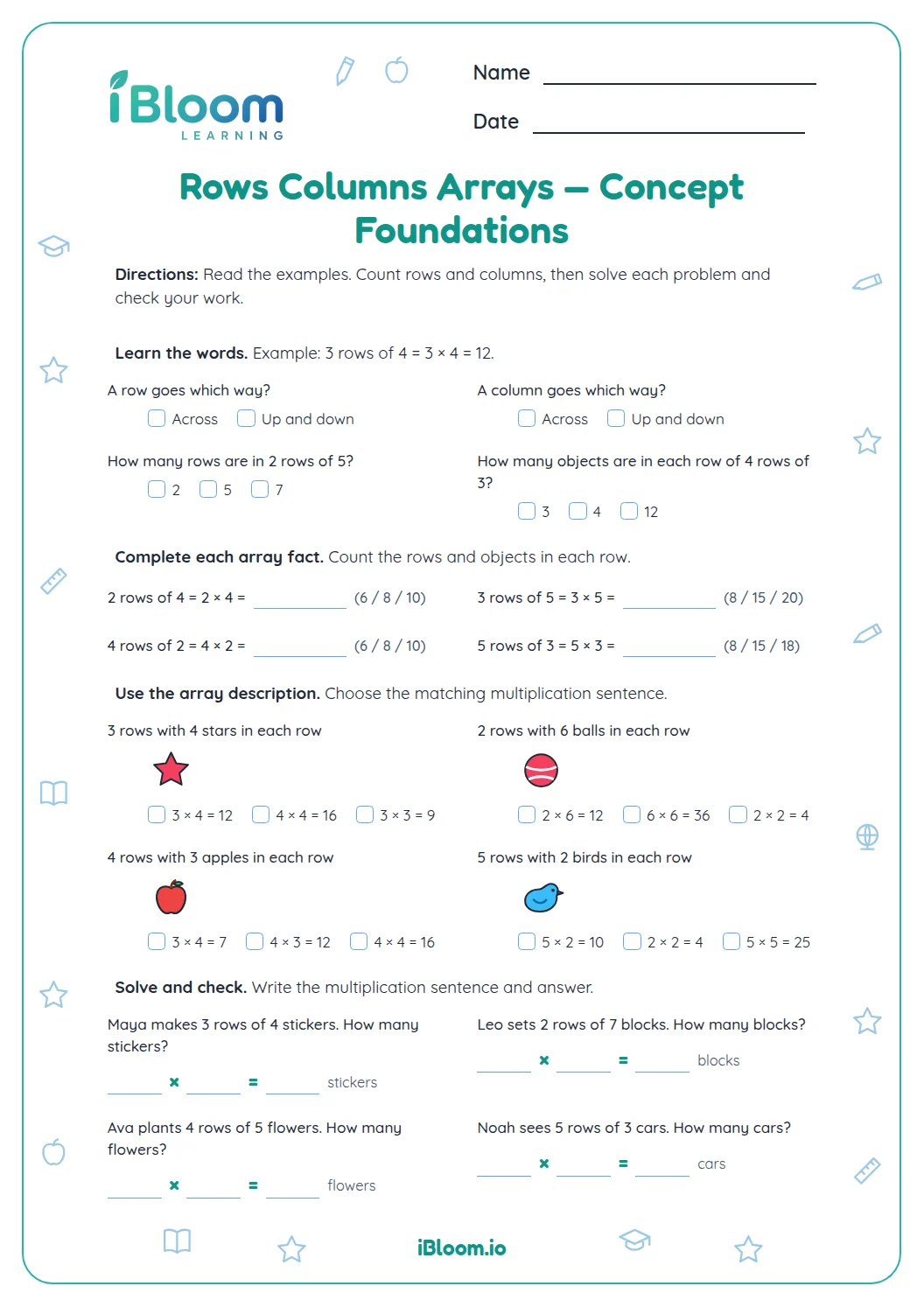
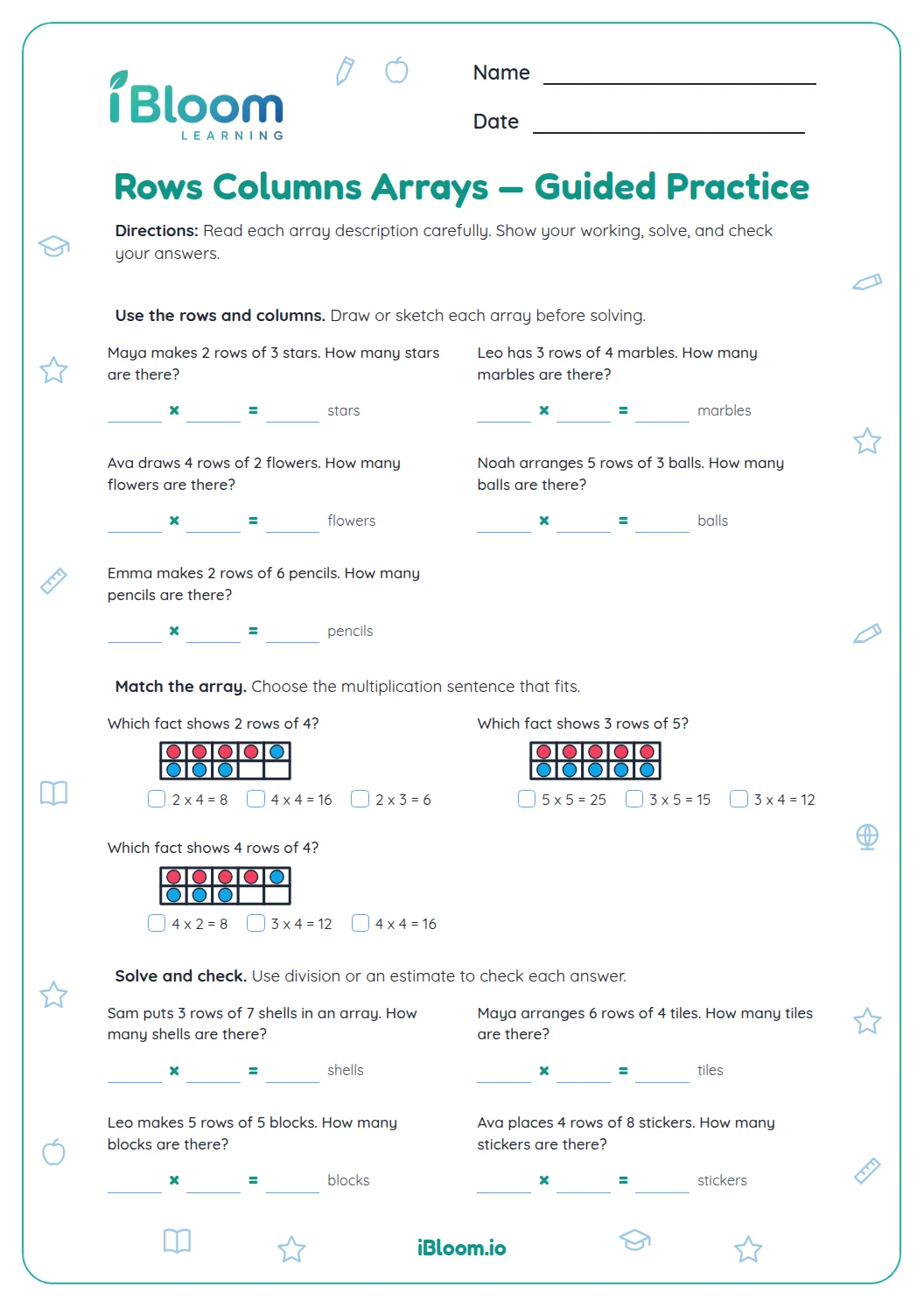
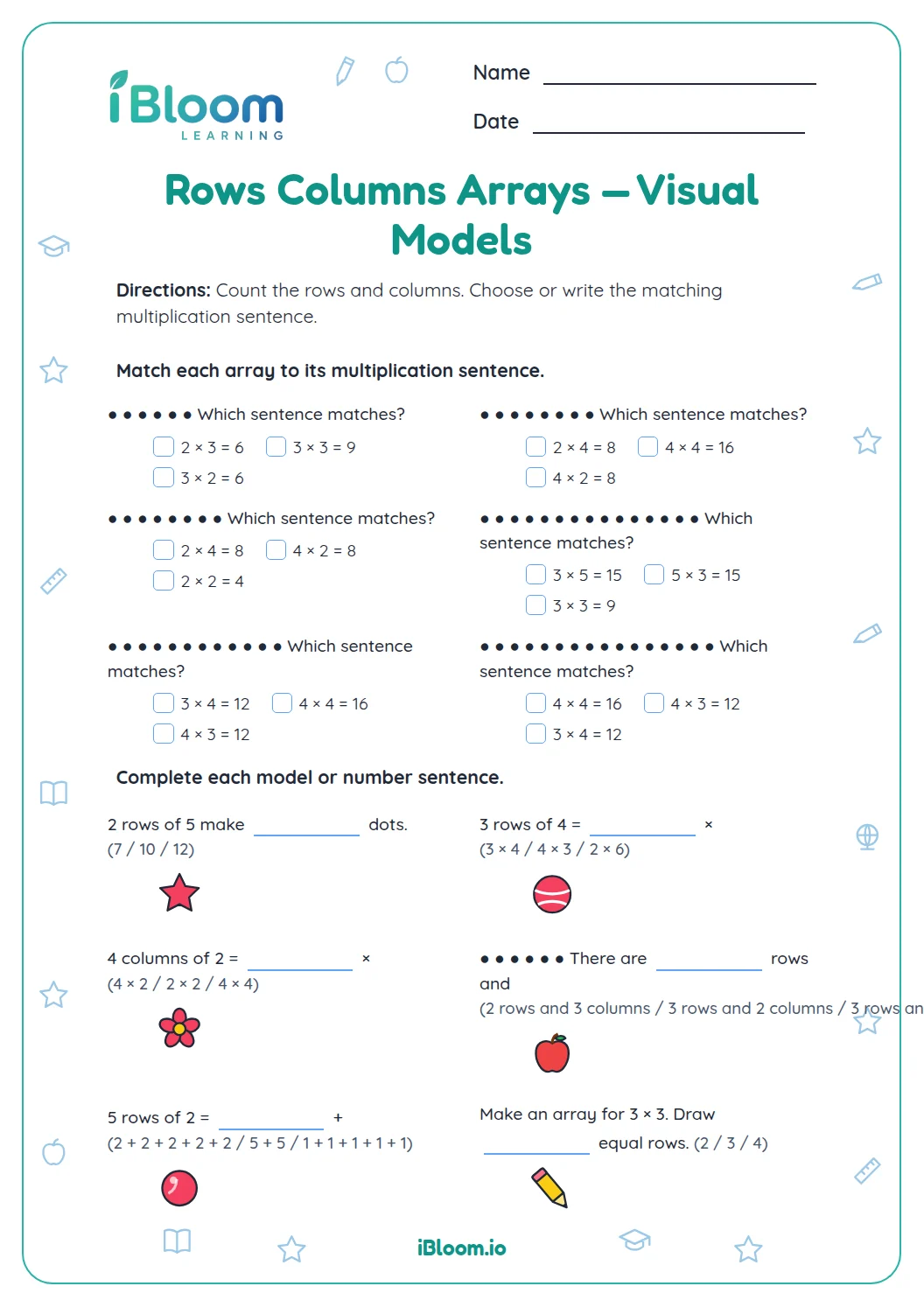
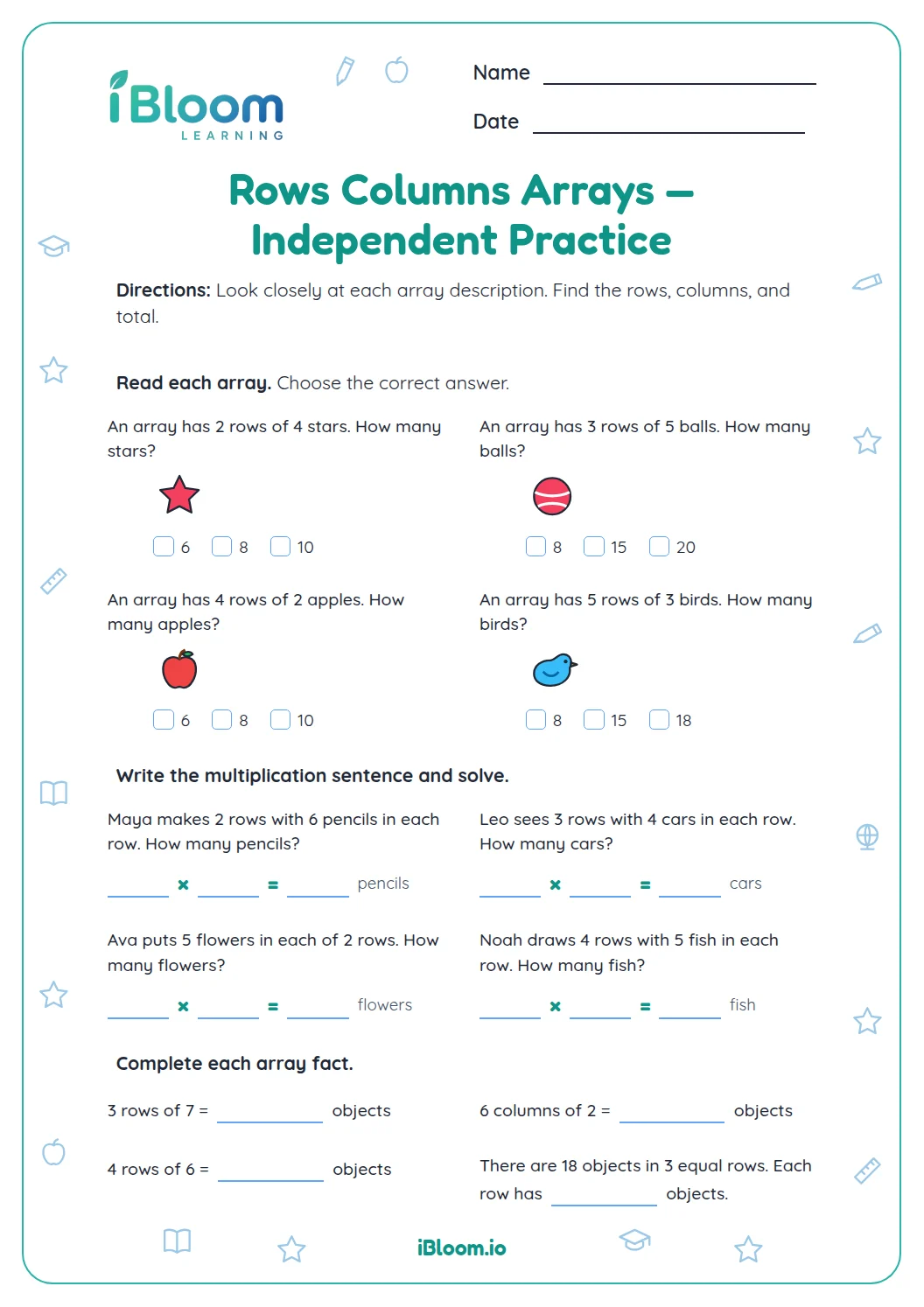
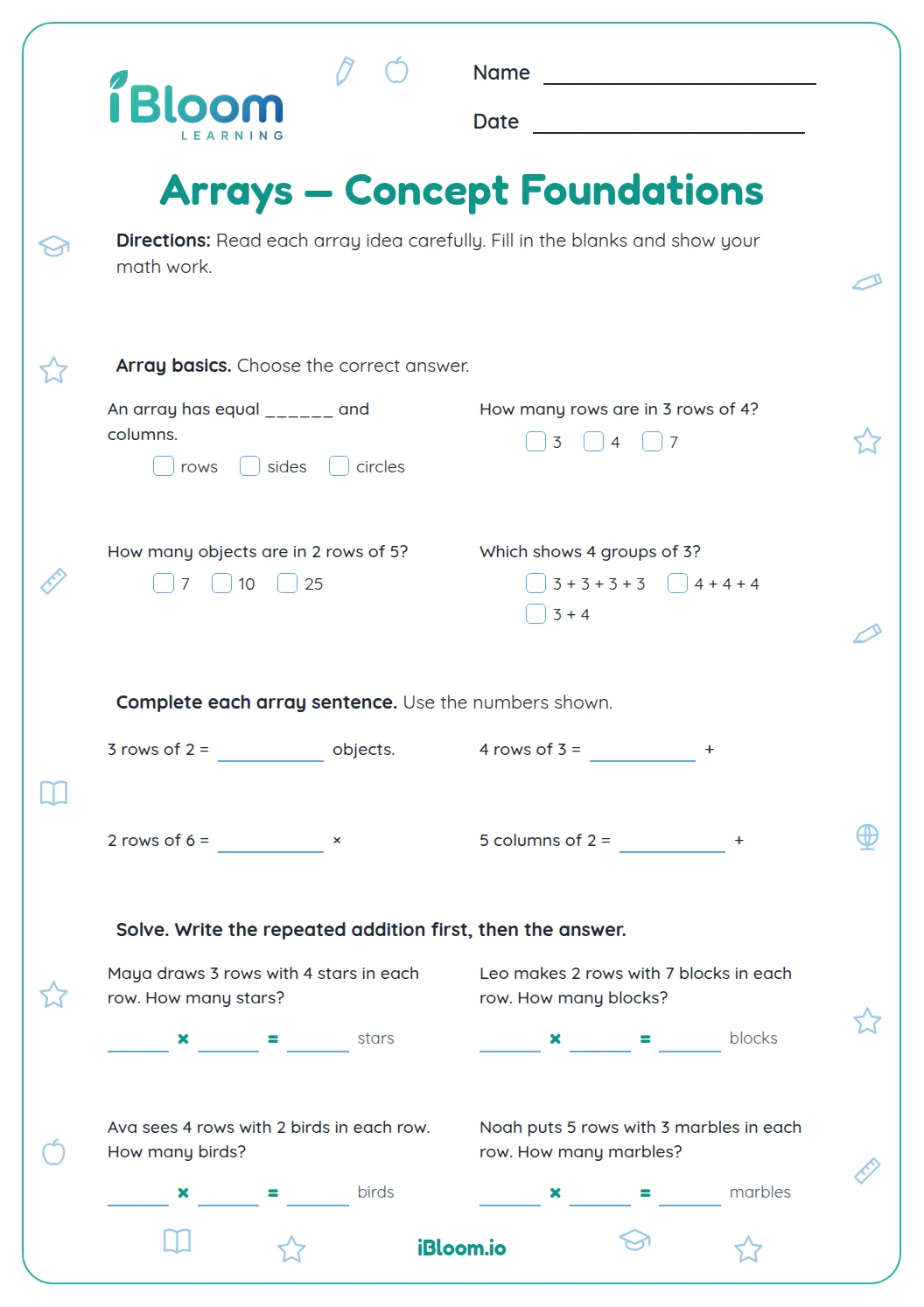
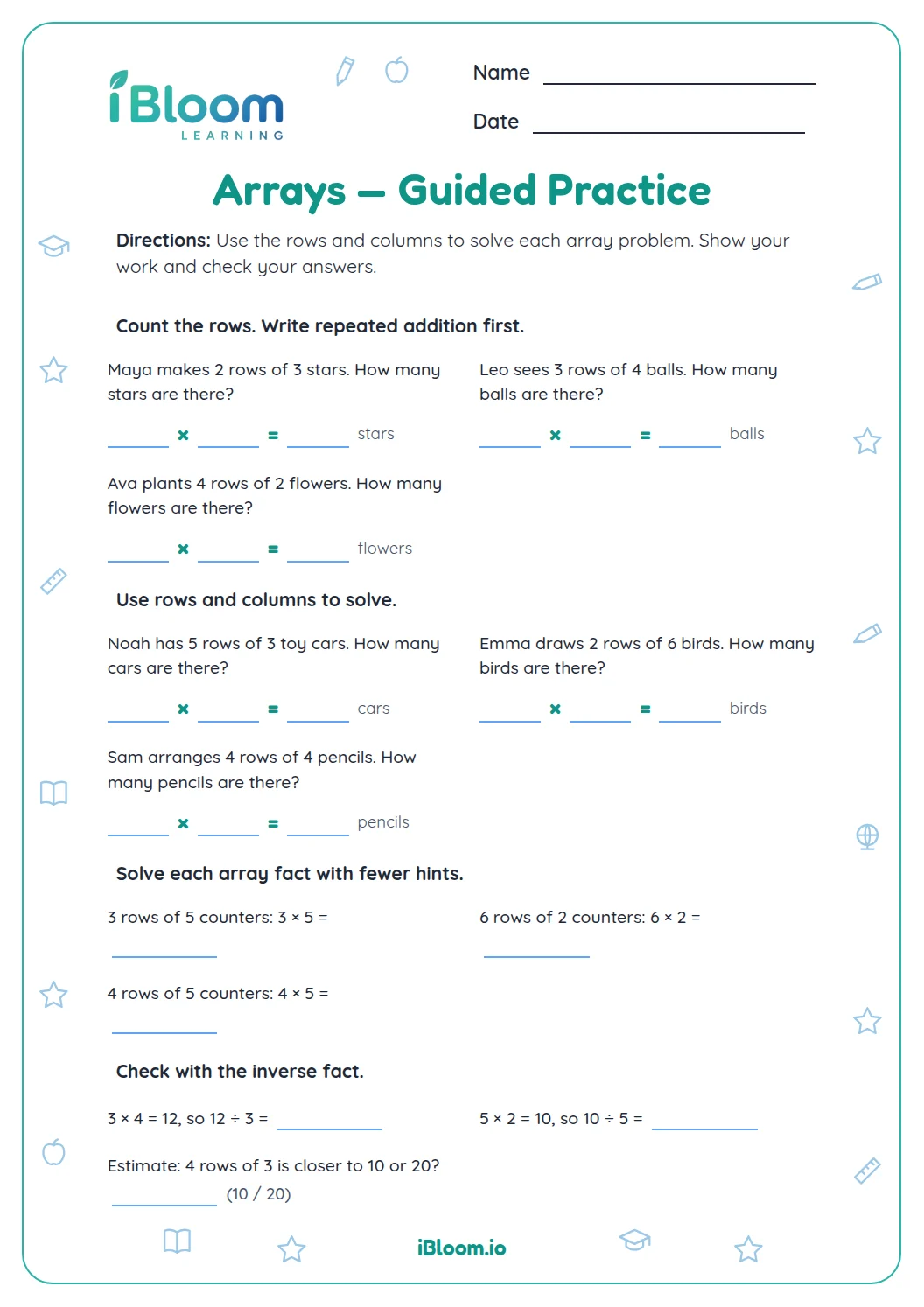
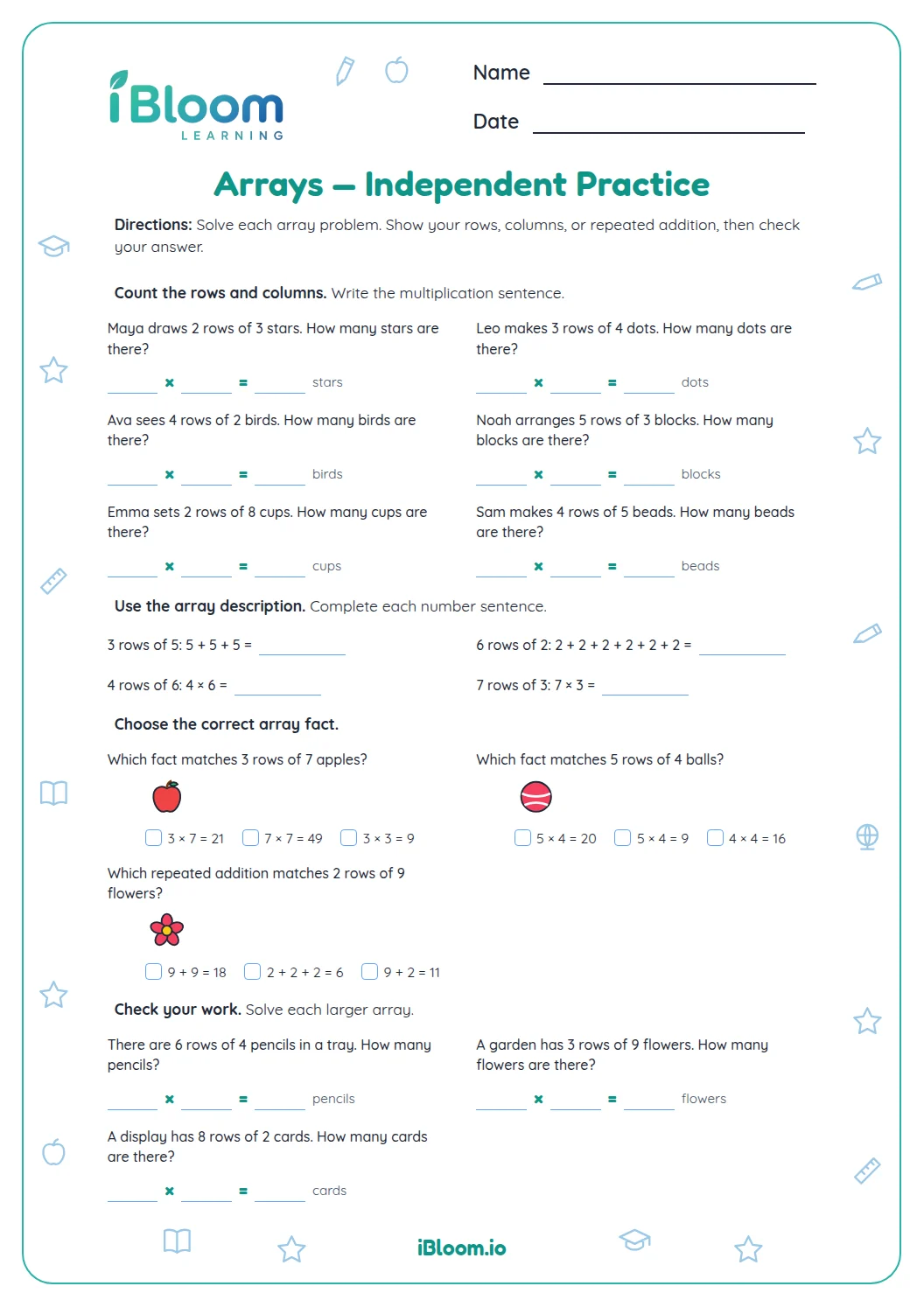
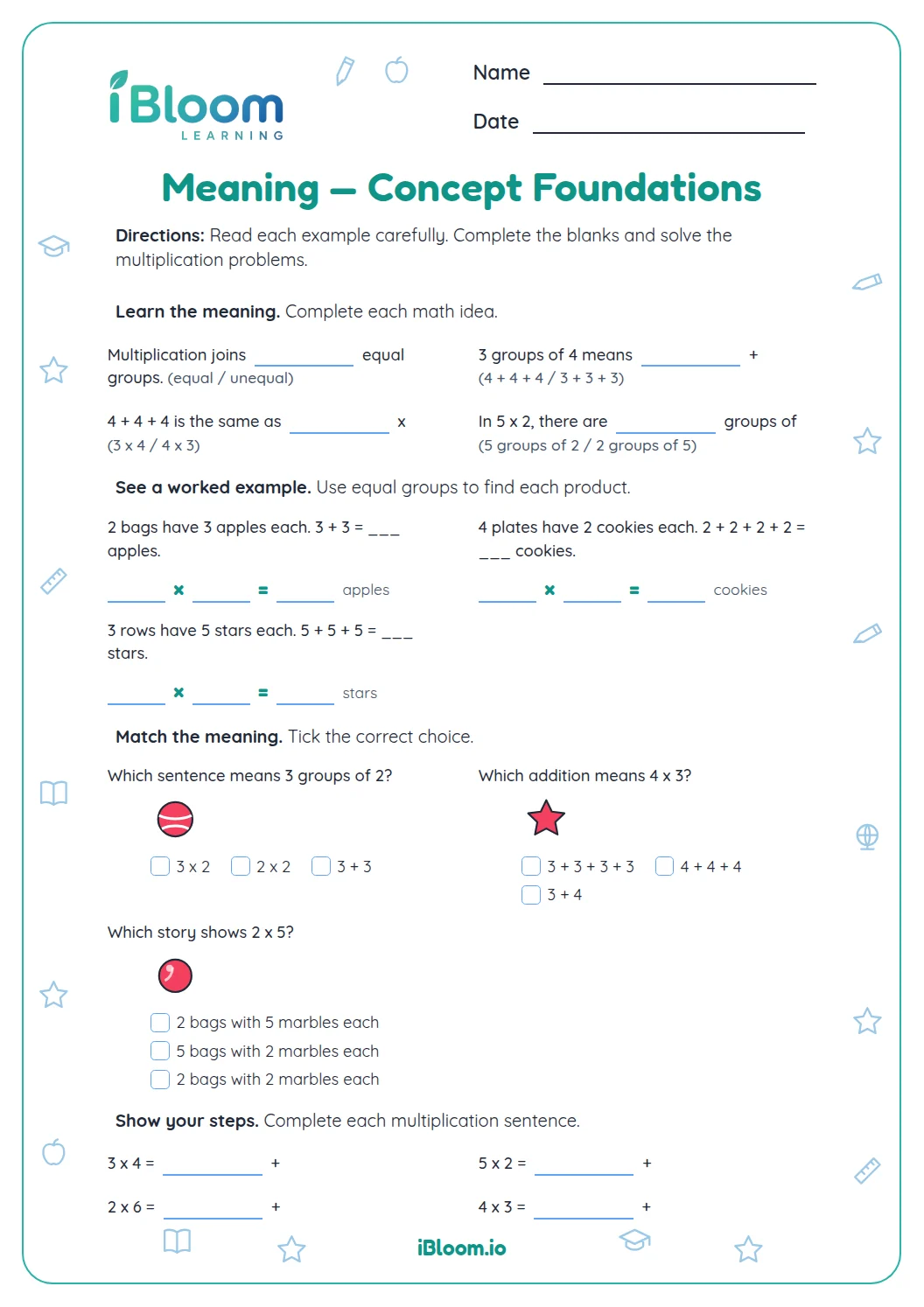
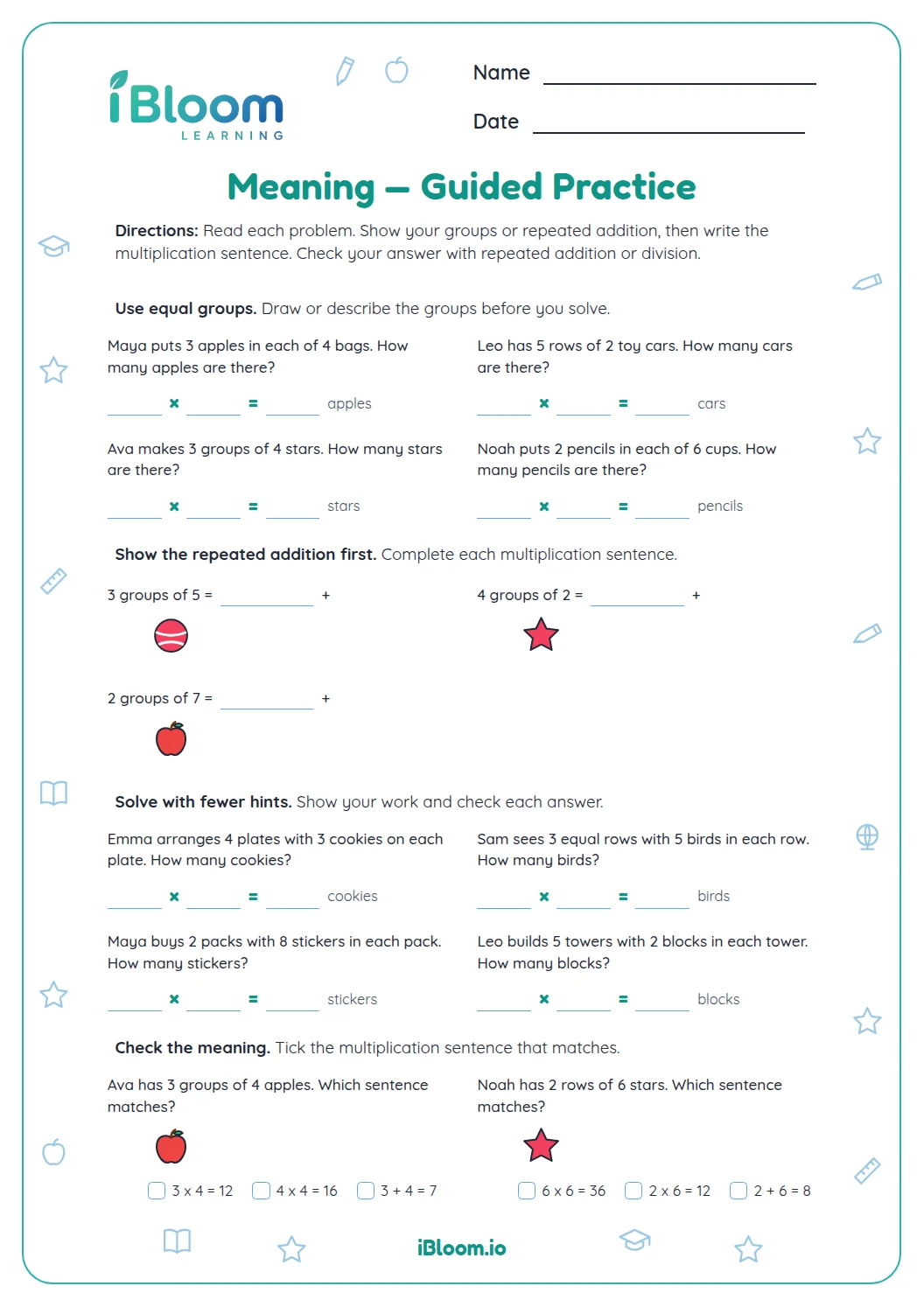
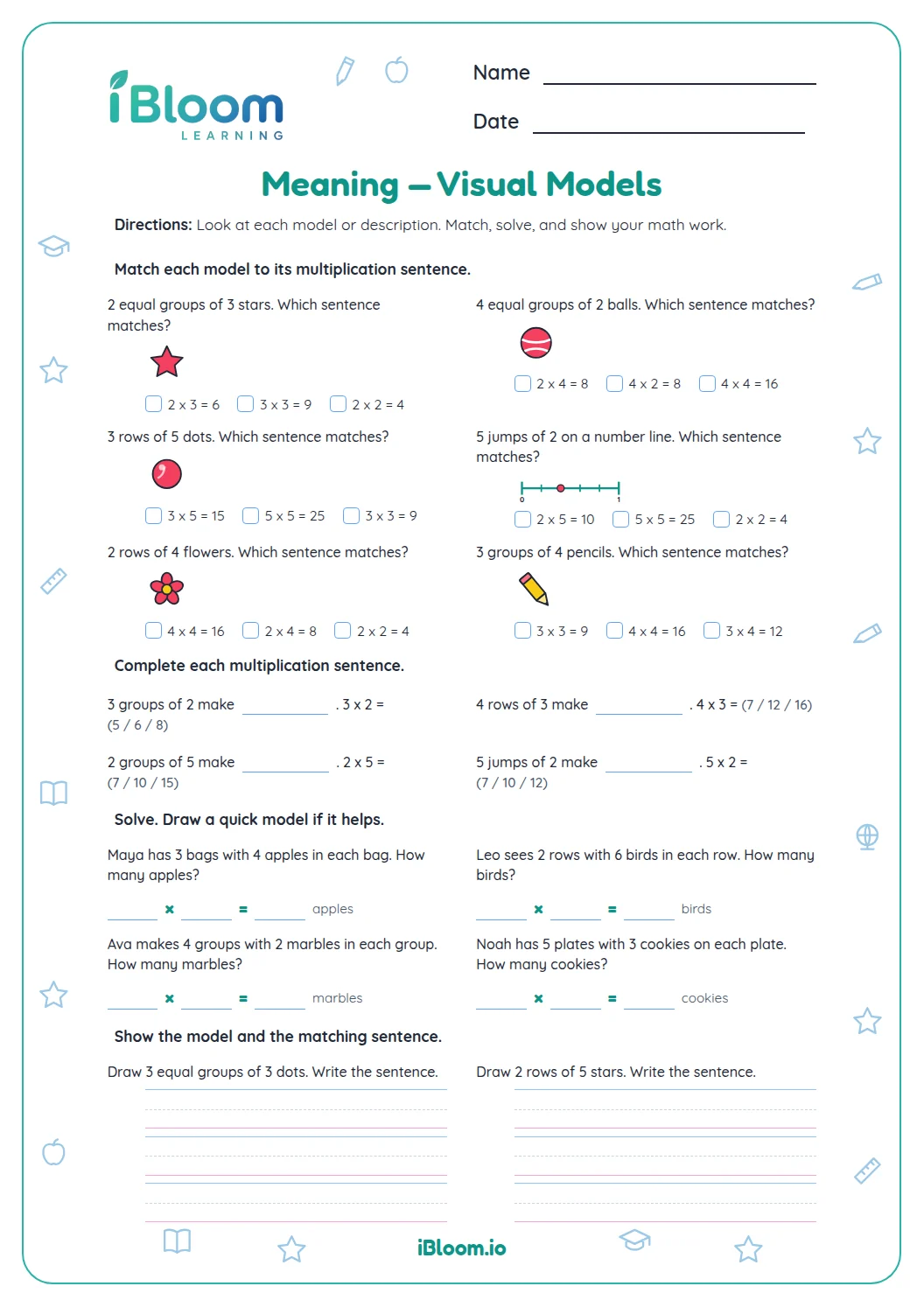
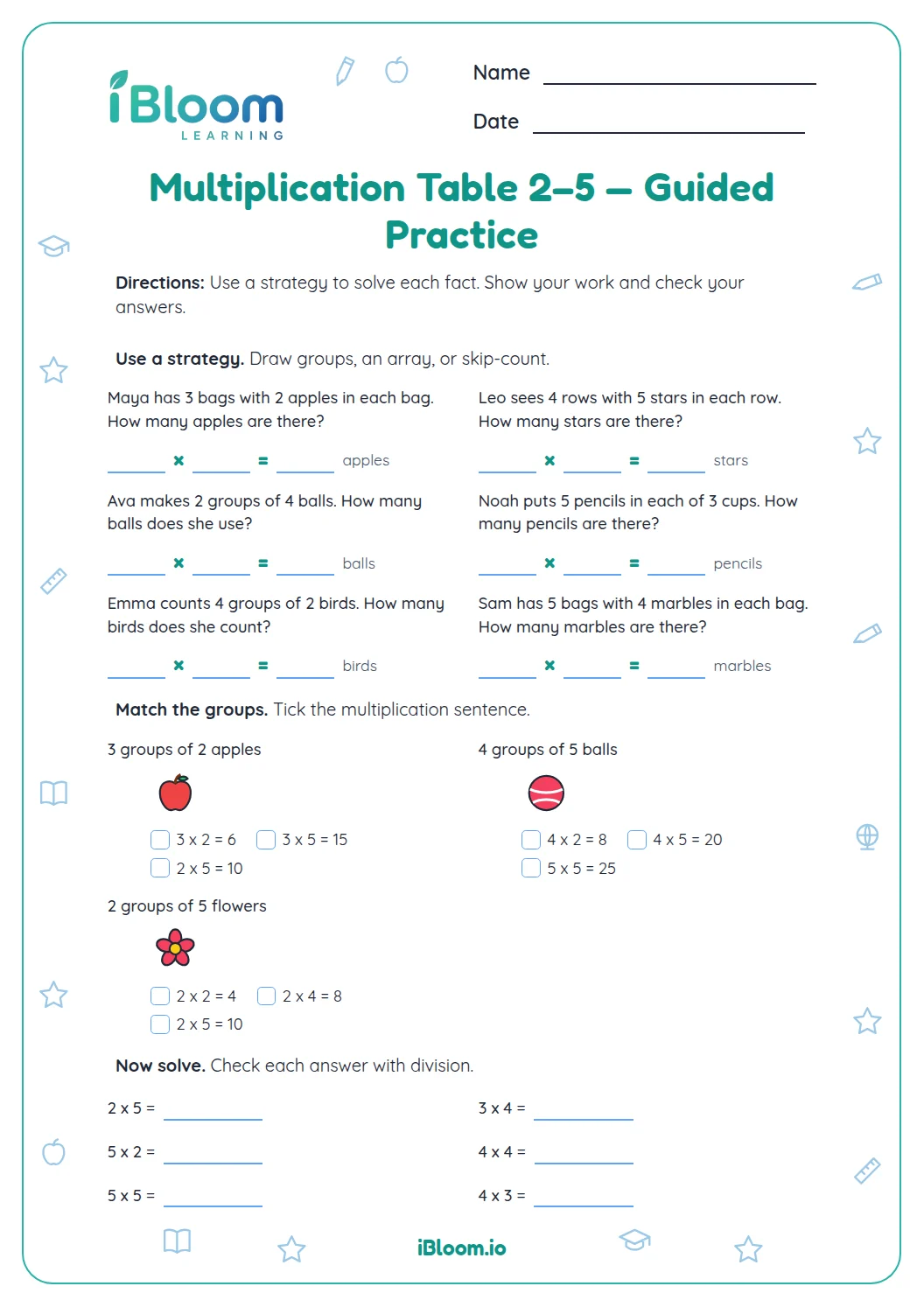
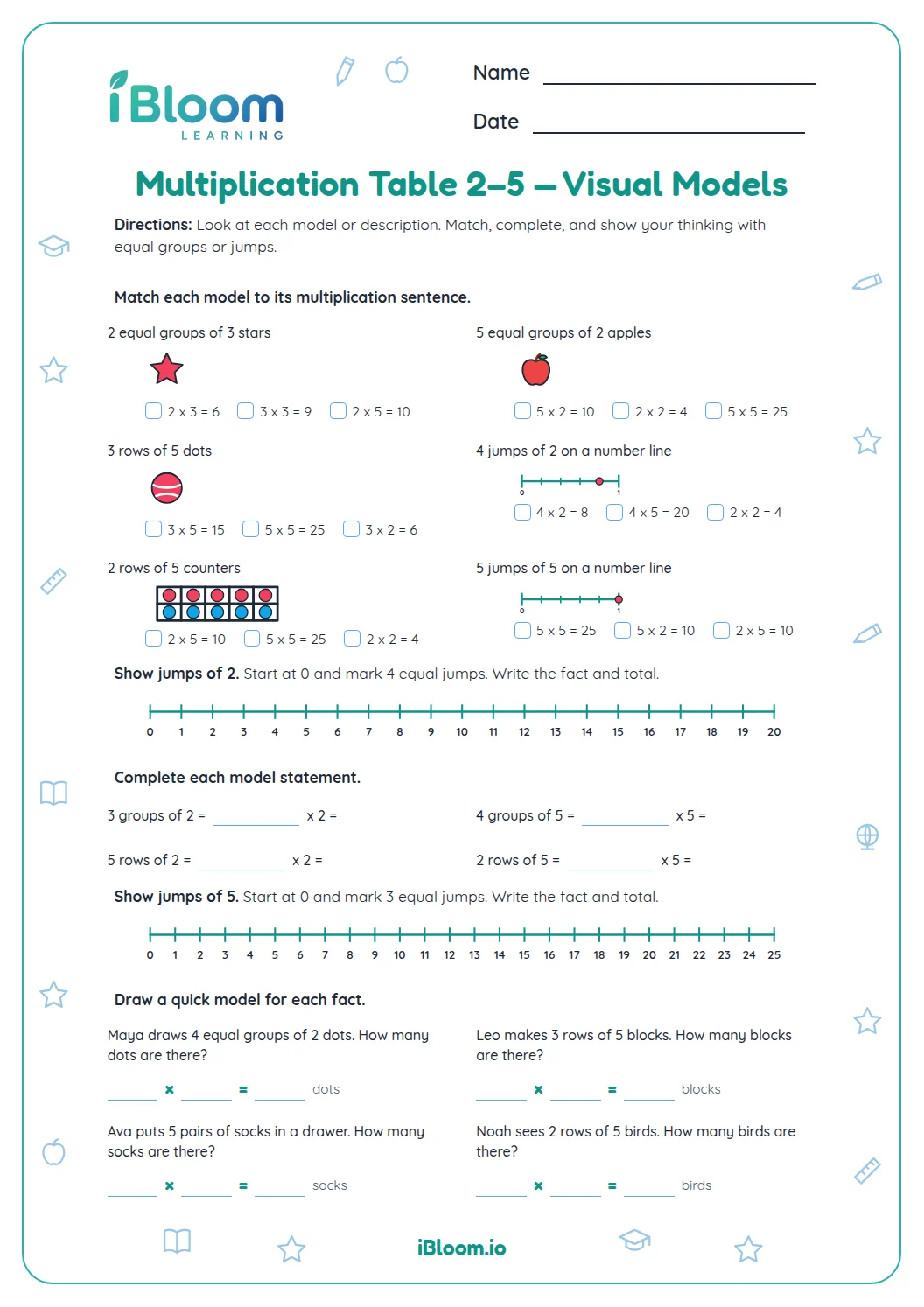
This Grade 2 printable has 14 questions on arrays and equal-addend equations. Children count two picture arrays, choose sums for equal groups, and reason about rows, columns, and totals. The separate answer key marks each result and equation. It practices CCSS 2.OA.C.4.
Aligned to 2.OA.C.4
How can you count rows and write equal addends?
An array arranges objects in equal rows and columns. To write repeated addition for rows, use the number of objects in one row as the addend and repeat it once per row. For example, two rows of three are 3 + 3 = 6.
The first part uses picture arrays and equal-group totals. The second connects rows to repeated addends, compares turned arrays, and matches an array description to its equation.
- 1The first array has 2 rows with 3 apples in each row. Add 3 + 3 to get 6 apples altogether.
What will children practice?
The first part uses picture arrays and equal-group totals. The second connects rows to repeated addends, compares turned arrays, and matches an array description to its equation.
How can children check their answers?
Count the rows, then count the objects in one row. Write that row total once for each row and add. Check by counting columns another way; turning an array changes its orientation, not its total.
How to use this worksheet
- 1Count the rows and the objects in one row.
- 2Use the number in each row as the repeated addend.
- 3Add equal groups to find the total.
- 4Check the total by counting columns another way.
- 5Explain what each number in the equation represents.
Common mistakes and quick fixes
The mistake
Using the row count as the addend.
The fix
In 4 rows of 3, write 3 four times: 3 + 3 + 3 + 3.
The mistake
Counting only one row.
The fix
Count all rows, or multiply the row total by the number of rows through repeated addition.
The mistake
Thinking a turned array has a different total.
The fix
The row and column counts switch, but the objects remain the same.
Common Core alignment
This worksheet practices arrays and equal-addend equations through the skills named below.
Use equal-addend equations to find totals in arrays up to 5 by 5.
On this sheet: Use equal-addend equations to find totals in arrays up to 5 by 5.
Show the official wordingHide the official wording
Use addition to find the total number of objects arranged in rectangular arrays with up to 5 rows and up to 5 columns; write an equation to express the total as a sum of equal addends.
What to practice next
Make more practice
Further reading
Questions parents and teachers ask
What is an array?
An array is an arrangement of objects in equal rows and columns. Each row has the same number of objects, which makes the total easy to find with repeated addition. For example, two rows of three are 3 + 3 = 6.
How do I write an equation for four rows of three?
Write 3 + 3 + 3 + 3 = 12. The 3 represents the objects in each row, and it appears four times because there are four rows. The worksheet asks children to make this connection from picture arrays.
Why do turned arrays have the same total?
Turning an array changes the view: rows may become columns. No objects are added or removed, so the total remains the same. Three rows of four and four rows of three both contain 12 objects. The pictures make each equal group visible for a quick check.
Are the arrays within the standard range?
Yes. Turning an array can make rows become columns, but the objects stay the same. Three rows of four and four rows of three each contain 12 objects. Children can recount by rows or columns to verify the total.
What if my child counts each object one at a time?
Yes. The picture arrays and row-and-column descriptions use at most five rows and five columns. Children find totals and express arrays as sums of equal addends, matching 2.OA.C.4. Each pictured array is small enough to check by counting its rows or columns.
What is on the answer key?
There are 14 questions in two parts: reading picture arrays, then using equal groups and rows or columns to reason about totals. The key marks the totals and equations. Every array or array description stays within five rows and five columns.