
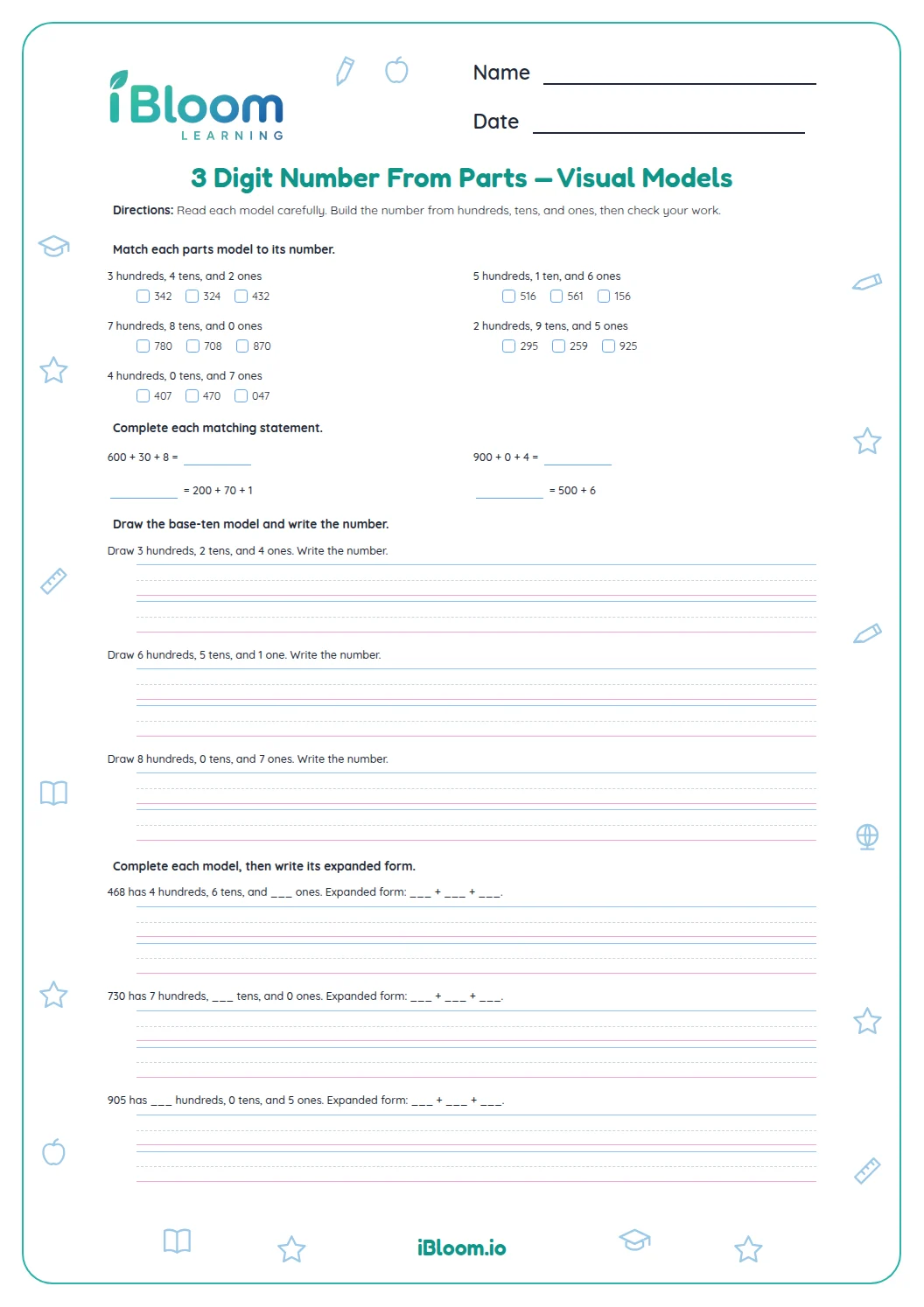
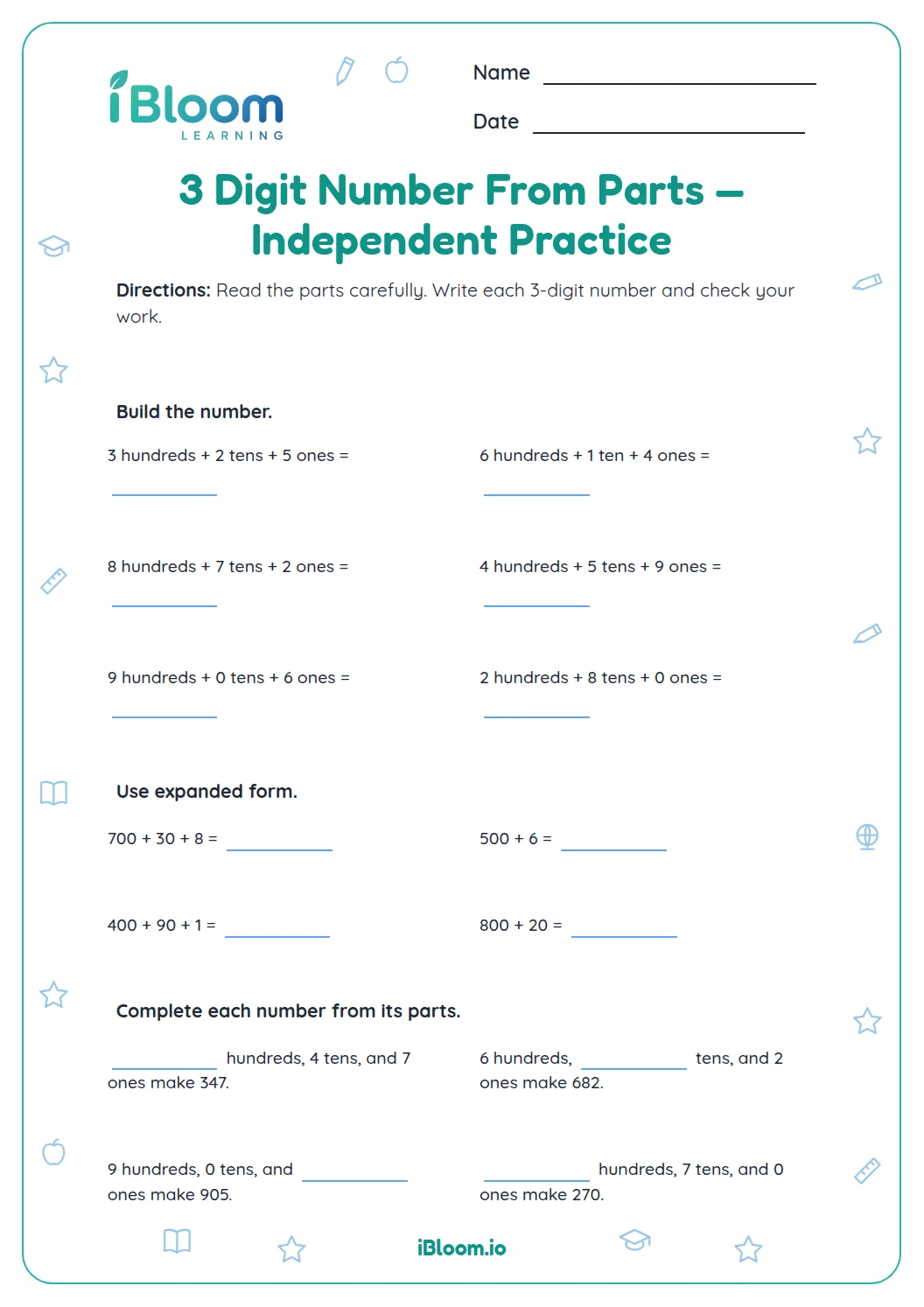

About this worksheet
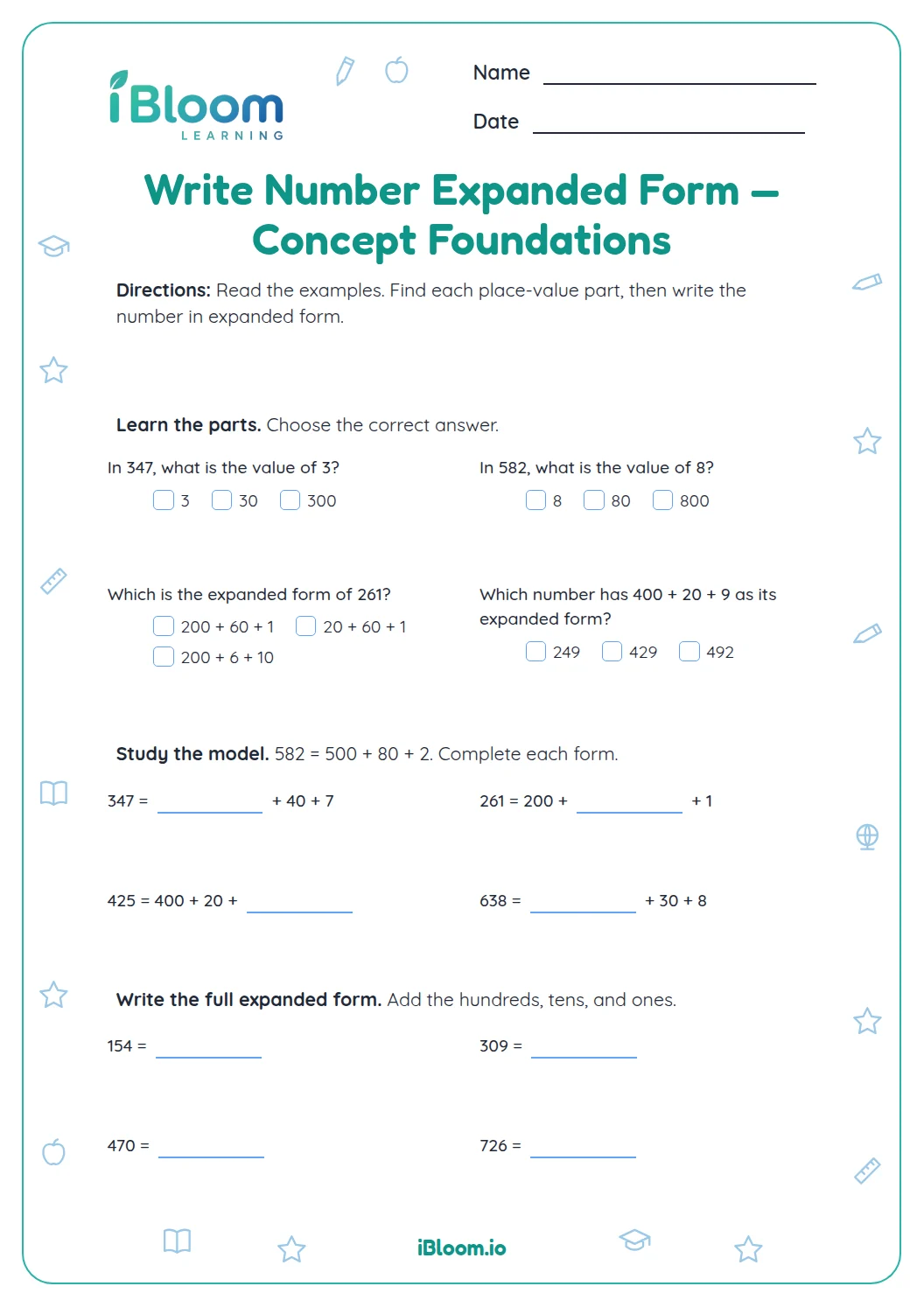
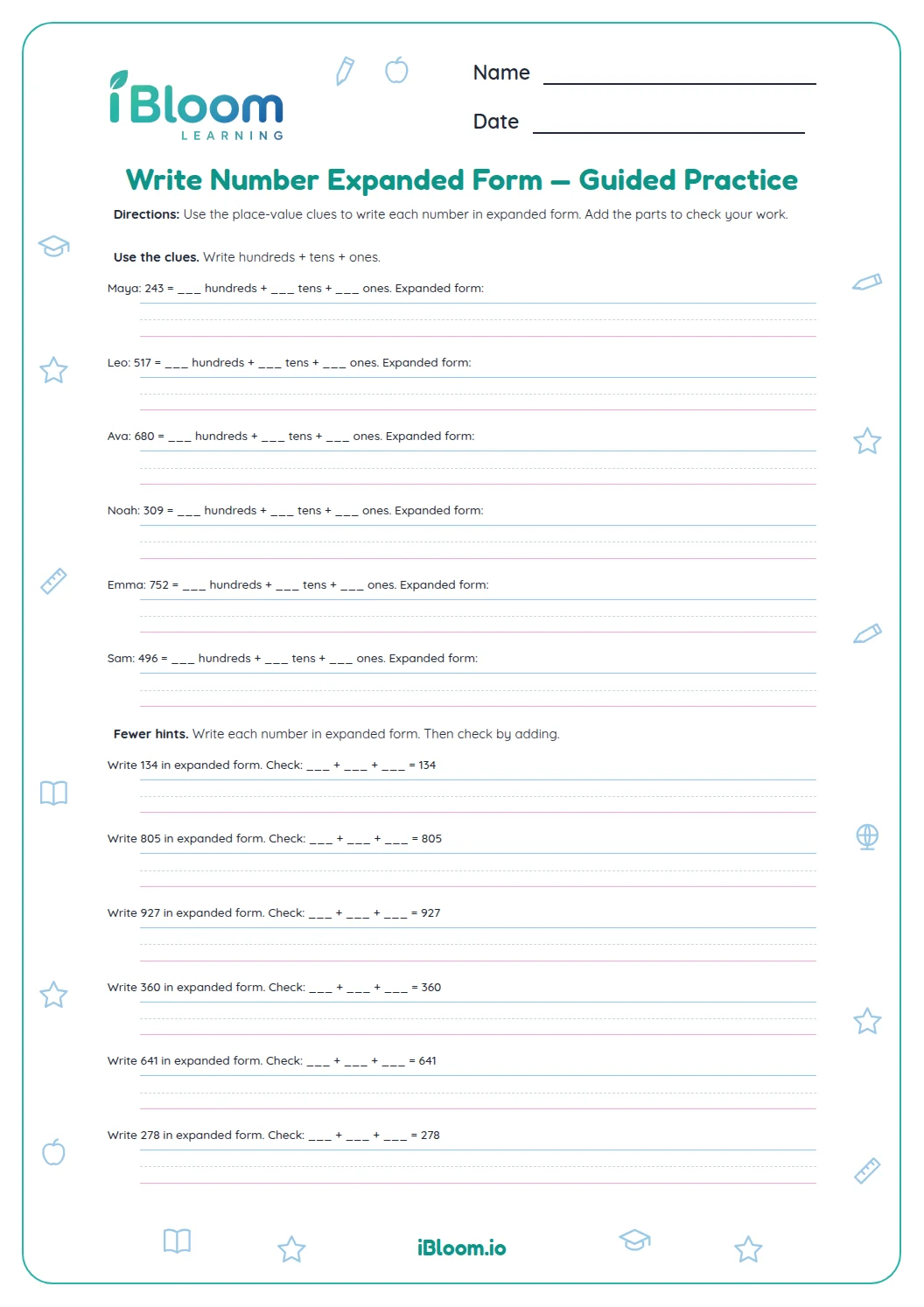
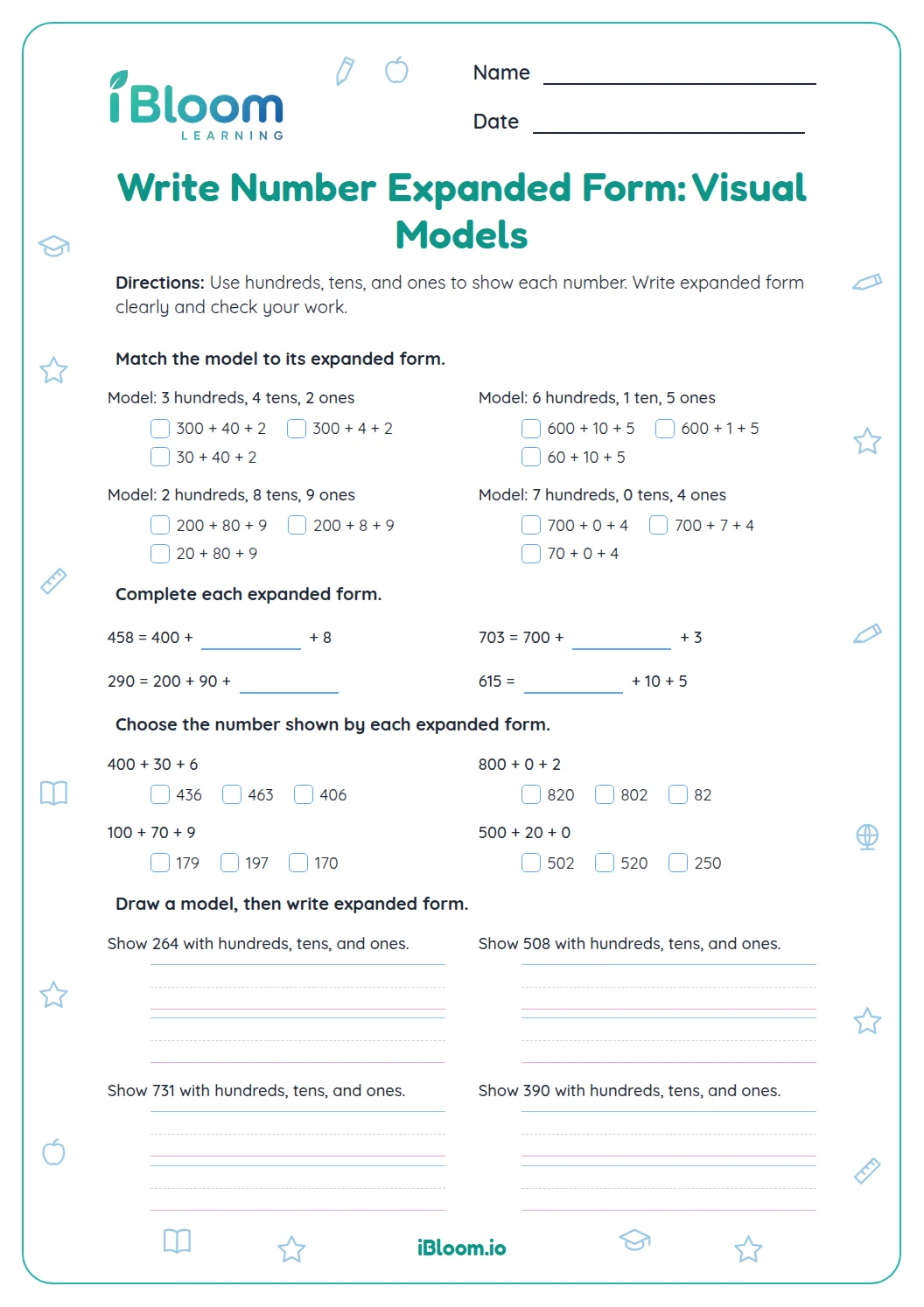
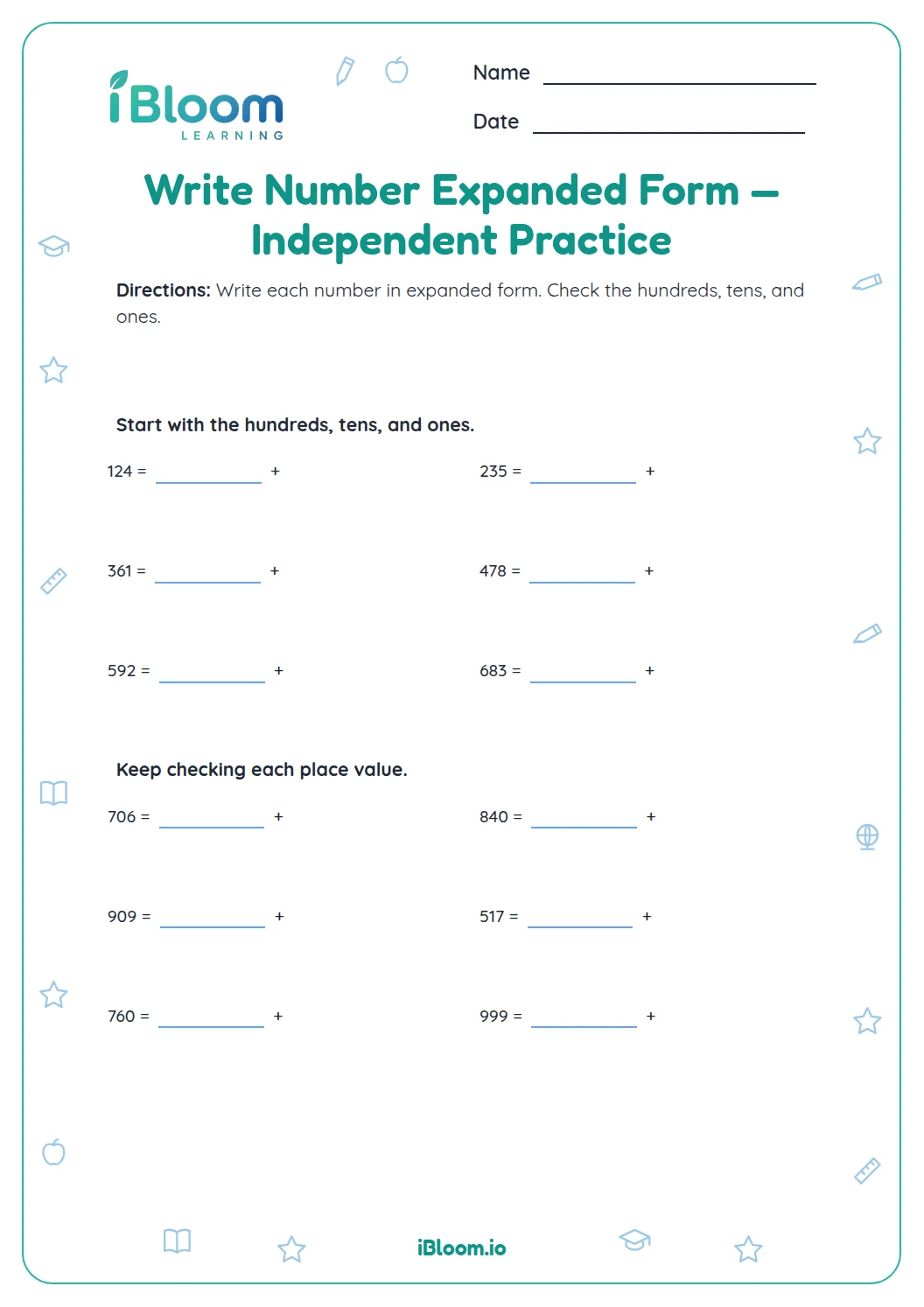
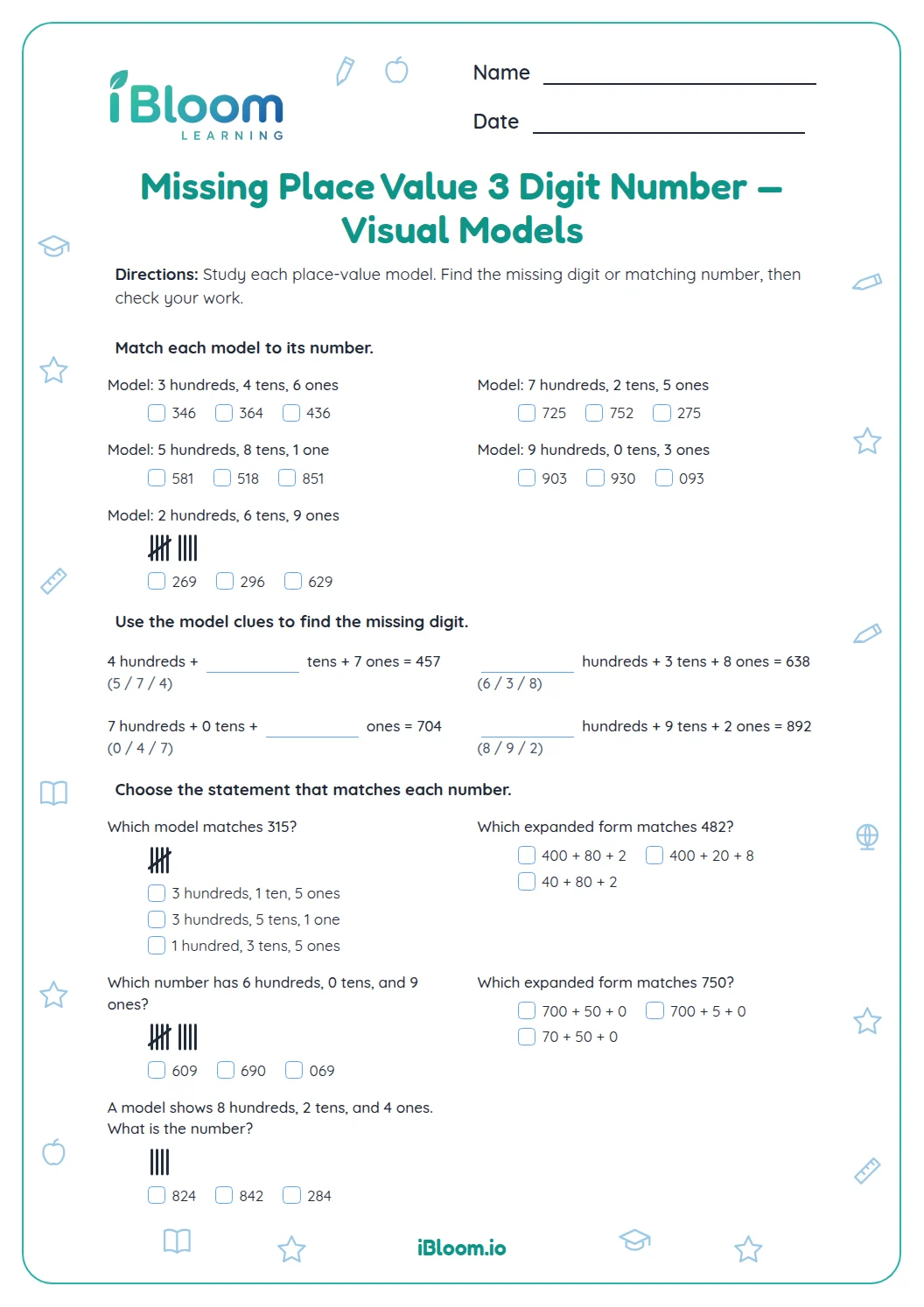
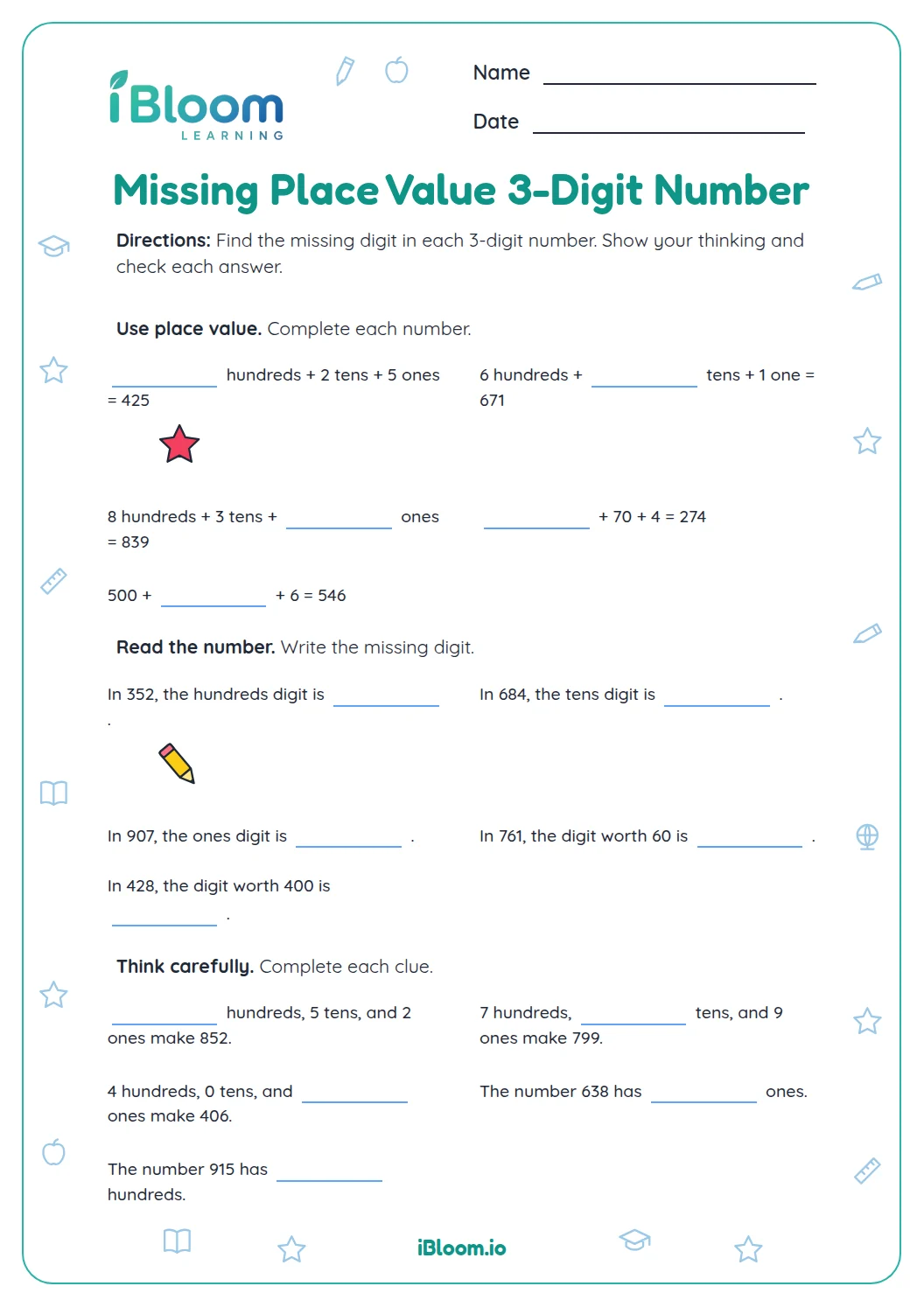
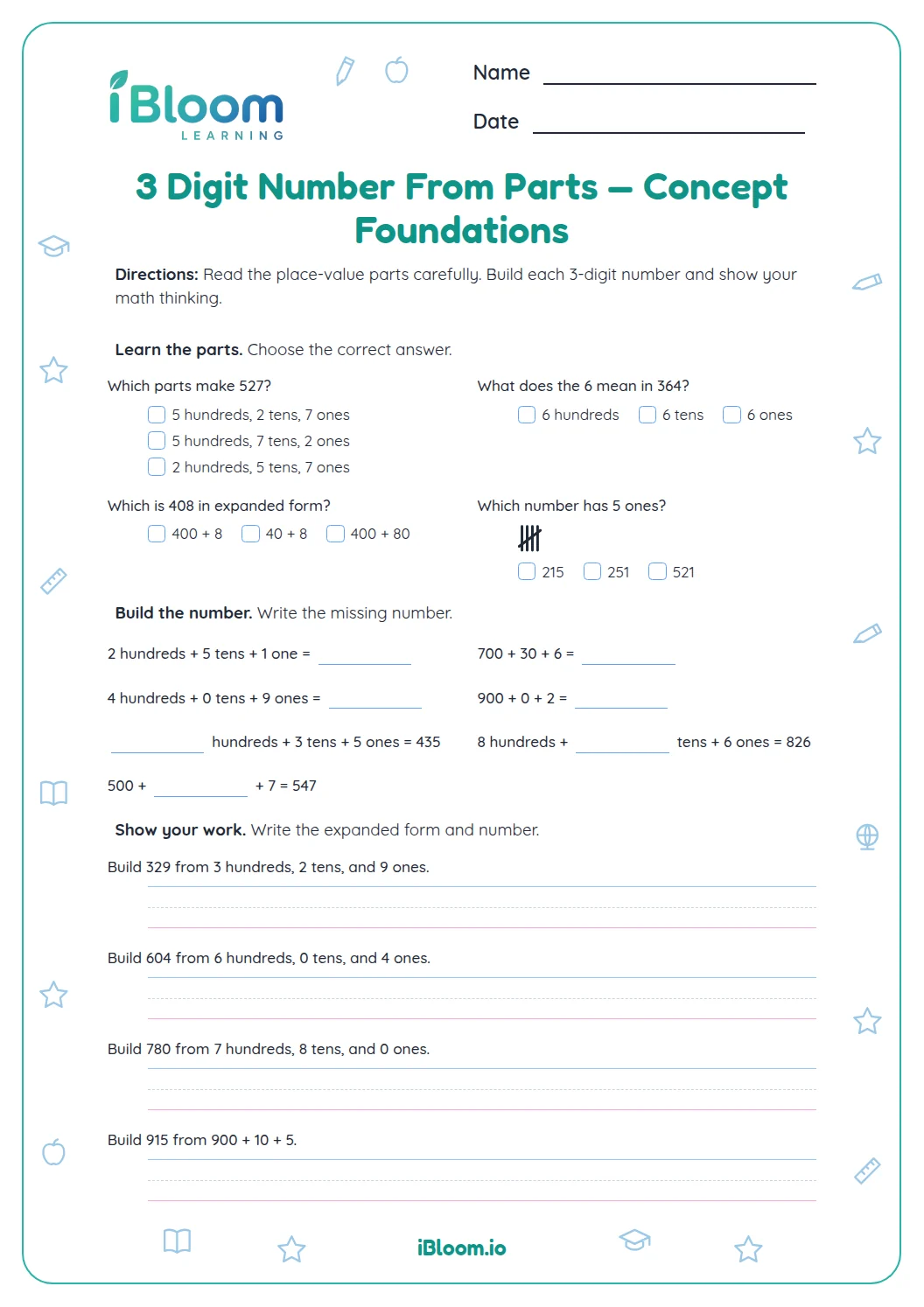
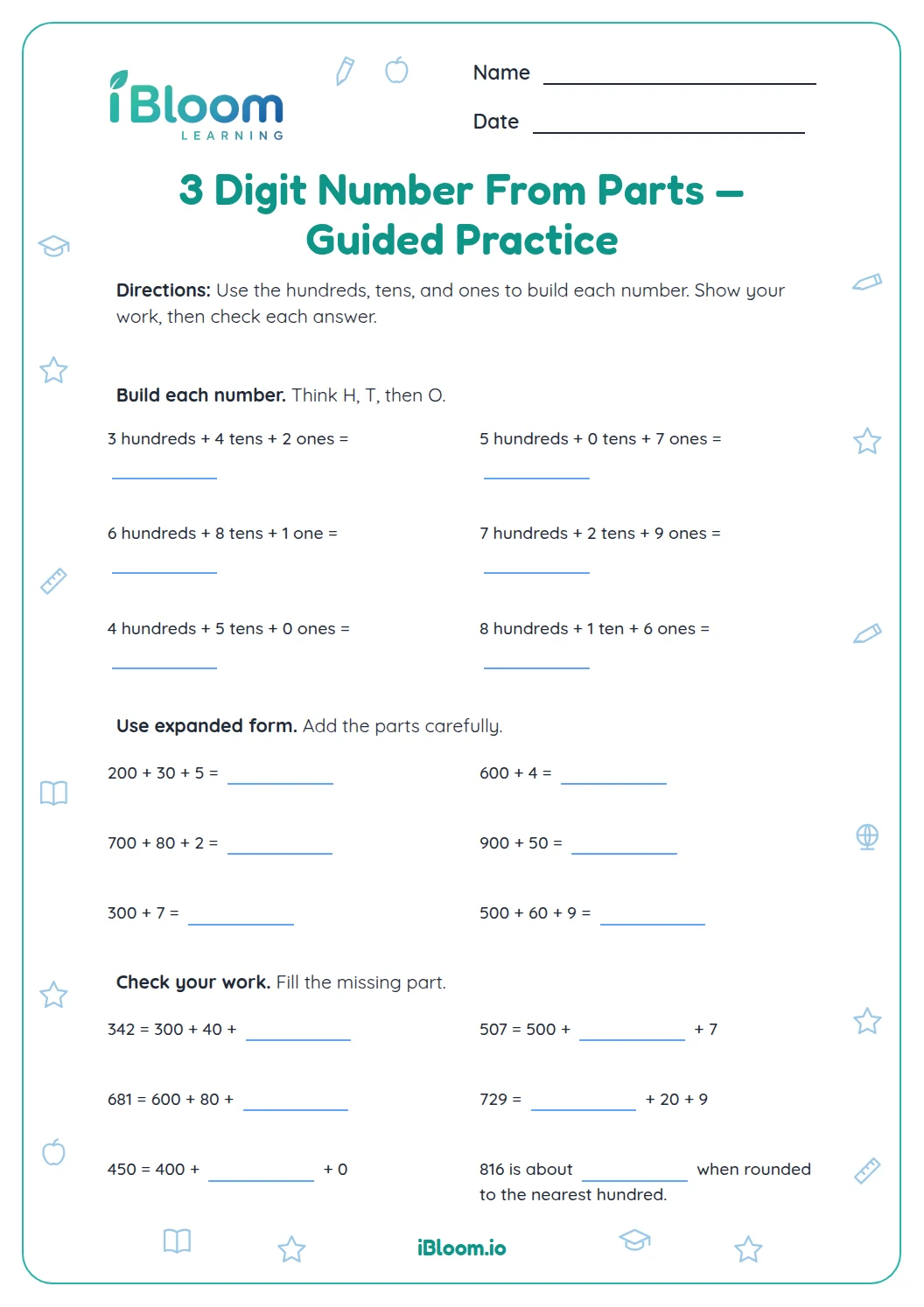
This Grade 2 worksheet practices writing three-digit numbers in expanded form. Students break apart numbers, express a real-world total as hundreds, tens, and ones, then choose expanded forms for several quantities. All 14 questions focus on the title skill, and the answer key shows each expanded sum. The page aligns with CCSS 2.NBT.A.3.
Aligned to 2.NBT.A.3
How do hundreds, tens, and ones make expanded form?
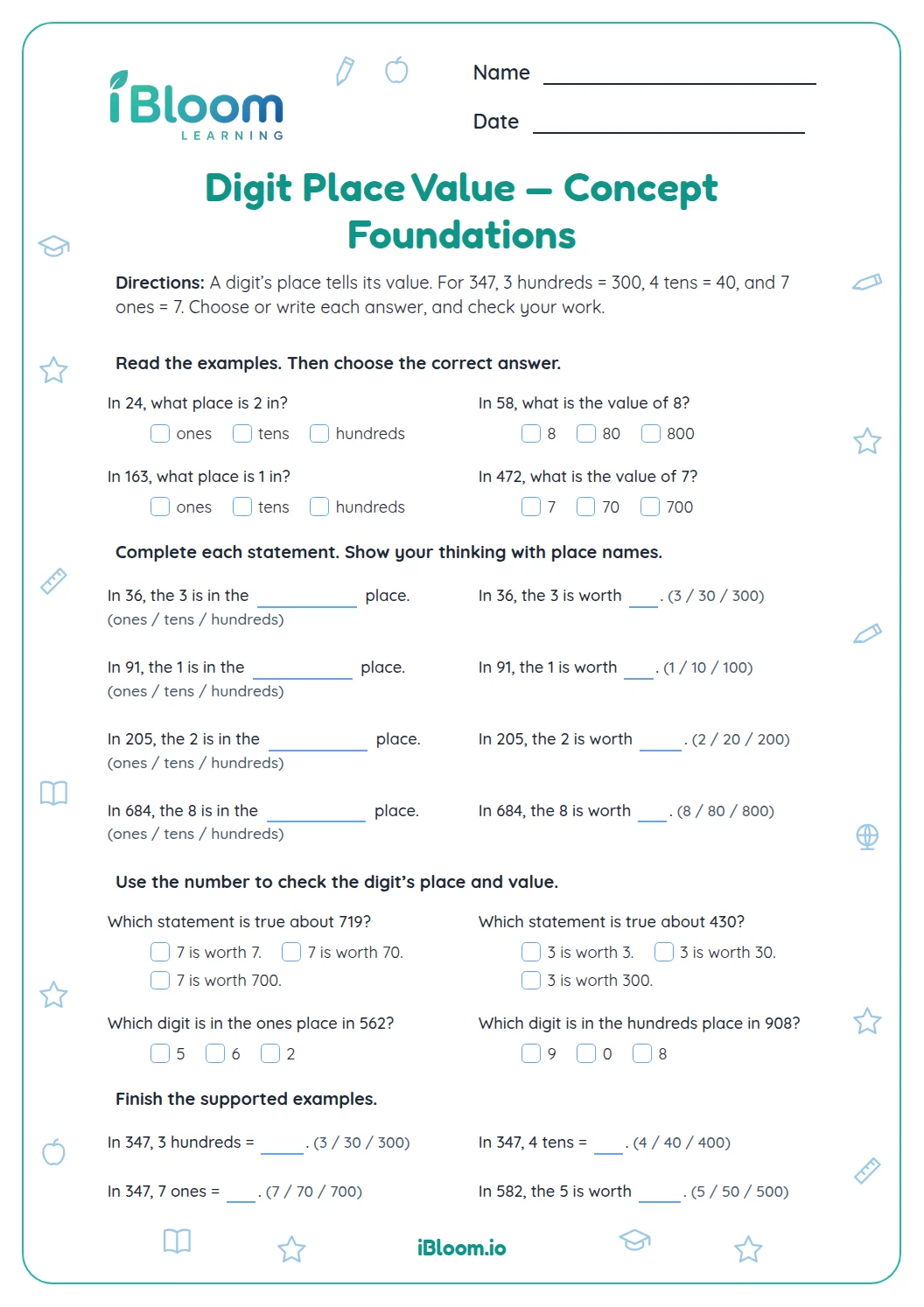
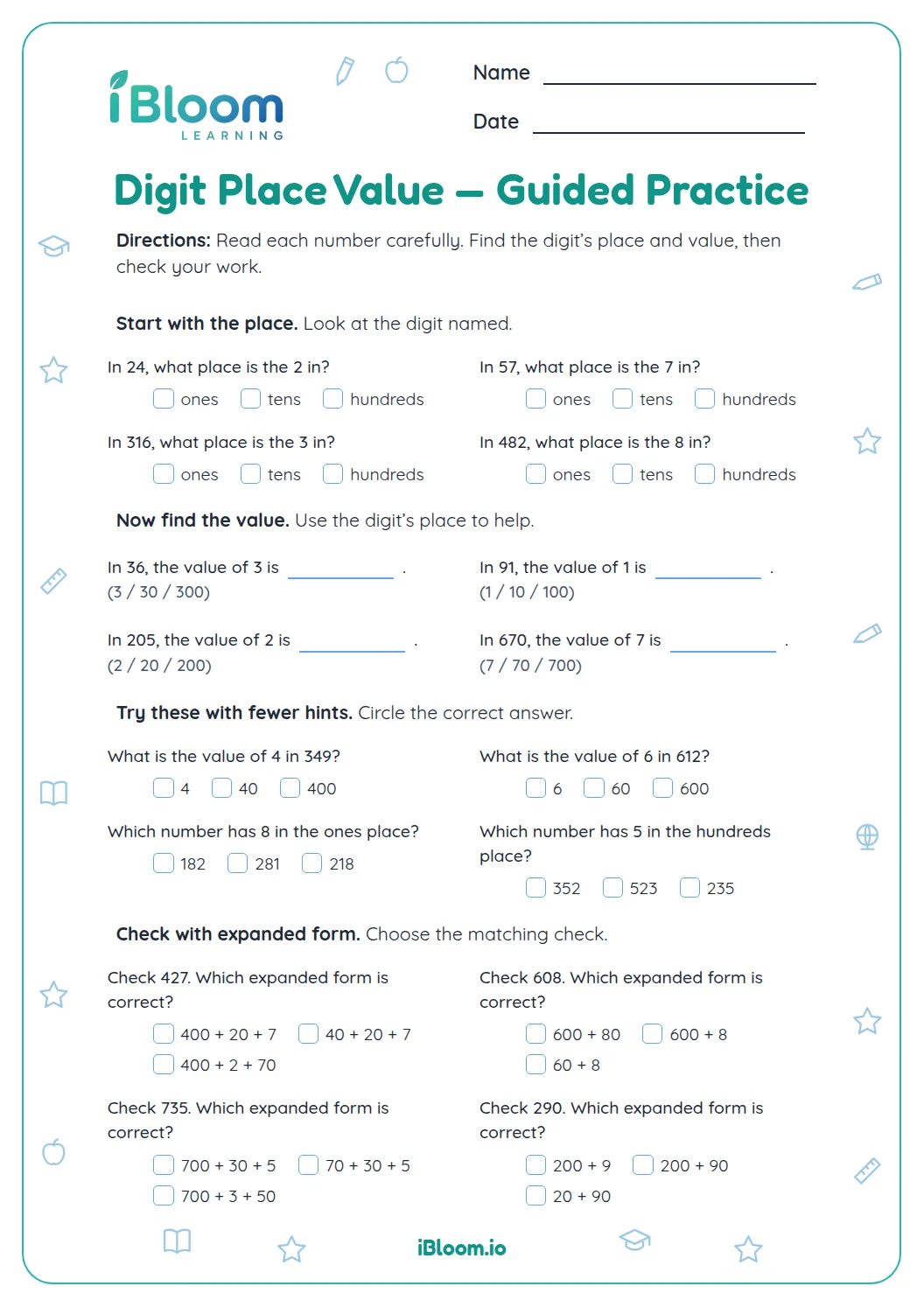
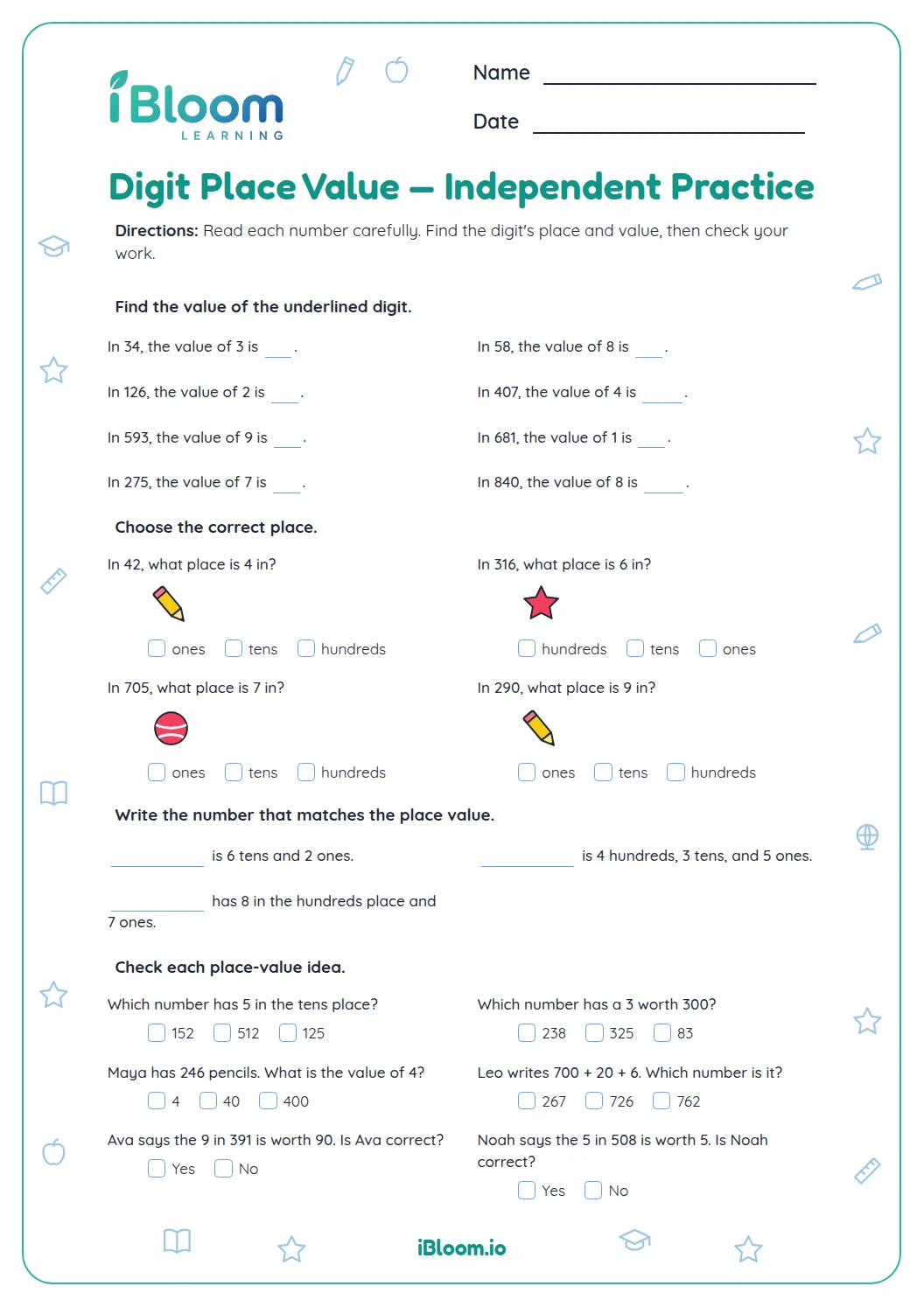
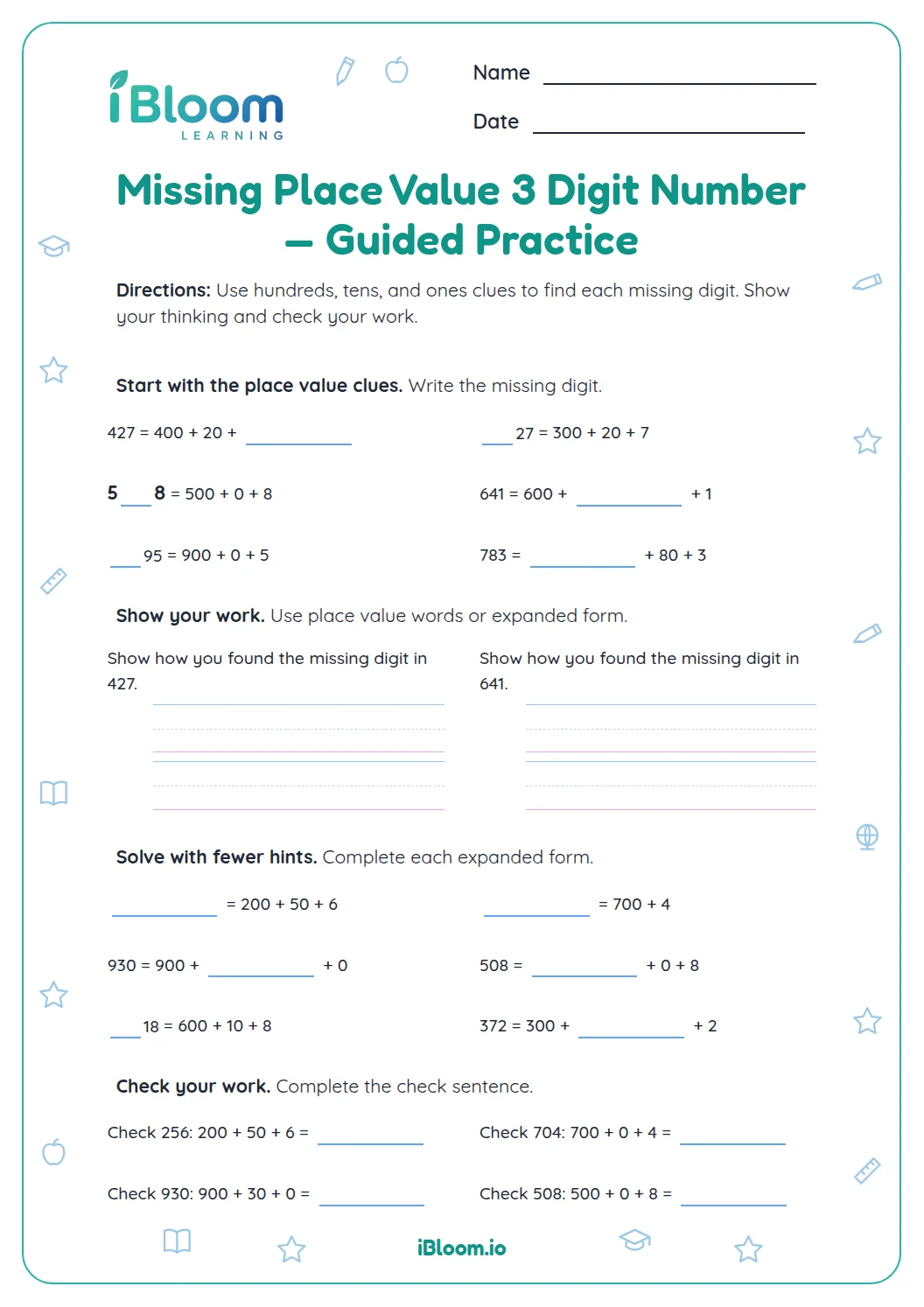
Expanded form shows the value of each digit as a sum. In 326, the 3 means 300, the 2 means 20, and the 6 means 6, so the number is 300 + 20 + 6. A zero place still matters in the number, even though its part adds zero.
- 1508 has 5 hundreds, 0 tens, and 8 ones.
- 2Write one part for each place: 500 + 0 + 8.
How does place value help with real quantities?
A story gives a number a reason to matter: students on a trip, books on a shelf, or cans collected. Find the number in the situation first, then break it into place values. For a change in the amount, use an equation before writing the new number in expanded form.
What will students practice on the pages?
The first part translates real quantities into expanded form. The later questions match numbers and place-value sums, including numbers with a zero in one place. The answer key accepts the listed place-value parts.
How can you use this worksheet?
- 1Read the story and underline the number or quantity it gives.
- 2Say the hundreds, tens, and ones aloud before writing the expanded form.
- 3For a change in quantity, write an addition or subtraction equation first.
- 4Add the expanded-form parts to check that they rebuild the number.
- 5Use the answer key to review zero places and correct any place-value slips.
Common mistakes and quick fixes
The mistake
Treating a tens digit as ones, such as writing 60 as 6.
The fix
Say the digit’s place name before writing its value: 6 tens is 60.
The mistake
Dropping the zero place in a number such as 508.
The fix
Include 0 tens in the expanded form to show the empty place.
The mistake
Writing the digits without adding their place values.
The fix
Write 500 + 0 + 8, then add the parts to confirm they equal 508.
Common Core alignment
This worksheet connects three-digit place value to practical quantities.
Read and write numbers through 1,000 in expanded form.
On this sheet: Students express three-digit quantities from everyday situations as hundreds, tens, and ones.
Show the official wordingHide the official wording
Read and write numbers to 1000 using base-ten numerals, number names, and expanded form.
What to practice next
Make more practice
Further reading
Questions parents and teachers ask
What does expanded form mean?
Expanded form writes a number as the sum of the value of each digit. For 326, that is 300 + 20 + 6: three hundreds, two tens, and six ones. This worksheet asks children to use that idea with everyday counts and to match numbers to their expanded forms.
How do you write a number with a zero in one place?
Keep the zero place in the place-value description so the number stays clear. For question 2, 508 is 500 + 0 + 8: five hundreds, no tens, and eight ones. The zero part adds nothing, but it shows that the tens place is empty.
Do students need to calculate before writing expanded form?
Only for a story that changes an amount. First solve the addition or subtraction, then write the new number as hundreds, tens, and ones. For a direct question, read the digits by place. The key shows the place-value parts so an adult can check both the calculation and the expanded form.
What is one helpful way to check an expanded form?
Add the place-value parts back together and compare the total with the original number. For 463, 400 + 60 + 3 equals 463. Then check each part against its digit: the 6 is in the tens place, so its value is 60.
Does the answer key accept equivalent expanded forms?
The key shows one clear form with hundreds, tens, and ones separated by plus signs. Equivalent forms that keep each digit’s place value are mathematically correct; the key can help adults compare a child’s response with the intended place-value breakdown.