

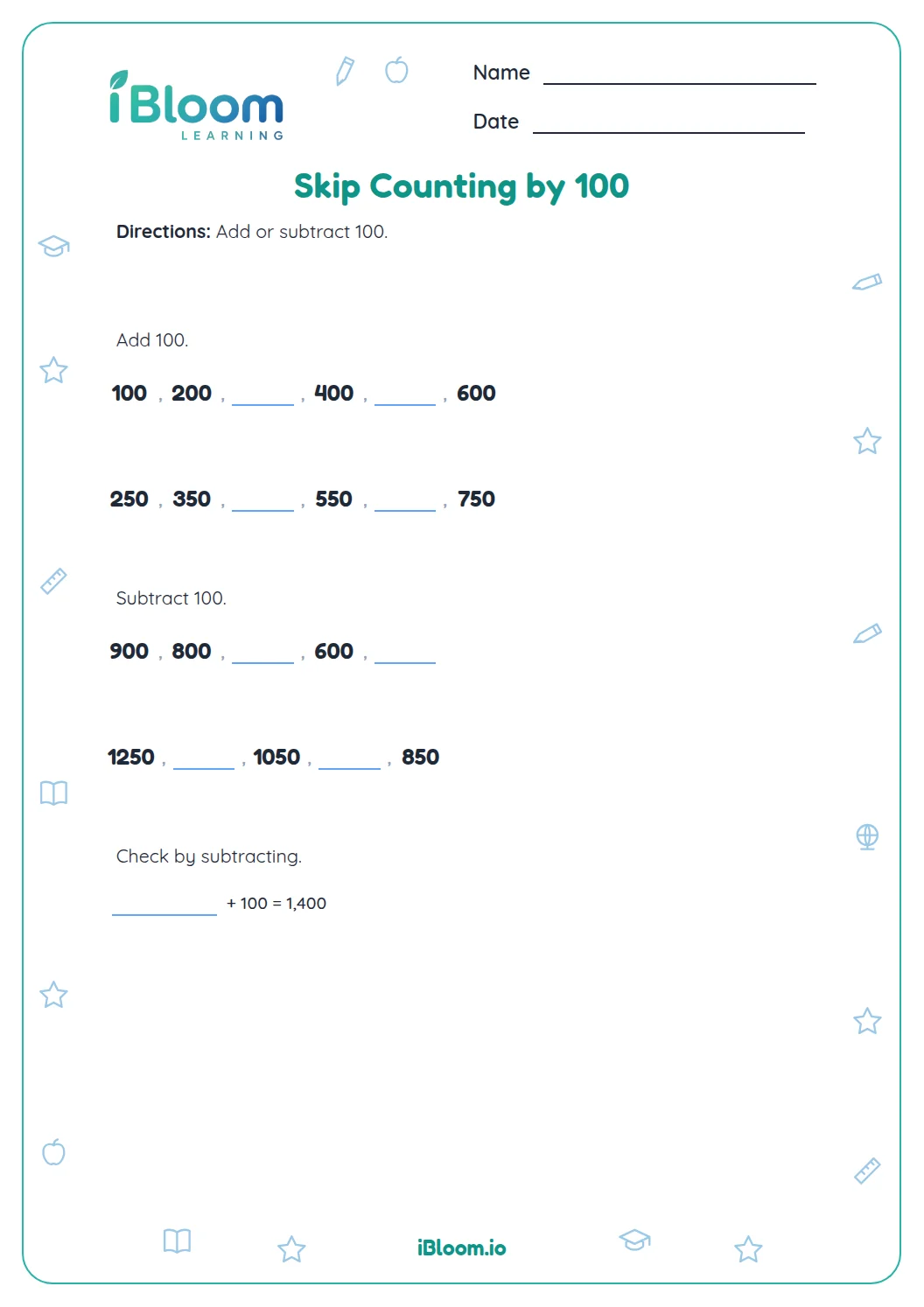
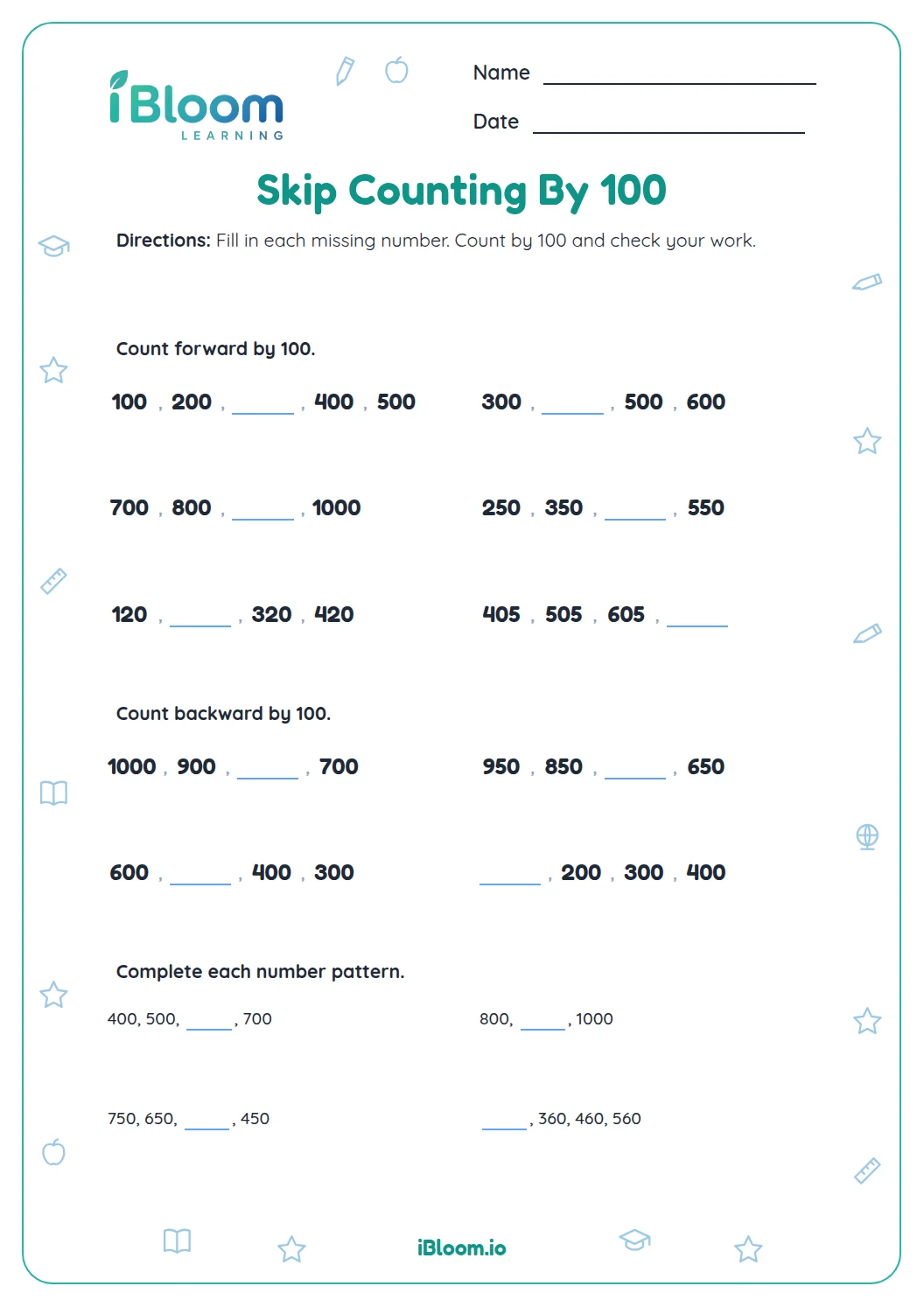
About this worksheet
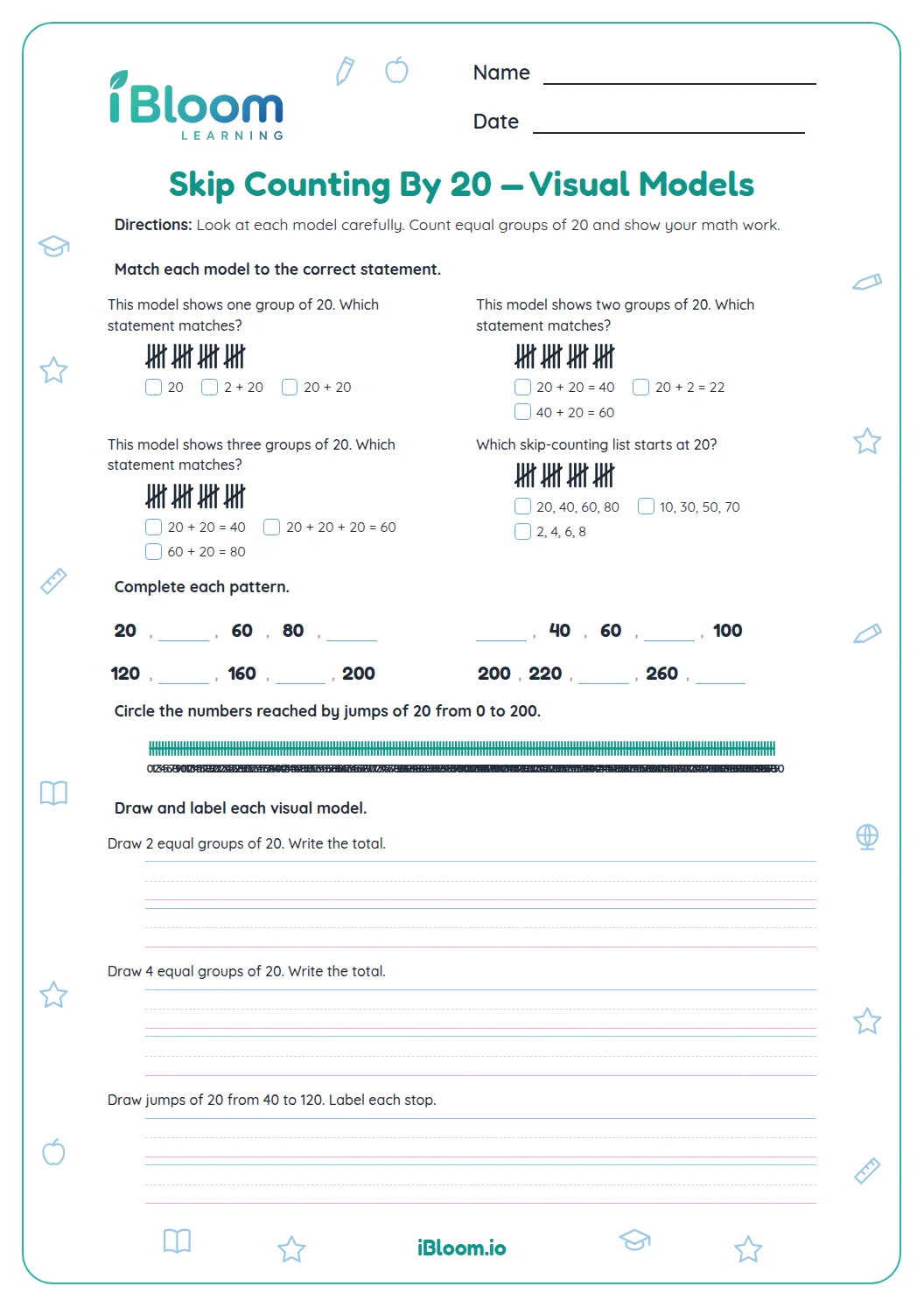
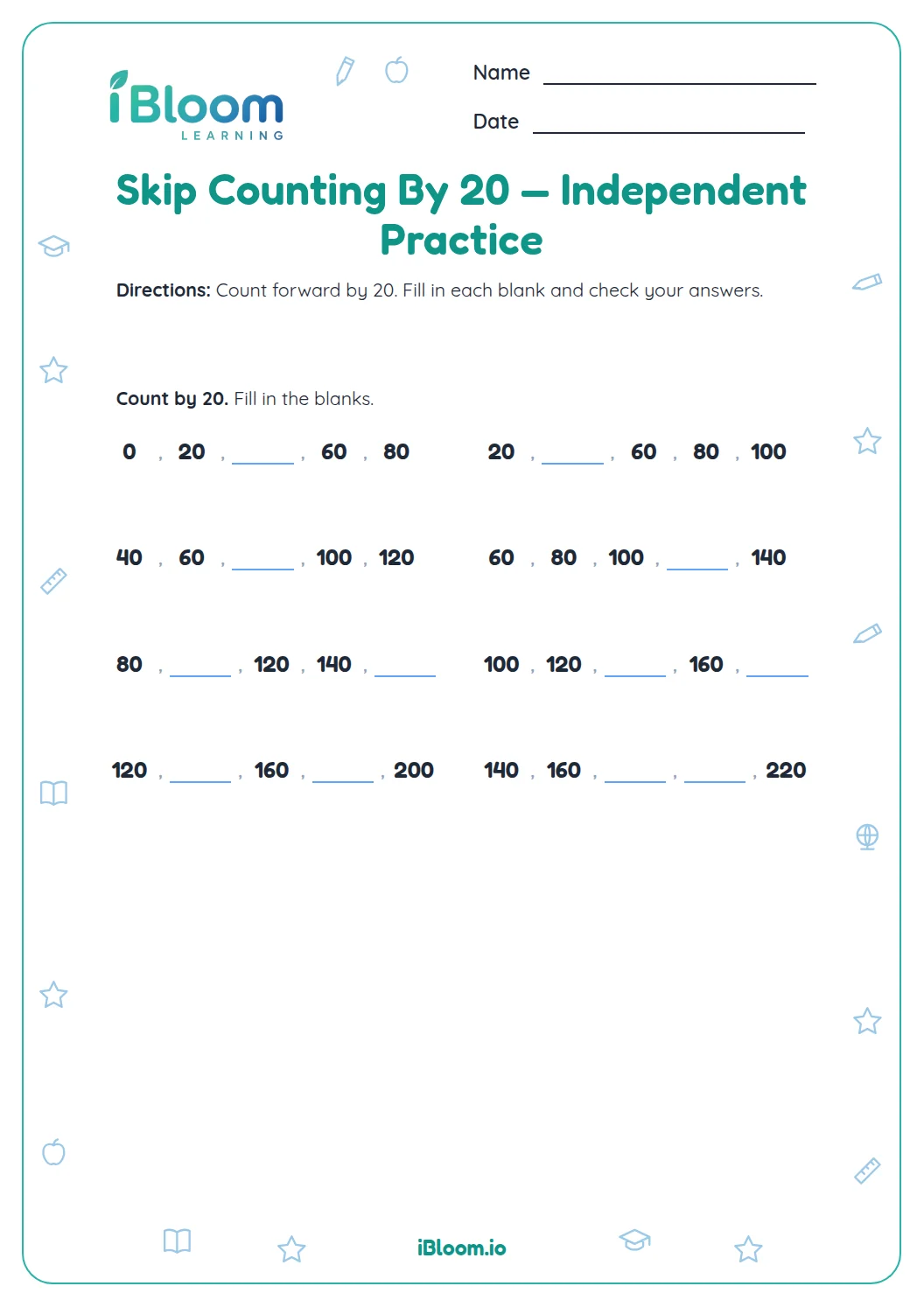
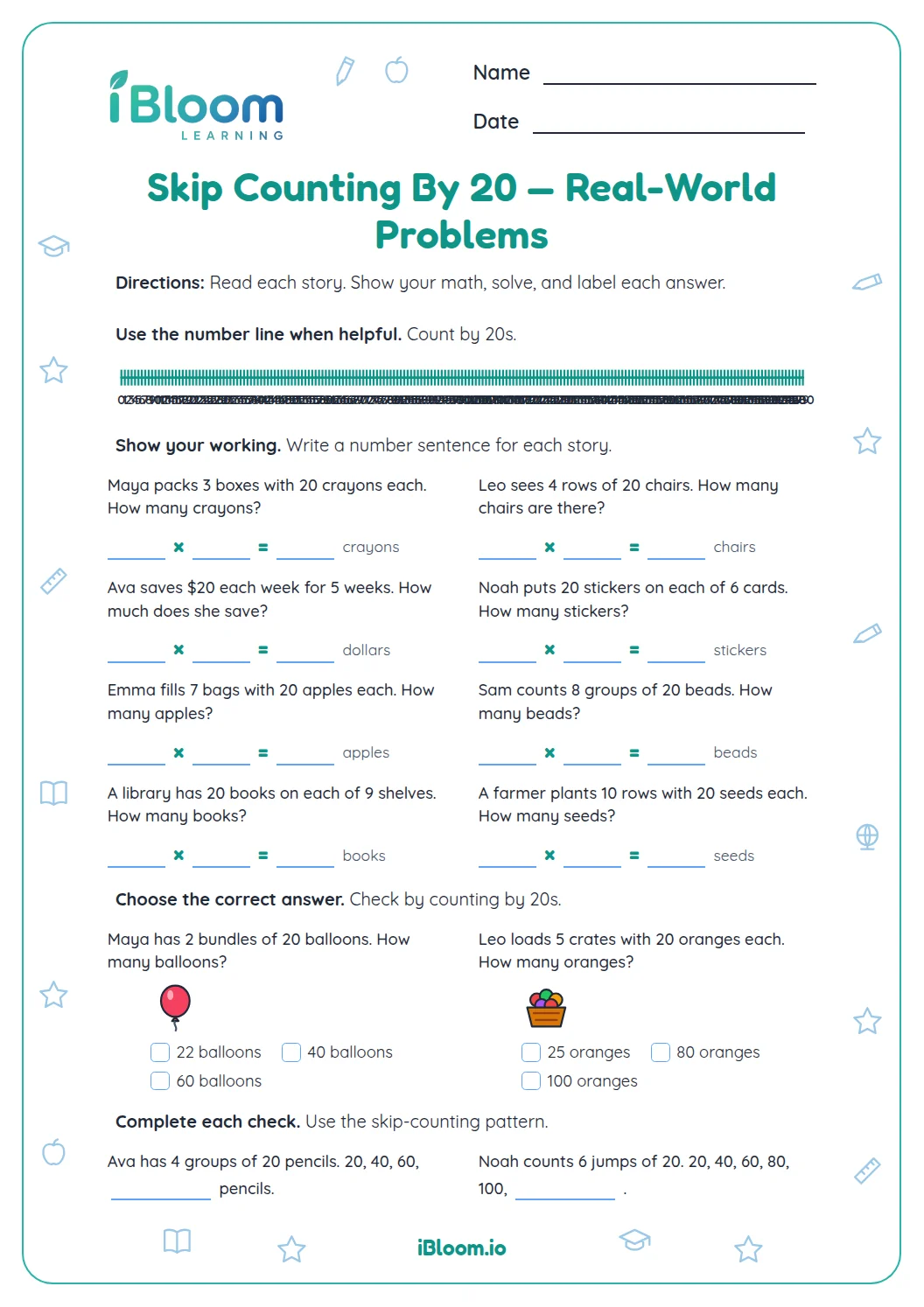
This Grade 2 printable builds fluency with counting by 20. Learners complete eight opening patterns, count equal jumps between values, explain why 320 follows 300, and finish more patterns within 1,000. All 20 questions practice the +20 rule, with a separate answer key. The forward counts connect to CCSS 2.NBT.A.2.
Aligned to 2.NBT.A.2
How can learners find a missing number?
Compare neighboring numbers and keep each jump at 20. In question 2, 140, ___, 180, 200 has 160 in the blank because two jumps span 140 to 180.
Count one jump at a time and check that the pattern continues by 20.
- 1140 → 160 → 180 → 200
- 2Each arrow adds 20.
- 3Missing number: 160
How do you count jumps between two numbers?
Count spaces between the endpoints, not the values you say aloud. From 200 to 300, count 200, 220, 240, 260, 280, 300: that is five jumps.
Check by adding 20 for each space until you reach the endpoint.
How can a +20 pattern help solve a question?
The sheet asks students to explain why 320 follows 300, then complete more +20 patterns and count jumps between endpoints.
For example, 300, 320, 340 follows the rule because each new value is 20 greater than the one before it.
How to use this worksheet
- 1Read two neighboring values and notice their difference.
- 2Add 20 for each step in the sequence.
- 3For a missing middle value, make one jump from the number before it.
- 4Count the spaces between endpoints for jump questions.
- 5Check each answer by adding 20 again.
Common mistakes and fixes
The mistake
Counting the endpoint as an extra jump.
The fix
Count the spaces between numbers; 200 to 300 takes five jumps of 20.
The mistake
Changing the jump size midway.
The fix
Keep each step at 20 and check neighboring differences.
The mistake
Counting backward in a forward pattern.
The fix
Add 20 each time unless the prompt explicitly gives a decreasing count.
Common Core alignment
This worksheet practices the standard below through its own question set.
Count forward within 1,000 while tracking equal jumps of 20.
On this sheet: The number sequences stay within 1,000 and ask learners to count forward by equal jumps of 20.
Show the official wordingHide the official wording
Count within 1000; skip-count by 5s, 10s, and 100s.
What to practice next
Make more practice
Further reading
Questions parents and teachers ask
What does skip-counting by 20 mean?
It means adding 20 each time: 20, 40, 60, 80. This worksheet asks students to continue sequences, fill gaps, explain one +20 step, and count jumps between values. All items keep the same forward counting rule and stay within 1,000.
How can I find a missing middle number?
Check the size of one jump. In 140, ___, 180, 200, the gap from 140 to 180 covers two jumps of 20, so the missing value is 160. Adding 20 once to 140 gives the number between the endpoints without skipping a step.
How many jumps are there from 200 to 300?
There are five jumps of 20: 200 to 220, 240, 260, 280, and 300. Count the spaces between the values rather than counting the starting number as a jump; five groups of 20 also make the difference of 100, which checks the jump count.
Does the practice stay within 1,000?
Yes. The sequences and jump questions stay at or below 1,000, and the largest endpoint is 1,000. Students can check every forward step by adding 20 and compare neighboring values to spot a missed count. The last patterns use values below that limit as well.
How many questions are included?
There are 20 questions in four parts: eight opening sequence gaps, jump counts, one short written explanation, and more pattern questions. The worksheet uses two pages, followed by a separate two-page answer key. Every item asks students to apply or explain a +20 count.
What can learners try next?
They can compare counting by 20 with counting by 10 or 100. The related Grade 2 pages linked above provide practice with other fixed skip-counting steps. Students can also make their own sequences and ask a partner to find a missing value.