
About this worksheet
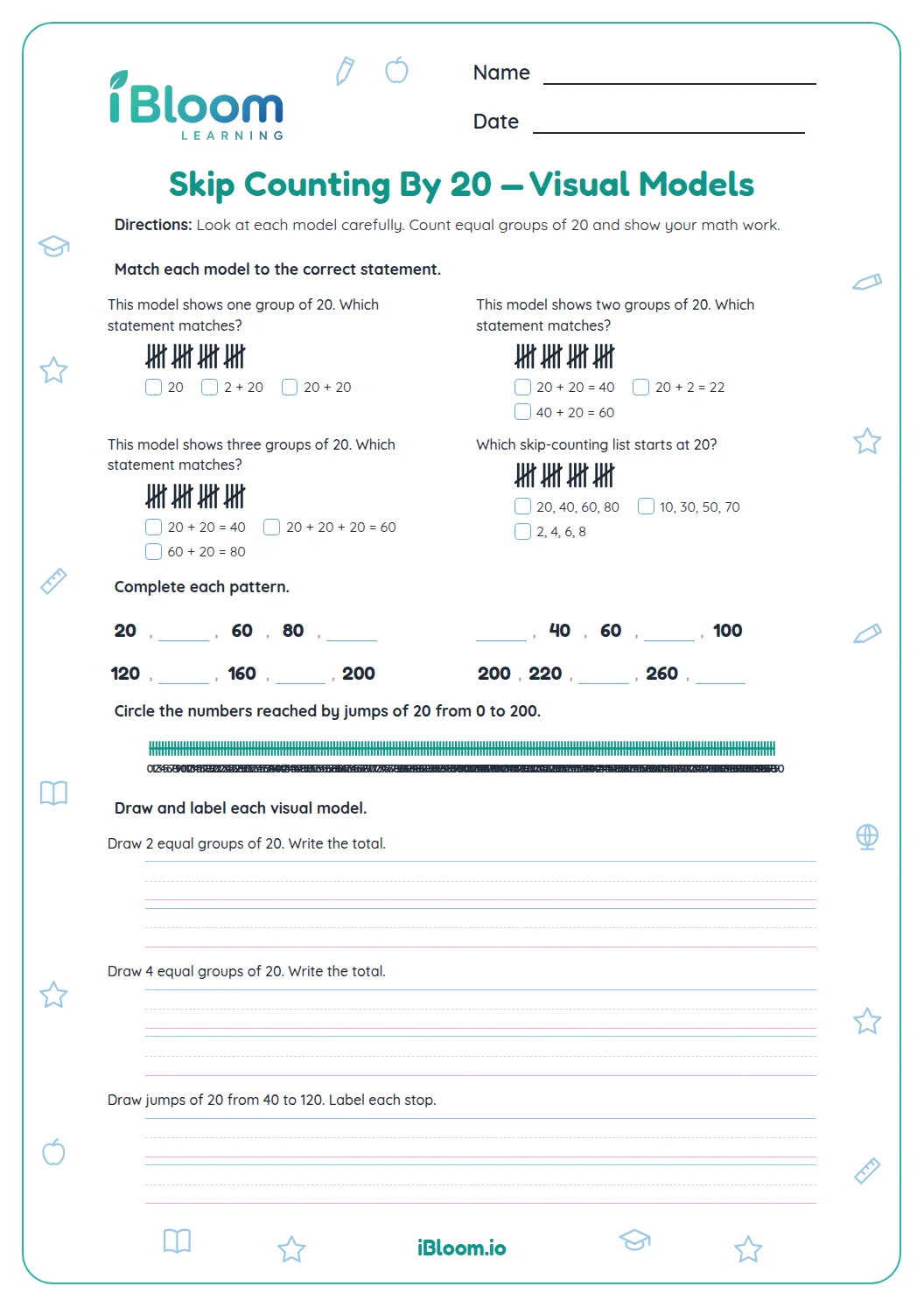
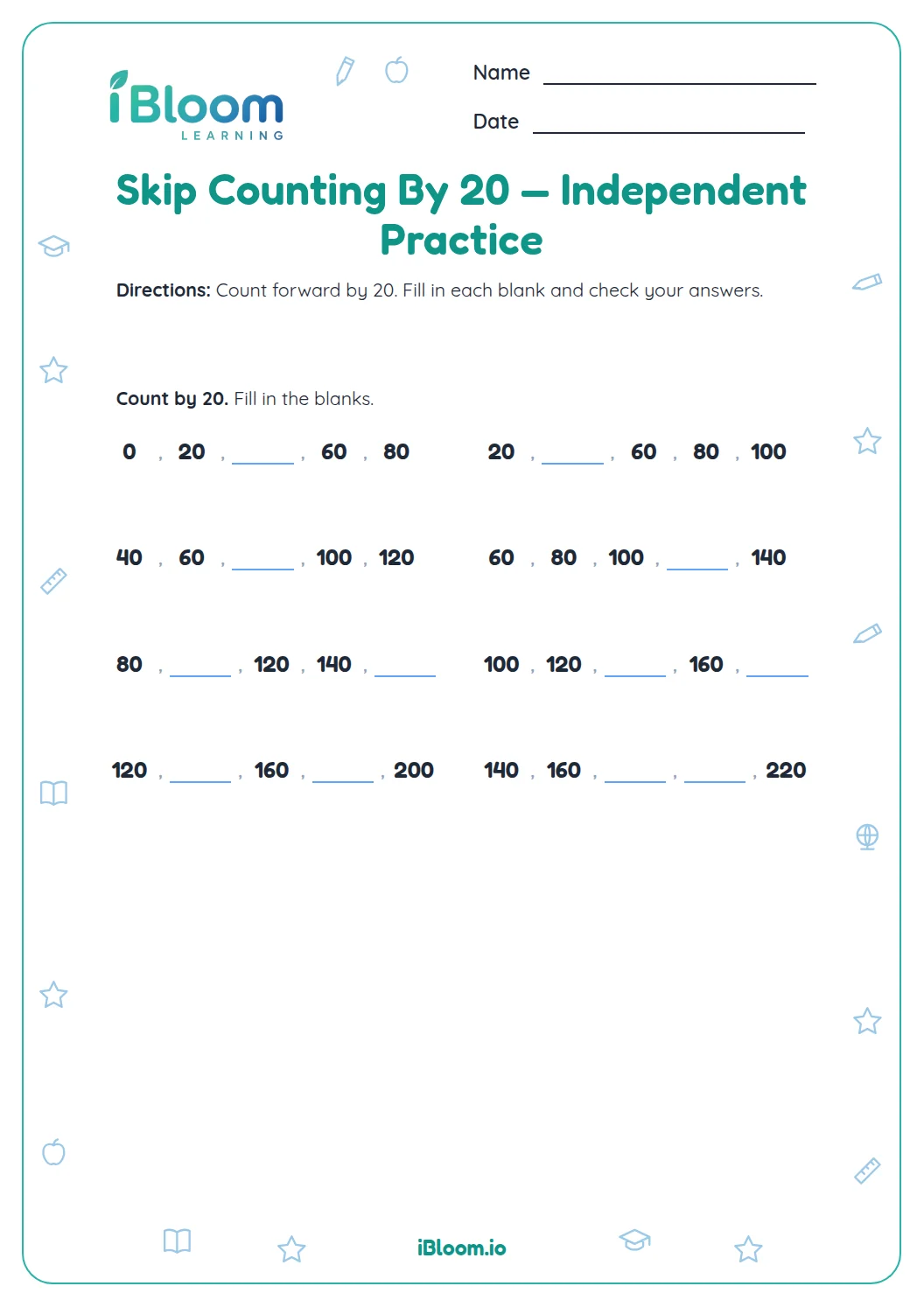
This Grade 2 worksheet builds fluency with counting by 20. Children complete four sequences, read four labeled points on number lines, and connect groups of 20 to totals. The number lines make each jump visible while the group questions connect the pattern to repeated addition. It supports CCSS 2.NBT.A.2, which includes skip-counting patterns. A separate answer key is included.
Aligned to 2.NBT.A.2
How does this page practice counting by 20?
Part A extends four sequences by adding 20. Part B asks for values at points on number lines with equal jumps of 20. Part C connects groups of 20 to totals through repeated addition.
What pattern stays the same when counting by 20?
Each new number is 20 more than the number before it. The tens digits follow a repeating pattern while the hundreds digit changes as the count passes each hundred.
- 1Start at 0 and add 20 each time.
- 20, 20, 40, 60, 80
- 3The missing numbers are 20, 40, 60, and 80.
How can a number line help?
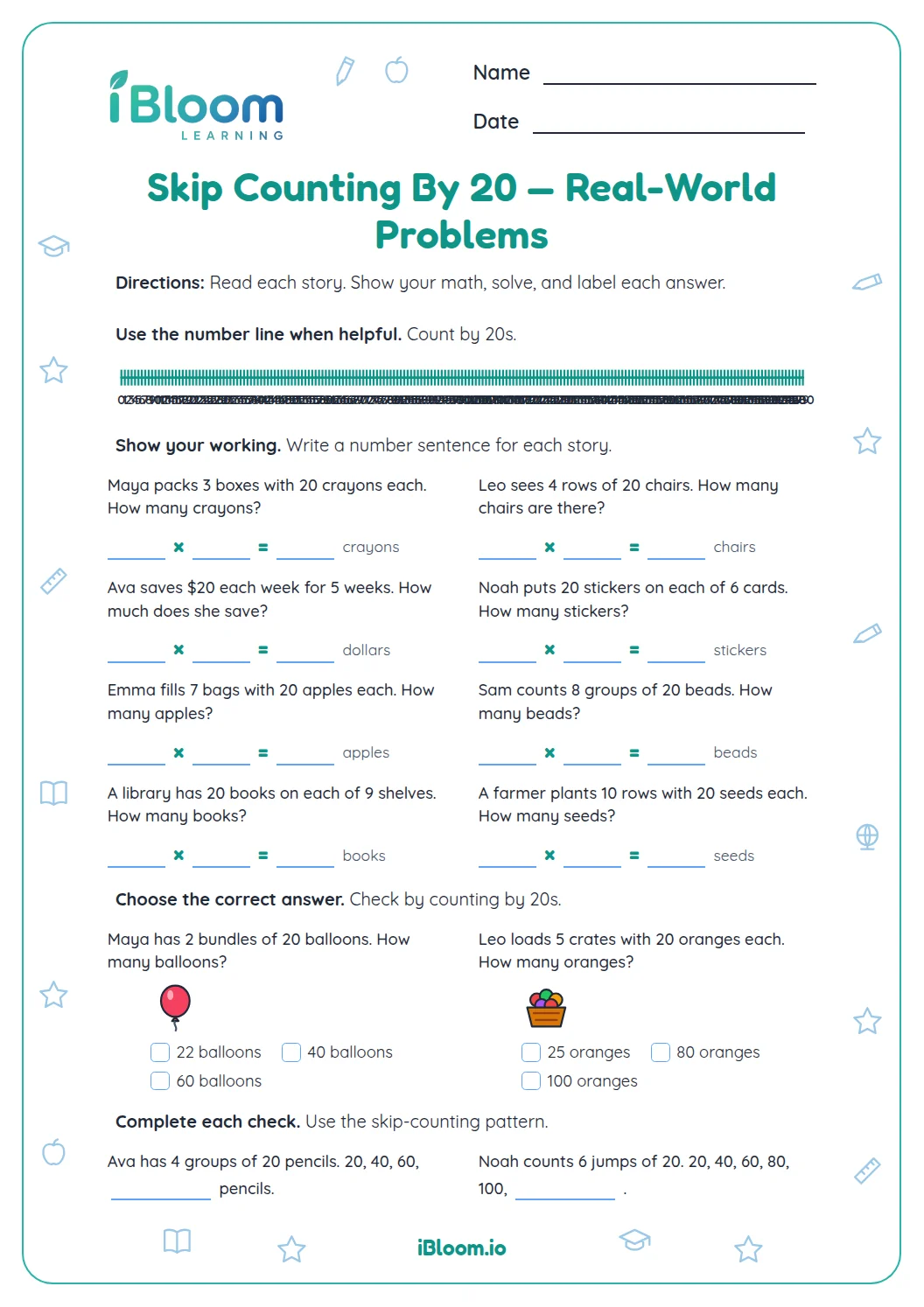
Each group contributes 20. For five groups, write 20 + 20 + 20 + 20 + 20, or use the pattern 20, 40, 60, 80, 100 to find the total.
- 1Five groups of 20
- 220 + 20 + 20 + 20 + 20 = 100
- 3The total is 100.
How to use this worksheet
- 1Read the starting number.
- 2For a sequence, add 20 to the last number.
- 3On a number line, count each interval as one jump of 20.
- 4For groups, multiply the number of groups by 20 or add 20 repeatedly.
- 5Check that the count increases by exactly 20 each time.
Common mistakes and quick fixes
The mistake
Adding 2 instead of 20.
The fix
Keep the zero in the tens place: 40, 60, 80.
The mistake
Skipping a tick on the number line.
The fix
Touch each interval once and say the next multiple of 20.
The mistake
Confusing the number of groups with the total.
The fix
Count one group as 20, then find the sum for all groups.
Common Core alignment
This practice connects the listed grade-level standard to short, focused worksheet tasks.
Count by 20s within 1,000 and recognize the sequence pattern.
On this sheet: The number patterns count forward by 20, applying place-value patterns.
Show the official wordingHide the official wording
Count within 1000; skip-count by 5s, 10s, and 100s.
What to practice next
Make more practice
Further reading
Questions parents and teachers ask
How many questions are included?
There are 14 questions across three worksheet pages: four number sequences, four number-line points, and six group-total problems. The last six ask children to write repeated-addition equations as well as find each sum. The separate answer key lists the completed sequences, point values, and totals.
Does the number line show the answer?
Each number line marks point A but does not print its value beside the point. The ticks show equal jumps of 20, so children can count from an endpoint to determine the number at A. The key gives the value for each marked point.
What is the rule for counting by 20?
Add 20 to the number just named. For example, starting at 100 gives 120, 140, 160, and 180. The worksheet varies the starting amount and also asks children to connect groups of 20 with repeated addition, so they can see the same pattern in sequences and totals.
How are groups connected to skip counting?
Each group has 20, so the total is the sum of one 20 for every group. Five groups can be written as 20 + 20 + 20 + 20 + 20, which equals 100. Counting by 20 reaches the same total in equal steps.
What materials are needed?
A pencil is enough for the printed sequences, number lines, and equations. Children can point to each number-line tick as they count by 20. No counters are required, though objects grouped into sets of 20 can help introduce the idea.