
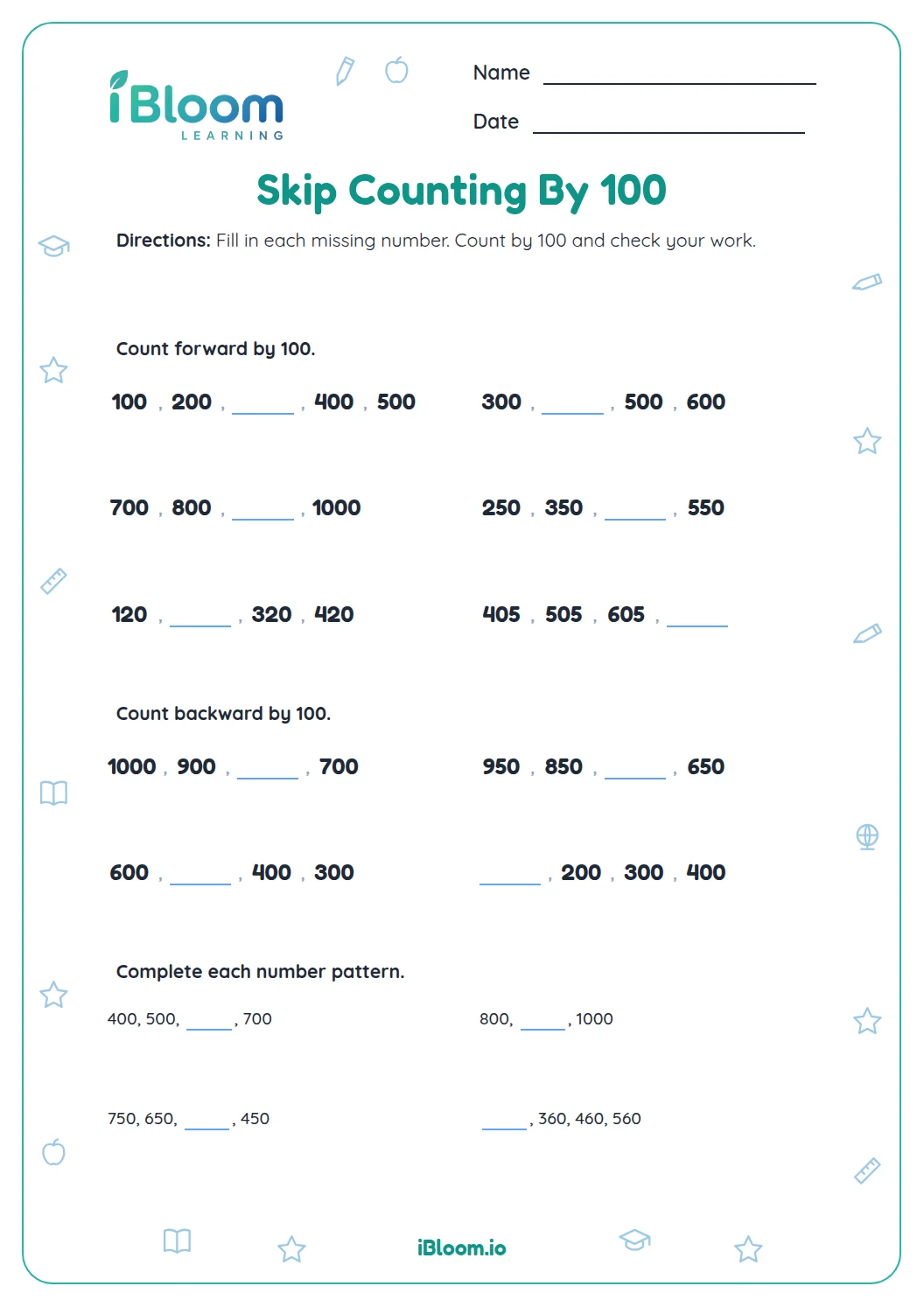
About this worksheet
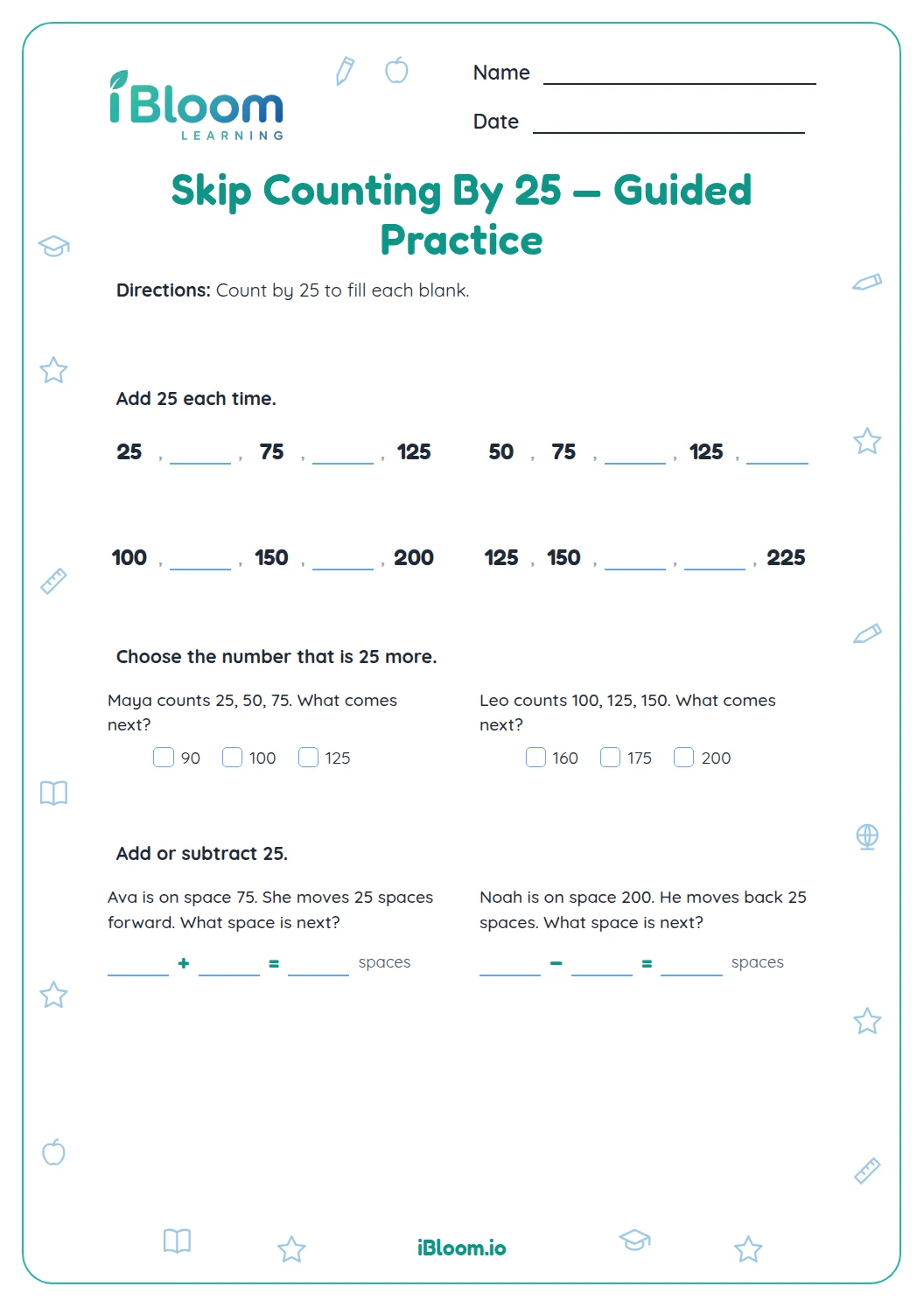
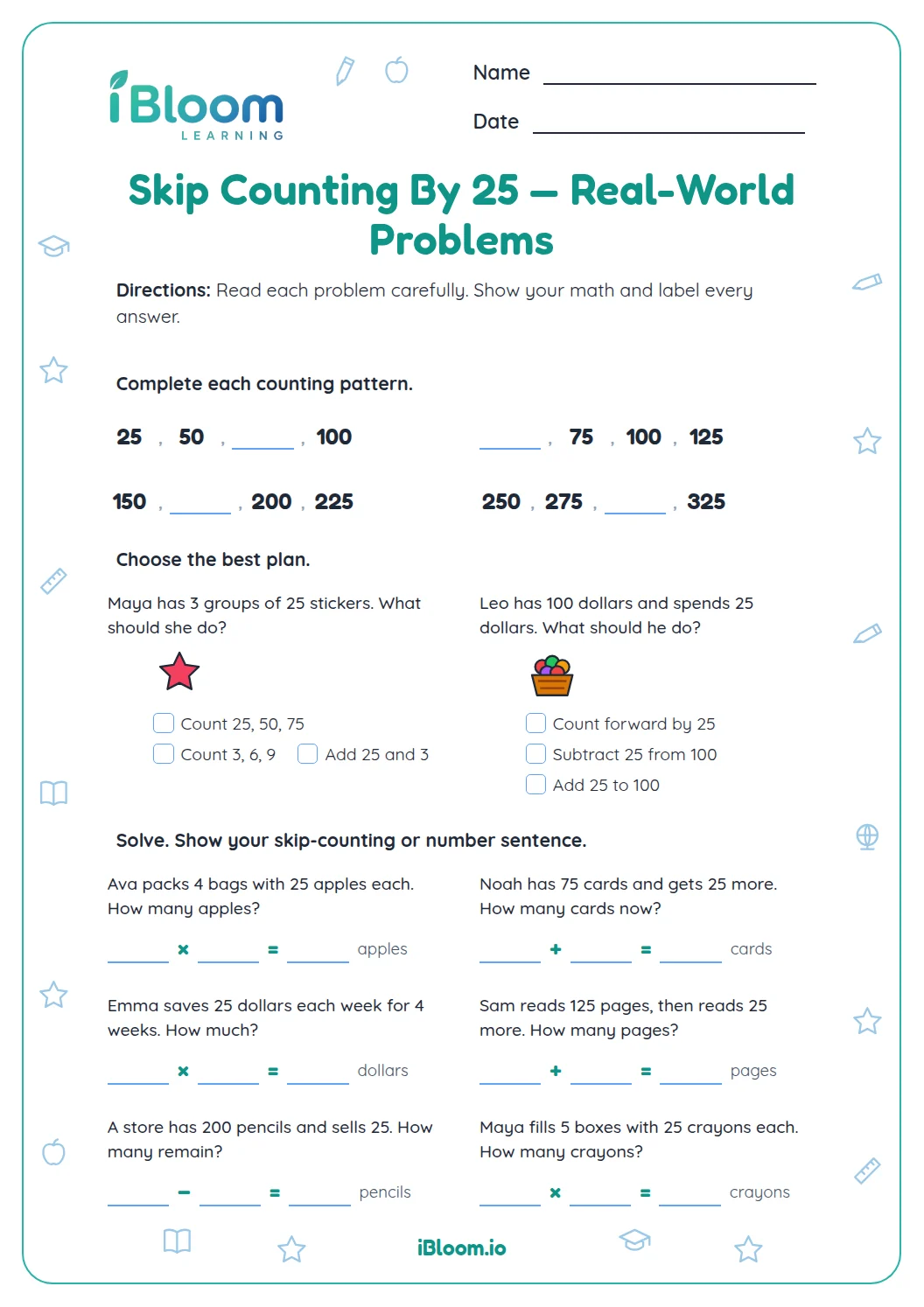
This two-page printable gives Grade 2 students 16 chances to practice skip counting by 25. Part A has missing numbers in forward and backward sequences. Part B applies the same pattern to starting points, comparisons, and groups of quarters. The values stay within 1,000. Children can use the sequence to see how each step adds or subtracts 25; the separate answer key lists the completed numbers.
Aligned to 2.NBT.A.2
What changes when you count by 25?
Each number is 25 greater than the one before it. Four jumps of 25 make 100, so the hundreds digit changes after every four jumps. The ones and tens digits make a repeating pattern.
How do you complete a missing number?
Compare neighboring numbers and ask whether the sequence is increasing or decreasing. Then add or subtract 25 once for each step.
- 125, 50, ___, 100
- 250 + 25 = 75
- 3Check: 75 + 25 = 100.
How do quarters connect to 25?
A quarter is worth 25 cents. Counting quarters is another way to practice the same jumps, such as 25, 50, 75, and 100 cents.
How to use this worksheet
- 1Read the numbers on both sides of a blank.
- 2Decide whether the sequence moves forward or backward.
- 3Add or subtract 25 to find one step.
- 4For a longer sequence, repeat the step in order.
- 5Check the pattern by comparing every neighboring pair.
Common mistakes and quick fixes
The mistake
Adding 25 in a backward sequence.
The fix
Check whether the numbers are getting smaller; subtract 25 each time.
The mistake
Skipping a step when two blanks are requested.
The fix
Write each missing number in order and verify the jump between them.
The mistake
Mixing up the value of one quarter.
The fix
Remember that one quarter is 25 cents and four quarters make 100 cents.
Common Core alignment
This sheet connects the practice to a specific Common Core skill.
Count forward by equal jumps to build number patterns.
On this sheet: Children continue and interpret a count-by-25 sequence within 1,000.
Show the official wordingHide the official wording
Count within 1000; skip-count by 5s, 10s, and 100s.
What to practice next
Make more practice
Further reading
Questions parents and teachers ask
What does skip counting by 25 mean?
It means adding 25 each time you say the next number. The sequence begins 25, 50, 75, 100, then continues 125, 150, and so on. The separate answer key lists the response, and a quick reread helps children connect each answer to its clue.
Can students count backward on this sheet?
Yes. Several sequences decrease by 25, and one prompt asks students to continue backward from 400. Students can check by subtracting 25 at each step. The separate answer key lists the response, and a quick reread helps children connect each answer to its clue.
How are quarters used in the practice?
A quarter is worth 25 cents, so counting quarters follows the same steps of 25. Two questions connect the pattern to groups of quarters, and the answer key gives the cents total for each jar. Students can check the pattern by adding one more quarter at a time.
What is the number range?
All sequence values stay between 25 and 925. The worksheet keeps the work within 1,000 while giving students several starting points. The separate answer key lists the response, and a quick reread helps children connect each answer to its clue.
How many questions and answer pages are included?
There are 16 questions across two worksheet pages and a separate two-page answer key. The practice includes missing terms, ordered sequences, and questions applying the count-by-25 pattern. Each sequence changes by a consistent 25, so students can use the step to check their work.