
About this worksheet
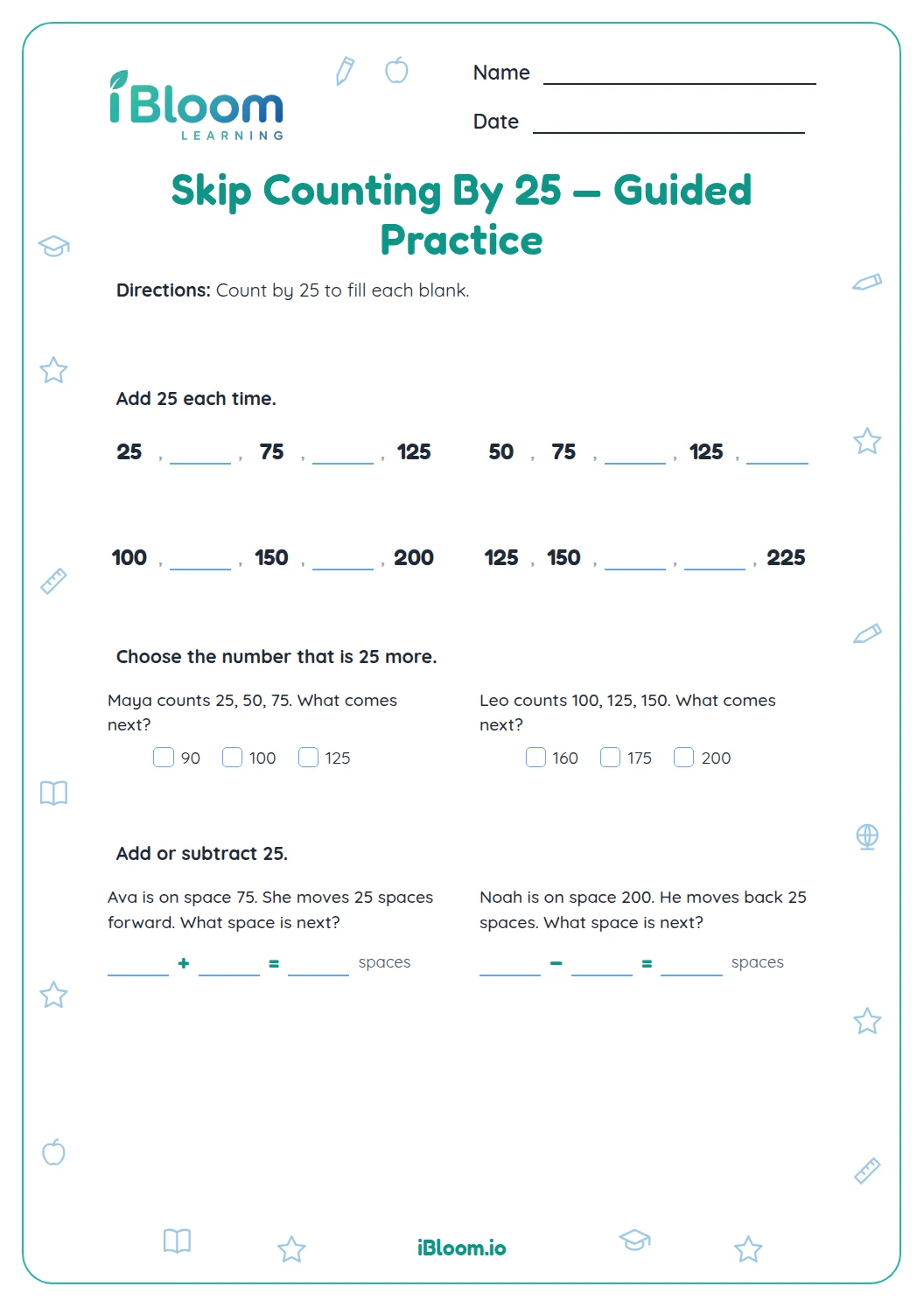
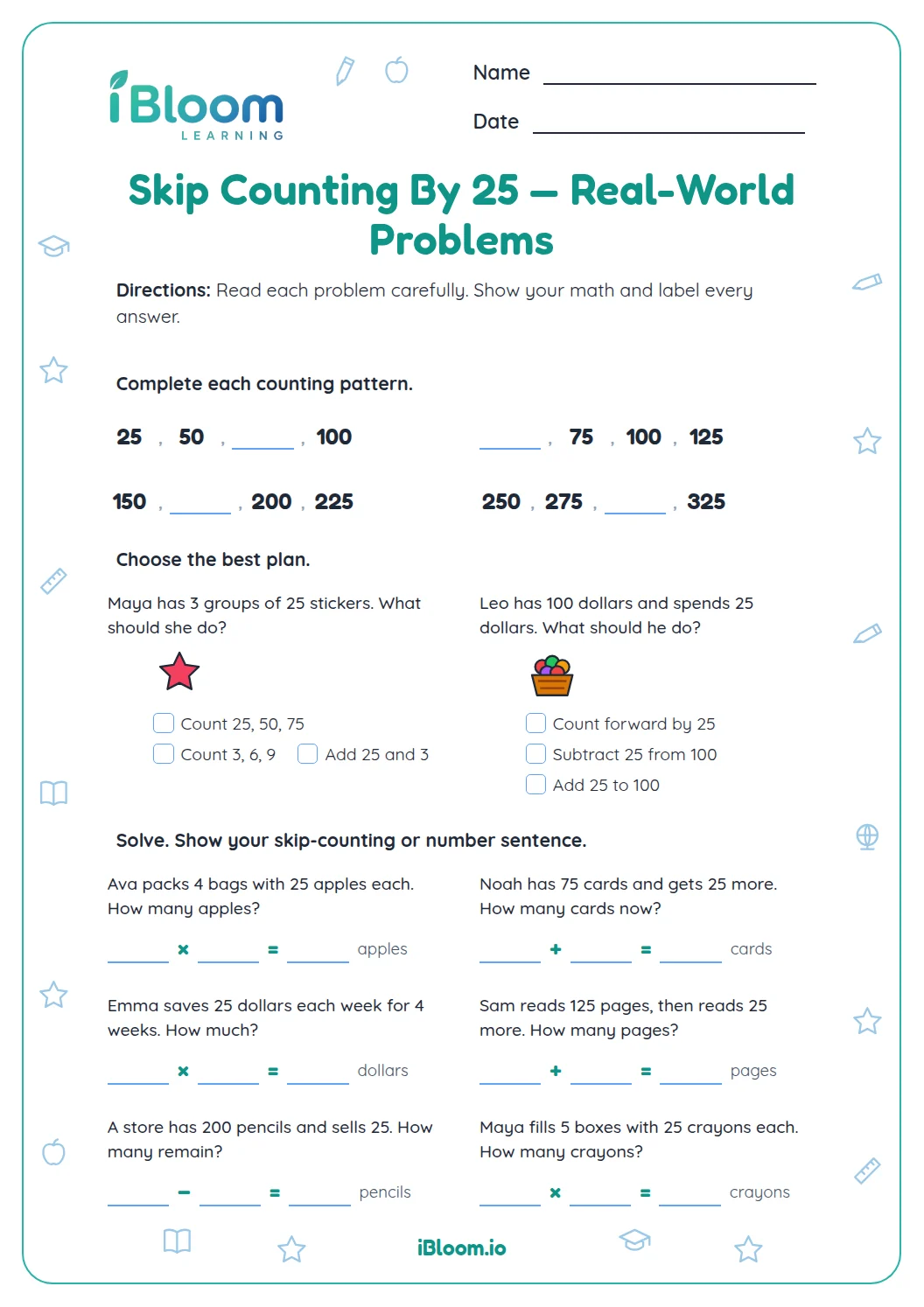
This free Grade 2 worksheet connects counting by 25 with adding 25. Children read two number lines, fill six gaps in counting patterns, complete six addition sentences using 20 + 5, and explain two answers. The numbers reach 300, with practice crossing from 75 to 100 and from 175 to 200. These models and written additions practice Common Core 2.NBT.B.7. Use the sheet after a child can add tens and ones; the separate answer key includes sample explanations.
Aligned to 2.NBT.B.7
What does a jump of 25 mean?
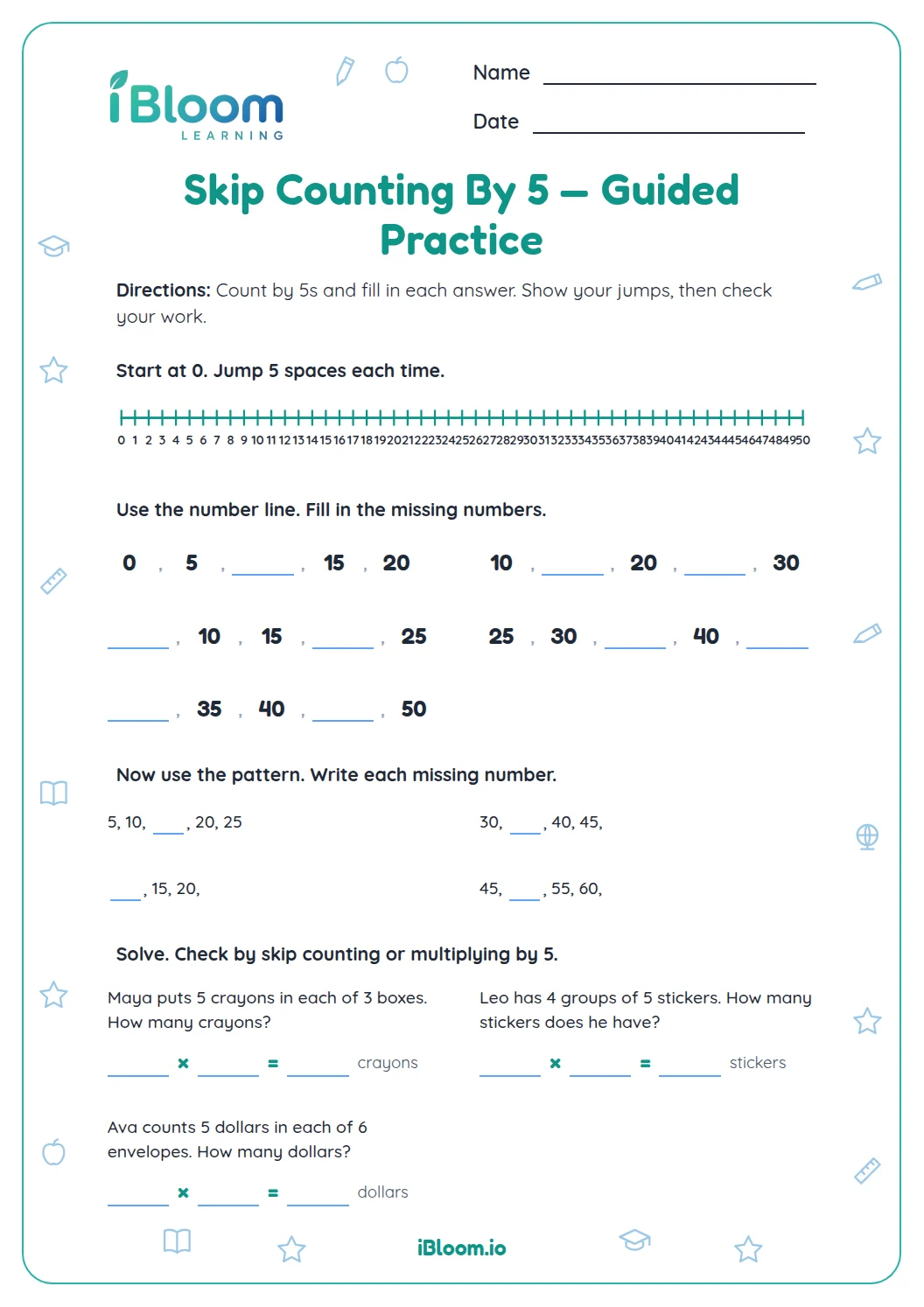
Each space between neighboring ticks stands for 25. On the first line, move from 0 to 25, then to 50, 75 and 100. Point A is at the third jump from zero.
Part A has two number-line questions. The second starts at 100, so children must keep the starting value in mind.
How do the missing-number patterns work?
Part B has six sequences with one missing number each. Add 25 to the number before the gap, then check that adding another 25 reaches the next printed number. This checks the gap from both directions.
- 150, 75, ___, 125
- 275 + 25 = 100
- 3100 + 25 = 125, so the missing number is 100.
How does 20 + 5 help?
Part C breaks one step into two small additions. Question 9 asks for 75 + 20; question 10 continues with 95 + 5. Together they show why 75 + 25 crosses into the next hundred.
Questions 11 and 12 repeat that method from 175. Questions 13 and 14 start from 250. In Part D, children explain how to reach 300 from 275, then identify the missing step in Leo’s answer.
How to work through the sheet
- 1Say 0, 25, 50, 75, 100 while pointing along the first number line.
- 2Let your child count the jumps to A and B.
- 3Complete each pattern gap, checking the next printed number too.
- 4Work through the paired additions in Part C, then explain the two answers in Part D.
- 5Check the key and revisit any gap using 20 + 5.
Mistakes to notice and how to help
The mistake
Writing 175, 195, 225 in question 7.
The fix
Add 20 to get 195, then 5 to reach 200; the jump must total 25.
The mistake
Calling A 100 because the starting tick was counted as the first 25.
The fix
Start on zero. Count a jump only when moving to the next tick.
The mistake
Writing 95 as the answer to 75 + 25.
The fix
That adds only 20. Finish with the extra 5 to reach 100.
Common Core alignment
Use equal jumps and place value to add 25 to numbers within 1,000.
On this sheet: Number lines model equal additions of 25, and Part C splits 25 into 20 and 5.
Show the official wordingHide the official wording
Add and subtract within 1000, using concrete models or drawings and strategies based on place value, properties of operations, and/or the relationship between addition and subtraction; relate the strategy to a written method. Understand that in adding or subtracting three-digit numbers, one adds or subtracts hundreds and hundreds, tens and tens, ones and ones; and sometimes it is necessary to compose or decompose tens or hundreds.
What to practice next
Make more practice
Further reading
Questions parents and teachers ask
How many questions are on the sheet?
There are 16 questions in four parts. Two use number lines, six have a missing number in a counting pattern, and six are addition sentences. The final two ask children to explain an addition and find a missing step, using the same 20 + 5 strategy.
Does counting always start at zero?
No, several patterns start at a different multiple of 25. The second number line starts at 100, and the last pattern starts at 225. Have your child read the first number before counting, then add 25 for each move to the right.
Why does the pattern go from 75 to 100?
Adding 25 to 75 makes 100. Part C separates that jump into 75 + 20 = 95 and 95 + 5 = 100. Let your child say both steps aloud, then reread the sequence 50, 75, 100, 125 to hear the equal jumps.
What do the letters on the number lines mean?
A and B mark numbers for your child to find. The end labels show where each line starts and stops, and each space represents 25. Count spaces from the starting number to the letter, then write the value on the answer line.
How should I use the answer key?
Use the key after your child has checked each pattern by adding 25. For a missed number, return to the previous value and work forward together. The key includes the six addition answers and sample explanations, so you can check both the result and the strategy.