


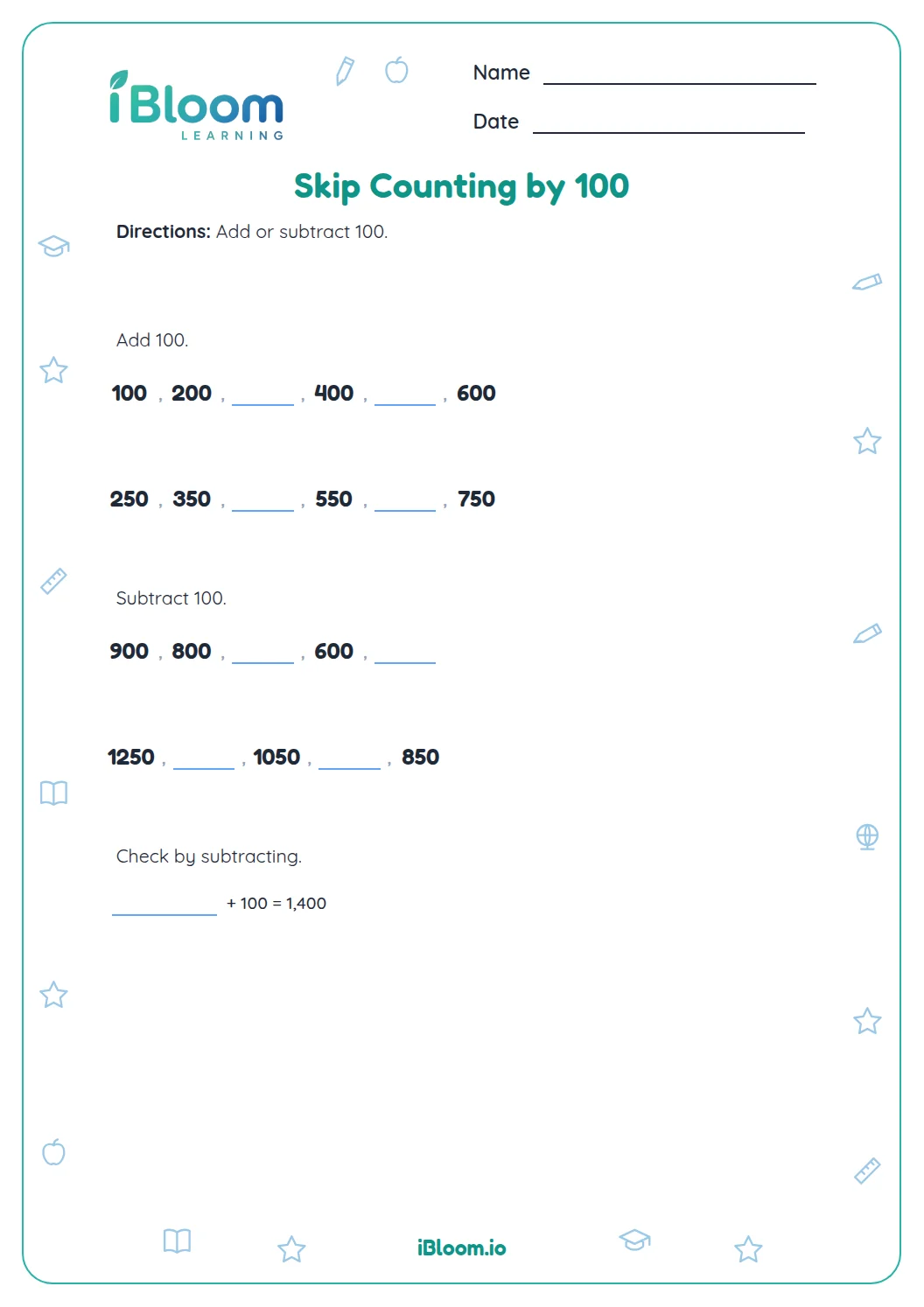
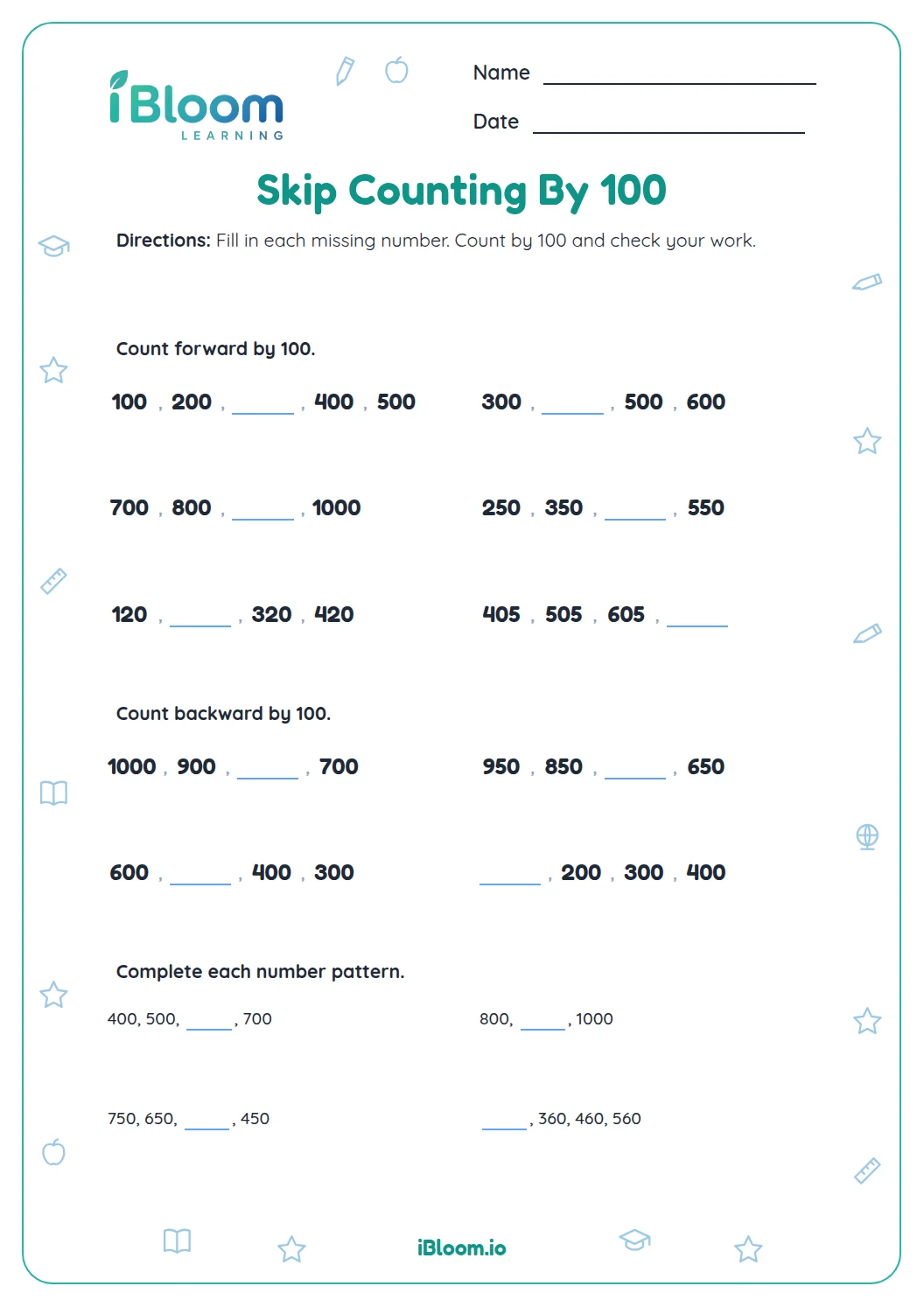
About this worksheet
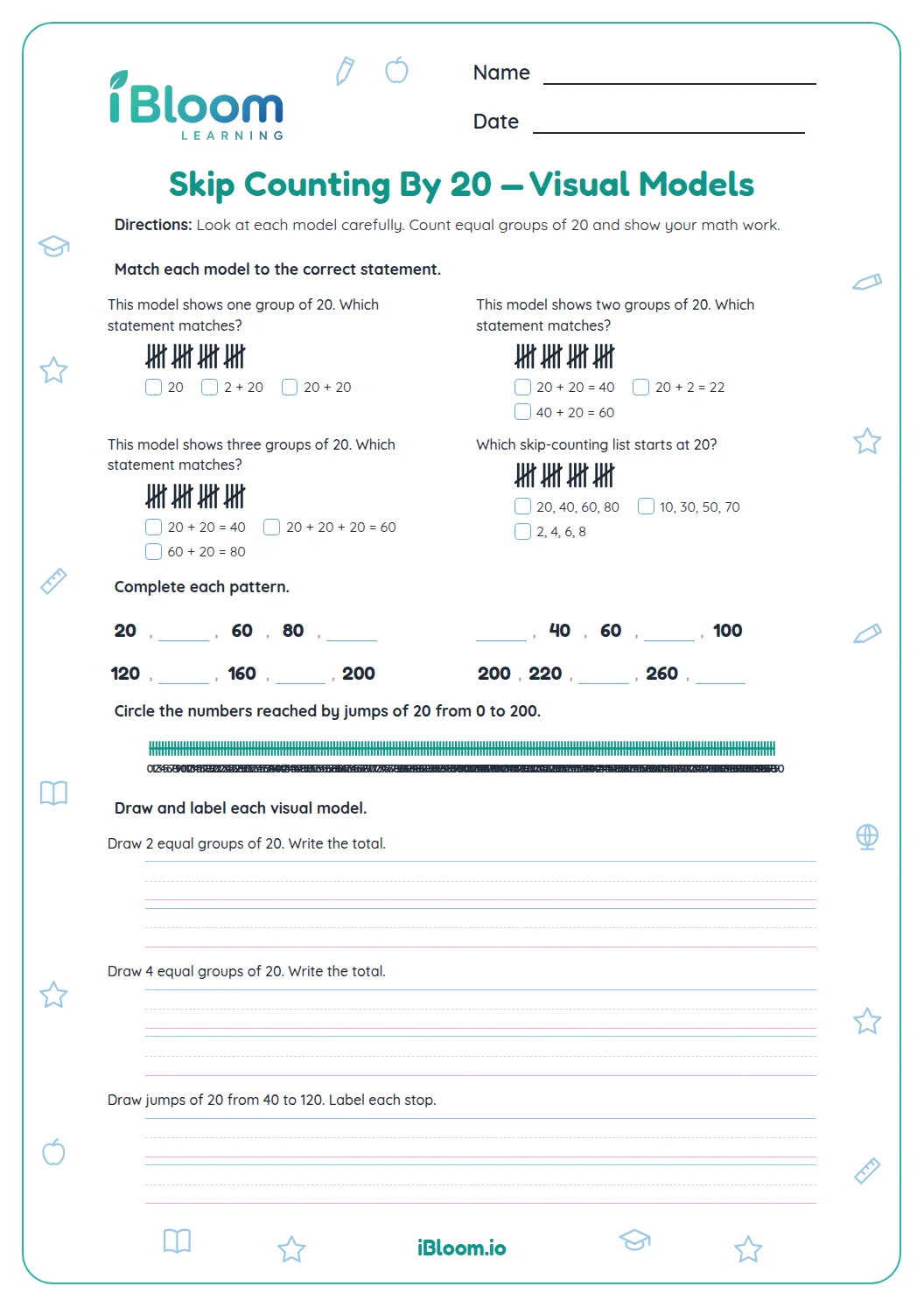
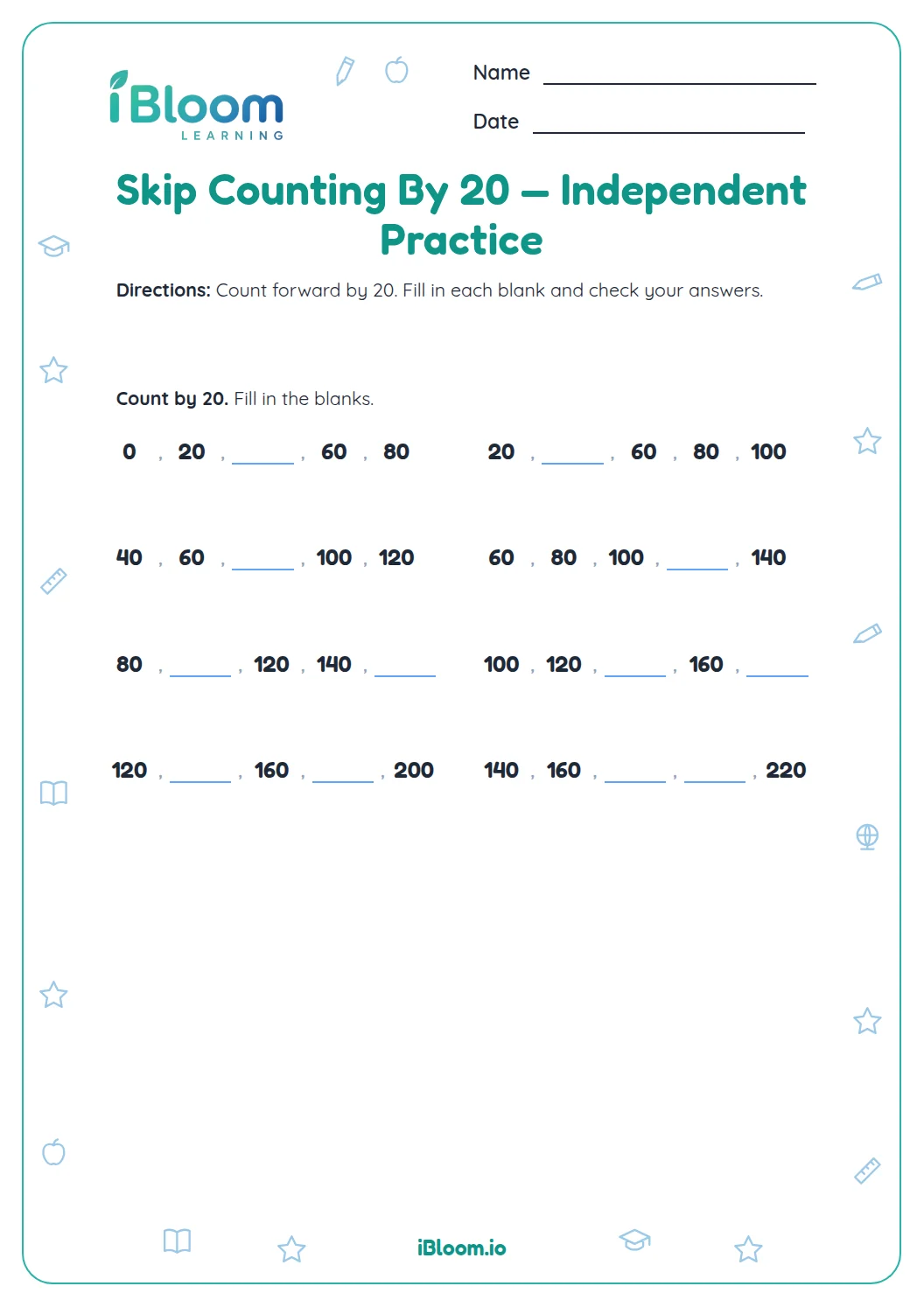
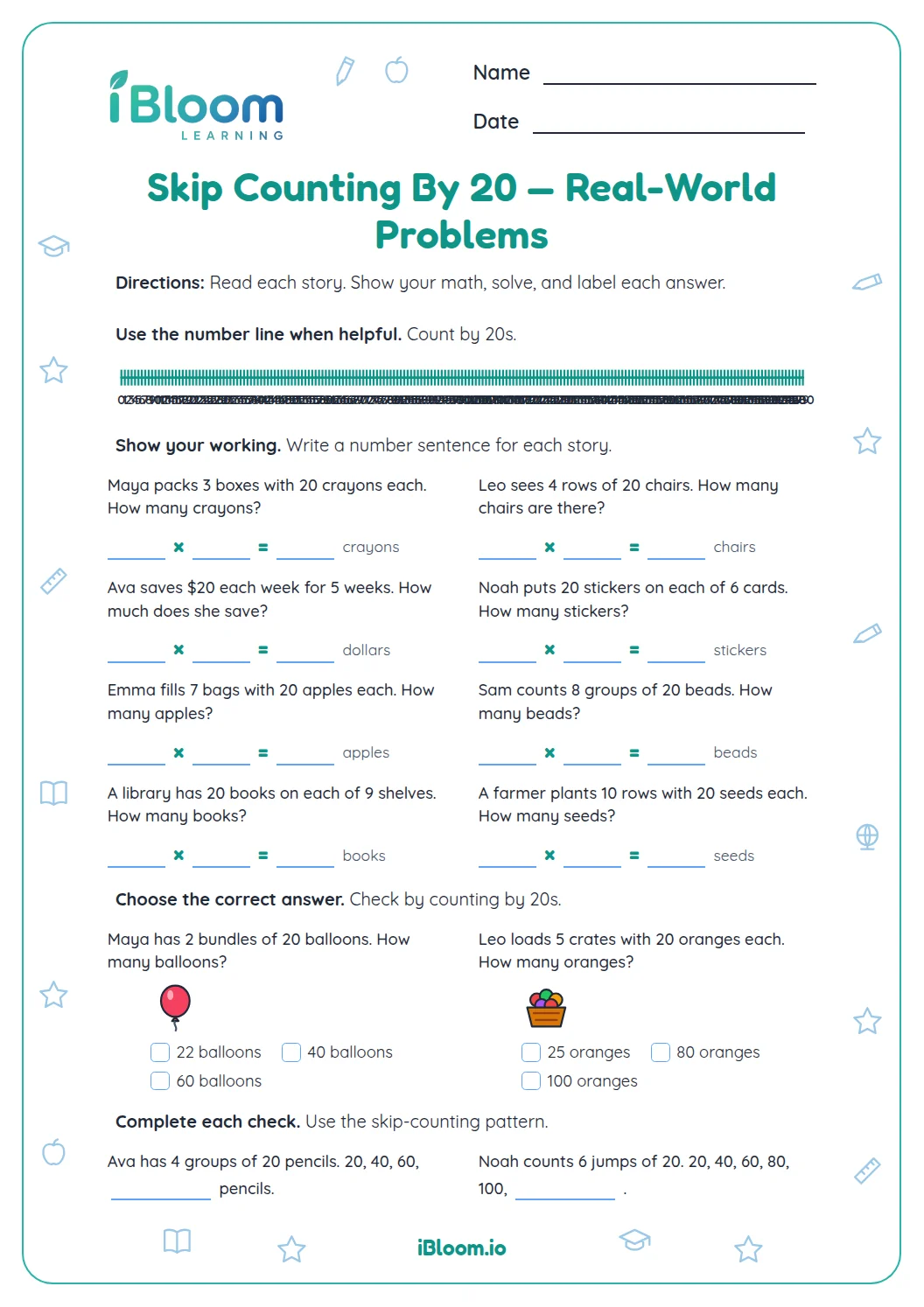
This free printable gives Grade 2 students 16 problems on counting forward by 20. Parts A and B build number patterns within 1,000, and Part C asks students to find totals or count equal jumps. The separate answer key supports checking each step.
What does this worksheet practice?
Parts A and B build missing-number patterns by adding 20. Part C uses the same counting step to find totals or count jumps.
There are 16 questions: 11 pattern gaps and 5 questions about equal jumps. The separate key lists one answer for each item.
How do equal jumps help you count?
Question 12 asks students to count forward by 20 for four jumps from 0. The values are 20, 40, 60, and 80, so the endpoint is 80.
- 10 → 20 → 40 → 60 → 80
- 2Four jumps of 20 reach 80.
How can students check a missing number?
Add 20 from left to right, then check the blank from the number on its right by subtracting 20. For example, a blank between 140 and 180 must be 160: each neighboring pair differs by 20.
What can students practice next?
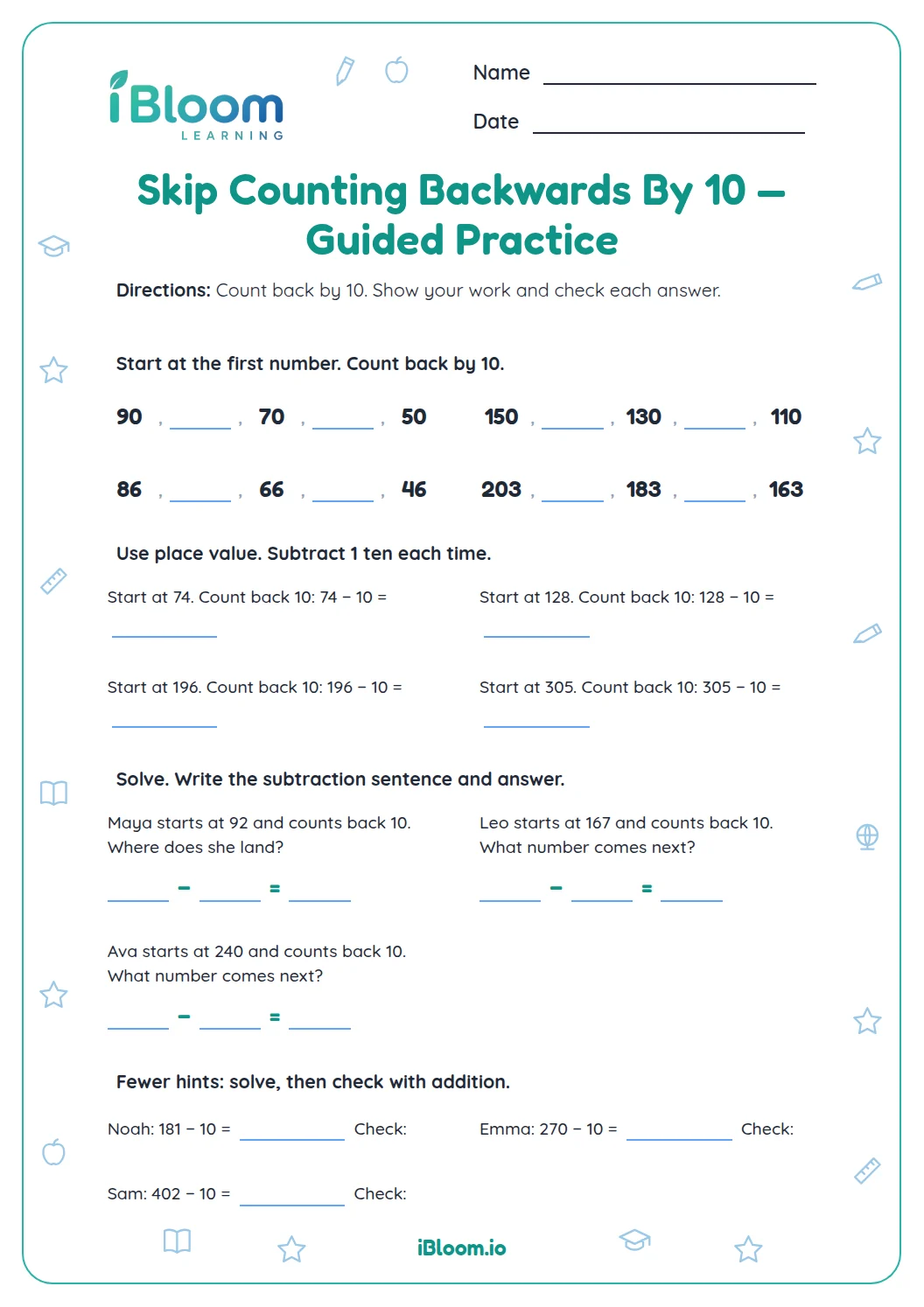
After counting by 20, try a related pattern such as counting by 10 or 100. The linked Grade 2 pages also practice counting backward by a fixed amount.
How to use this worksheet
- 1Read the first number in each pattern.
- 2Add 20 once for every jump in Parts A and B.
- 3Check a missing middle value from both neighboring numbers.
- 4For a jump question, count each move, not the starting value.
- 5Use the answer key to check each pattern and endpoint.
Common mistakes and quick fixes
The mistake
Adding 2 instead of 20.
The fix
Think “two tens” and check that neighboring values differ by 20.
The mistake
Counting the starting number as a jump.
The fix
Start at the given value and count only each move.
The mistake
Skipping a number in the pattern.
The fix
Add 20 one step at a time and check the value before and after each blank.
What to practice next
Make more practice
Questions parents and teachers ask
How do you skip count by 20?
Add 20 to the number you have: 80, 100, 120, 140. Parts A and B ask students to complete or extend patterns like these. Part C asks them to count jumps or find the value reached after several jumps.
Does this worksheet begin every pattern at zero?
No. The missing-number patterns in Parts A and B begin at different values. The five questions in Part C start at zero or give an endpoint, but every jump still adds 20. This lets students practice the same counting rule in more than one way.
How can a student check a missing number?
Check both neighboring jumps. Between 140 and 180, the missing value is 160 because 140 + 20 = 160 and 160 + 20 = 180. Checking from both sides can catch a skipped number or a jump that is too large.
How do the jump questions work?
Start at 0 and add 20 once per jump. Four jumps reach 80, while five jumps reach 100. Other questions give an endpoint and ask you to count how many jumps of 20 reach it. The key shows the total or jump count.
What does the answer key include?
The separate answer key gives the missing values for all 11 patterns and the totals or number of jumps for the five equal-jump questions. Students can compare each result with the key and check that each forward step changes by 20.