



About this worksheet
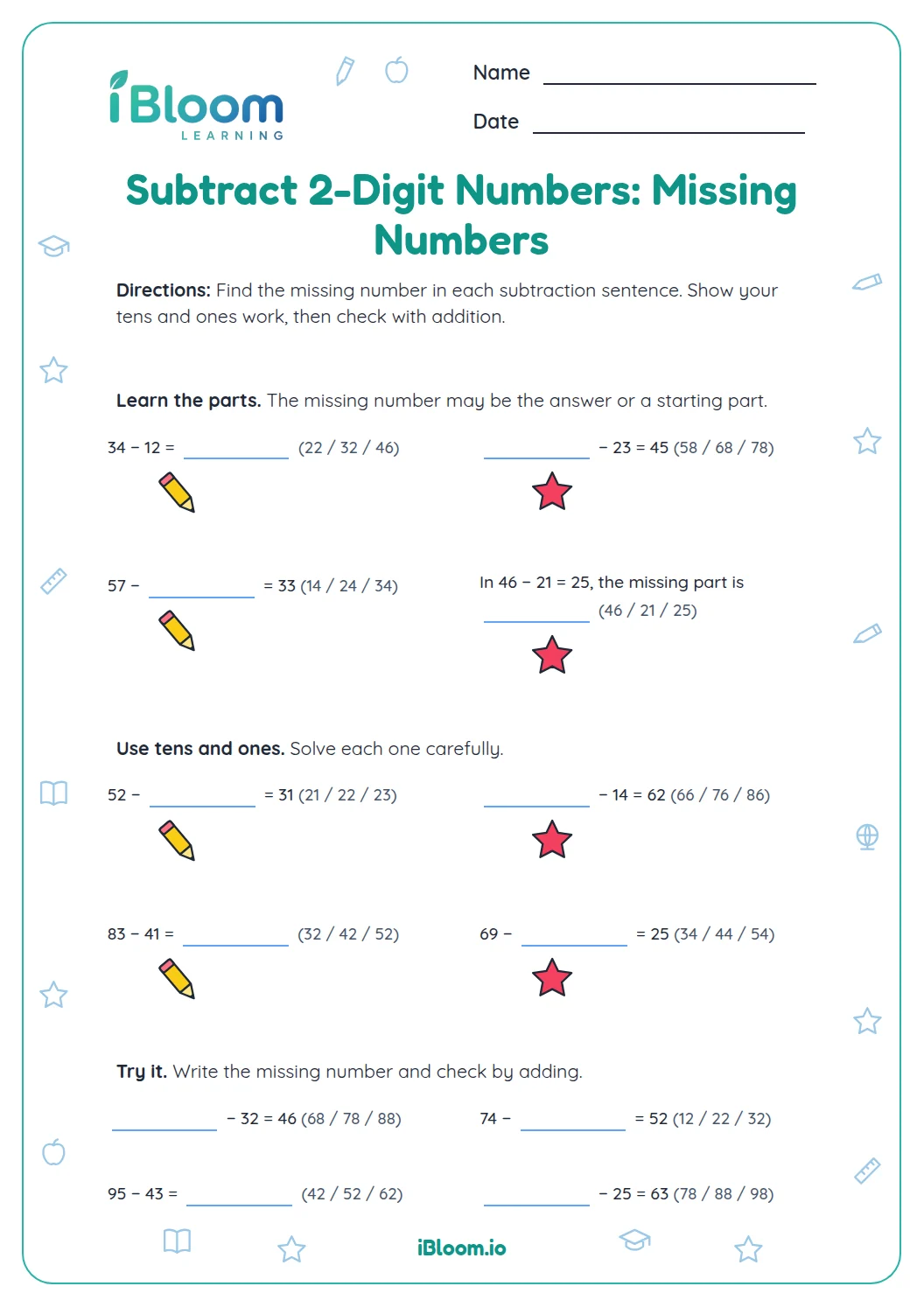
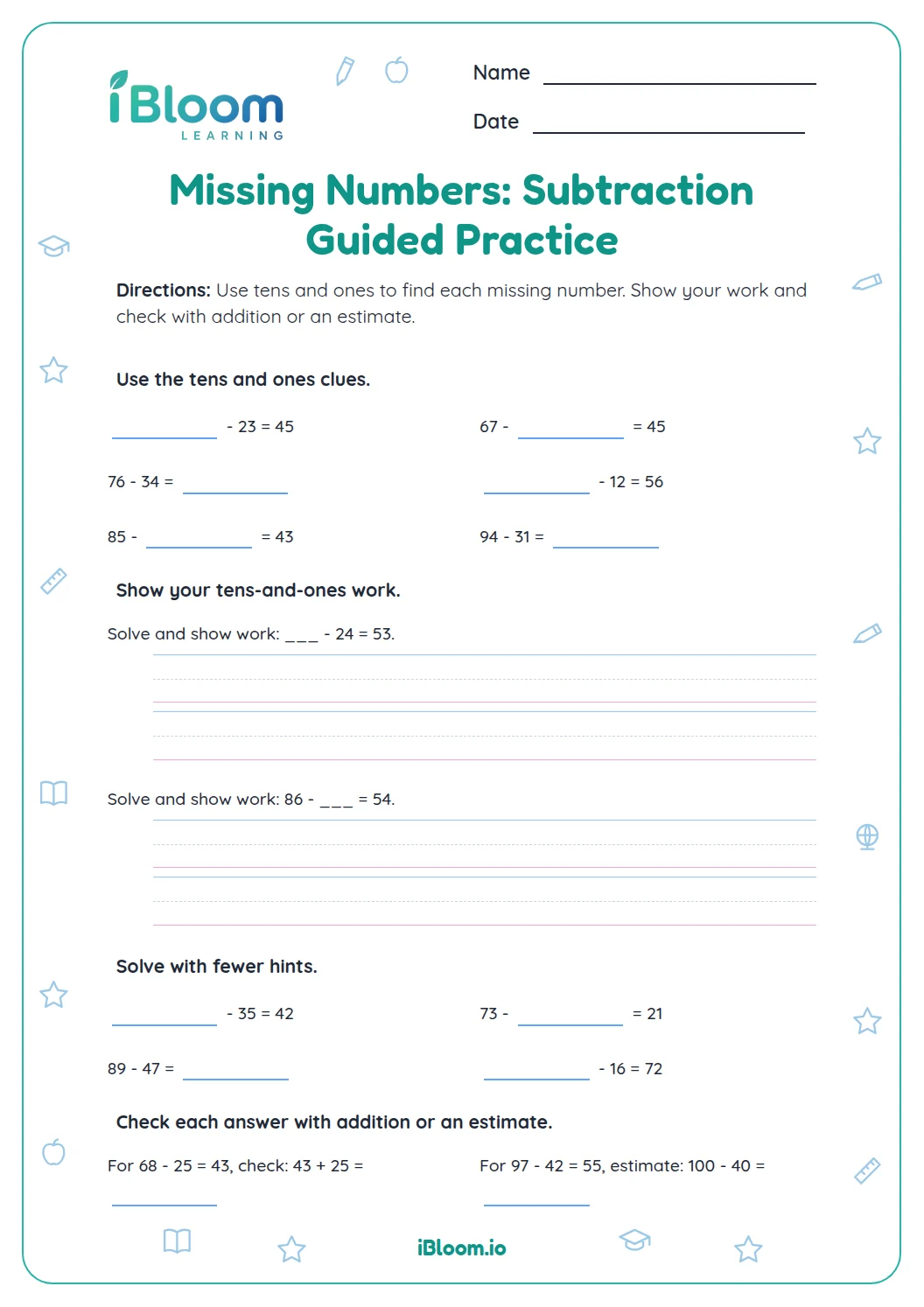
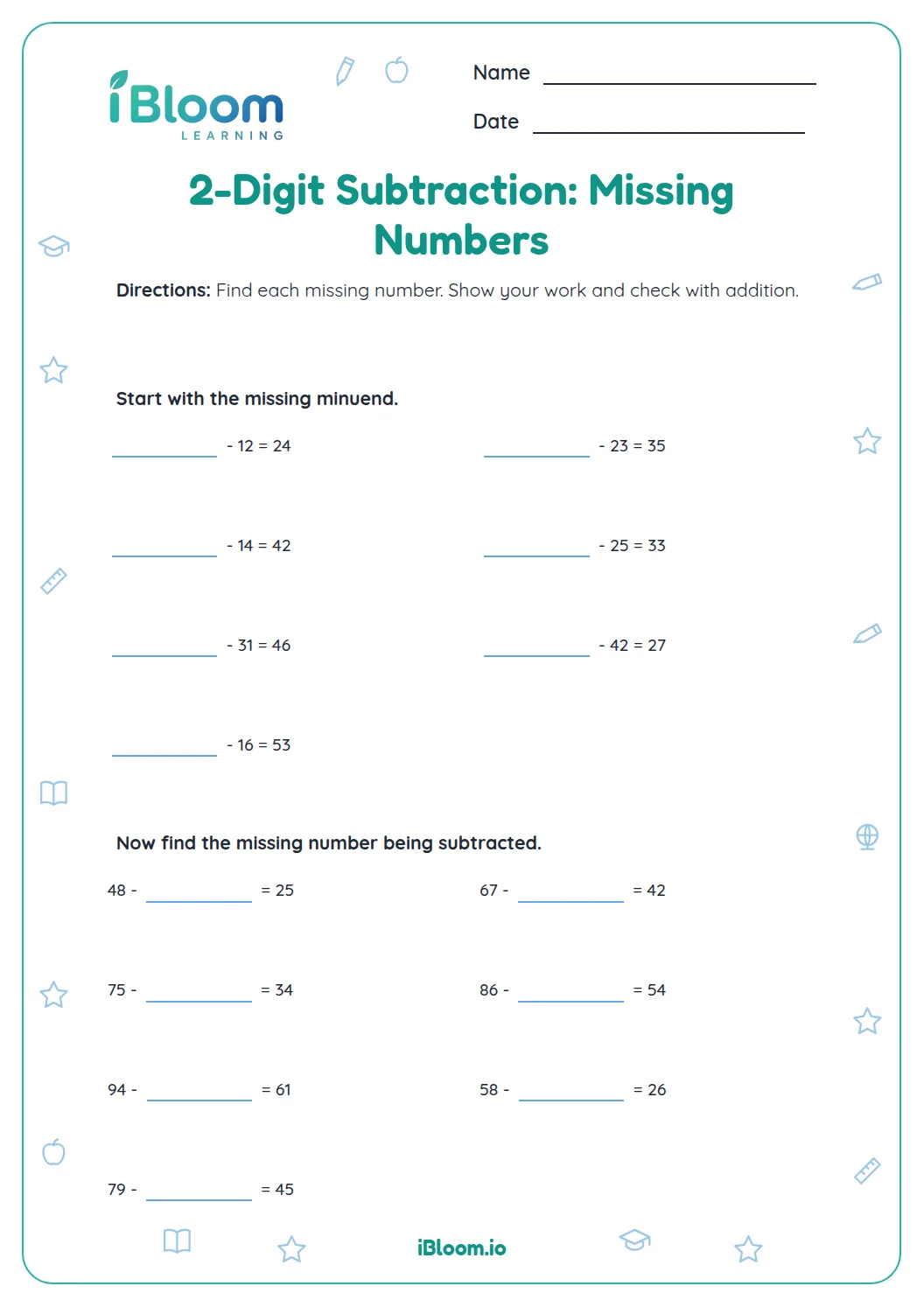
The first part gives missing-value equations. Two short bead and book problems apply the same idea, and the final equations invite an addition check.
Aligned to 2.NBT.B.5
Use addition to find the blank
A subtraction equation has three parts: the starting number (minuend), the number taken away (subtrahend), and the difference. If the blank is the number taken away, add the difference to the subtrahend’s partner: 58 − ___ = 26 becomes 26 + ___ = 58, so the blank is 32.
When the starting number is missing, combine the amount taken away and the amount left. When the difference is missing, subtract as usual.
Check without regrouping
The two story problems ask how many were used or lent. Find the amount by subtracting what remains from the starting amount. Then add the answer back to what remains.
Part A practices equations, Part B applies them to short situations, and Part C gives more equations, including an addition check. In each subtraction, the ones digit being subtracted is no greater than the ones digit above it, so regrouping is not needed.
A quick routine for missing numbers
- 1Read the equation and name the blank: starting amount, amount taken away, or difference.
- 2Use the inverse relationship when the blank is a minuend or subtrahend.
- 3Solve the two story problems by comparing the starting amount with what remains.
- 4Check each result with addition, such as 26 + 32 = 58.
- 5Use the answer key after a part and correct the equation that caused an error.
Common subtraction errors
The mistake
Subtracting the smaller number from the larger one without attending to the blank.
The fix
Name the missing part first, then use addition if the blank is the starting number or amount taken away.
The mistake
Giving the amount left when asked how many were used.
The fix
For the bead problem, subtract the 32 still left from the 76 beads at the start.
The mistake
Checking a difference by subtracting again.
The fix
Add the difference and the amount taken away. The sum should equal the starting number.
Curriculum alignment
This page practices Grade 2 two-digit addition and subtraction within 100, with place-value reasoning and the inverse relationship.
Use place-value strategies and addition relationships to subtract within 100.
On this sheet: Students subtract within 100 and use addition to check missing minuends, subtrahends, and differences.
Show the official wordingHide the official wording
Fluently add and subtract within 100 using strategies based on place value, properties of operations, and/or the relationship between addition and subtraction.
What to practice next
Make more practice
Further reading
Questions parents and teachers ask
What kinds of missing numbers are on this worksheet?
The equations ask learners to find a missing starting number, a missing number taken away, or a missing difference. The bead and book problems ask how many were used or lent. All subtraction stays within 100 and avoids regrouping. The equations include each missing part of a subtraction sentence.
How does addition help with subtraction?
Addition undoes subtraction. For 58 − ___ = 26, the missing amount plus 26 must equal 58, so 26 + 32 = 58. For a missing starting number, combine the amount removed and the amount remaining. Addition also checks the final answer. For example, 26 + 32 = 58 checks the missing subtrahend.
What does no regrouping mean here?
No regrouping means the ones digit being subtracted is not larger than the ones digit above it. For example, 74 − 31 can be solved by subtracting tens and ones directly. The numbers on this sheet are chosen so each subtraction can be completed that way.
How should I help with a missed word problem?
Ask what the problem tells us at the start and what remains. In the bead item, Mia starts with 76 and has 32 left; subtracting 32 from 76 gives the amount used. Have the learner check by adding the used beads and the beads left.
Can the answer key help check the work?
The key gives the missing values and the word-problem answers. For a useful check, ask the learner to show the related addition sentence too, such as 26 + 32 = 58 for 58 − ___ = 26. That links the answer to the inverse operation.