




About this worksheet
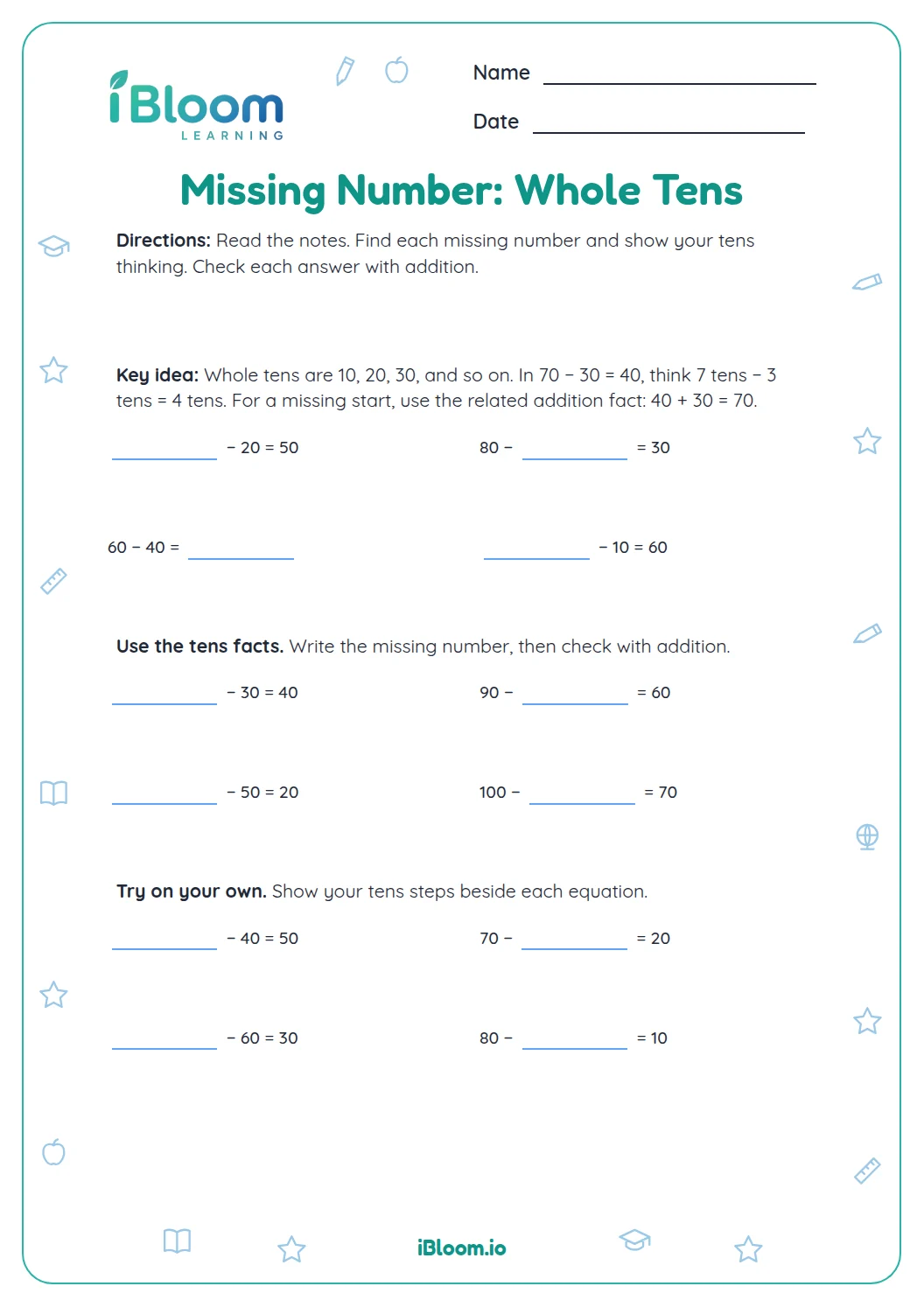
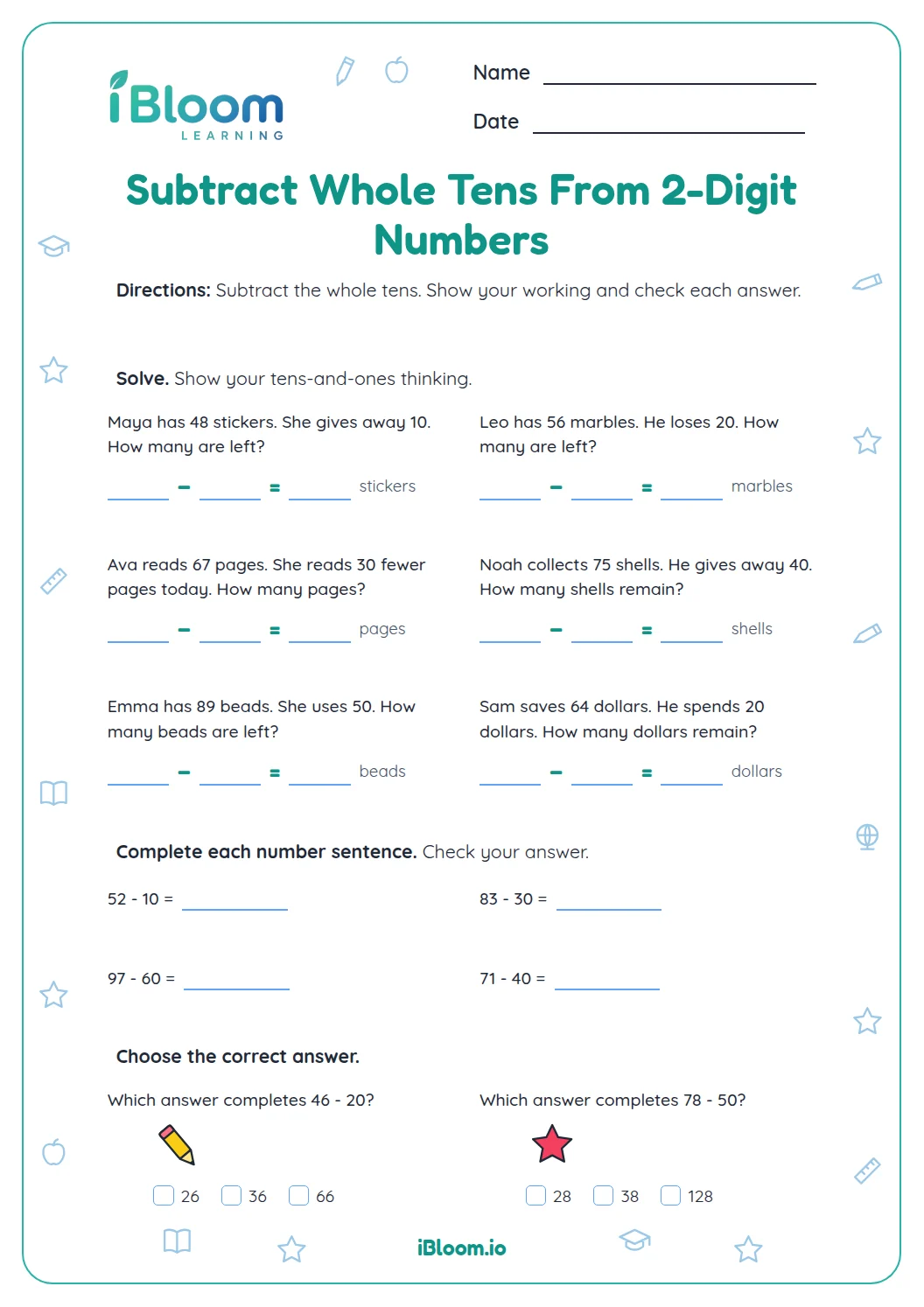
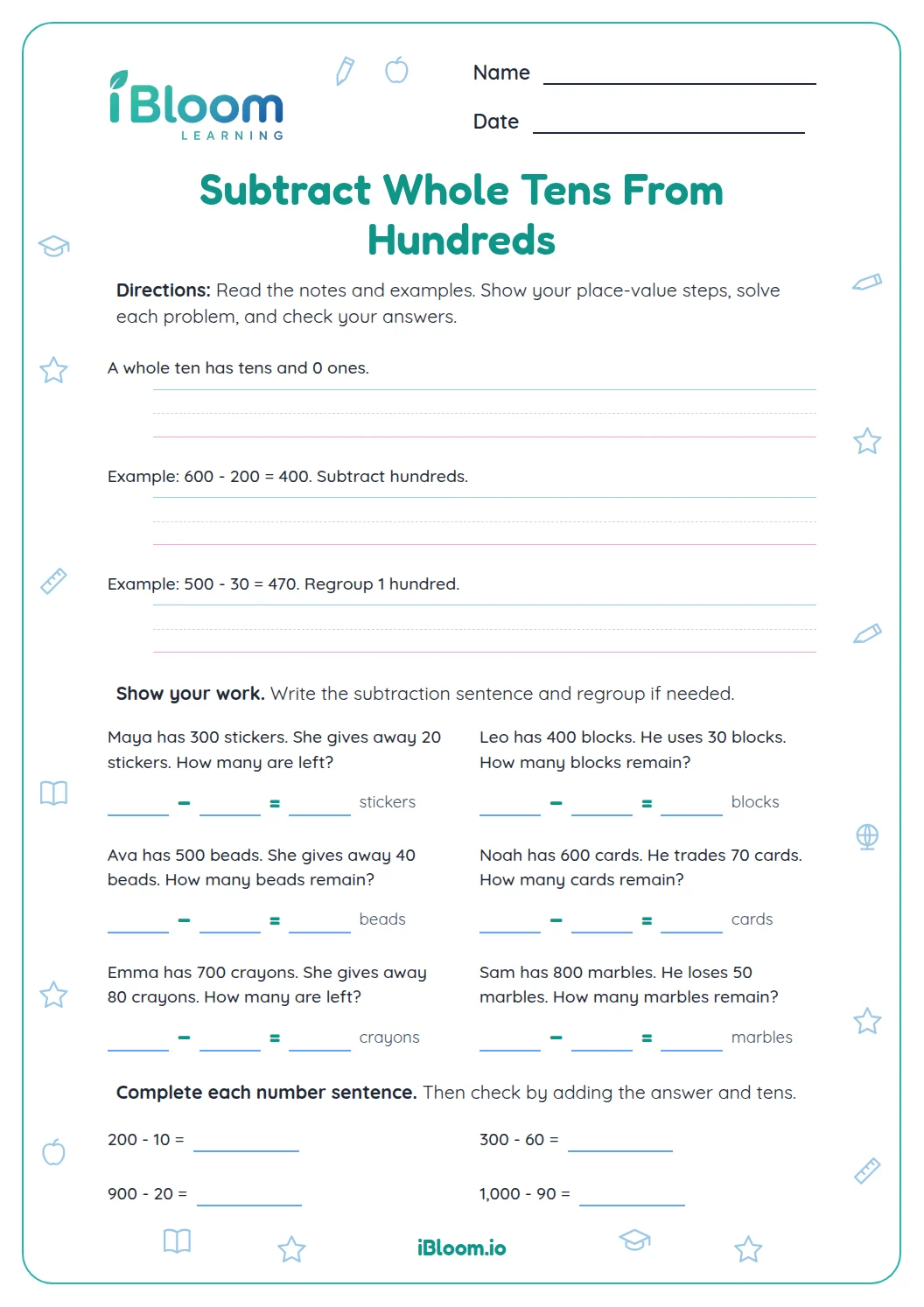
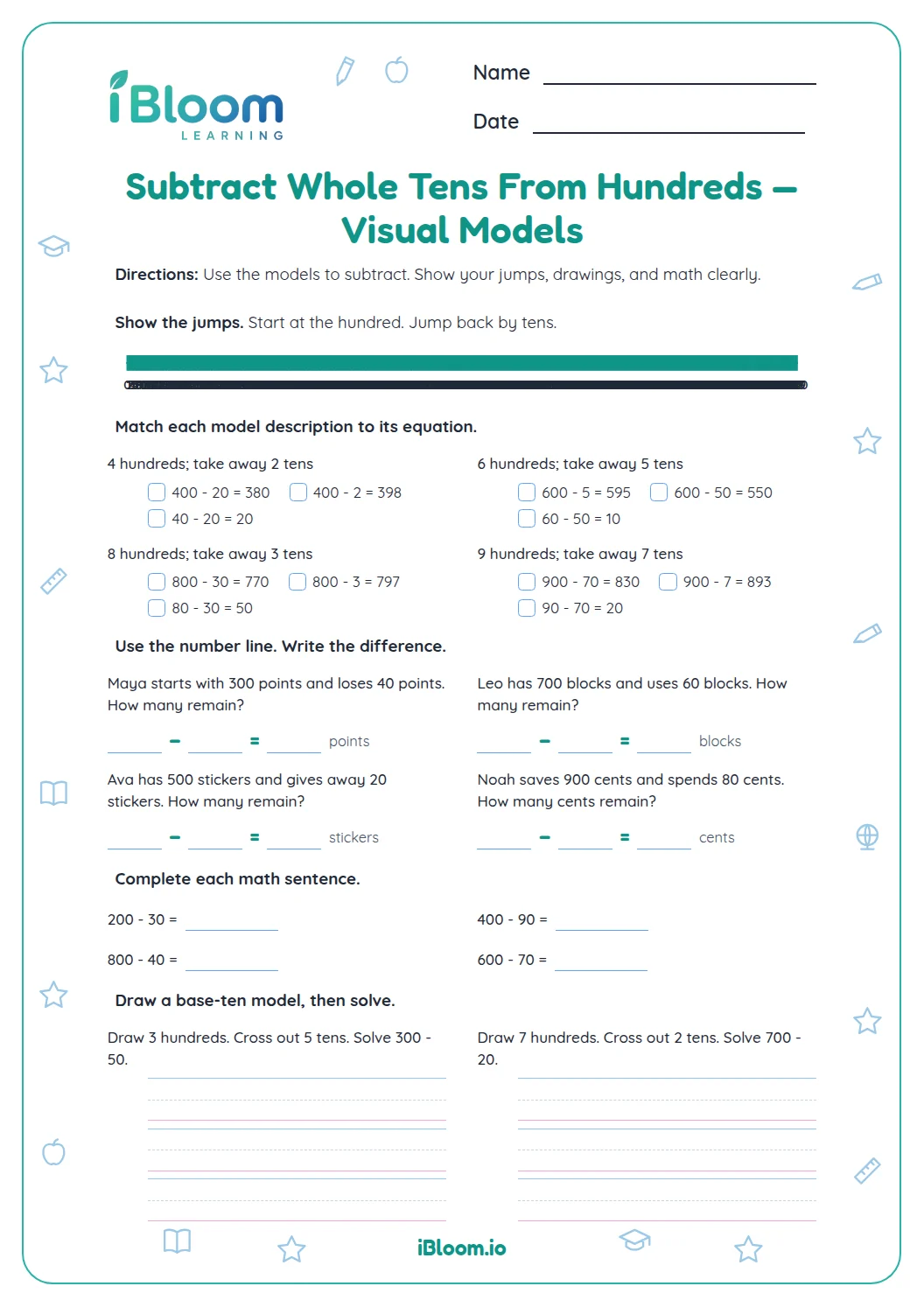
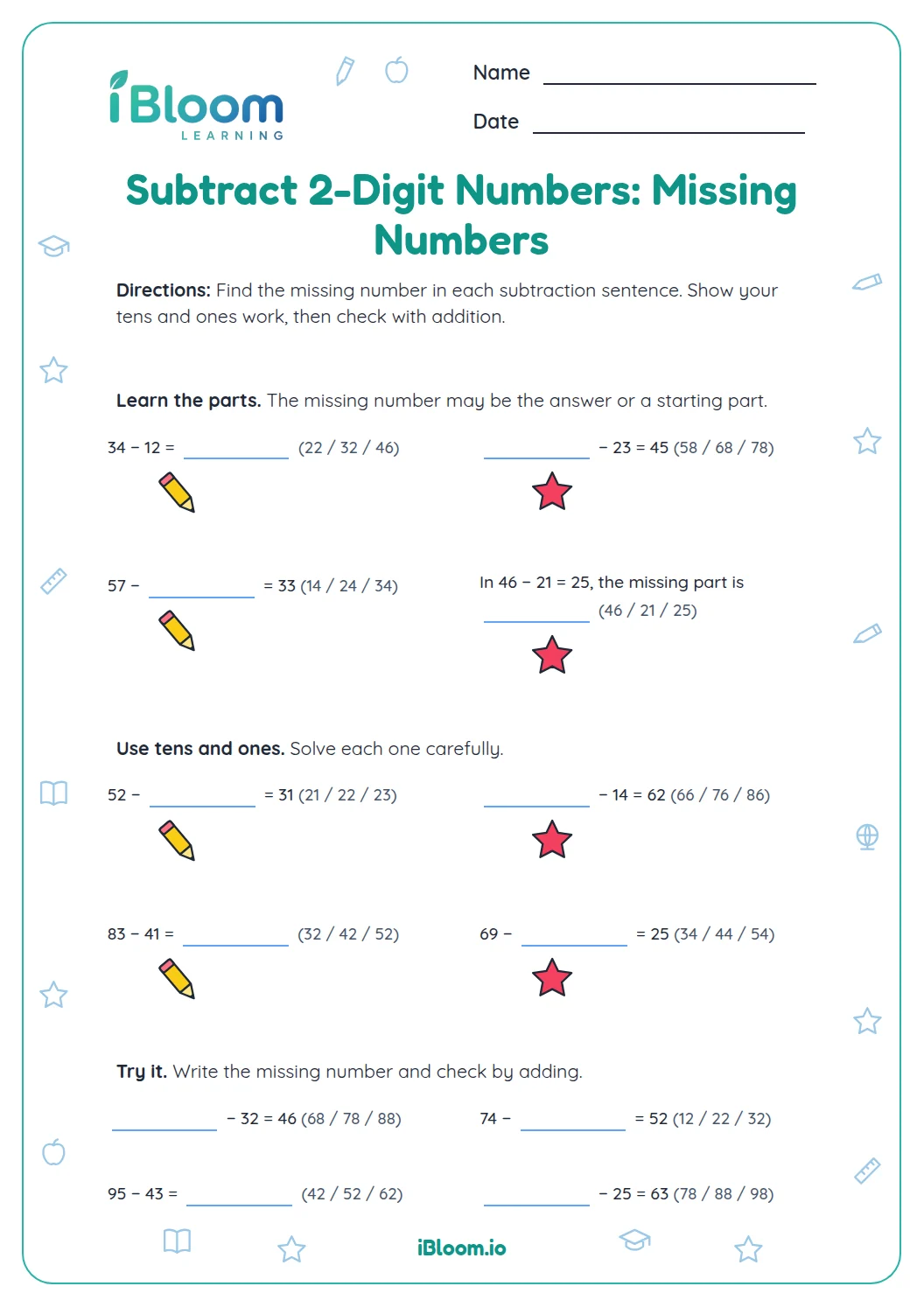
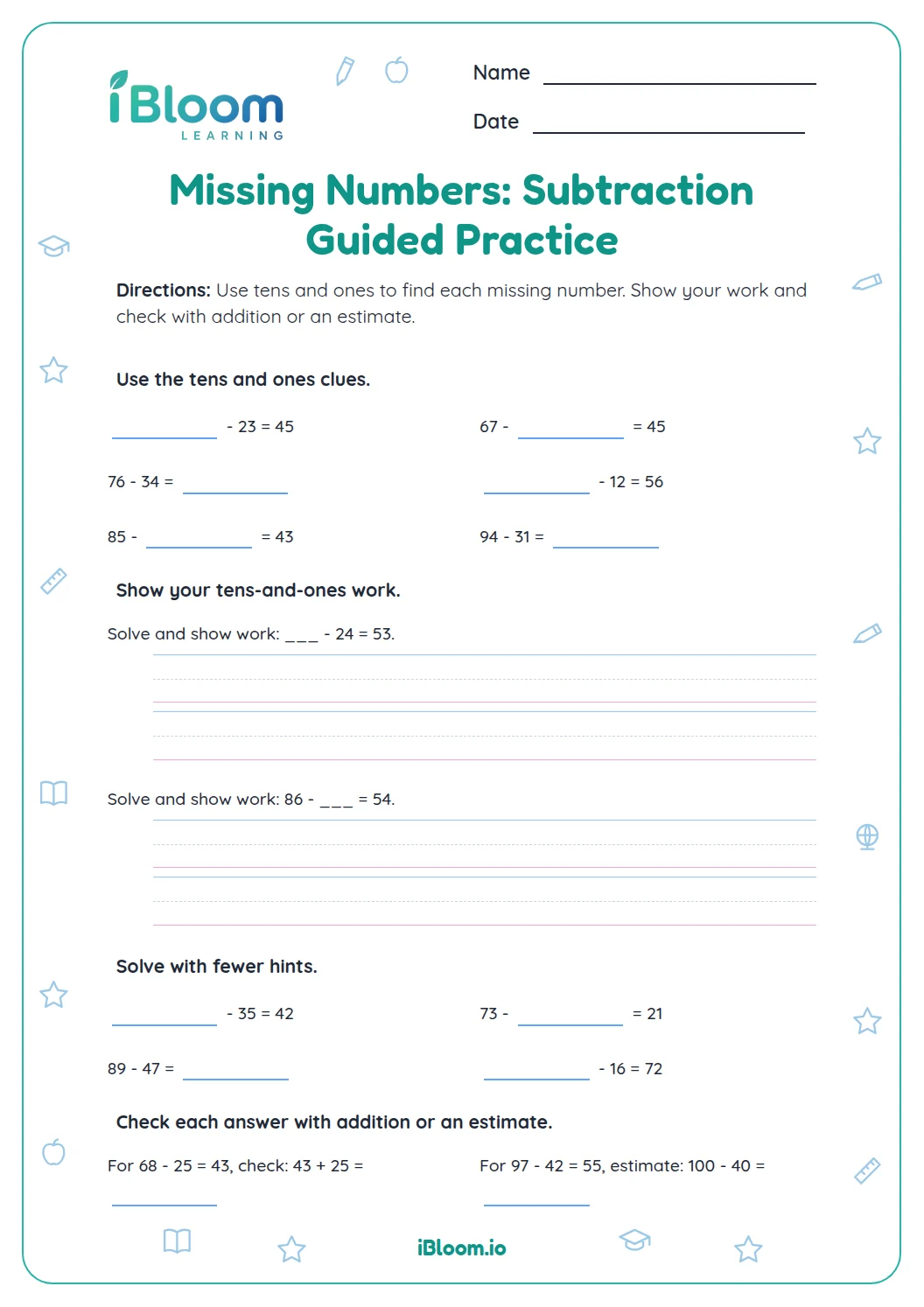
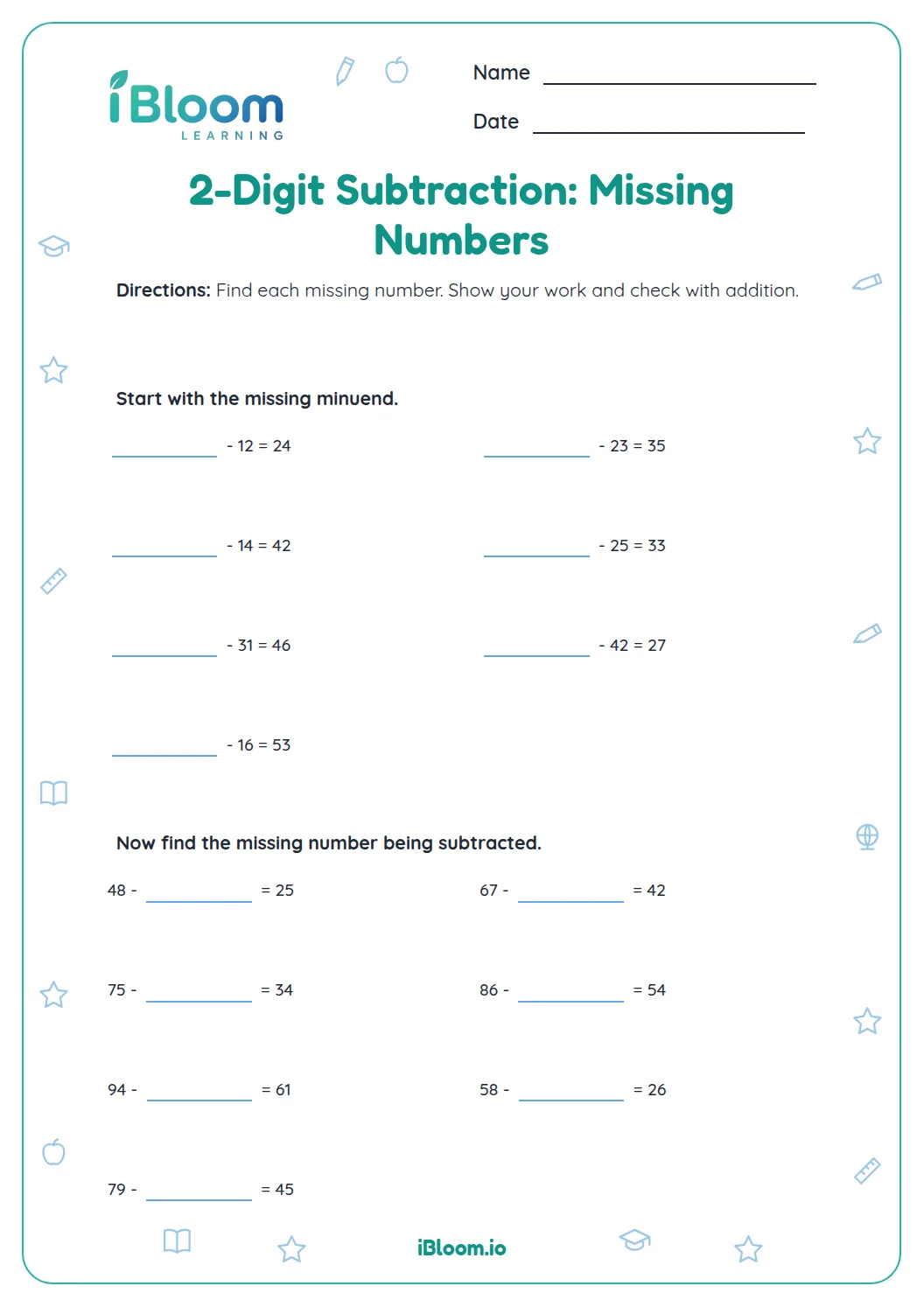
This Grade 2 worksheet practices subtraction and missing terms with multiples of ten. Fourteen questions pair equations with base-ten block drawings: children find the subtracted amount, recover a starting amount, and solve short take-away stories. The visuals make tens visible while keeping the focus on subtraction relationships. It supports CCSS 2.NBT.B.7 through place-value models and strategies. An answer key is included.
Aligned to 2.NBT.B.7
How do the models support missing-number subtraction?
Every item includes base-ten rods representing tens. Part A asks for the amount removed, Part B asks for the starting amount, and Part C asks for the amount that remains in short stories.
How can you find the missing amount taken away?
Compare the starting number with the result. The difference between them is the amount removed. With tens, compare the number of tens rather than counting individual ones.
- 180 − ___ = 50
- 2There are 8 tens at the start and 5 tens left.
- 38 tens − 5 tens = 3 tens.
- 4The missing number is 30.
How can you find a missing starting number?
If the amount removed and the amount left are known, add them to recover the start. For example, 40 removed and 50 left means the starting amount was 90. The rods represent tens, so three rods stand for 30.
How to use this worksheet
- 1Read the equation before using the drawing.
- 2Count the tens blocks in the model.
- 3For a missing amount, compare the start and what remains.
- 4For a missing start, add the removed amount and the result.
- 5Write the answer as a whole number of tens.
Common mistakes and quick fixes
The mistake
Writing 3 instead of 30 for three tens.
The fix
Say “three tens” and record 30.
The mistake
Subtracting the result from the wrong term.
The fix
For a missing start, add the removed amount to the result.
The mistake
Counting blocks as ones.
The fix
Each long base-ten rod represents ten.
Common Core alignment
This practice connects the listed grade-level standard to short, focused worksheet tasks.
Use place-value models and strategies to subtract whole tens.
On this sheet: Base-ten blocks show subtraction of a multiple of ten, and missing terms are solved with place value.
Show the official wordingHide the official wording
Add and subtract within 1000, using concrete models or drawings and strategies based on place value, properties of operations, and/or the relationship between addition and subtraction; relate the strategy to a written method. Understand that in adding or subtracting three-digit numbers, one adds or subtracts hundreds and hundreds, tens and tens, ones and ones; and sometimes it is necessary to compose or decompose tens or hundreds.
What to practice next
Make more practice
Further reading
Questions parents and teachers ask
How many items are on the worksheet?
There are 14 questions across three worksheet pages. Four find the amount taken away, six find the starting amount, and four use short subtraction stories. Each question includes a base-ten drawing, and the separate key gives the missing number or result.
What does each base-ten rod mean?
Each long rod represents one ten. For example, eight rods represent 80 and five rods represent 50. Comparing the number of rods helps children see how many tens are removed or how many tens make the starting amount.
How do you find a missing number in 80 − blank = 50?
Compare the starting amount, 80, with the amount left, 50. The difference is 30, so 30 is the missing amount taken away. In tens, that means three rods are removed from eight rods, leaving five rods, or 50.
How can a child find the missing starting amount?
Add the amount taken away to the result. If 40 was removed and 50 remains, then 40 + 50 = 90 was the starting amount. The child can also check by subtracting 40 from 90 and confirming that 50 remains.
Are the problems about single digits or whole tens?
Every equation and story uses whole tens, such as 20, 50, or 90. The base-ten rods reinforce that each counted rod is worth ten. Answers should be written as whole numbers of tens, not as counts of individual rods.