






About this worksheet
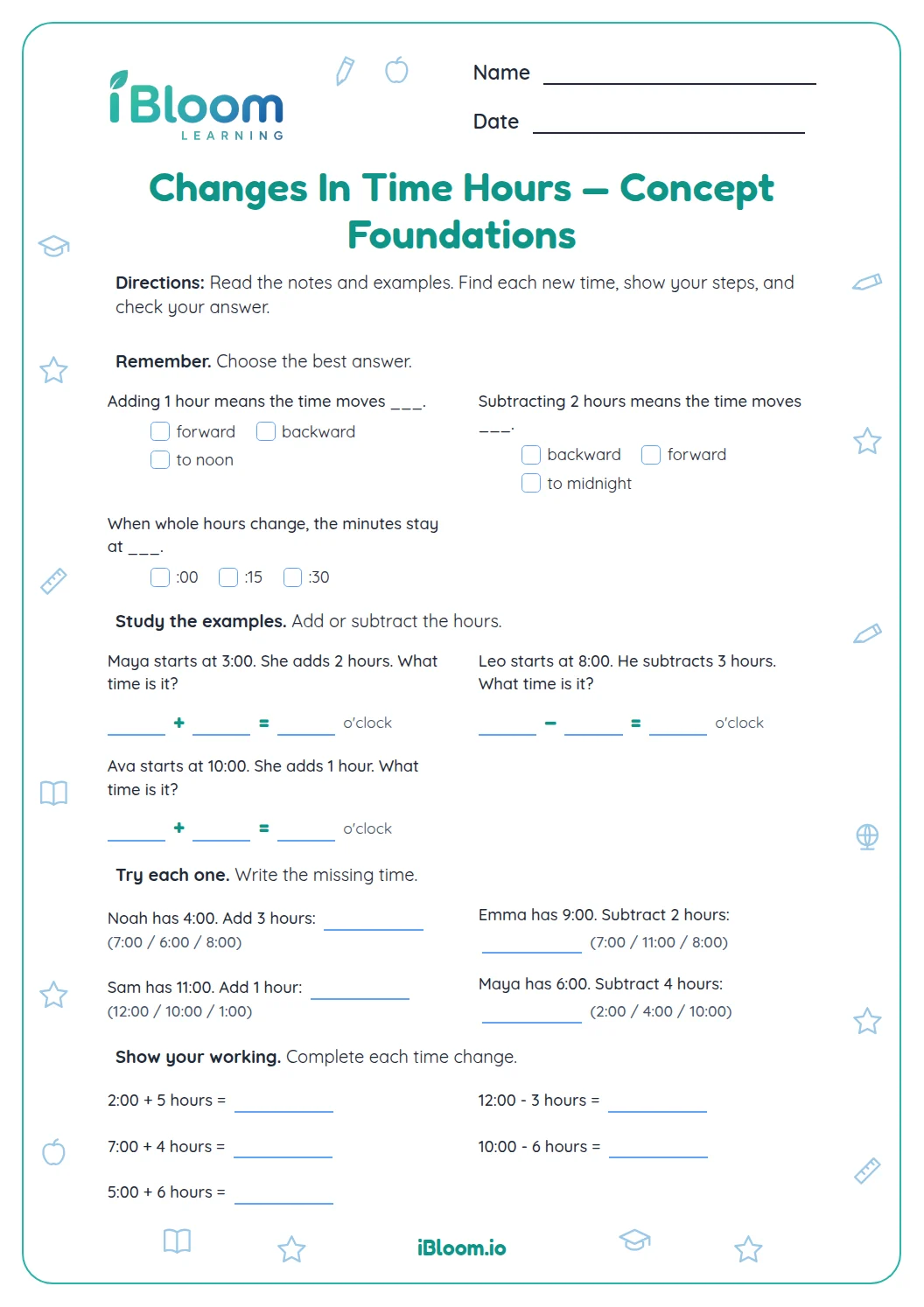
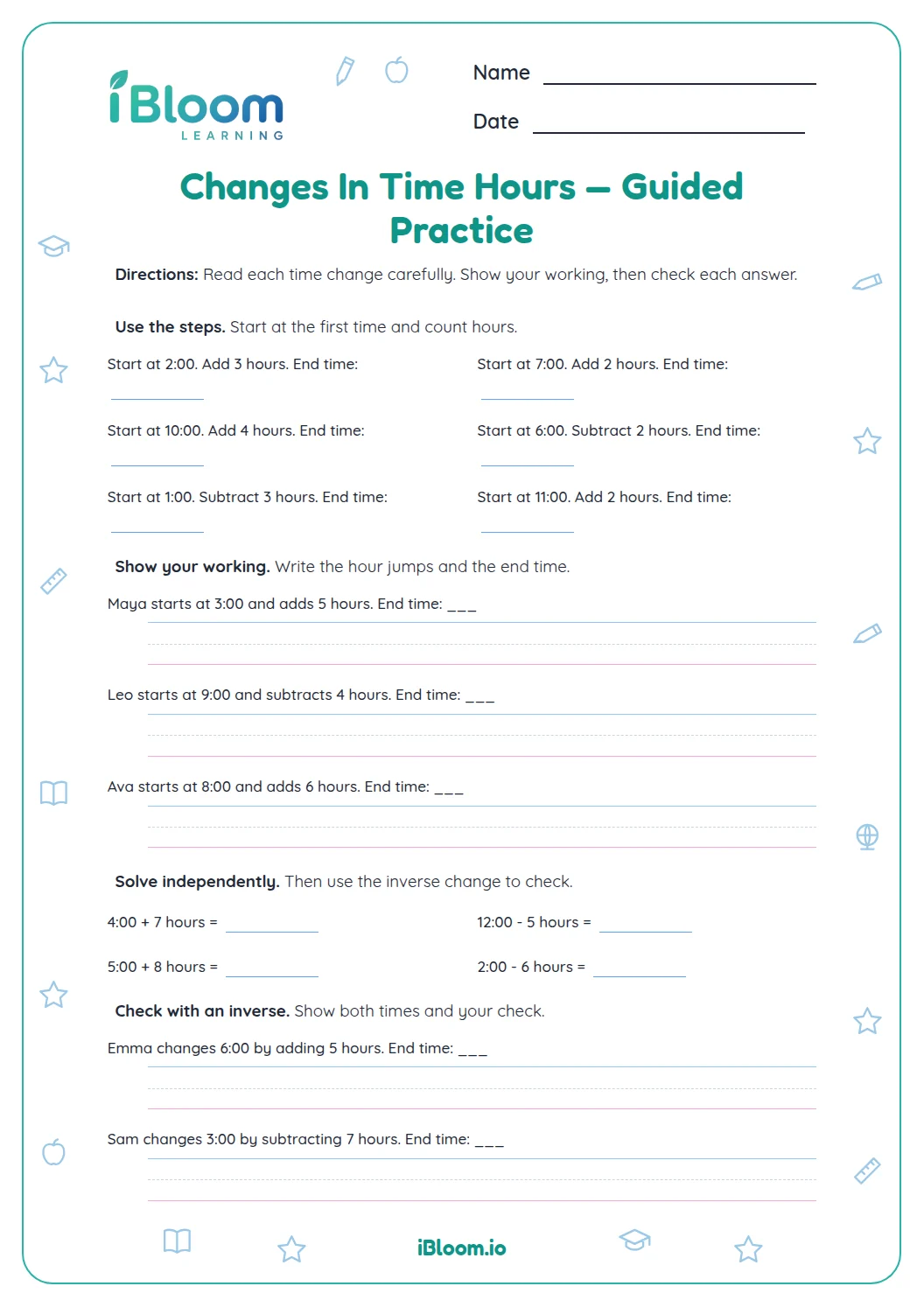
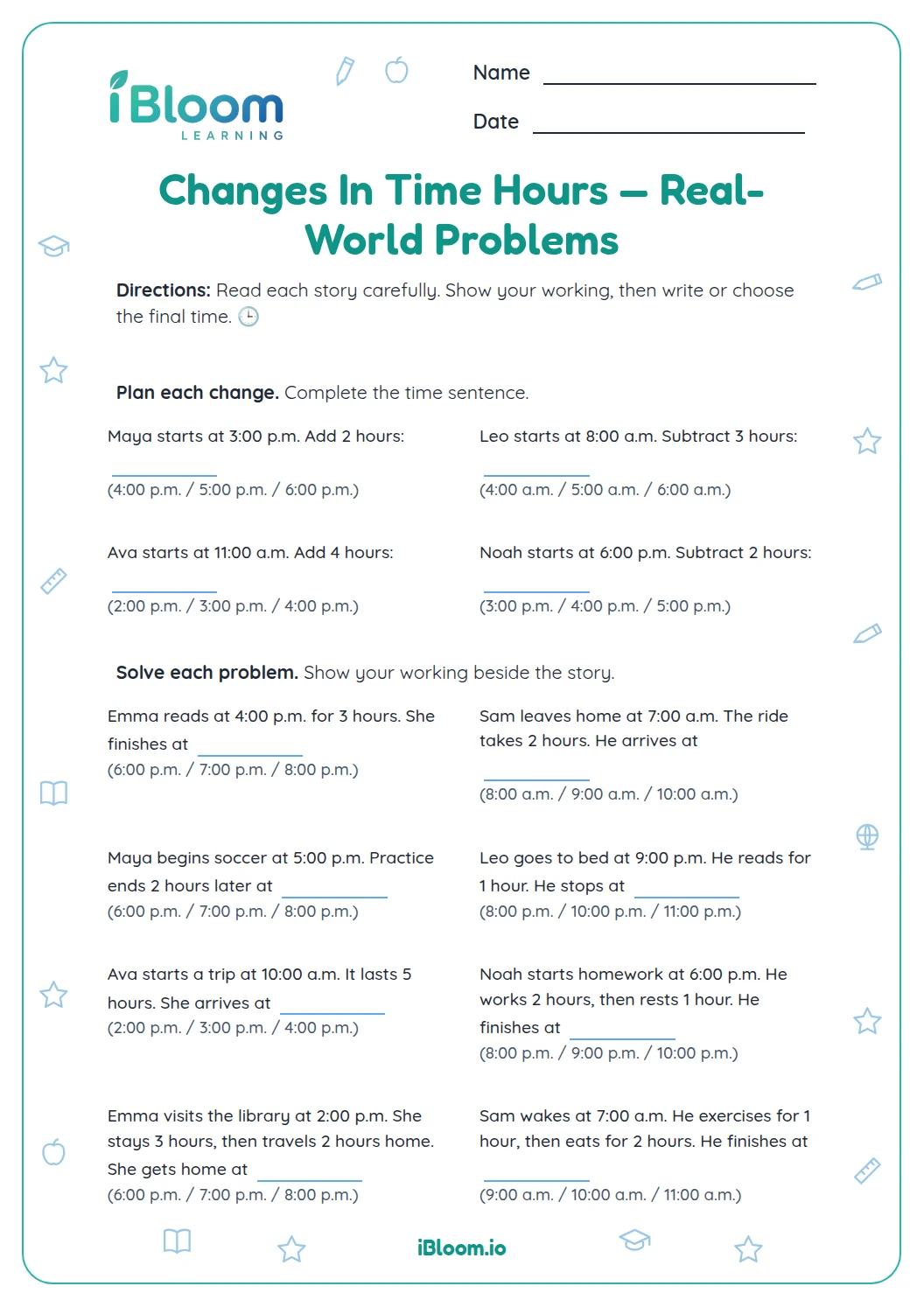
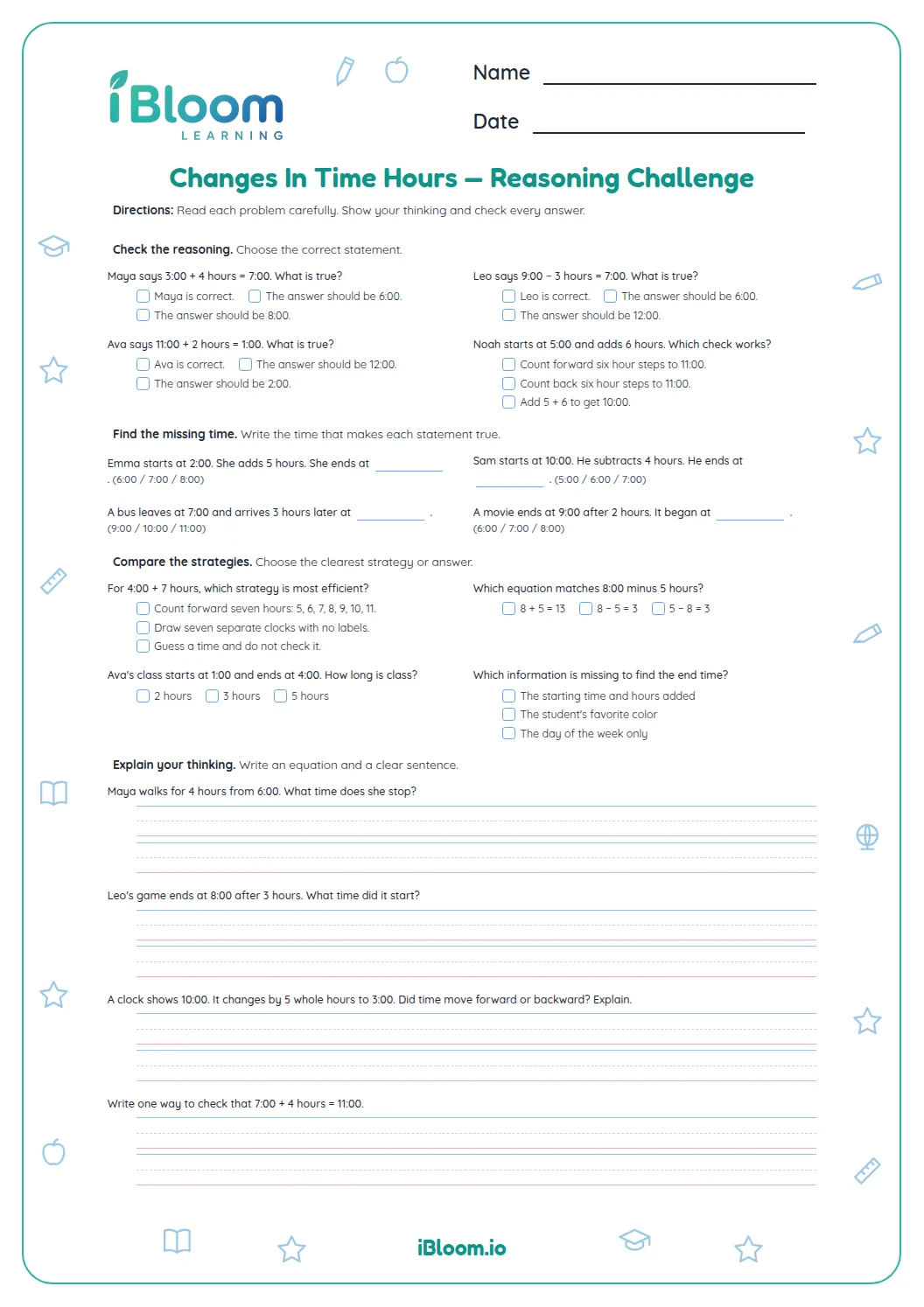
This Grade 2 printable practices changes in time by whole hours. Ten questions show an analog clock for the starting time, and four more ask learners to find an earlier time from a stated start. The changes stay within the same 12-hour cycle, keeping the focus on counting hours on a clock. The related elapsed-time work is described in CCSS 3.MD.A.1; a separate answer key is included.
Aligned to 3.MD.A.1
How do you find a later time?
Start at the given hour and count forward one hour for each step. In question 1, begin at 2:00 and count three hours: 3:00, 4:00, 5:00.
- 1Start at 2:00. Move 3 hours later.
- 2Answer: 5:00
- 3Count three hour steps forward.
How do you find an earlier time?
Start at the given hour and count backward the number of steps named. Keep the hour hand in mind as you move from one number to the next.
What does the clock model show?
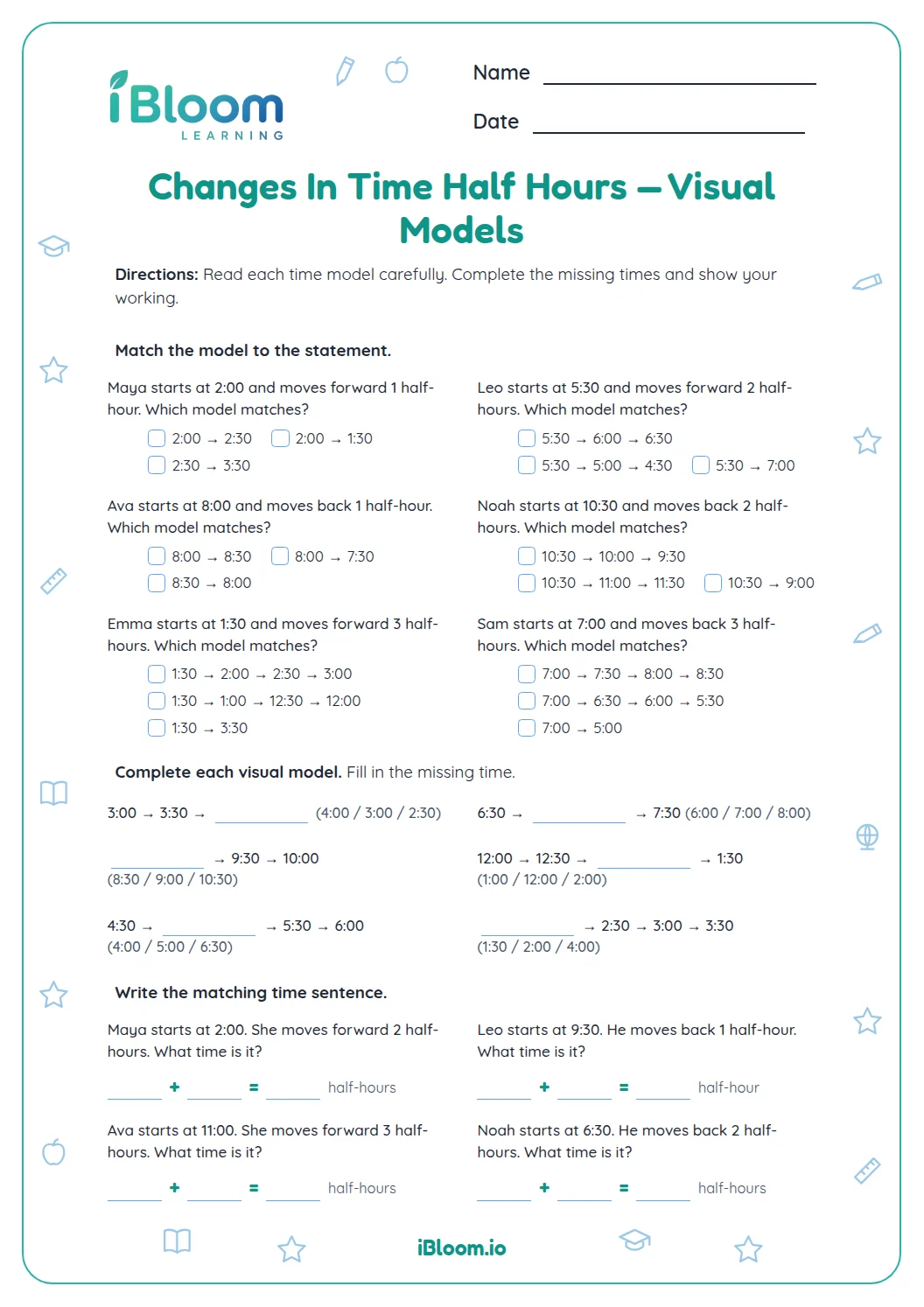
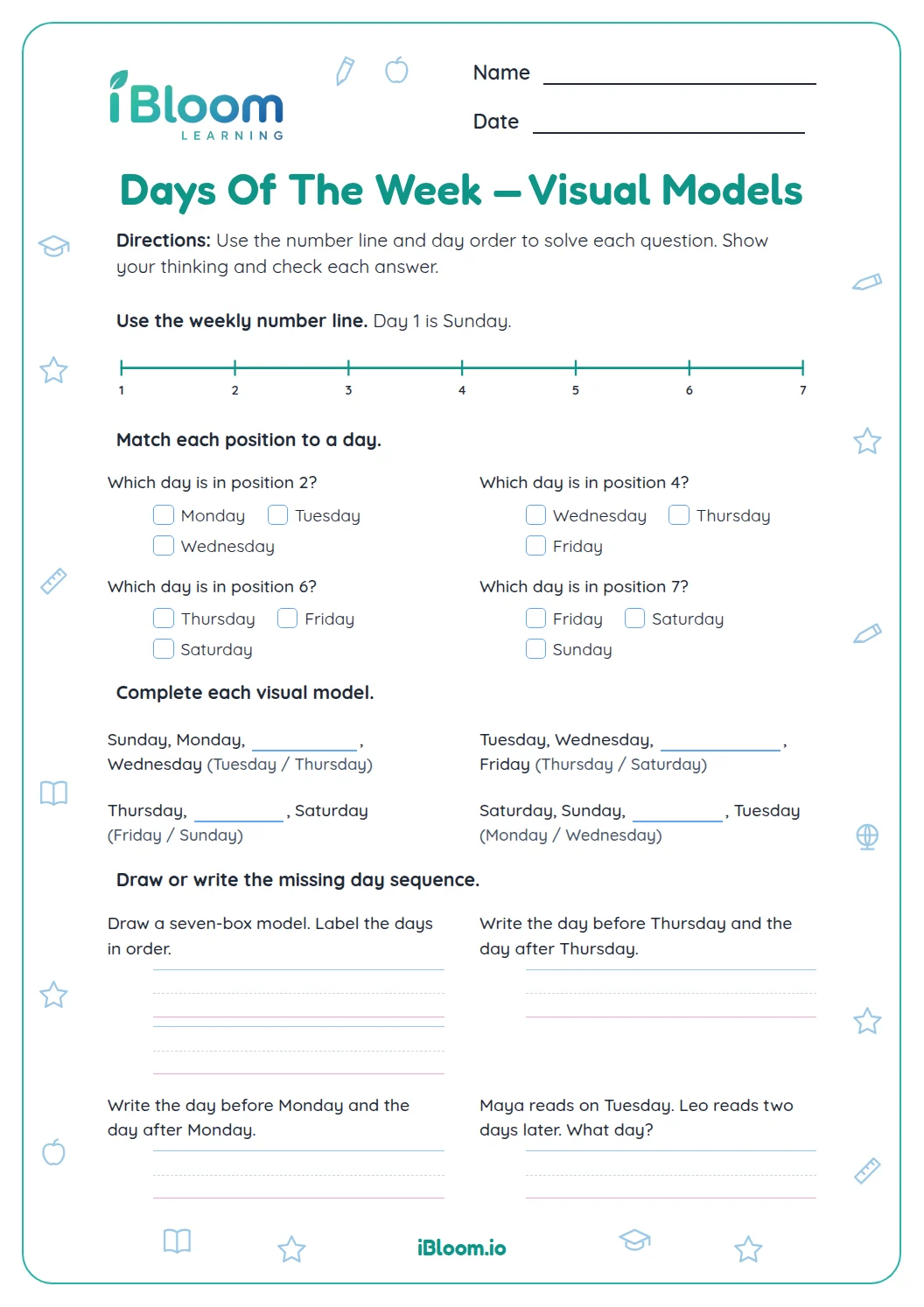
Four questions include a number line with the starting hour marked. Count each interval in the direction named; the written questions use the same one-hour steps.
How to use this worksheet
- 1Read the starting time on the clock or in the question.
- 2Identify whether to move later or earlier.
- 3Count one number on the clock for each hour.
- 4Keep the minutes the same.
- 5Check the final time against the number of steps.
Common mistakes and quick fixes
The mistake
Counting the starting hour as the first hour later.
The fix
Move to the next hour for the first elapsed hour.
The mistake
Moving in the wrong direction.
The fix
Circle “later” or “earlier” before counting.
The mistake
Changing the minutes during a whole-hour change.
The fix
Keep the minute hand at 12, so the time remains :00.
Common Core alignment
This worksheet represents whole-hour time changes and solves them by counting on or back.
Represent a whole-hour time change on a number line and find the ending time.
On this sheet: The worksheet directly practices this skill.
Show the official wordingHide the official wording
Tell and write time to the nearest minute and measure time intervals in minutes. Solve word problems involving addition and subtraction of time intervals in minutes, e.g., by representing the problem on a number line diagram.
What to practice next
Make more practice
Further reading
Questions parents and teachers ask
Do the questions go both forward and backward?
Yes. The first eight ask for later times, and the final six ask for earlier times. Every change is a whole number of hours, so learners count one clock number per step. Ask the learner to explain how the text or numbers support that answer.
How many problems show clocks?
Four of the 14 questions include a number line with the starting hour marked. The other questions provide the start time in words and continue practice with whole-hour changes. Ask the learner to explain how the text or numbers support that answer.
Do the minutes change?
No. Each starting time is on the hour, and every change is a whole number of hours. The answer remains on the hour, so its minutes stay at :00. Ask the learner to explain how the text or numbers support that answer.
Is an answer key included?
Yes. A separate answer key lists the ending time for each question. To check, begin at the start time again and count the required number of hour steps in the correct direction. Ask the learner to explain how the text or numbers support that answer.
Which standard does this practice connect to?
The page connects to CCSS 3.MD.A.1, which includes solving time-interval problems using number lines. These questions focus on whole-hour steps forward and backward from a stated time. Ask the learner to explain how the text or numbers support that answer.
How long should practice take?
About 20 minutes is a useful estimate. Learners can read the starting clocks, move the hour hand in their mind, and check each result with the answer key afterward. Ask the learner to explain how the text or numbers support that answer.