






About this worksheet
This free printable Grade 2 worksheet lets children practice time on their own, from clock faces to the days on a calendar. They read six analog clocks to the nearest five minutes, solve three short time stories about reading, a trip and piano practice, choose a.m. or p.m. for two daily events, and answer five calendar questions about days, dates and months. It practices telling and writing time to the nearest five minutes with a.m. and p.m. (CCSS 2.MD.C.7). A separate answer key is included.
Aligned to 2.MD.C.7
How do you read the minutes on a clock?
Each number on the clock face stands for five minutes more than the number before it: the 1 is 5 minutes, the 2 is 10, the 3 is 15 and so on up to the 12, which is 0 or 60. Children count by fives from the 12 to find where the long hand points.
In question 4 the long hand points to the 4, so the minutes are 20. The short hand is just past the 8, so the hour is 8 and the time is 8:20. Reading the 4 as "4 minutes" gives the wrong choice 8:04, and mixing up the two hands gives 4:40, so the three choices test both common slips.
- 1Short hand: just past 8, so the hour is 8.
- 2Long hand: on the 4, so count 5, 10, 15, 20.
- 3The time is 8:20.
- 4Not 8:04 (the 4 is not 4 minutes) and not 4:40 (the hands are swapped).
How do the time stories work?
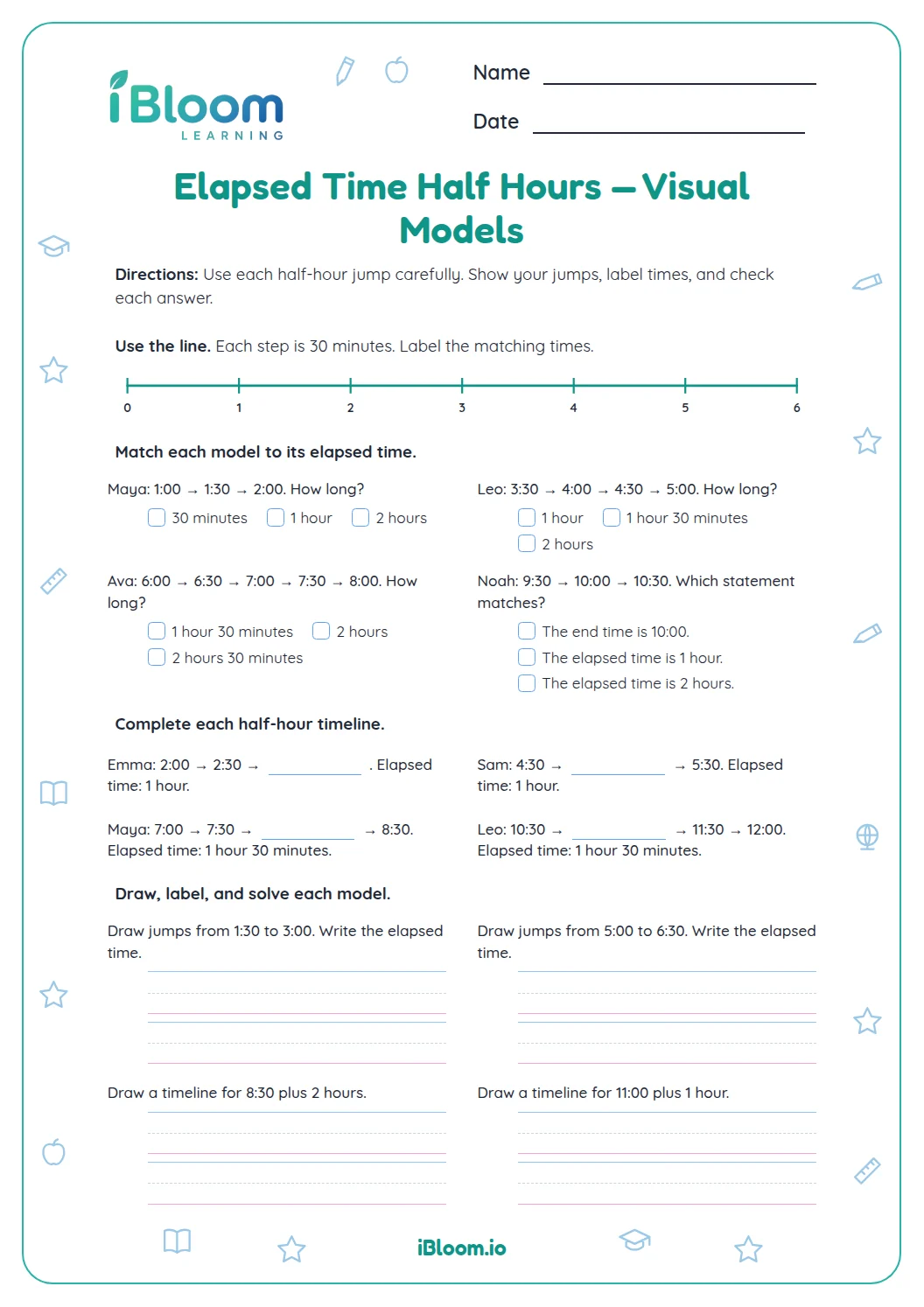
Part B gives a start time and either a length of time or an end time. Maya starts reading at 4:00 and reads for 1 hour, so she stops at 5:00. Leo leaves at 8:30 and arrives 30 minutes later, at 9:00. Ava plays the piano from 2:15 to 2:45, and the long hand moves from the 3 to the 9, which is 30 minutes.
Children can picture the clock hands moving or count on by fives. Every story jumps by a whole hour or a half hour, so the answers land on easy clock times.
What do a.m. and p.m. mean?
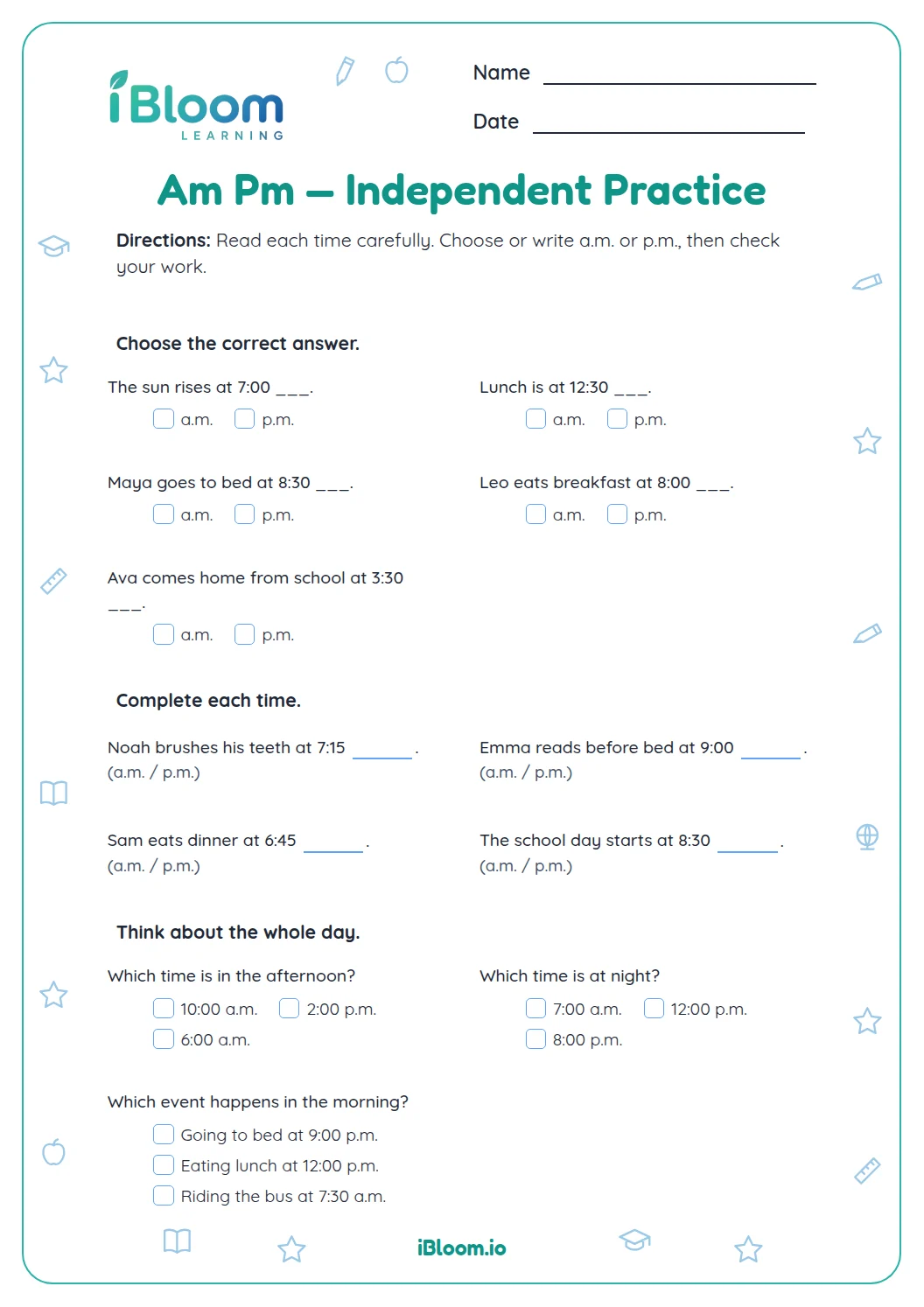
A.m. covers the hours from midnight until noon, and p.m. covers noon until midnight. Because a clock face shows only 12 hours, the same 7:00 happens twice a day, once in the morning and once in the evening.
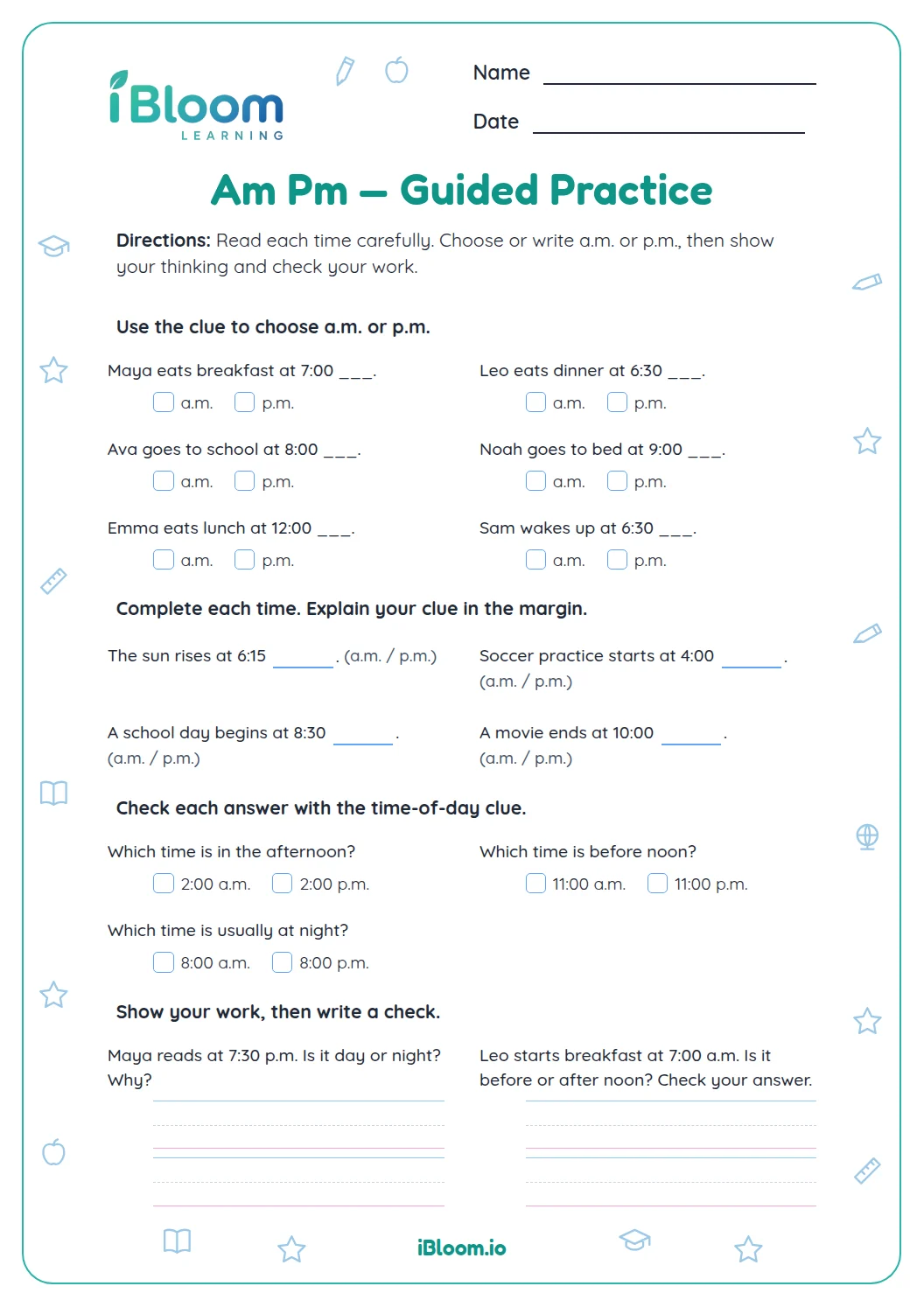
Part C pairs a time with an everyday event. Waking up at 7:00 happens in the morning, so it is a.m. Dinner at 6:00 comes in the evening, so it is p.m.
What is on this worksheet?
Sixteen questions in four parts, on two pages: the clocks fill page 1, and the stories, a.m. and p.m. and calendar questions share page 2.
- Part A, Read the clock: six clock faces (3:30, 7:15, 10:45, 8:20, 11:10 and 5:40), each with three times to choose from
- Part B, Time stories: three short stories with a blank for a time or a number of minutes
- Part C, a.m. or p.m.: two everyday events
- Part D, Calendar facts: five multiple-choice questions about tomorrow and yesterday, a date one week later, the month after June and the days in April
- A separate answer key
How to use this worksheet at home or in class
- 1Give your child a real analog clock or a drawn one to move the hands on while they work.
- 2In Part A, have your child say the hour first and then count by fives for the minutes before looking at the choices.
- 3In Part B, ask them to act out the story on the clock, moving the long hand for each half hour that passes.
- 4In Part C, ask what is happening outside, light or dark, to decide between a.m. and p.m.
- 5In Part D, keep a calendar handy. Count days on it to check each answer.
- 6Mark with the answer key and have your child redo any clock they read wrongly by saying the hour and then counting the minutes aloud.
Common mistakes and quick fixes
The mistake
Reading the minute hand as minutes directly, so a long hand on the 4 becomes 8:04 instead of 8:20.
The fix
Have your child count by fives from the 12 up to the number: 5, 10, 15, 20. Each number on the clock is five more minutes.
The mistake
Swapping the hands, so the time 7:15 is read as 3:35.
The fix
Remind your child that the short hand tells the hour and the long hand tells the minutes. Say the hour first.
The mistake
Counting the starting day as day one on the calendar, so a week after Monday, March 12 becomes Sunday, March 18 instead of Monday, March 19.
The fix
Count the jump, not the starting day. Seven days after Monday is the next Monday.
Common Core alignment
Most US states use the Common Core standards or a close state version. This sheet practices the time standard below.
Tell time on analog clocks to five minutes and use a.m. and p.m.
On this sheet: Part A reads clocks to five minutes, Part B writes times, and Part C uses a.m. and p.m.
Show the official wordingHide the official wording
Tell and write time from analog and digital clocks to the nearest five minutes, using a.m. and p.m.
What to practice next
Make more practice
Further reading
Questions parents and teachers ask
What should my child know before this worksheet?
Your child should know the numbers 1 to 12 and be able to skip count by fives to 60. They should also know the days of the week in order. If counting by fives is shaky, practice around the clock face first, touching each number and saying 5, 10, 15 and so on.
What time is it when the short hand is on 7 and the long hand is on 3?
It is 7:15. The short hand shows the hour, 7, and the long hand on the 3 shows 15 minutes, because 3 times 5 is 15. We say it is a quarter past seven. Question 2 on the worksheet shows this clock and offers 7:03 and 3:35 as common mix-ups.
How do I know whether a time is a.m. or p.m.?
Think about whether it happens in the morning or the evening. A.m. is from midnight until noon, and p.m. is from noon until midnight. Waking up and eating breakfast are a.m. times, while dinner and bedtime are p.m. times. Part C of the sheet asks two questions like this, about waking up and dinner.
How many minutes pass from 2:15 to 2:45?
Thirty minutes pass. The long hand moves from the 3 to the 9, which is six numbers, and each number is five minutes, so 6 times 5 is 30. That is half an hour. This is the Ava piano question in Part B, where the blank is filled with 30.
Why are calendar questions on a time worksheet?
Clocks measure the hours in a day, and calendars measure the days in a week and month, so children use both to describe when things happen. Part D asks what day comes tomorrow or yesterday, what day falls a week after March 12 and how many days April has.
Is there an answer key for this worksheet?
Yes. A separate two-page answer key shows the correct time for each clock, the answer to each time story, the a.m. or p.m. choice and each calendar answer. Print the worksheet on its own, let your child work through it, then use the key to check the answers together.