




About this worksheet
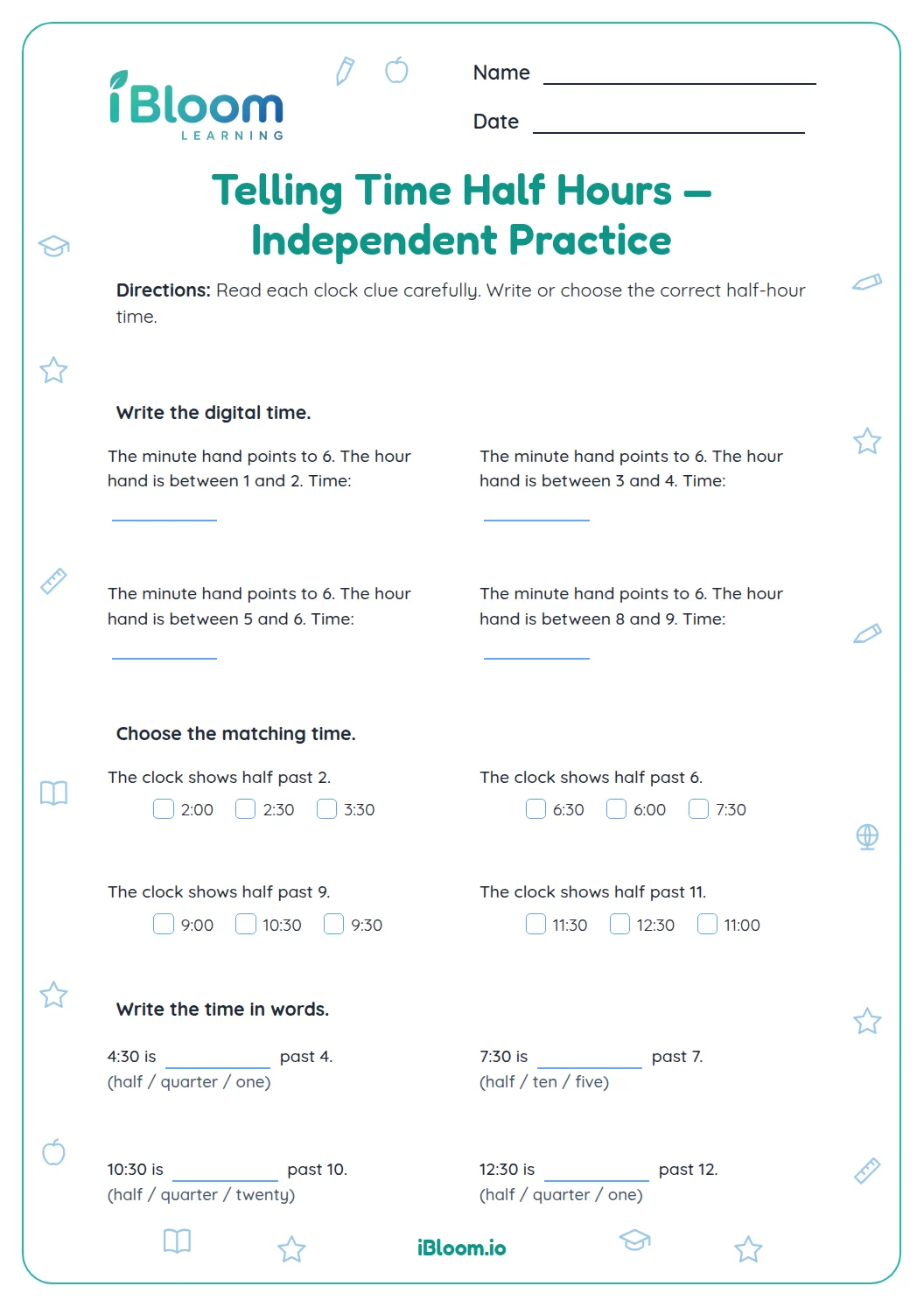
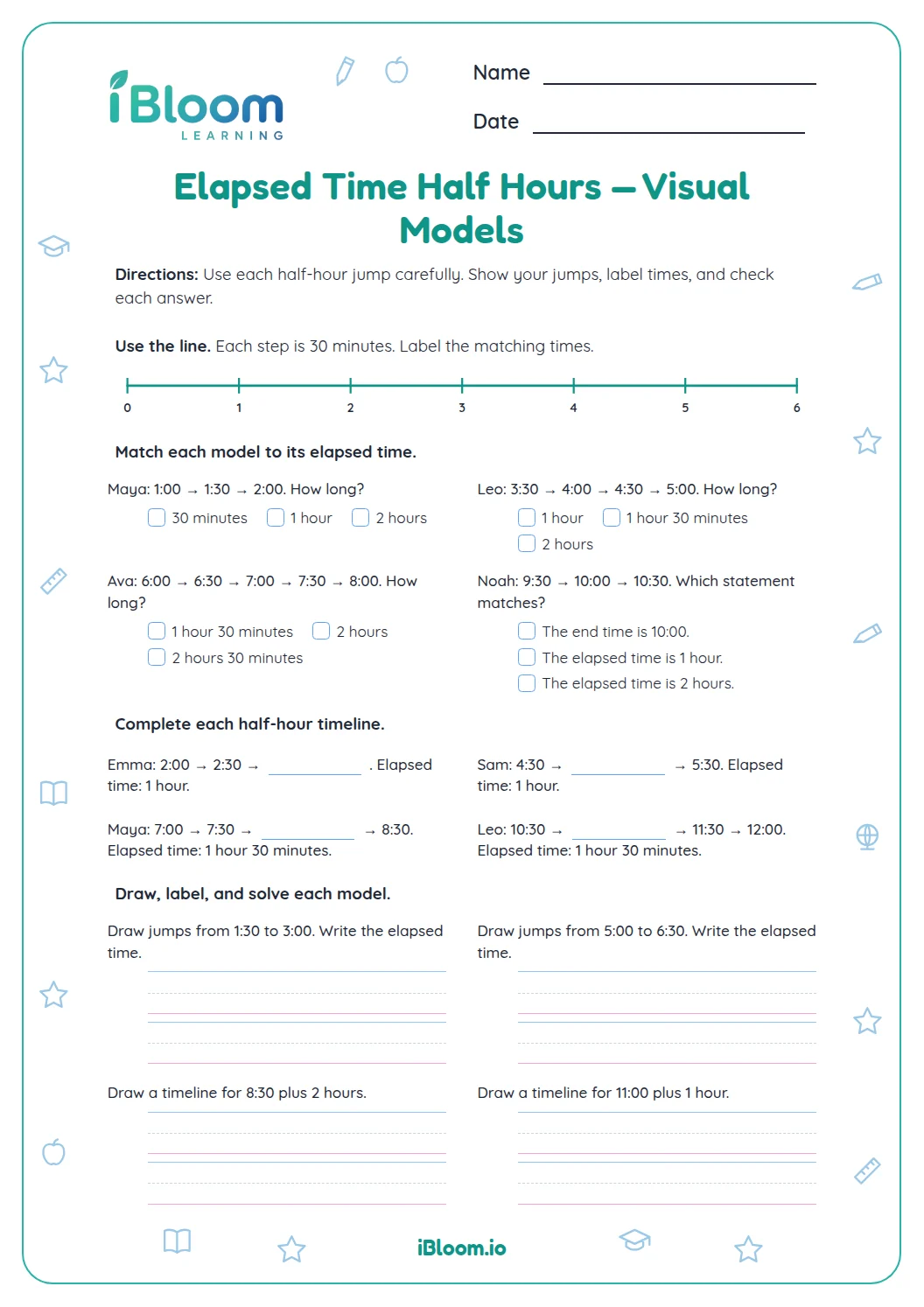
This Grade 2 worksheet practices reading analog clocks to quarter hours, matching clock faces to digital times, and interpreting quarter-after and quarter-before clues. Sixteen questions move from clock reading to time language and minute intervals. The separate key makes it easy to check the answers. The practice aligns with CCSS 2.MD.C.7.
Aligned to 2.MD.C.7
How do the hands show a quarter hour?
Each number on a clock stands for five minutes when the minute hand moves around the face. At 3 it is :15; at 9 it is :45.
- 1At 2:15, the minute hand points to 3.
- 2The time is quarter after 2.
How to use this worksheet
- 1Read the model or direction at the start of each part.
- 2Work through the questions in order, showing steps where useful.
- 3Reread each answer in the context of its question.
- 4Use the answer key to check and correct your work.
Common mistakes and quick fixes
The mistake
Reading the hour hand as if it jumps exactly to the next number.
The fix
Check which hour number the short hand has passed.
The mistake
Calling :45 quarter after.
The fix
At :45, 15 minutes remain until the next hour: quarter before.
The mistake
Counting each clock number as one minute.
The fix
Count by fives around the minute-hand numbers.
Common Core alignment
This worksheet gives focused practice with the standard below.
Read and write quarter-hour times on analog clocks.
On this sheet: Read and write quarter-hour times on analog clocks.
Show the official wordingHide the official wording
Tell and write time from analog and digital clocks to the nearest five minutes, using a.m. and p.m.
What to practice next
Make more practice
Further reading
Questions parents and teachers ask
What does quarter after mean?
Quarter after means 15 minutes past the hour. On an analog clock, the minute hand points to 3, as in 4:15. Students can use the hand position to connect the phrase with the digital time. This gives students a chance to explain the choice, check the relevant detail, and connect the answer with the skill practiced on this printable.
What does quarter before mean?
Quarter before means 15 minutes until the next hour. At 6:45, the clock is a quarter before 7. The phrase names how much time remains before the next hour begins. This gives students a chance to explain the choice, check the relevant detail, and connect the answer with the skill practiced on this printable.
Does the worksheet include half-hour times?
Yes. The clock reading questions include a half-hour example alongside quarter-hour times. This helps students connect the minute hand at 6 with thirty minutes past the hour. This gives students a chance to explain the choice, check the relevant detail, and connect the answer with the skill practiced on this printable.
How many questions are on the printable?
There are 14 questions in three parts: reading clock faces, matching times, and interpreting time language and minute intervals. Students move from reading a clock to using time phrases. This gives students a chance to explain the choice, check the relevant detail, and connect the answer with the skill practiced on this printable.
Is an answer key included?
Yes. A separate key lists the digital time for each clock and the answers to the time-language questions. An adult or student can use it to check completed work. This gives students a chance to explain the choice, check the relevant detail, and connect the answer with the skill practiced on this printable.