





About this worksheet
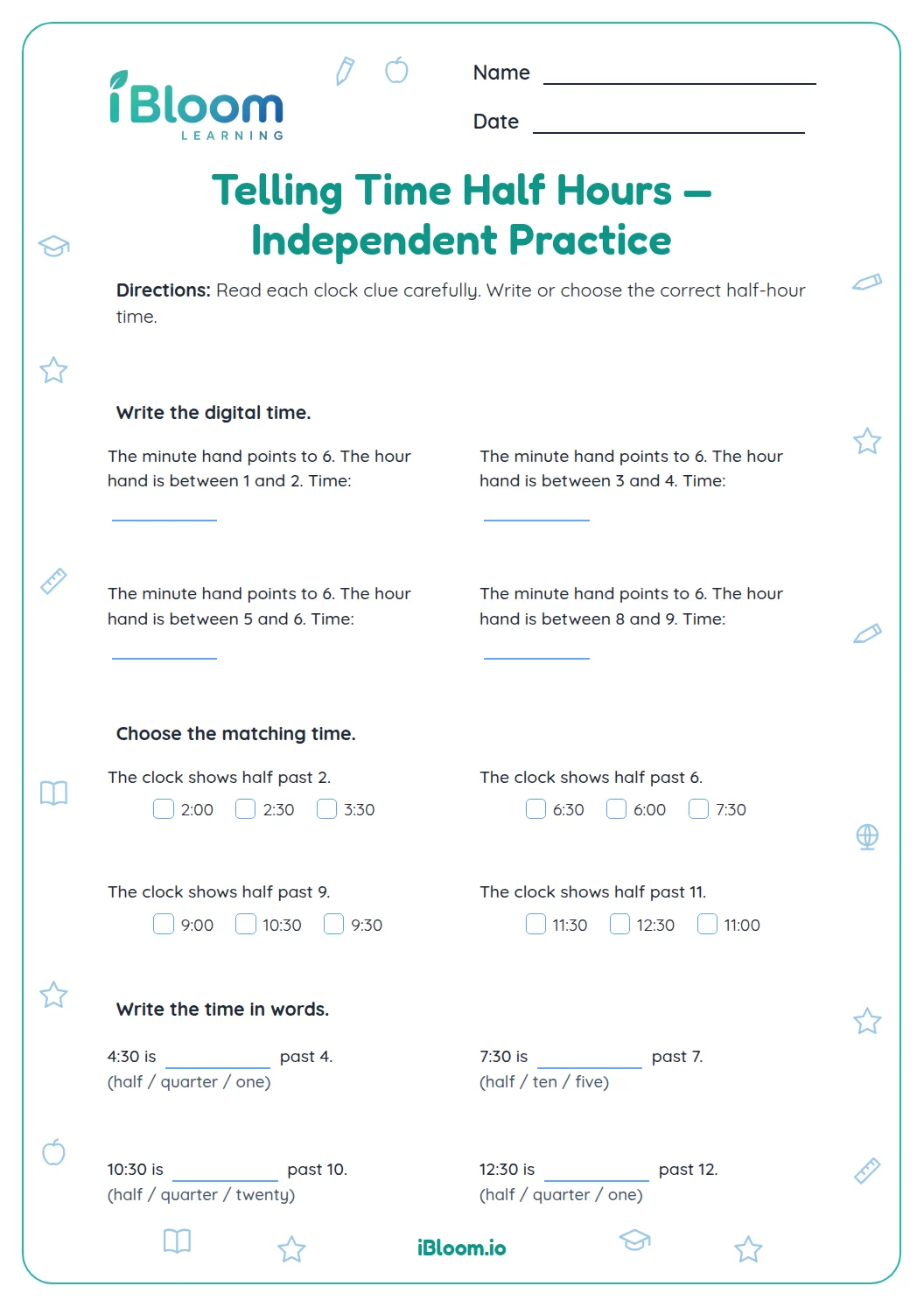
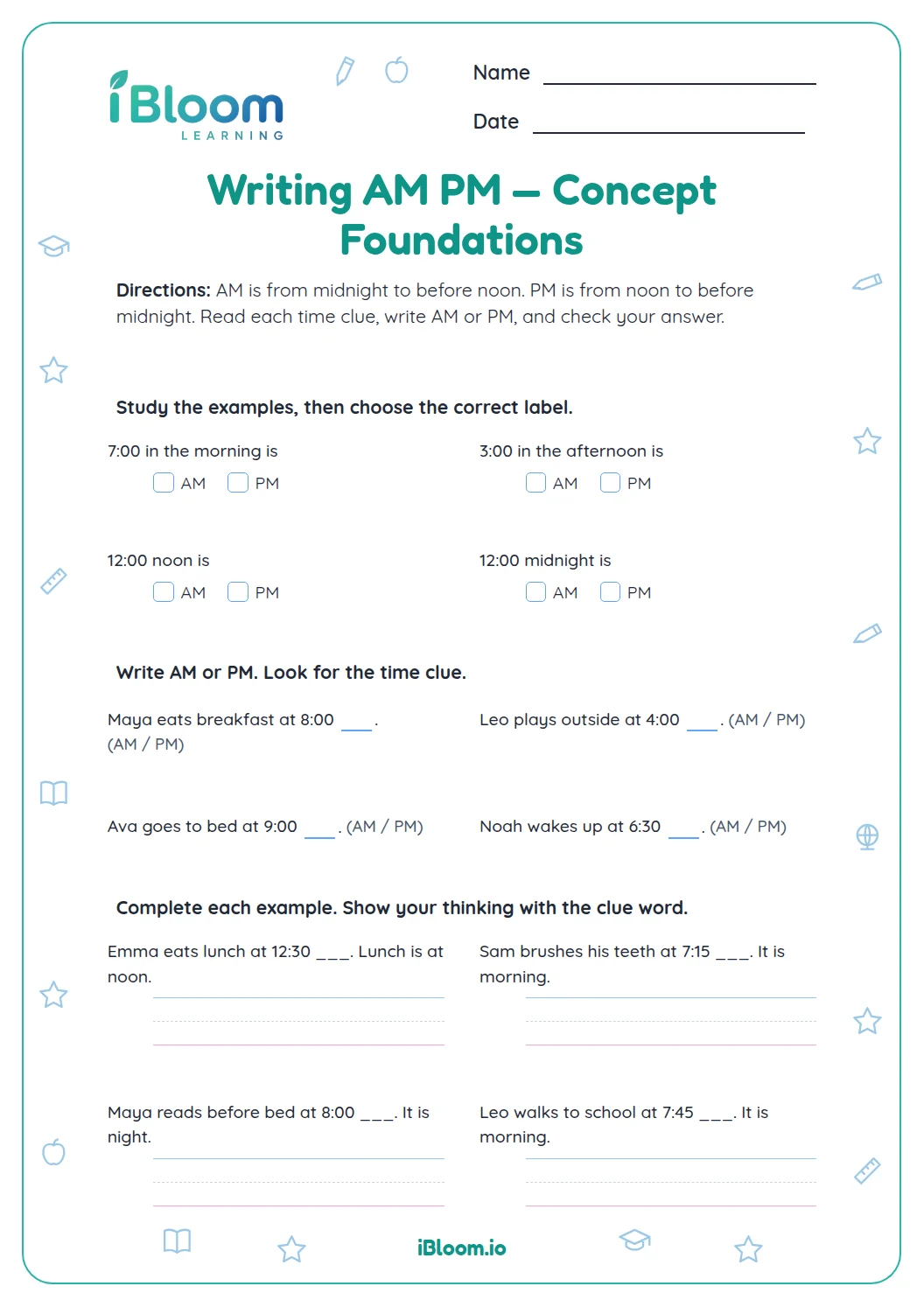
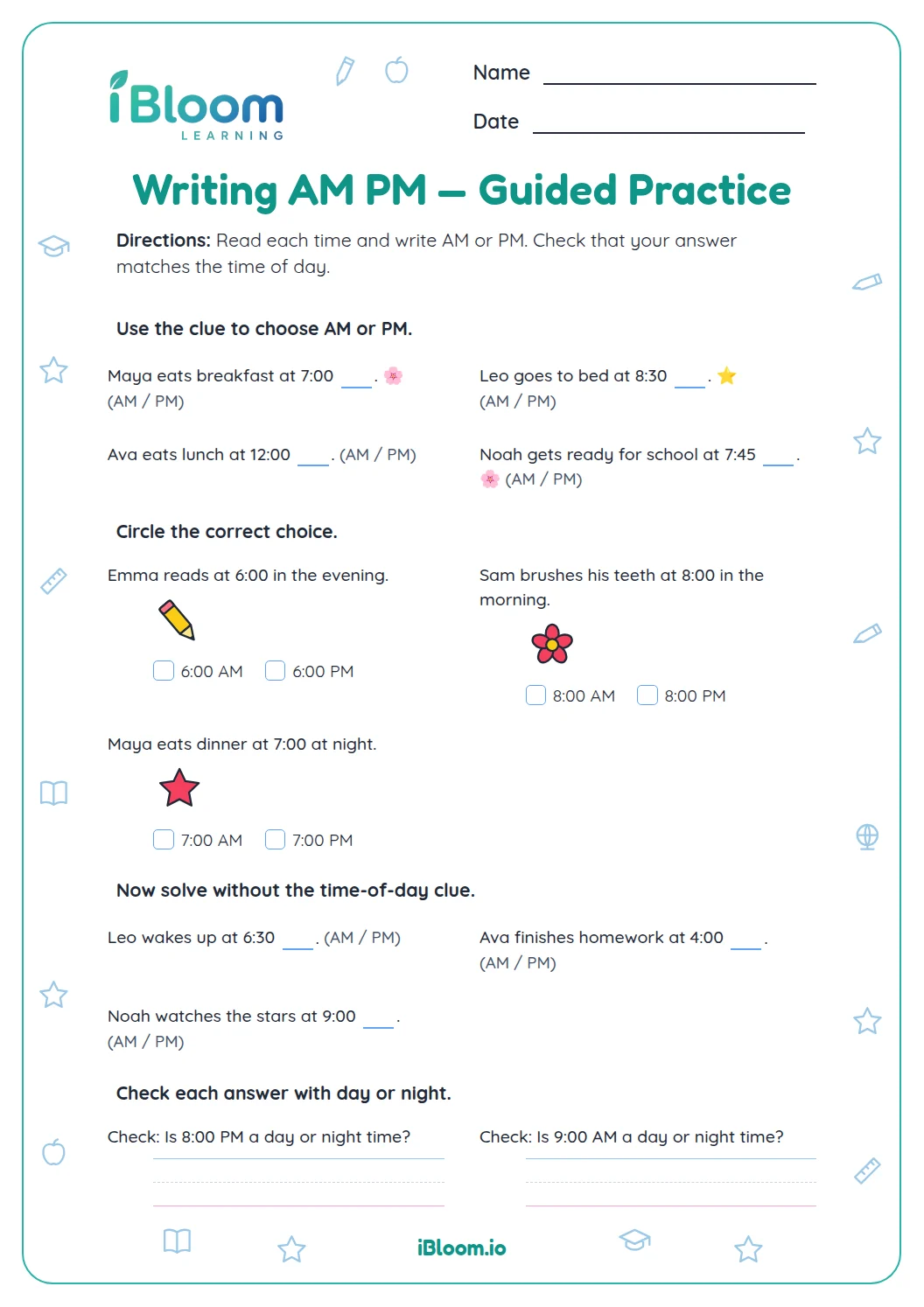
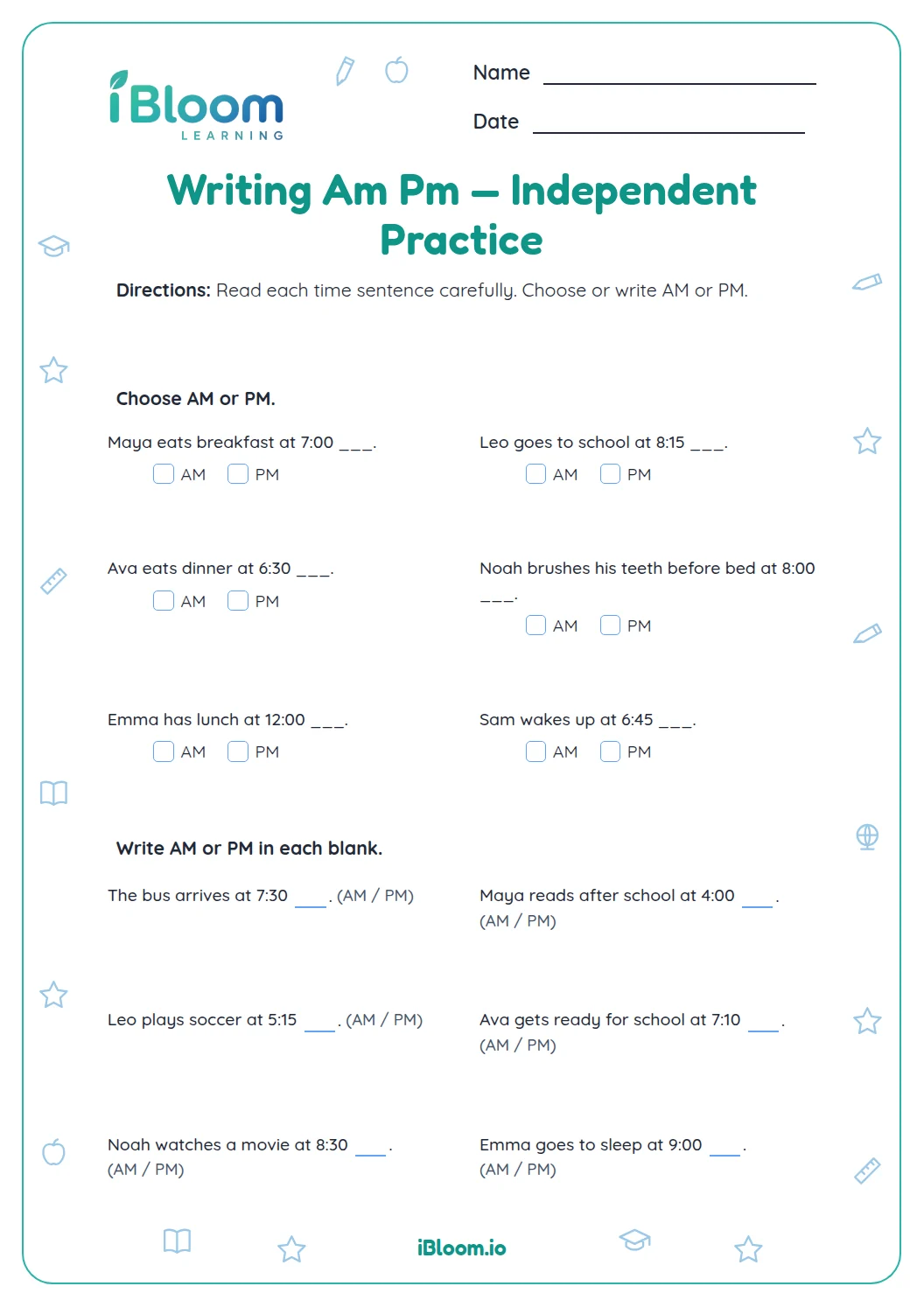
This free Grade 2 worksheet builds five-minute clock reading from the minute hand outward. In Part A, children choose how many minutes past the hour three clocks show. In Part B, they read six clocks and write the time in digital form. Part C connects three clocks to morning, afternoon and evening events using a.m. and p.m. The twelve questions practice Common Core 2.MD.C.7. Each analog clock has a short hour hand and a long minute hand, and the separate answer key shows the correct choices and written times.
Aligned to 2.MD.C.7
Why does the clock number 8 mean 40 minutes?
Each space between neighboring clock numbers is five minutes. Starting at 12, count 5 at 1, 10 at 2, and continue until you reach the long hand. At 8, eight groups of five minutes have passed.
Part A isolates this idea with the long hand pointing to 1, 3 and 6. The choices separate the clock label from the number of minutes.
Which hour should children write between two numbers?
Use the hour the short hand has already passed. At 7:40, it is moving toward 8, but the eighth hour has not begun. The long hand will reach 12 when the hour changes.
- 1The long hand points to 8: count 5, 10, 15, 20, 25, 30, 35, 40.
- 2The short hand is between 7 and 8, so the hour is 7.
- 3Write 7:40.
How do the last three clocks use a.m. and p.m.?
Question 10 places breakfast in the morning, question 11 places practice in the afternoon, and question 12 places bedtime in the evening. Children read the hands first and add a.m. or p.m. using the event description. The event matters because an analog clock face repeats every twelve hours.
Part B includes 6:05 and 1:55. These two times help check whether the child keeps the leading zero in minutes and waits for the hour hand to reach the next hour.
How to use this worksheet
- 1Point to the long minute hand and the short hour hand on question 1.
- 2Count around the clock by fives, beginning just after 12.
- 3Finish Part A by choosing minutes past the hour.
- 4For each Part B clock, read the hour first and then the minutes.
- 5Use morning, afternoon or evening in Part C to add a.m. or p.m.
- 6Check the key and reread any clock whose hour changed too soon.
Mistakes to notice and how to help
The mistake
Writing 7:08 when the long hand points to 8.
The fix
Count eight five-minute steps to get 40 minutes, then write 7:40.
The mistake
Reading 1:55 as 2:55 because the short hand is close to 2.
The fix
Check whether the short hand has reached 2. It is still in the hour that began at 1.
The mistake
Writing 6:5 instead of 6:05.
The fix
Minutes use two digits in a digital time. Add a zero before a single-digit minute number.
Common Core alignment
Read clocks in five-minute steps and use a.m. or p.m. for everyday events.
On this sheet: Children connect minute-hand positions to minutes, write clock times and label morning or afternoon events.
Show the official wordingHide the official wording
Tell and write time from analog and digital clocks to the nearest five minutes, using a.m. and p.m.
What to practice next
Make more practice
Further reading
Questions parents and teachers ask
What should my child know before starting these clocks?
Your child should recognize the numbers around a clock and count by fives to 60. Begin by comparing the lengths of the two hands. Part A then builds the link between a clock number and minutes past the hour before Part B asks for complete times.
Why is the hour hand between two numbers?
The hour hand moves gradually as the minutes pass. At 7:40 it has passed 7 and is heading toward 8, so the hour is still 7. Ask which number it has already reached while moving clockwise, then read the minute hand to finish the time.
Do children write a.m. or p.m. for every clock?
Children add a.m. or p.m. for the three daily events in Part C. Breakfast is in the morning, practice is in the afternoon, and bedtime is in the evening. Read each clock first, then use the event clue to choose the label. The key gives the complete times.
How can I explain 6:05 without confusing five and fifty?
Point to the long hand at 1 and count one group of five minutes. Write the minutes as 05 after the colon, making 6:05. Contrast that with the long hand at 10, which marks ten groups of five minutes and would mean 50 minutes past.
How many clocks and printable pages are included?
There are twelve clocks in three parts, with a separate answer key. Three questions ask for minutes past the hour, six ask for digital times, and three add a.m. or p.m. Print the two worksheet pages for the child and keep the two key pages for checking.