




About this worksheet
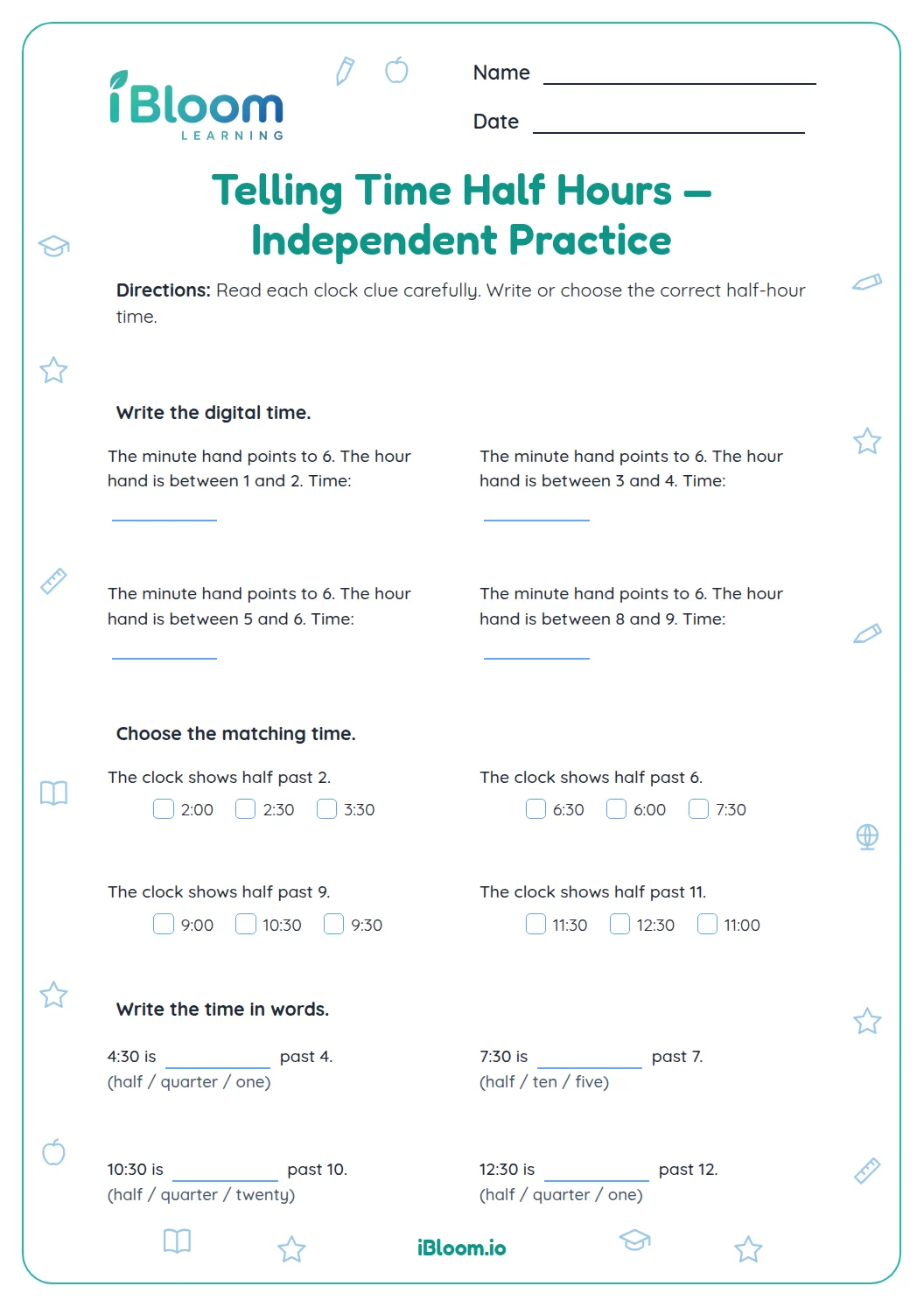
This free Grade 2 printable gives children 16 analog clocks to read, all showing times on the half hour. Part A offers three choices for each clock; Part B asks children to write the time themselves. Each question has its own clock model so the hands, rather than a sentence clue, show the time. The answer key lists the matching digital time for every clock. The work practices Common Core 2.MD.C.7, telling and writing time from analog and digital clocks.
Aligned to 2.MD.C.7
What does the minute hand tell you?
Start with the long hand. On every clock in this practice, it points to 6, which marks 30 minutes. The short hand sits between two hour numbers because half of that hour has passed.
How do you choose the matching time?
Read the short hand as the hour that has already begun, not the number it is approaching. For example, when it rests between 4 and 5, the hour is 4. Add 30 minutes because the long hand points to 6.
- 1The long hand points to 6, so it is :30.
- 2The short hand is between 4 and 5, so the hour is 4.
- 3The clock reads 4:30.
How should you write a time?
Write the hour, a colon, and two minute digits. A half-hour time ends in 30, such as 8:30. In Part B, read each new clock independently before writing.
How to use this worksheet
- 1Point to the long hand and identify the minute mark.
- 2When it points to 6, say “30 minutes.”
- 3Look between which two numbers the short hand sits.
- 4Use the earlier hour number because that hour has started.
- 5Write the time with a colon, then check the answer key.
Common mistakes and quick fixes
The mistake
Writing the next hour when the short hand is between two numbers.
The fix
Name the hour the short hand has passed; 4:30 comes before 5:00.
The mistake
Reading the long hand at 6 as six minutes.
The fix
On an analog clock, each number marks five minutes; 6 × 5 is 30.
The mistake
Writing 4:3 instead of 4:30.
The fix
Use two digits for minutes, including the zero in 30.
Common Core alignment
Read and write times shown on analog clocks to the nearest five minutes.
On this sheet: Every question reads an analog clock; the times use half-hour intervals.
Show the official wordingHide the official wording
Tell and write time from analog and digital clocks to the nearest five minutes, using a.m. and p.m.
What to practice next
Make more practice
Further reading
Questions parents and teachers ask
What does the long hand show on these clocks?
The long hand is the minute hand. On every clock on this worksheet it points to 6, which means 30 minutes have passed in the current hour. Children can count by fives around the clock to confirm: 5, 10, 15, 20, 25, 30.
Why is the short hand between two numbers?
At half past an hour, the next hour has not started yet. The short hand has moved away from the hour number it passed and is heading toward the next one. Read the number it has passed: between 4 and 5 means the hour is 4.
How many clock questions are included?
There are 16 questions across two parts. Part A has eight multiple-choice clock readings, and Part B has eight clocks where children write the time. The separate answer key gives the correct digital time for each clock. The key helps check the work.
What is a good way to support a learner?
Use a paper clock or draw a clock face and move the minute hand to 6. Explain that the hour hand moves gradually, too, so it sits between hour numbers at half past. Then have the learner point to the hour that has already begun.
Does this worksheet include an answer key?
Yes. A separate answer-key section is generated with the worksheet and lists each of the 16 clock times. You can let a child try the questions first, then use the key to check the written times and talk through any clock that was tricky.