



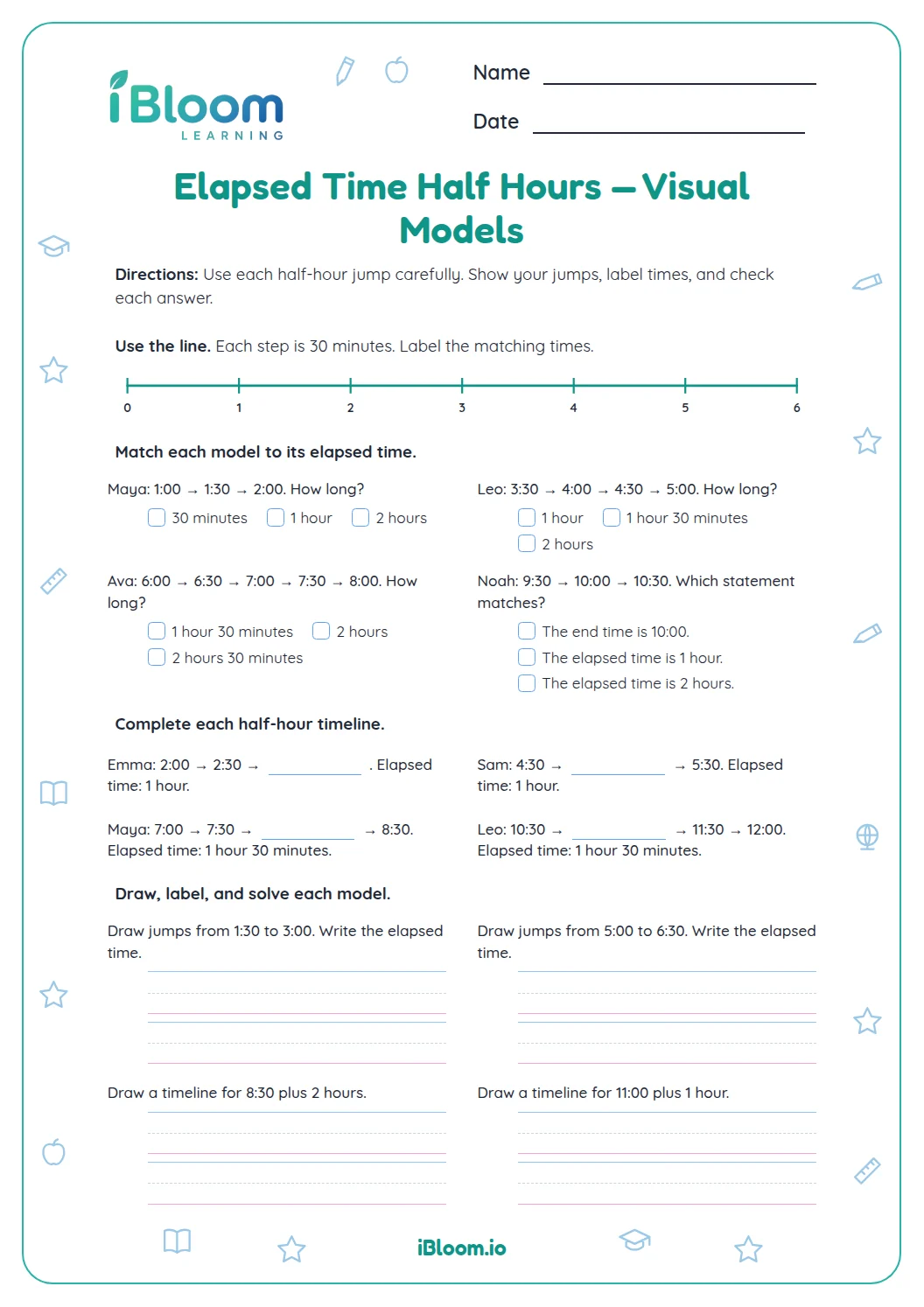

About this worksheet
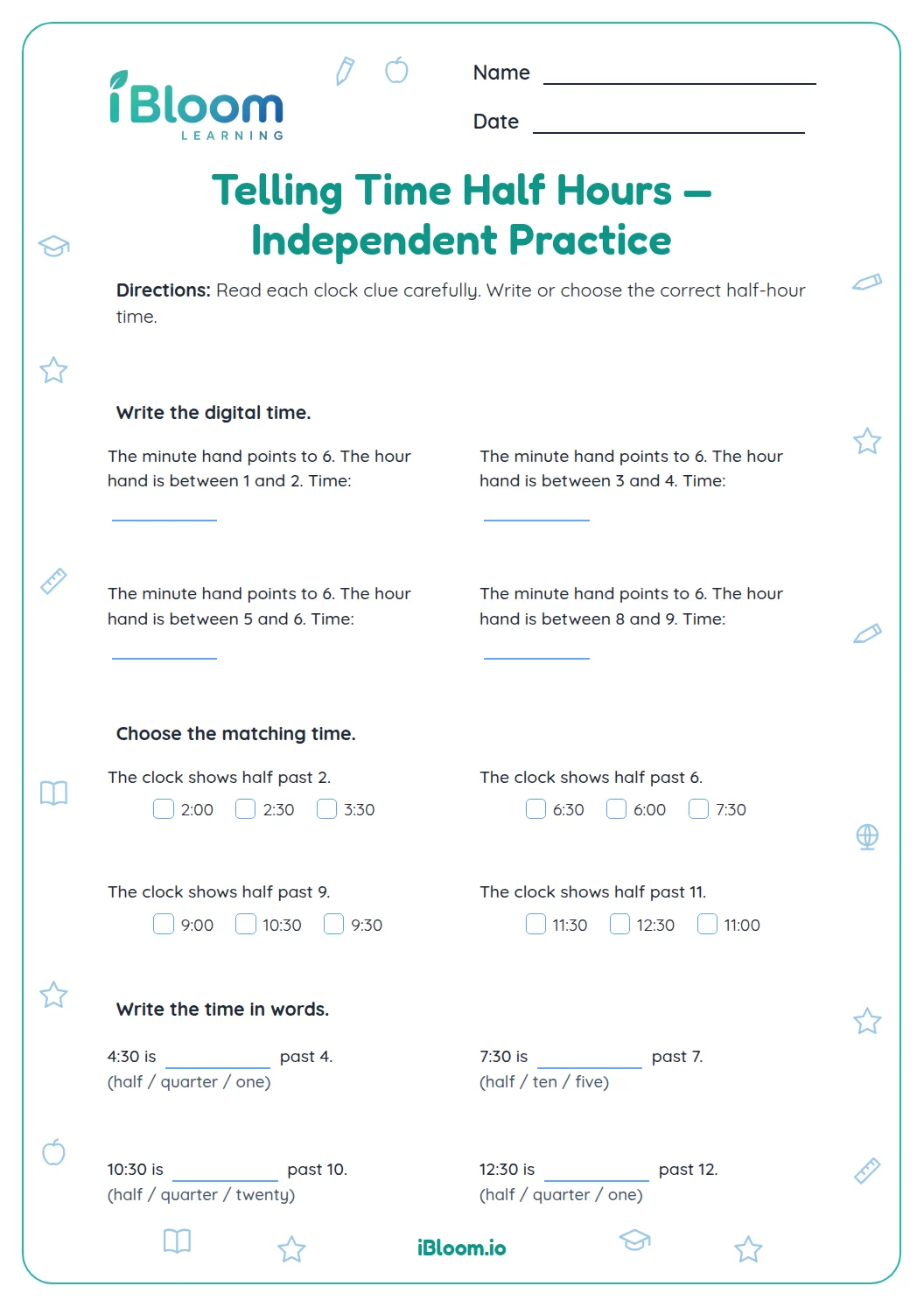
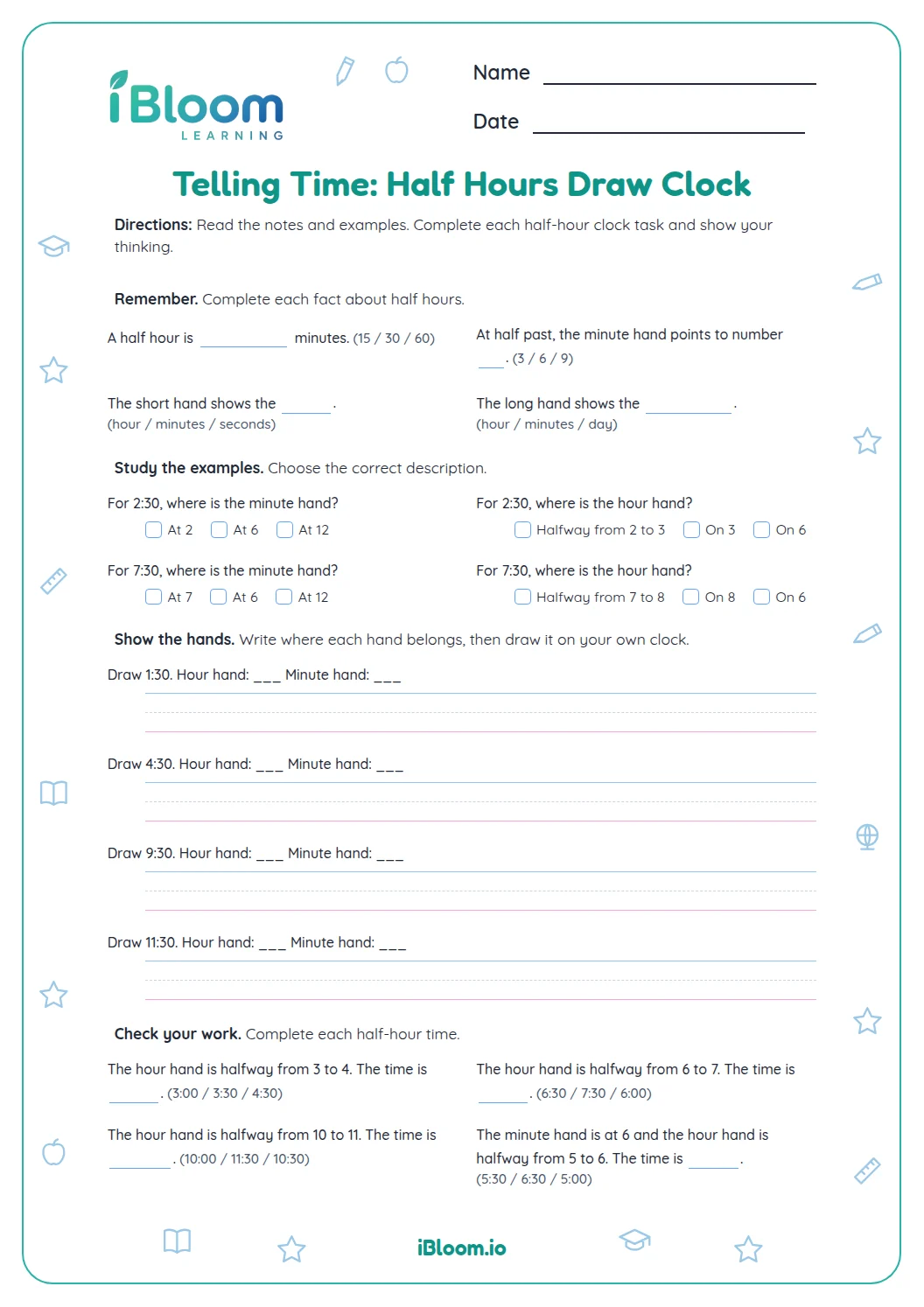
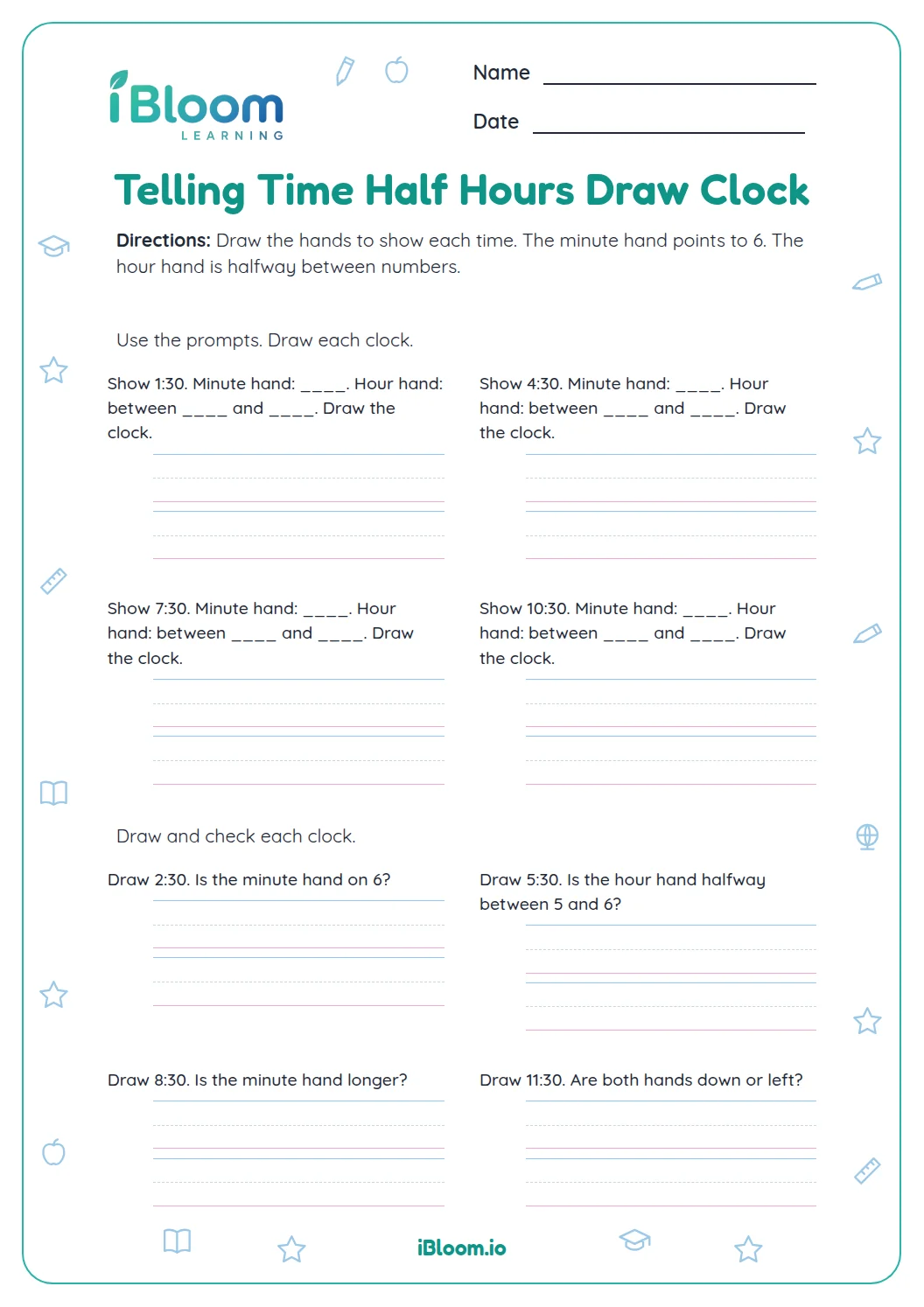
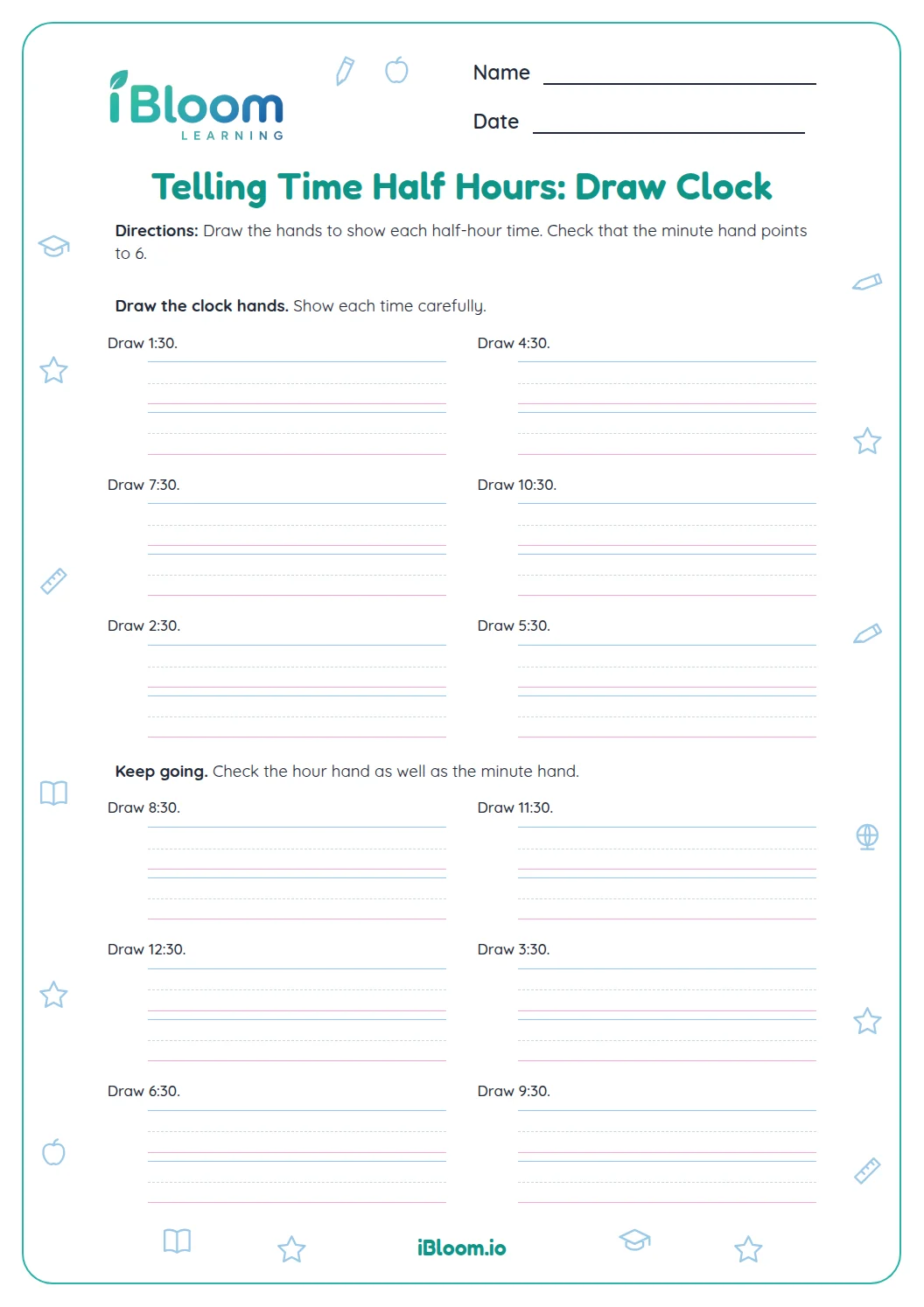
This Grade 2 printable builds skill reading analog clocks at the half hour and checking explanations about the two hands. Children read six clocks, solve four short time stories, and choose corrections for four common clock-reading claims. It aligns with Common Core 2.MD.C.7, which asks students to tell and write time from analog and digital clocks. The answer key gives a clear response for every item.
Aligned to 2.MD.C.7
What will students practice?
Students read whole-hour and half-hour clocks, then apply those times to simple schedules. The final part mirrors the original reasoning task: check what each hand shows and correct a mistaken time explanation.
- Read the minute hand at 12 or 6.
- Use 30-minute steps in a schedule.
- Check whether a claim describes both clock hands correctly.
How do you move ahead one half hour?
Start with the time you know, then move the minute hand from 12 to 6 for 30 minutes. When the hour hand reaches the next hour, write that new time.
- 1A bus leaves at 8:00 and arrives half an hour later.
- 28:00 + 30 minutes = 8:30
How can children check a time answer?
Ask whether the answer is earlier or later than the starting time. A half hour changes the minutes from :00 to :30 or from :30 to the next :00.
How to use this worksheet
- 1Read the minute hand: at 12 means :00 and at 6 means :30.
- 2Name the hour the short hand has reached or is moving toward.
- 3For a schedule, count one 30-minute step at a time.
- 4For elapsed time, move backward from the ending time.
- 5Check that your answer is earlier or later as the question says.
Common mistakes and quick fixes
The mistake
Calling the time 6:30 when the hour hand is near 7.
The fix
At 6:30 the hour hand is between 6 and 7, so the time is still in the six o’clock hour.
The mistake
Treating a half hour as 50 minutes.
The fix
A half hour is 30 minutes; move the minute hand from 12 to 6.
The mistake
Moving forward when asked when something began.
The fix
Start at the ending time and count backward 30 minutes.
Read analog clocks and record half-hour times in digital form.
On this sheet:
Show the official wordingHide the official wording
Tell and write time from analog and digital clocks to the nearest five minutes, using a.m. and p.m.
What to practice next
Make more practice
Questions parents and teachers ask
What does the minute hand show at a half hour?
At a half hour, the minute hand points to 6 because 30 minutes have passed since the top of the hour. Children can count the minute marks or notice that the hand has moved halfway around the clock face, from 12 to 6.
Does the hour hand point to a number at 4:30?
At 4:30, the hour hand is between 4 and 5. It has moved partway toward 5, but the time is still in the four o’clock hour. Looking at both hands helps children tell the two parts of the time and name the correct hour.
How can children add a half hour to a time?
Move the minute hand from 12 to 6, or add 30 minutes. If the starting time is 7:30, another half hour reaches 8:00, so the hour changes as the minutes pass the end of the hour. The clock picture can show this movement clearly.
How can a child find a start time from an end time?
Begin with the ending time and count backward by 30 minutes for each half hour in the story. For example, if an activity ends at 5:30 and lasted half an hour, it began at 5:00. Check that the starting time comes before the ending time.
How can children check a half-hour clock explanation?
Check both hands together. At 4:30, the minute hand points to 6 and the hour hand sits between 4 and 5; a statement that the hour hand is exactly on 5 is not accurate. The final four questions practice correcting this kind of description.