


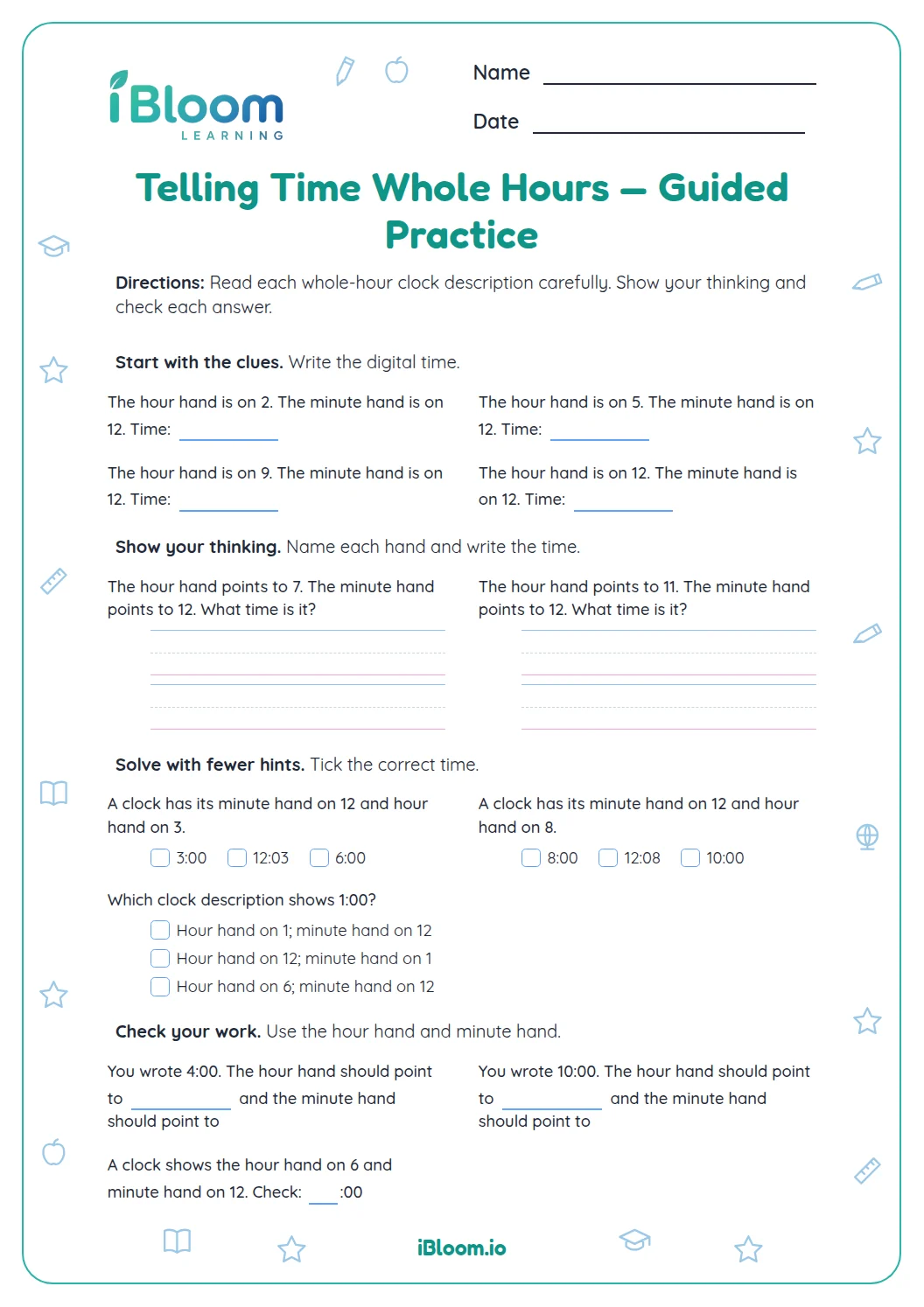
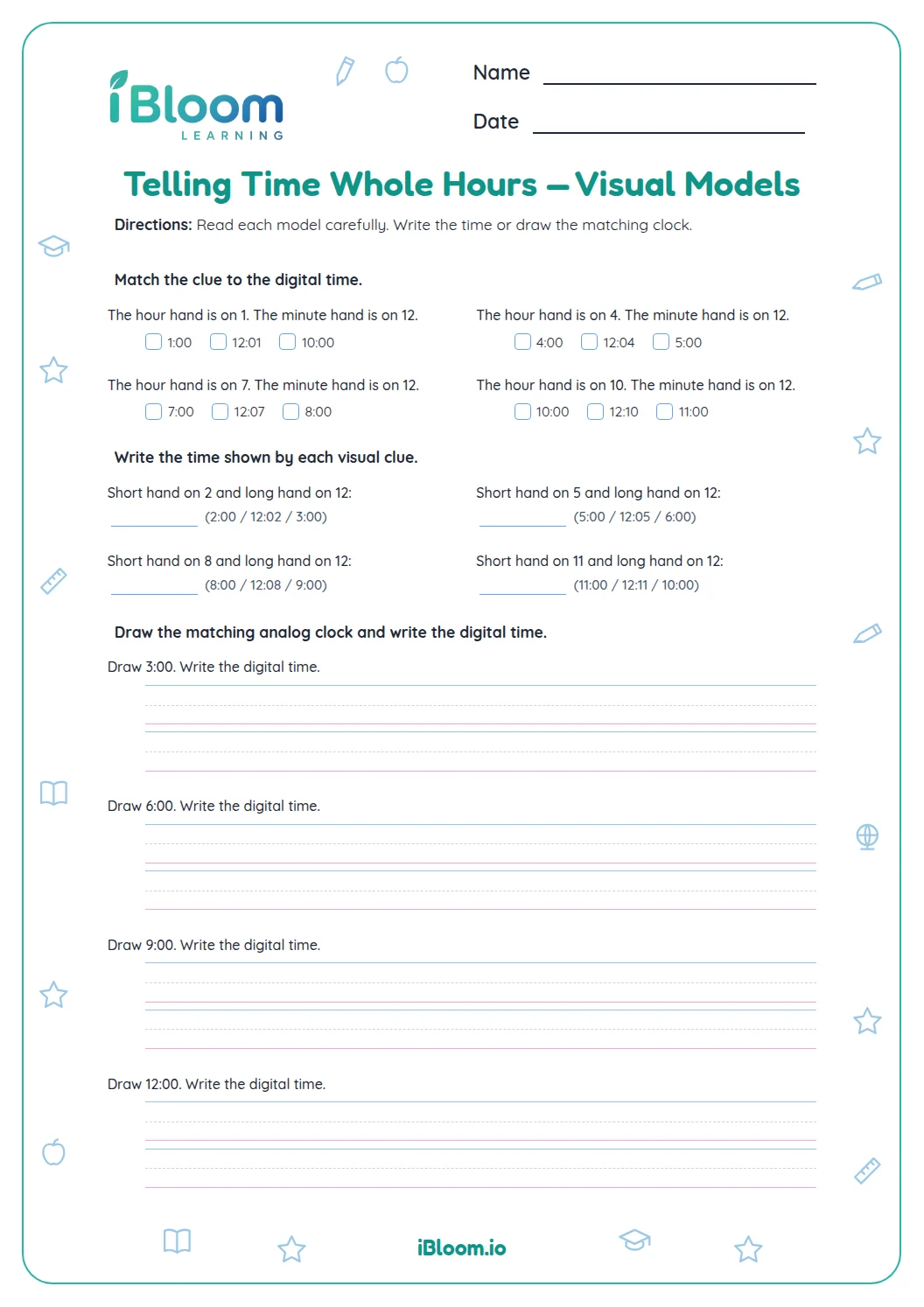
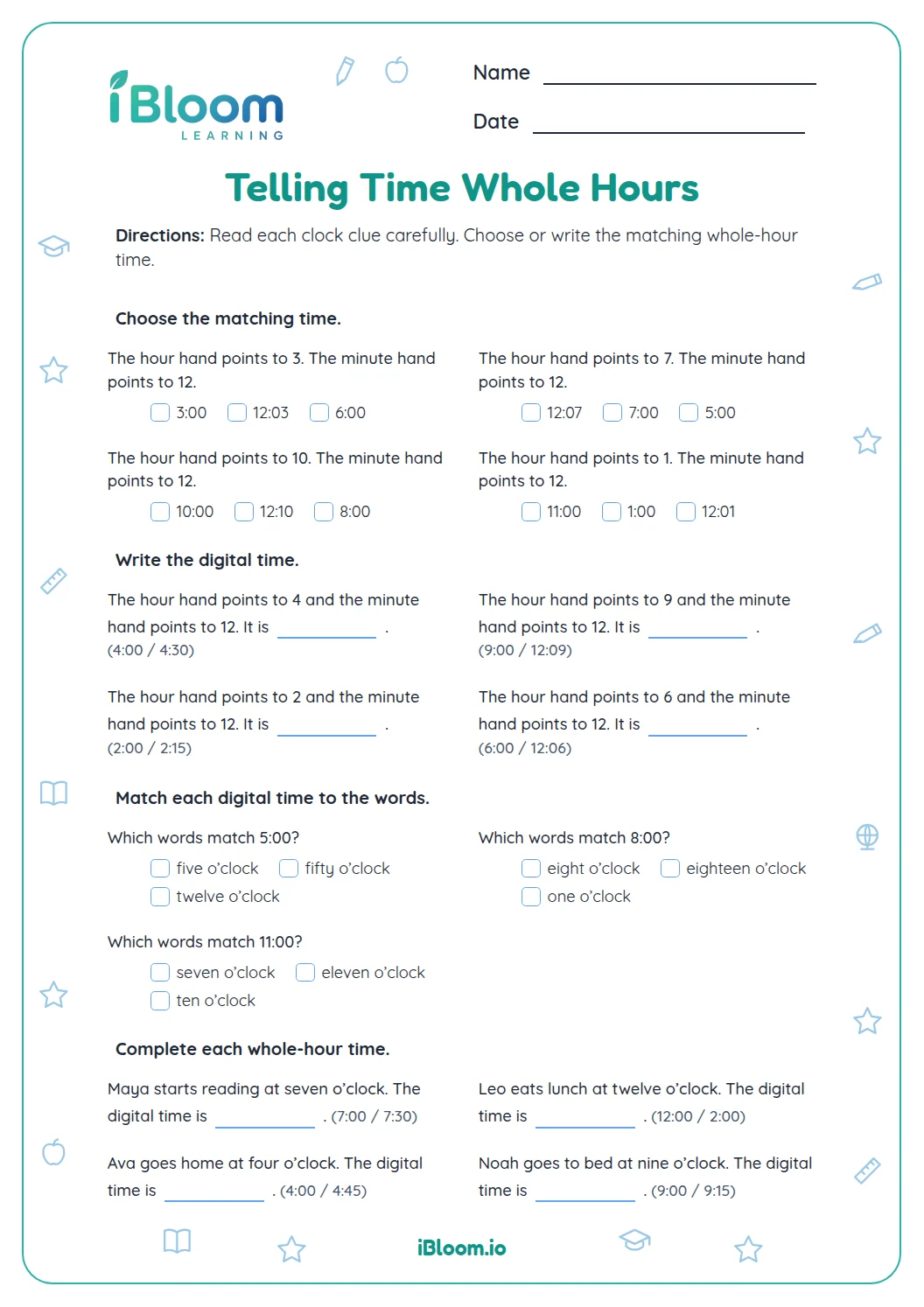
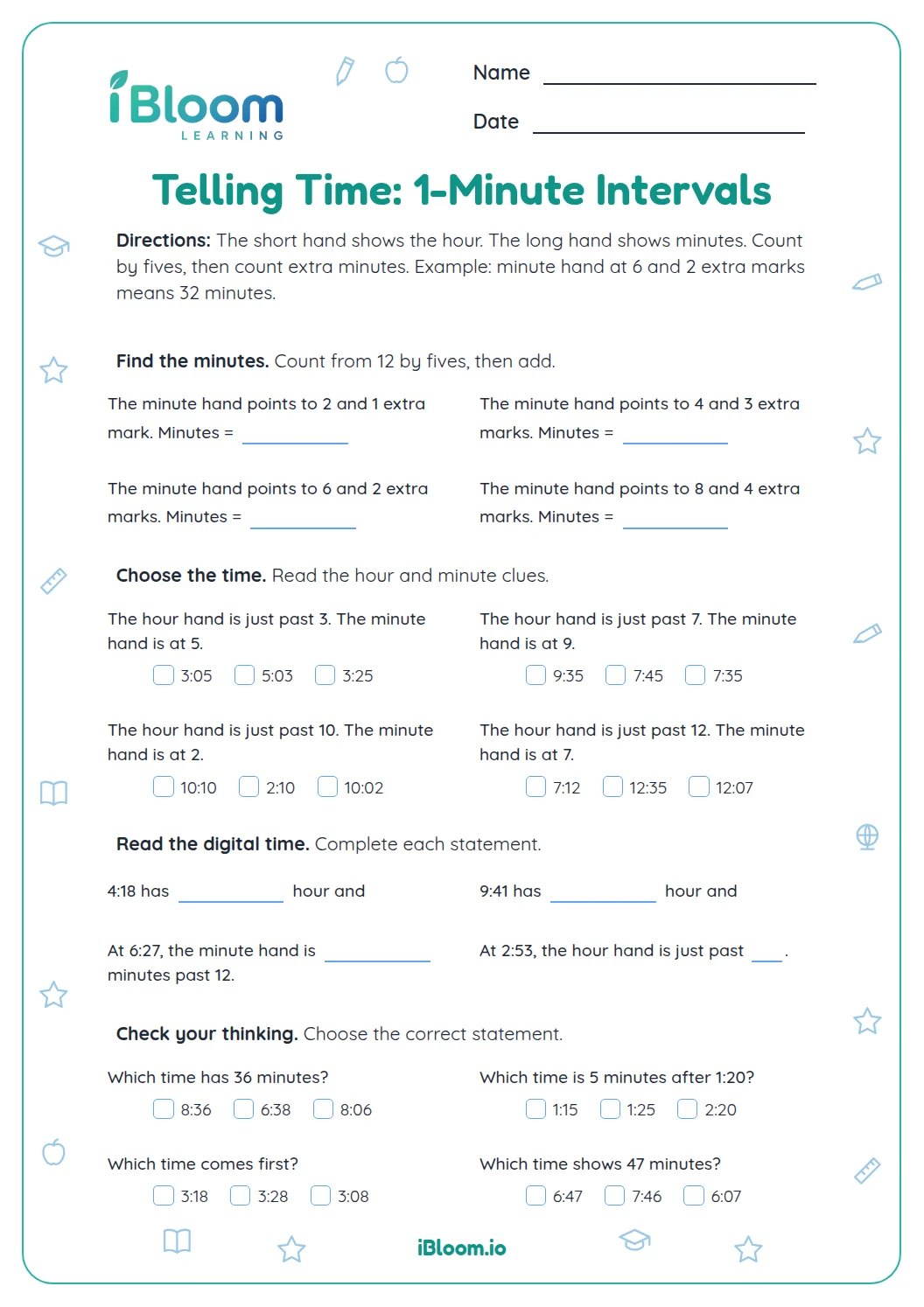


About this worksheet
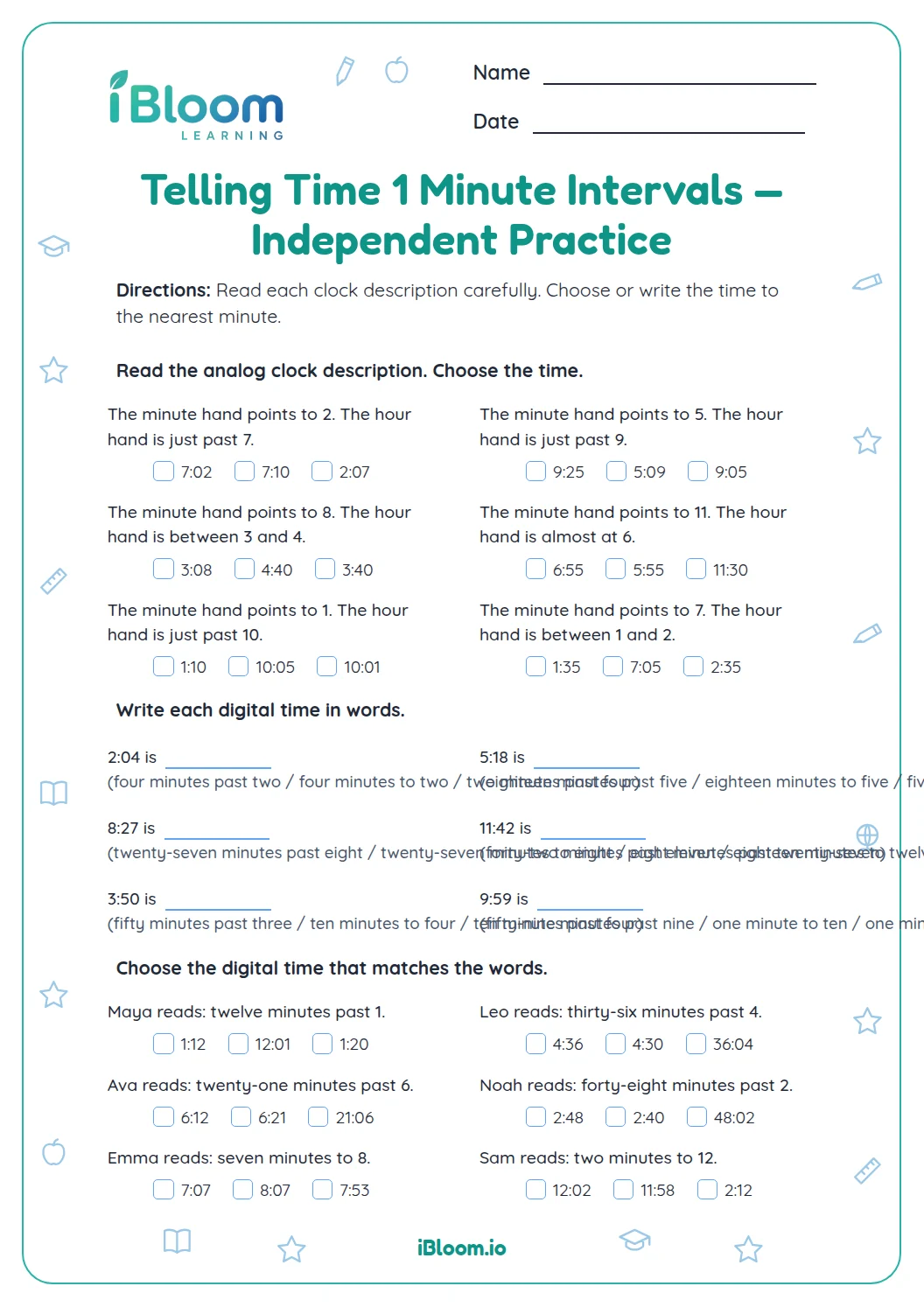
Four analog clock drawings practice reading to five-minute intervals. Ten compact multiple-choice questions ask learners to count by fives or move a time forward or back. All 14 items are distinct and fit Grade 2 expectations.
Aligned to 2.MD.C.7
How do students read the minute hand?
Four analog clock drawings practice reading to five-minute intervals. Ten compact multiple-choice questions ask learners to count by fives or move a time forward or back. All 14 items are distinct and fit Grade 2 expectations.
- 1Minute hand at 1 means 5 minutes.
- 2The hour hand has passed 7.
- 3The time is 7:05.
How do students track a short time change?
Four analog clock drawings practice reading to five-minute intervals. Ten compact multiple-choice questions ask learners to count by fives or move a time forward or back. All 14 items are distinct and fit Grade 2 expectations.
What is included in the practice set?
Four analog clock drawings practice reading to five-minute intervals. Ten compact multiple-choice questions ask learners to count by fives or move a time forward or back. All 14 items are distinct and fit Grade 2 expectations.
How to use this time worksheet
- 1Point to 12 and count by fives around each clock.
- 2Read the hour hand after deciding how many minutes have passed.
- 3Write digital times with a colon, such as 7:05.
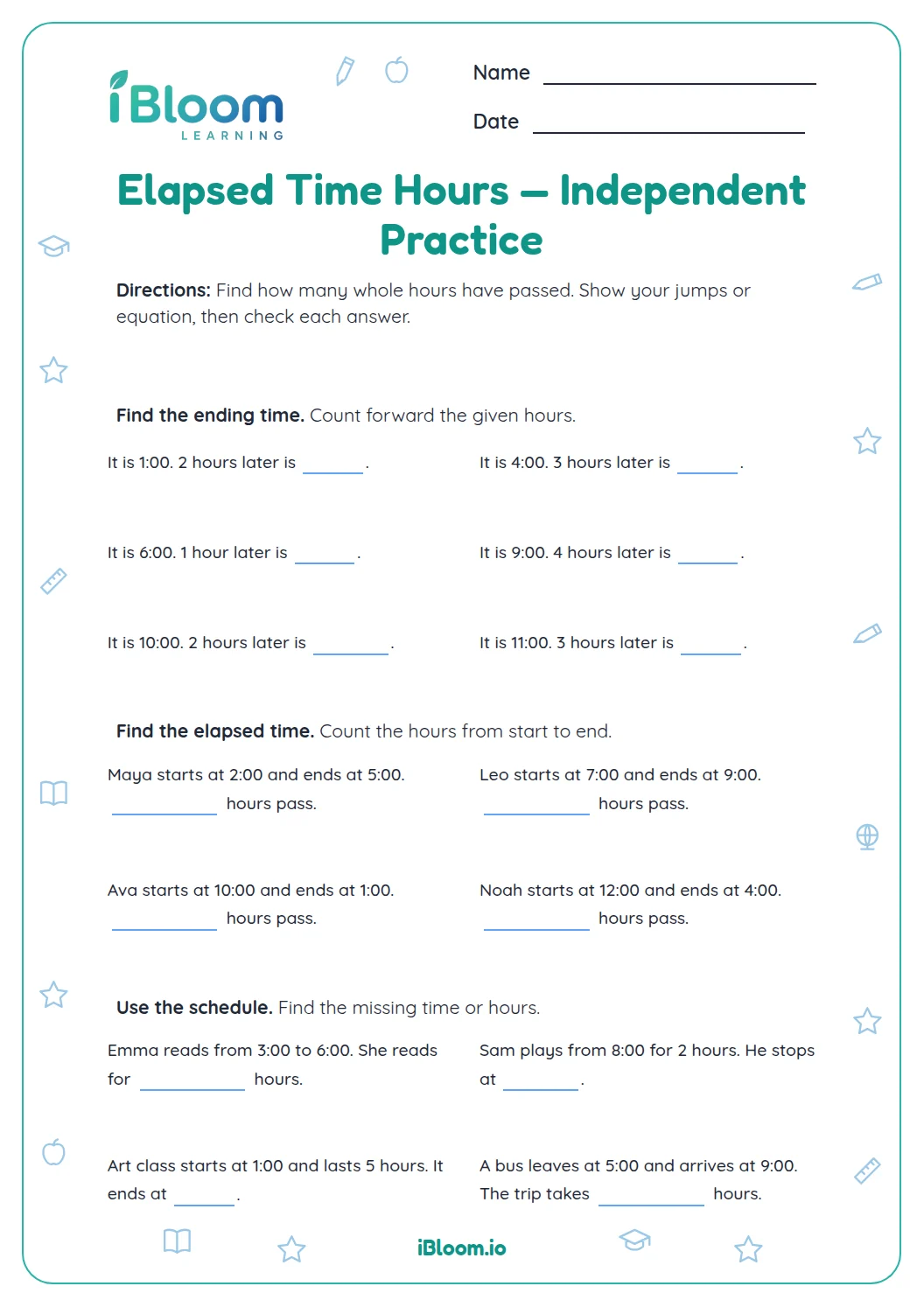
- 4For elapsed-time questions, add or subtract the stated minutes.
- 5Check the hour when a time change passes :00.
- 6Use the separate key to review each answer.
Clock-reading slips to check
The mistake
Counting the 1 on the clock as one minute.
The fix
Each number step is five minutes: 1 means :05, 2 means :10.
The mistake
Calling the next hour before the short hand reaches it.
The fix
Use the hour the short hand has already passed.
The mistake
Moving minutes backward for an after question.
The fix
Add minutes for after and subtract for before.
Common Core alignment
The clock-reading questions give practice with this Common Core standard.
Read analog clocks and write times to five-minute intervals.
On this sheet: Questions practice reading analog clocks and writing times to five-minute intervals.
Show the official wordingHide the official wording
Tell and write time from analog and digital clocks to the nearest five minutes, using a.m. and p.m.
What to practice next
Make more practice
Further reading
Questions parents and teachers ask
How do you count minutes on an analog clock?
This printable includes fourteen questions across the worksheet, followed by a separate answer key. Learners can complete each item independently, then use the key to check their work and revisit any response that needs correction before practicing again.
How many questions are included?
This printable includes fourteen questions across the worksheet, followed by a separate answer key. Learners can complete each item independently, then use the key to check their work and revisit any response that needs correction before practicing again.
What does the short hand show between two numbers?
This printable includes fourteen questions across the worksheet, followed by a separate answer key. Learners can complete each item independently, then use the key to check their work and revisit any response that needs correction before practicing again.
Does the worksheet include an answer key?
This printable includes fourteen questions across the worksheet, followed by a separate answer key. Learners can complete each item independently, then use the key to check their work and revisit any response that needs correction before practicing again.
How can I help with a time-change problem?
This printable includes fourteen questions across the worksheet, followed by a separate answer key. Learners can complete each item independently, then use the key to check their work and revisit any response that needs correction before practicing again.