






About this worksheet
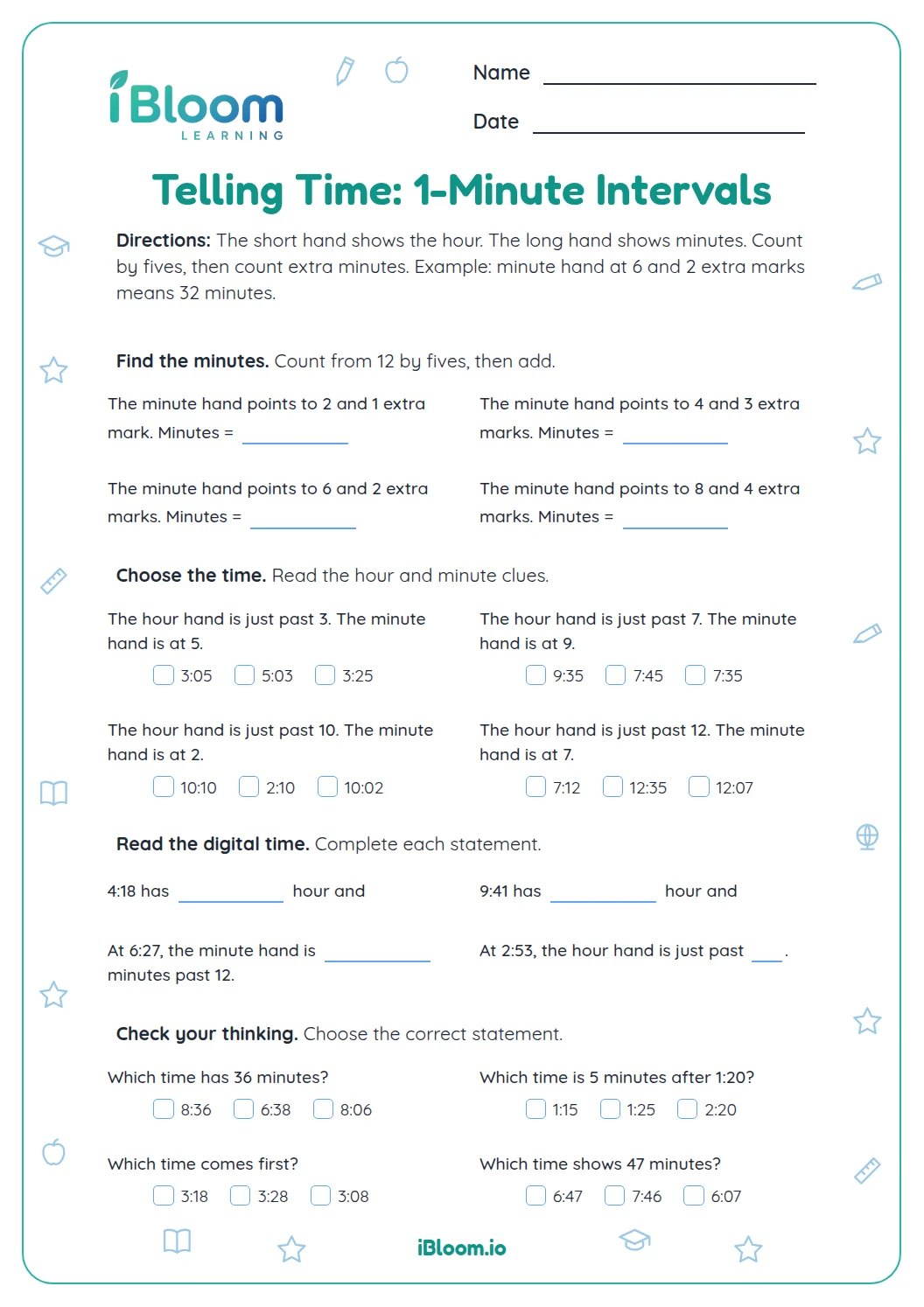
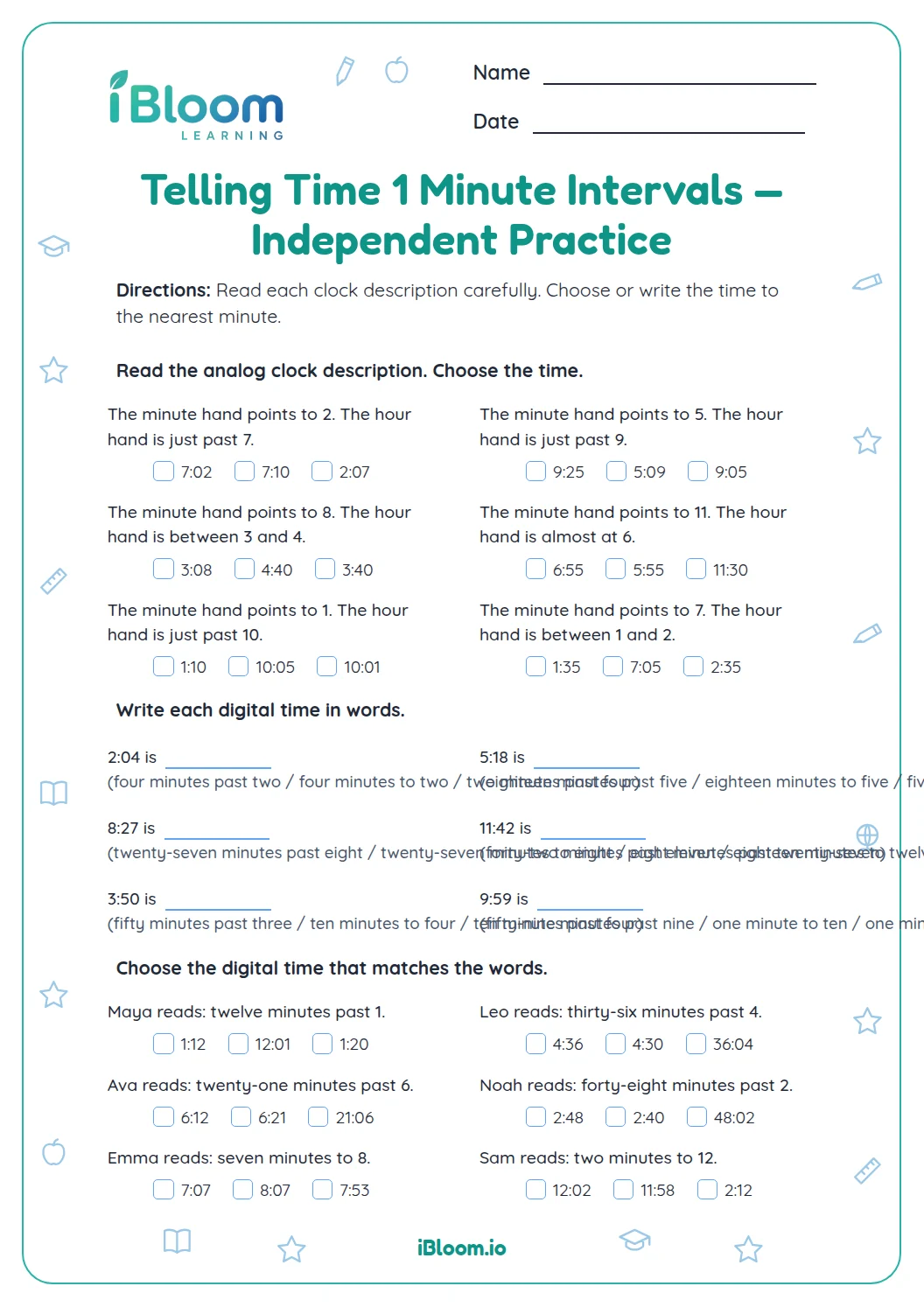
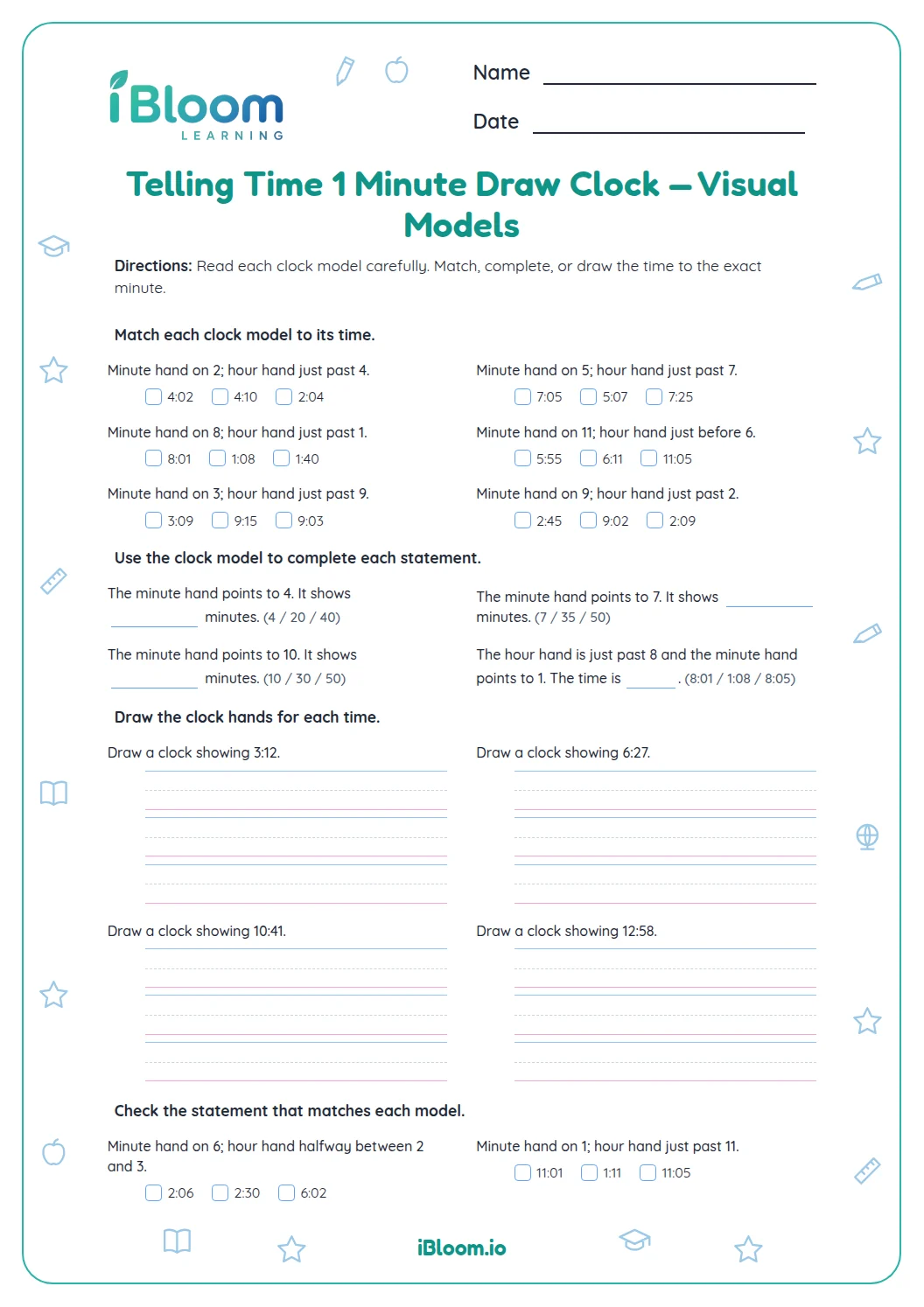
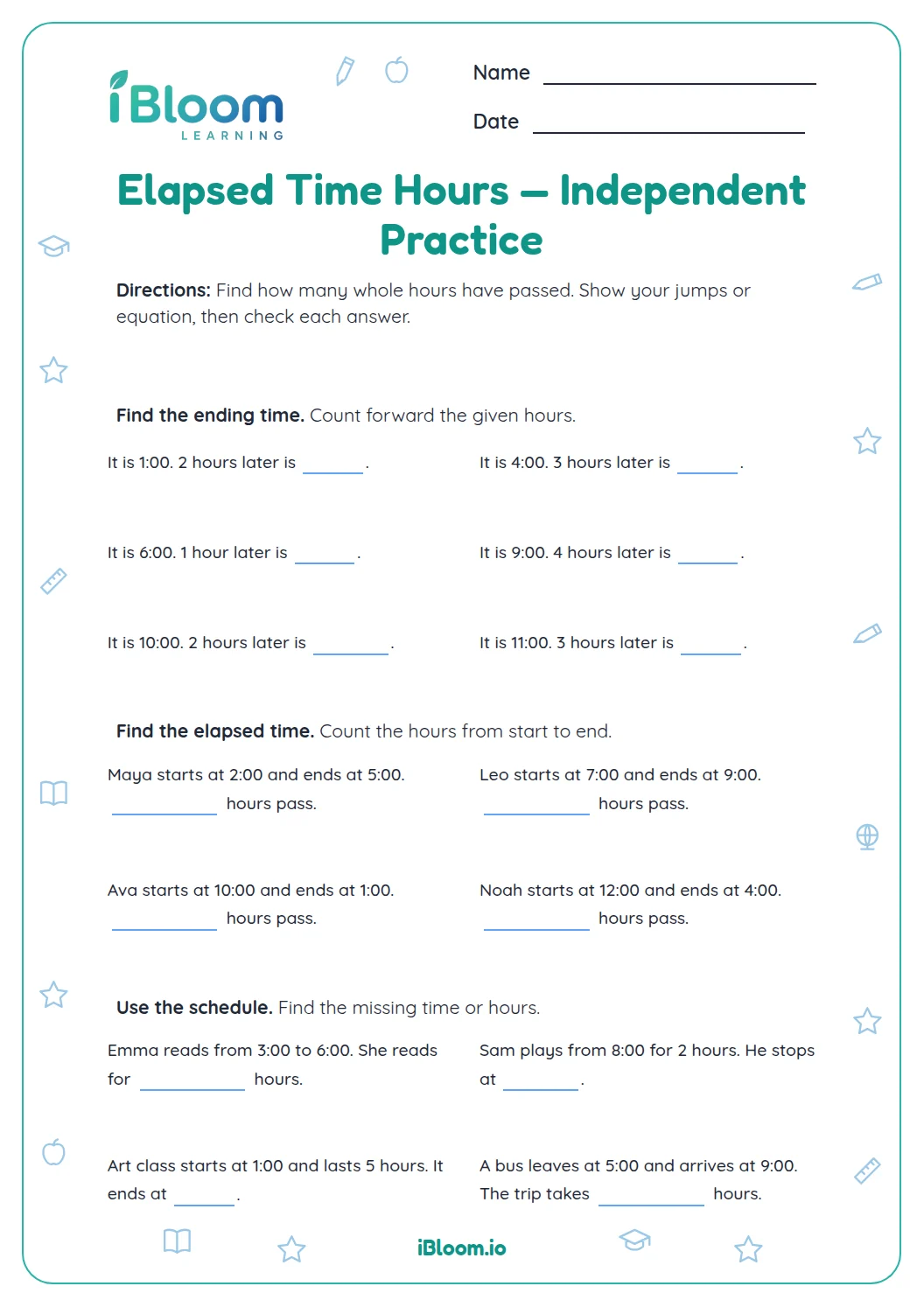
This Grade 2 time worksheet gives children focused practice reading analog clocks one minute at a time. Students read four clock faces, then solve ten questions about minute counts and one-minute changes. The answer key makes each time easy to check. The page practices reading clocks to the nearest minute and solving time problems in minutes.
Aligned to 3.MD.A.1
How do you read a clock to the exact minute?
Start with the short hand. It tells which hour has begun. Then count the marks from 12 to the long hand; each small mark adds one minute. The minute hand may point between the five-minute numbers, so count the small marks rather than rounding.
For question 1, the short hand has passed 2 and the long hand points to 14. Together those hands show 2:14.
- 1Short hand: after 2
- 2Long hand: 14 minutes after 12
- 3Time: 2:14
How can you check a digital time against an analog clock?
Read the analog clock first, then compare both parts of the time. In question 2, the clock shows 4 hours and 35 minutes, so write 4:35. Include a zero when the minute count is below 10.
What changes when one minute passes?
The hour usually stays the same as the minute count increases by one. At the end of an hour, the hour changes too: one minute after 11:59 is 12:00. Question 11 is a good reminder to move through the hour boundary instead of stopping at 11:60.
How should we use the answer key?
Ask your child to explain one clock by naming both hands. For a missed answer, locate the hour first and recount the minute marks from 12. The key supports a quick check; the clock face gives the reason for the answer.
How to use this worksheet
- 1Point to the short hand and say the hour it has passed.
- 2Count each small mark from 12 to the long hand.
- 3Write the time with a colon, including a zero before a one-digit minute.
- 4For a matching question, compare both the hour and minute numbers.
- 5For “one minute before” or “after,” change the minute by one and check whether the hour changes.
Common mistakes and quick fixes
The mistake
Reading the short hand as the minutes.
The fix
Name the short hand as the hour hand before counting the long hand.
The mistake
Counting each number on the clock as one minute.
The fix
The large numbers mark groups of five minutes; count the small marks for an exact minute.
The mistake
Writing 12:00 after 11:59 as 11:60.
The fix
After 59 minutes, the next minute starts a new hour.
Curriculum alignment
The listed Common Core standard connects to reading and writing clock times on this page.
Read clock times to the minute and find one-minute changes.
On this sheet: Questions use analog clock reading, digital notation, and minute changes, including a p.m. time.
Show the official wordingHide the official wording
Tell and write time to the nearest minute and measure time intervals in minutes. Solve word problems involving addition and subtraction of time intervals in minutes, e.g., by representing the problem on a number line diagram.
What to practice next
Make more practice
Further reading
Questions parents and teachers ask
What does the long hand show?
The long hand shows the minutes after the hour. Start at 12 and count each small mark until you reach it. For example, in question 1 the long hand points to 14, so the minute part is 14. The short hand tells which hour has begun.
Why does the hour hand sit between numbers?
The hour hand moves gradually as minutes pass. At 2:14 it is just beyond 2, but not yet at 3. Read the hour it has passed, then use the long hand for the exact minute count. This keeps the two hand roles clear.
How do I write a time with fewer than ten minutes?
Use a zero in the minute place. Question 4 shows six minutes after 10, written as 10:06. The zero keeps the minutes in the correct two-digit place and makes the time clear. Say the time aloud as ten oh six to keep the minute place clear.
Why does the hour change after 11:59?
A clock has 60 minutes in each hour. After the 59th minute comes the next hour, so one minute after 11:59 is 12:00. The minute hand returns to 12 while the short hand moves to the next hour. This rollover is the same pattern at the end of any hour. The minute hand completes its turn as the hour hand moves forward.
Can a child use the five-minute numbers to read these clocks?
The five-minute numbers are useful checkpoints, but exact-minute questions also need the small marks between them. For 2:14, count to 10 at the 2, then four more small marks. That gives 14 minutes. Each small mark between numbered marks stands for one minute. Counting each mark keeps a time such as 2:14 exact.
What should we practice next?
After reading exact-minute clocks, try the Telling Time 5 Minute Intervals page to build quick counting by fives. The draw-clock page offers a next step: place both hands to show a written time. The answer key also points to the related draw-clock practice. The next page practices setting hands for a time you can read here.