




About this worksheet
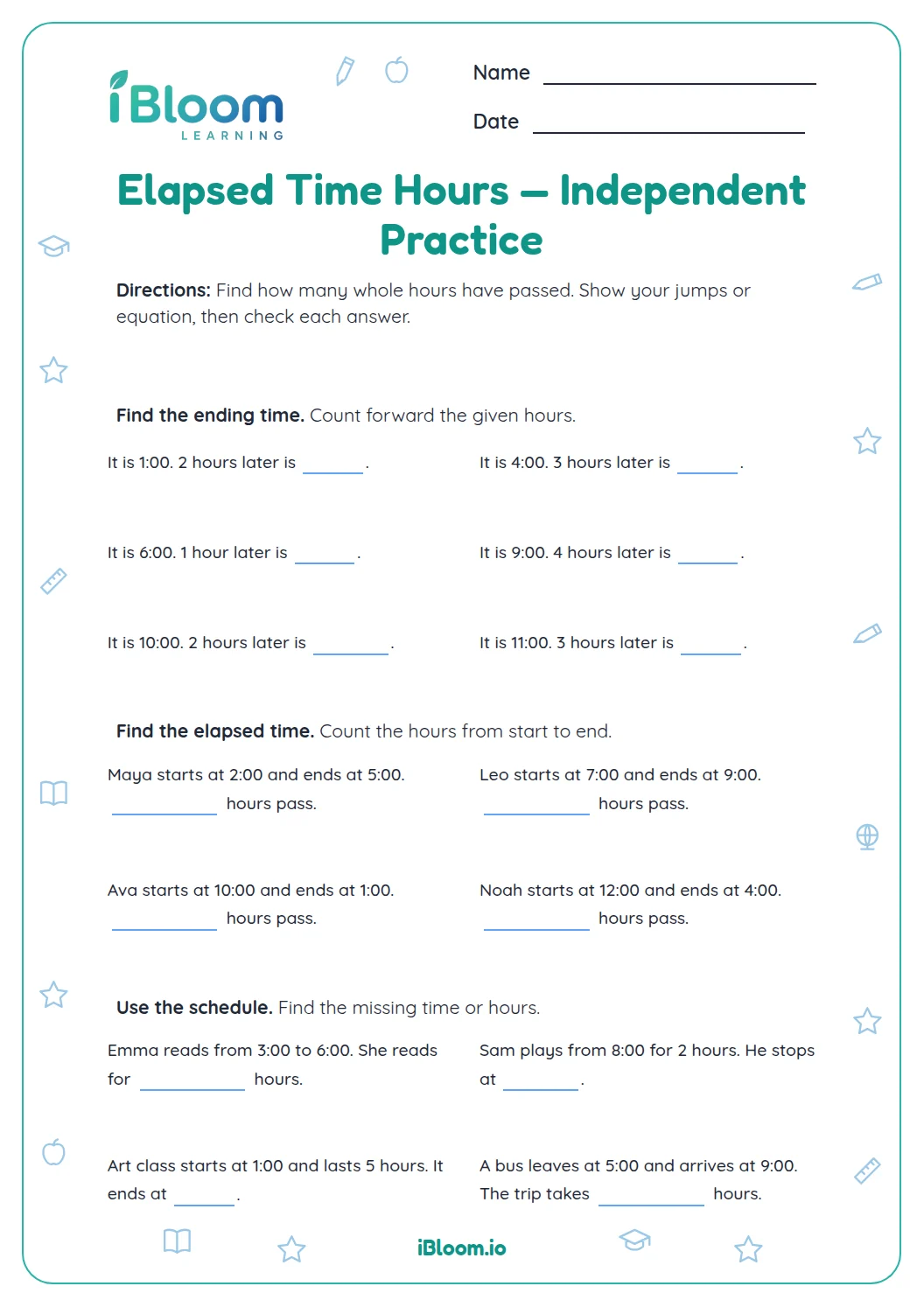
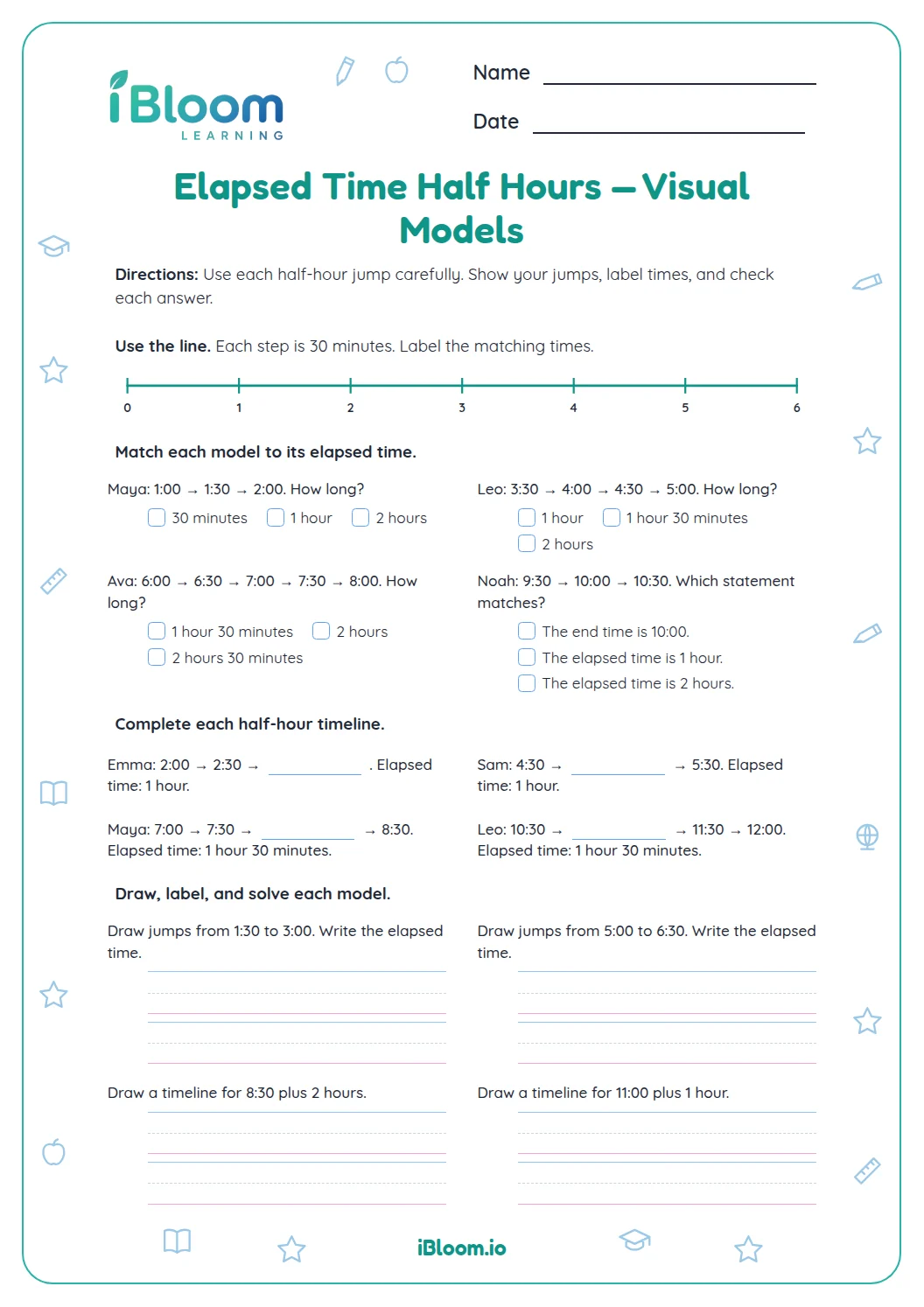
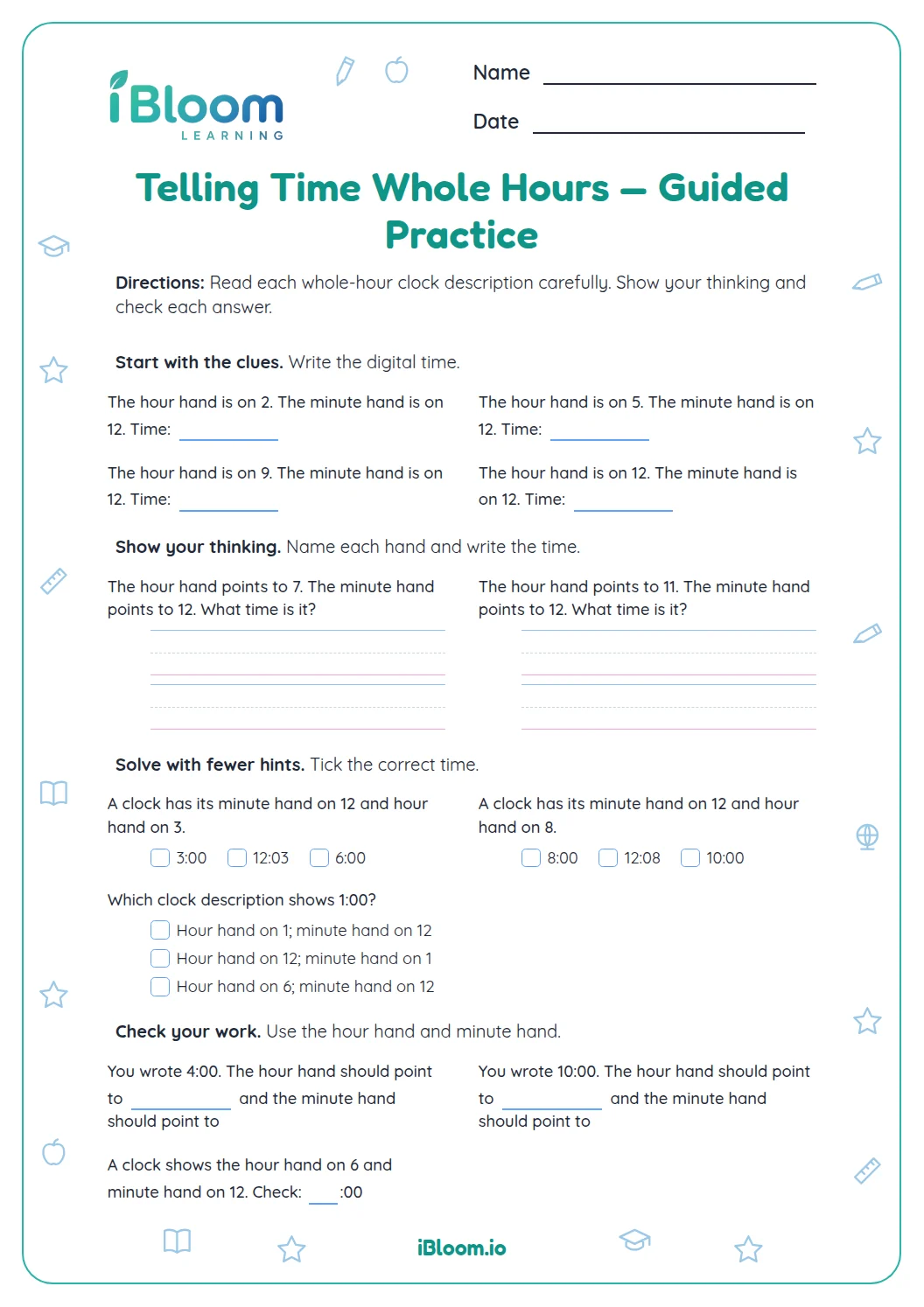
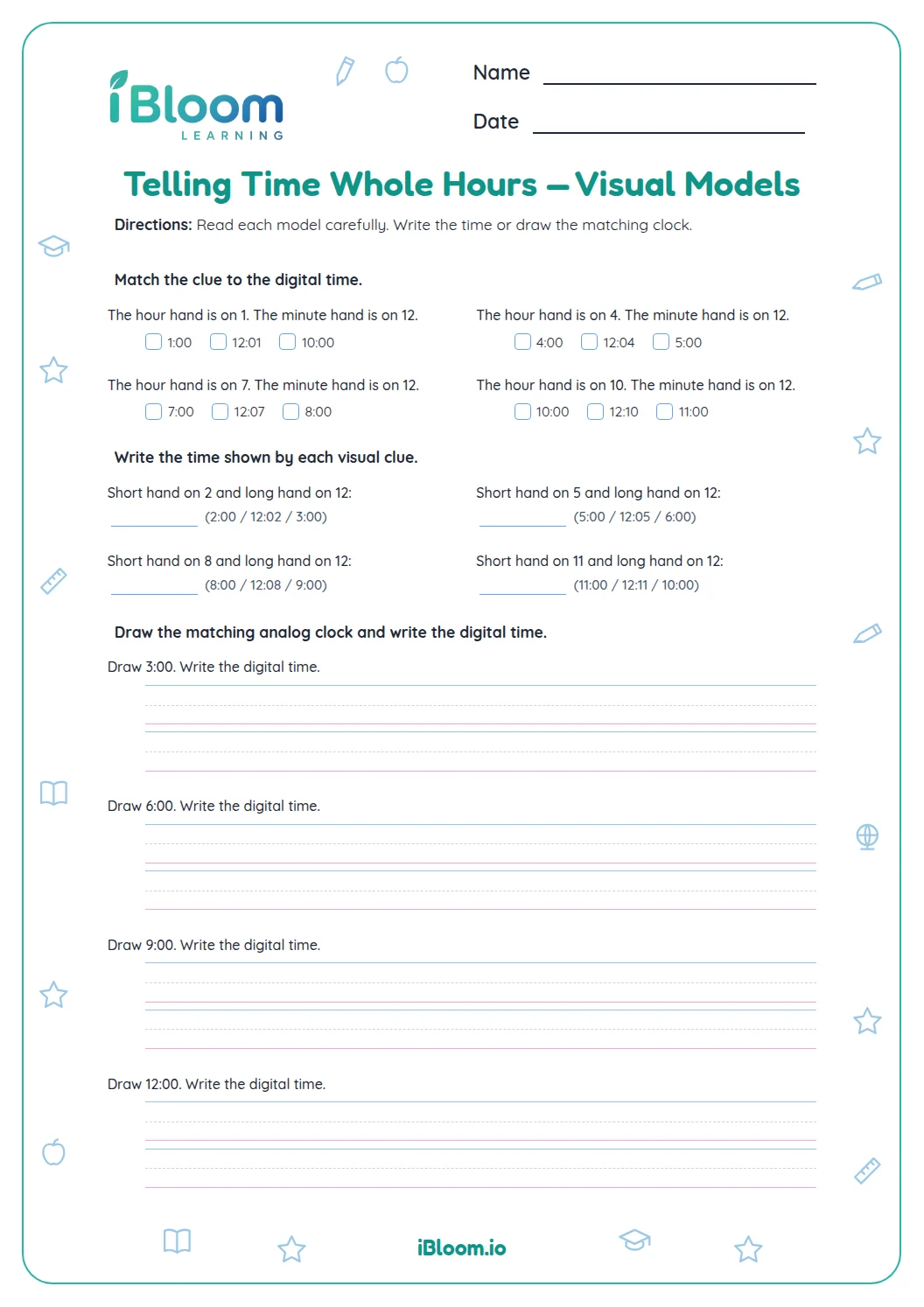
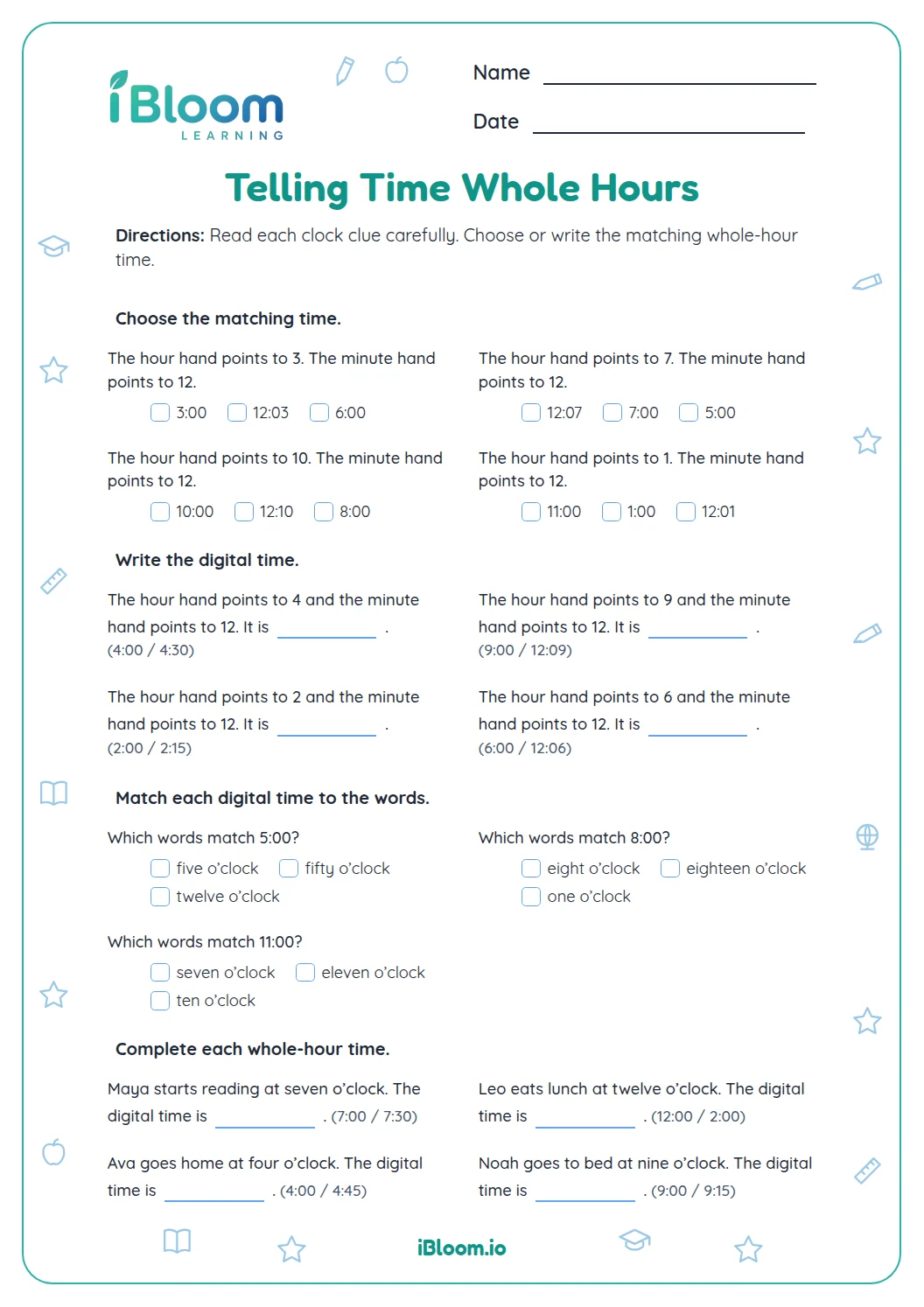
Four clock pictures ask for whole-hour readings. Ten short questions then practice elapsed time by counting whole-hour jumps. This title explicitly names a Grade 3 skill; the intervals remain simple and unambiguous.
Aligned to 3.MD.A.1
How do you read each starting clock?
Four clock pictures ask for whole-hour readings. Ten short questions then practice elapsed time by counting whole-hour jumps. This title explicitly names a Grade 3 skill; the intervals remain simple and unambiguous.
- Check that the minute hand points to 12.
- Read the number indicated by the hour hand.
How do you count hours across 12?
Four clock pictures ask for whole-hour readings. Ten short questions then practice elapsed time by counting whole-hour jumps. This title explicitly names a Grade 3 skill; the intervals remain simple and unambiguous.
- Say each next hour aloud.
- Count jumps, not the time labels.
How can you check an elapsed-time answer?
Four clock pictures ask for whole-hour readings. Ten short questions then practice elapsed time by counting whole-hour jumps. This title explicitly names a Grade 3 skill; the intervals remain simple and unambiguous.
- Use the same number of jumps in reverse.
How to use this worksheet
- 1Read the hour hand on the analog clock.
- 2Write the starting time as an hour and :00.
- 3For an interval, count each next hour until the end time.
- 4Keep counting after 12 when the interval crosses it.
- 5Count the jumps and label the answer in hours.
Common mistakes and quick fixes
The mistake
Counting the starting time as one elapsed hour.
The fix
Begin counting with the next hour; each move is one jump.
The mistake
Stopping at 12 during a crossing interval.
The fix
Continue with 1:00 after 12:00.
The mistake
Writing the ending time instead of the duration.
The fix
Count the hour jumps and give how many hours passed.
Curriculum alignment
The 16 questions now match the directions: eight whole-hour clock readings followed by eight whole-hour elapsed-time intervals. The title explicitly names elapsed time, a Grade 3 skill; this page keeps it to simple whole-hour jumps.
Tell and write time to the nearest minute and measure time intervals in minutes.
On this sheet: This title explicitly practices elapsed time; all intervals use whole-hour jumps.
Show the official wordingHide the official wording
Tell and write time to the nearest minute and measure time intervals in minutes. Solve word problems involving addition and subtraction of time intervals in minutes, e.g., by representing the problem on a number line diagram.
What to practice next
Make more practice
Questions parents and teachers ask
What does elapsed time mean?
This printable includes fourteen questions across the worksheet, followed by a separate answer key. Learners can complete each item independently, then use the key to check their work and revisit any response that needs correction before practicing again.
Why does the worksheet show clocks first?
This printable includes fourteen questions across the worksheet, followed by a separate answer key. Learners can complete each item independently, then use the key to check their work and revisit any response that needs correction before practicing again.
How should a student count from 10:00 to 2:00?
This printable includes fourteen questions across the worksheet, followed by a separate answer key. Learners can complete each item independently, then use the key to check their work and revisit any response that needs correction before practicing again.
Are minutes included in these problems?
This printable includes fourteen questions across the worksheet, followed by a separate answer key. Learners can complete each item independently, then use the key to check their work and revisit any response that needs correction before practicing again.
Why count the jumps instead of the clock numbers?
This printable includes fourteen questions across the worksheet, followed by a separate answer key. Learners can complete each item independently, then use the key to check their work and revisit any response that needs correction before practicing again.