







About this worksheet
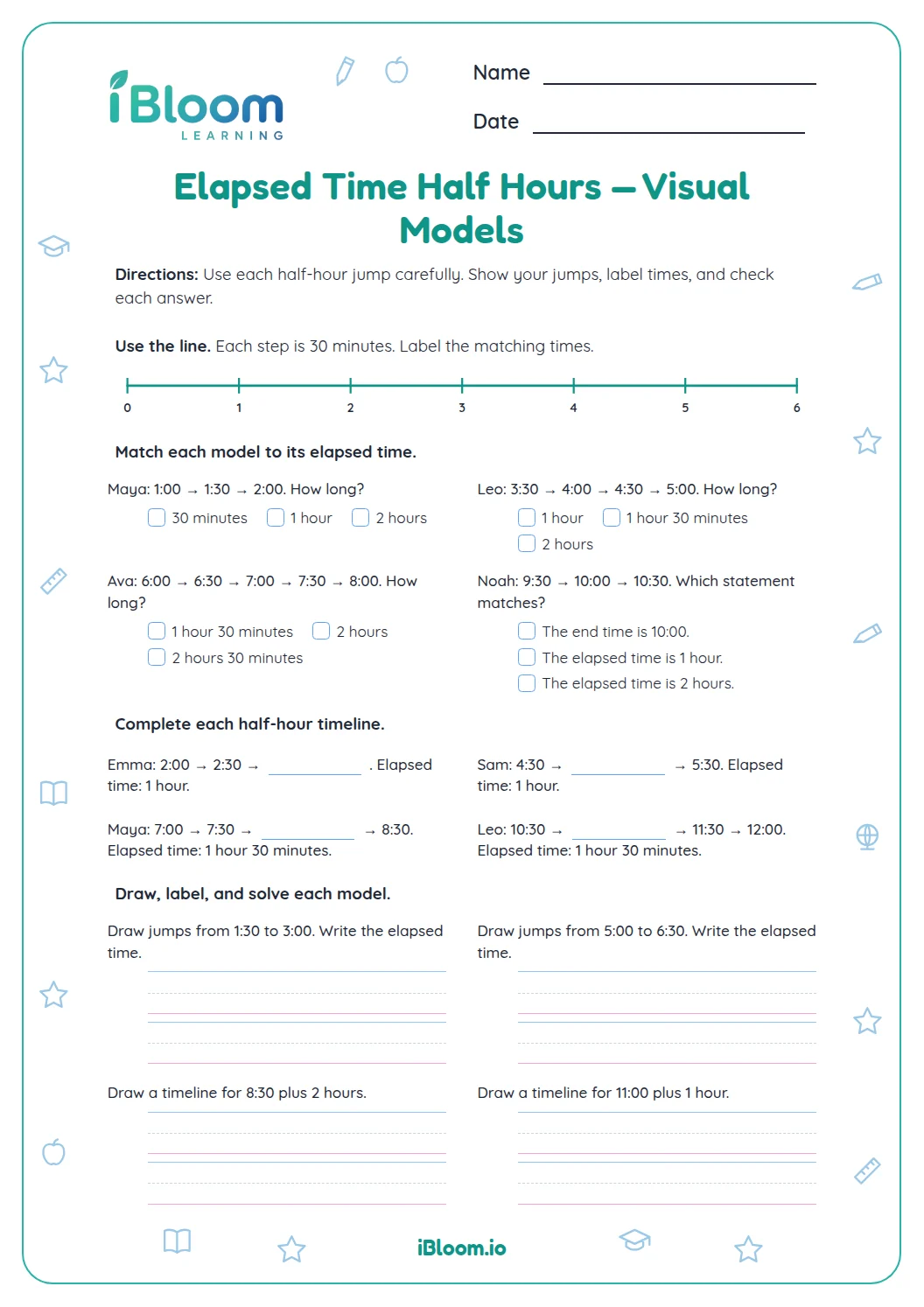
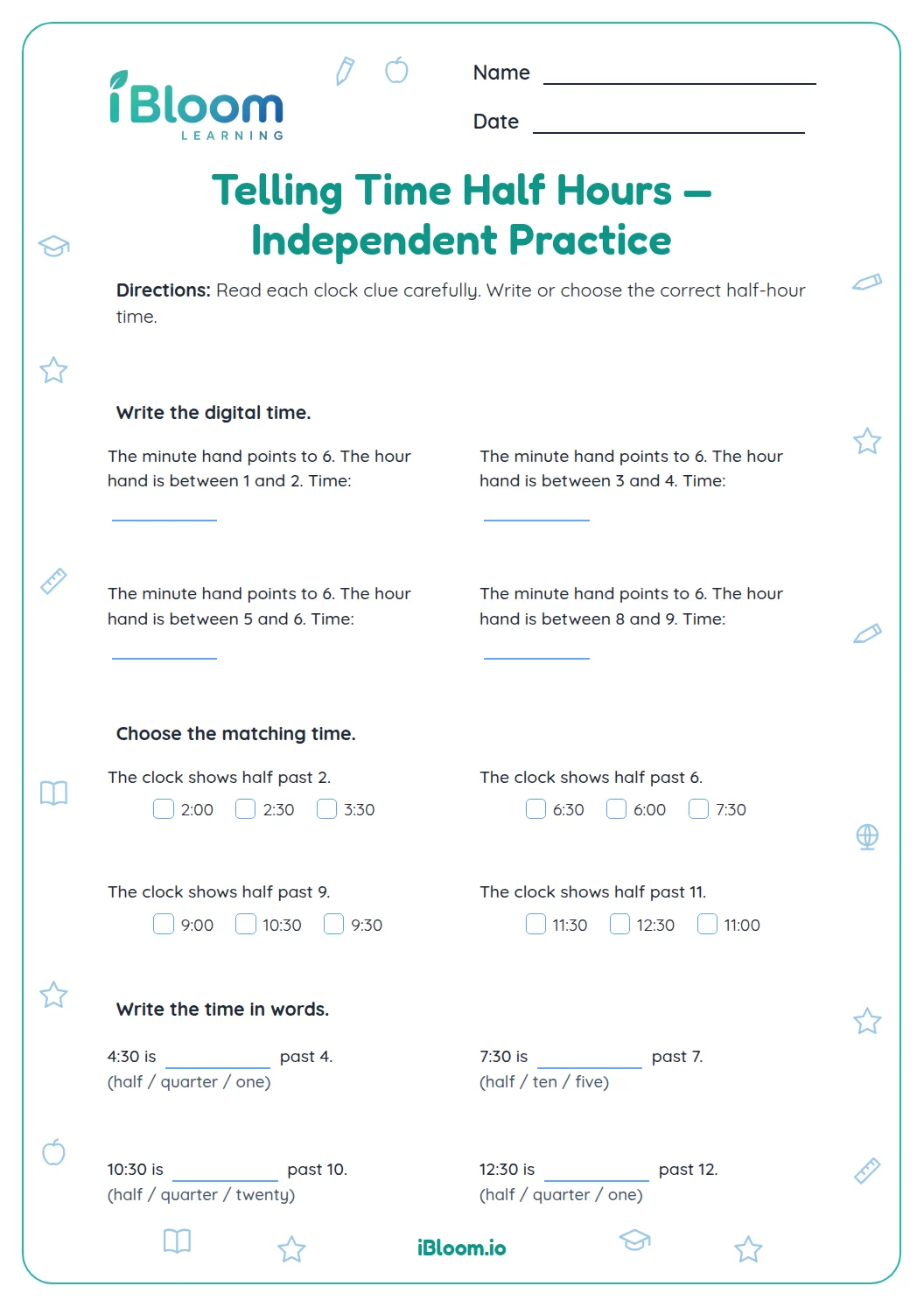
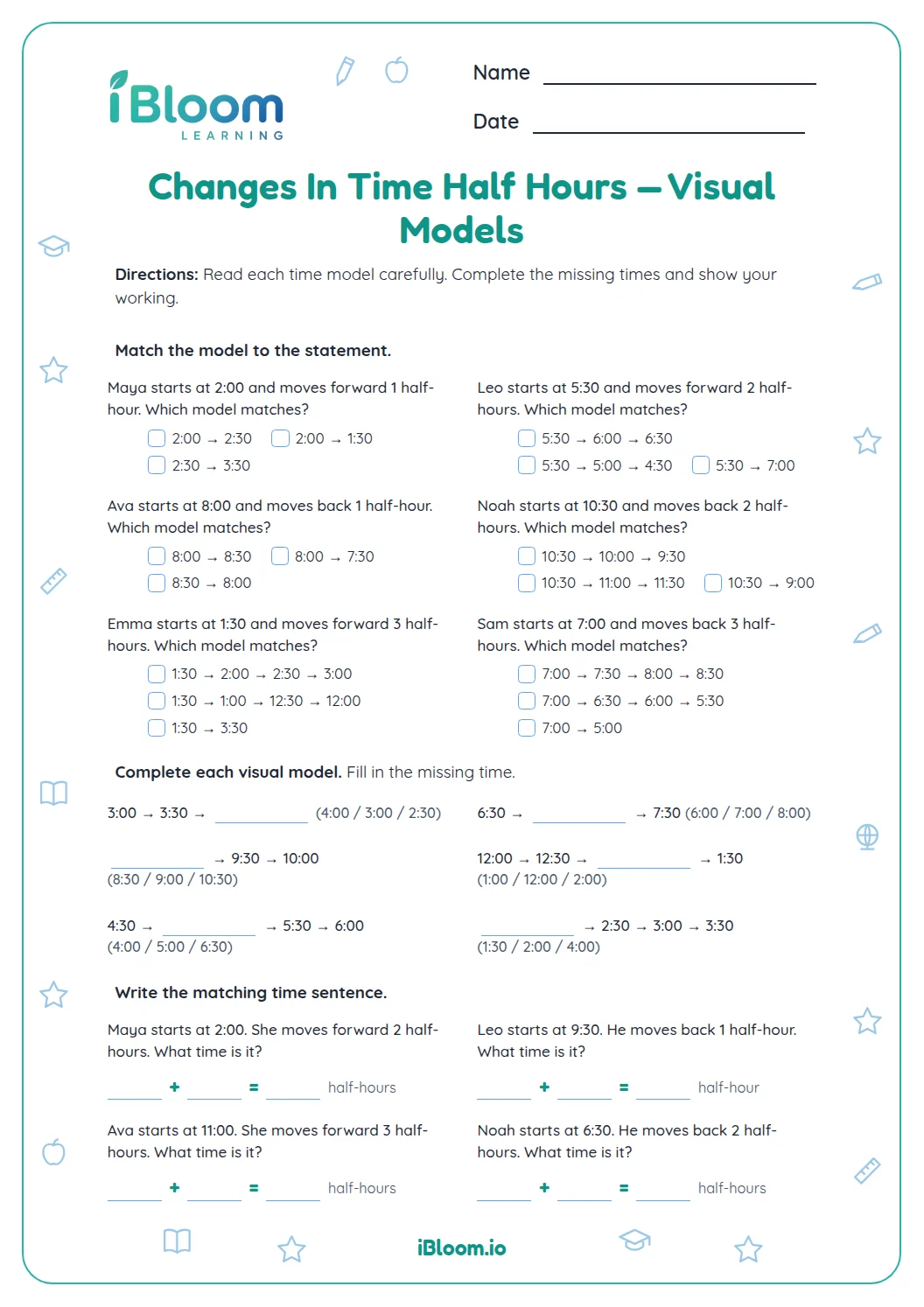
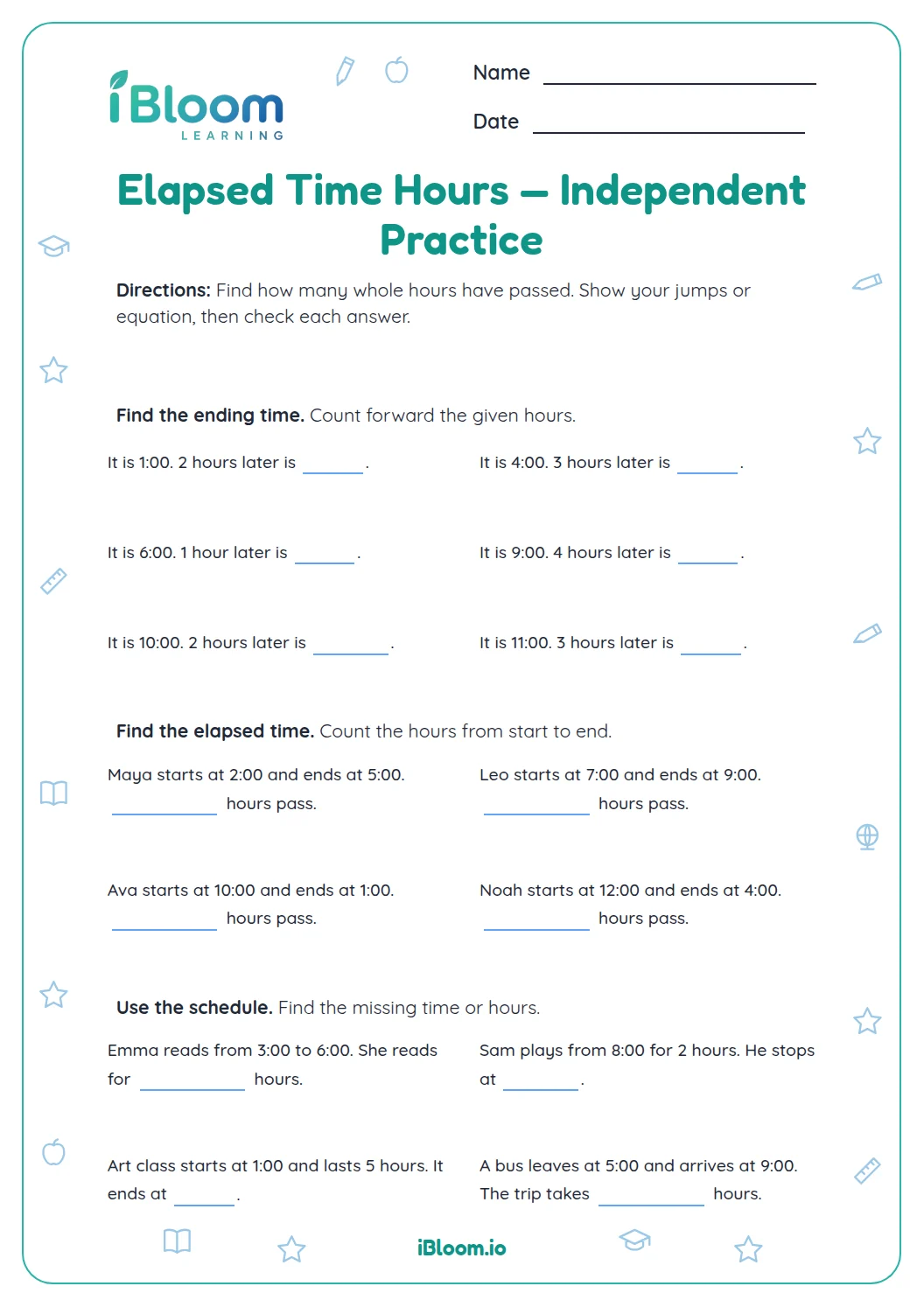
This guided practice worksheet introduces elapsed time through half-hour steps. Children read an analog clock model, find times 30 minutes before or after a shown time, and solve short duration stories using :00 and :30 times. The worksheet pages include 14 questions in two parts and a separate answer key. The situations use one or more half-hour intervals, keeping the arithmetic focused on the clock sequence.
Aligned to 3.MD.A.1
What changes in a half-hour step?
Thirty minutes is half of an hour. Starting at 3:30, moving forward 30 minutes reaches 4:00. The minute hand moves from 6 to 12 as the time crosses the hour.
- 1Start at 2:30
- 2End at 3:00
- 3Elapsed time: 30 minutes
How do you find a duration?
Compare start and end times by counting half-hour steps. From 8:30 to 9:30 is two steps, or one hour. Question 5 asks children to find that duration.
How do you solve a time story?
Identify whether the story gives a start and asks for an end, gives an end and asks for a start, or gives both times and asks for the duration. Then count the half-hour moves and state the answer with the correct unit.
How to use this worksheet
- 1Read the clock hands before moving through time.
- 2For 30 minutes later, count one half-hour step forward.
- 3For 30 minutes earlier, count one step backward.
- 4For a duration, count the half-hour steps between the two times.
- 5Check that the answer gives a time or a length of time, as asked.
Common mistakes and quick fixes
The mistake
Changing the hour without changing the minutes correctly.
The fix
Move from :00 to :30 or from :30 to the next :00.
The mistake
Reporting an end time when asked how long.
The fix
A duration is a length such as 30 minutes or 1 hour.
The mistake
Counting clock numbers as hours when only 30 minutes passed.
The fix
Count each move from :00 to :30 as half an hour.
Common Core alignment
This worksheet practices the following Common Core math skills.
Measure and solve time intervals in minutes using clocks and time steps.
On this sheet: Elapsed time is practiced in 30-minute steps using clocks and short stories.
Show the official wordingHide the official wording
Tell and write time to the nearest minute and measure time intervals in minutes. Solve word problems involving addition and subtraction of time intervals in minutes, e.g., by representing the problem on a number line diagram.
What to practice next
Make more practice
Further reading
Questions parents and teachers ask
What does elapsed time mean?
Elapsed time is how much time passes between a start and an end. This worksheet uses half-hour steps, so children can count one move for 30 minutes or two moves for one hour. Questions ask for start times, end times, and durations.
How can an analog clock show 30 minutes?
An analog clock shows 30 minutes when the minute hand points to 6, and it shows :00 when the hand points to 12. Read the hour hand too, especially when a time moves across an hour number. Question 1 gives clock-reading practice before the time-change questions.
How do I find the duration from 8:30 to 9:30?
Count from 8:30 to 9:00, then from 9:00 to 9:30. Those two half-hour steps make one hour. Question 5 asks children to apply this same elapsed-time reasoning to a bus ride with a start and arrival time, and to name the duration clearly.
Are the questions about times before as well as after?
Yes. One story gives an end time and asks for the start time. Other questions move forward from a start or give both times and ask for the duration, so children practice reading the direction of the change and naming the requested time or length.
Is an answer key included?
Yes. A separate answer key gives each clock time or duration. Clock answers use hour-and-minute notation such as 4:00, while duration answers include minutes or hours so the requested quantity is clear and an adult can check the time steps shown in the child’s work.