





About this worksheet
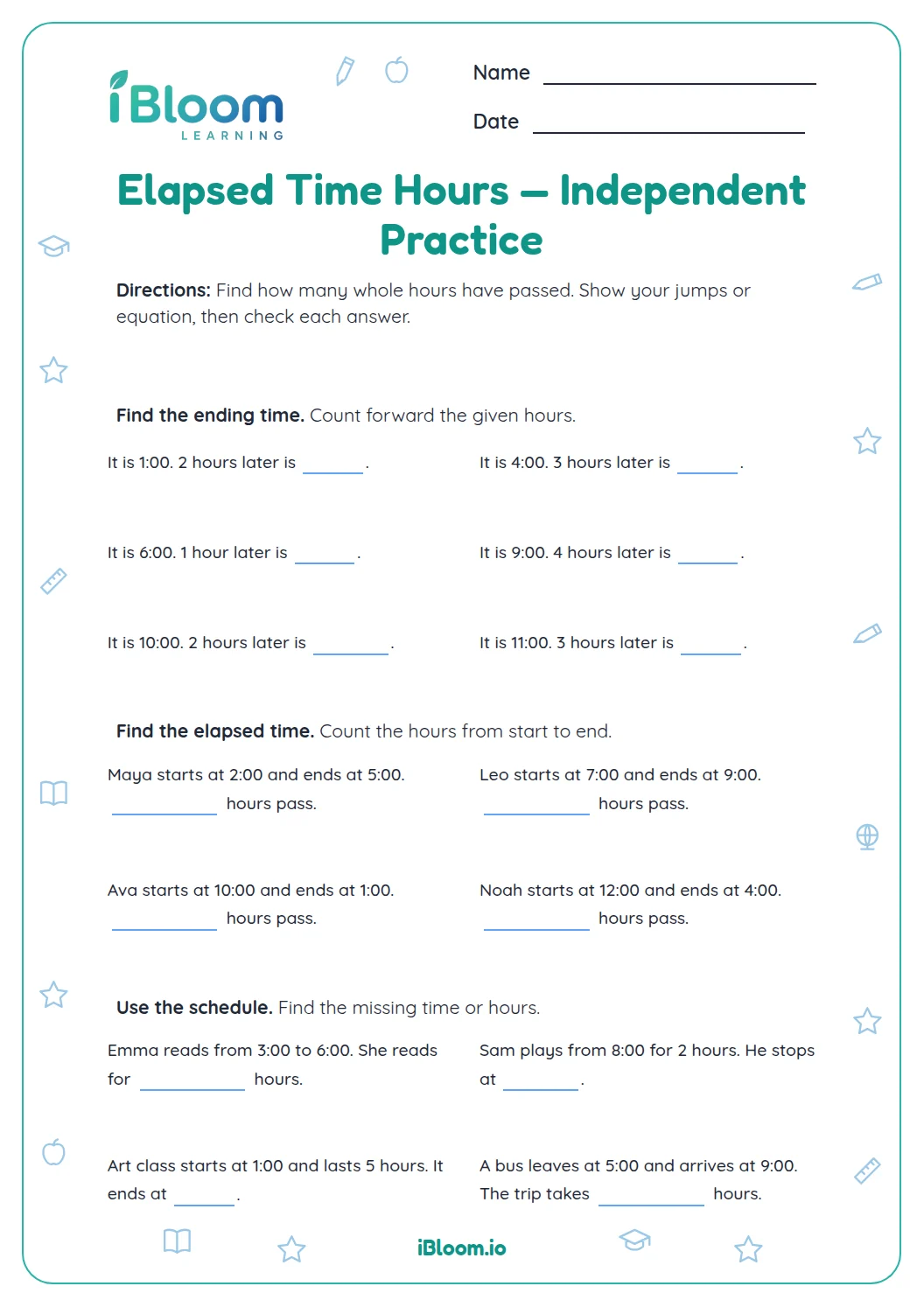
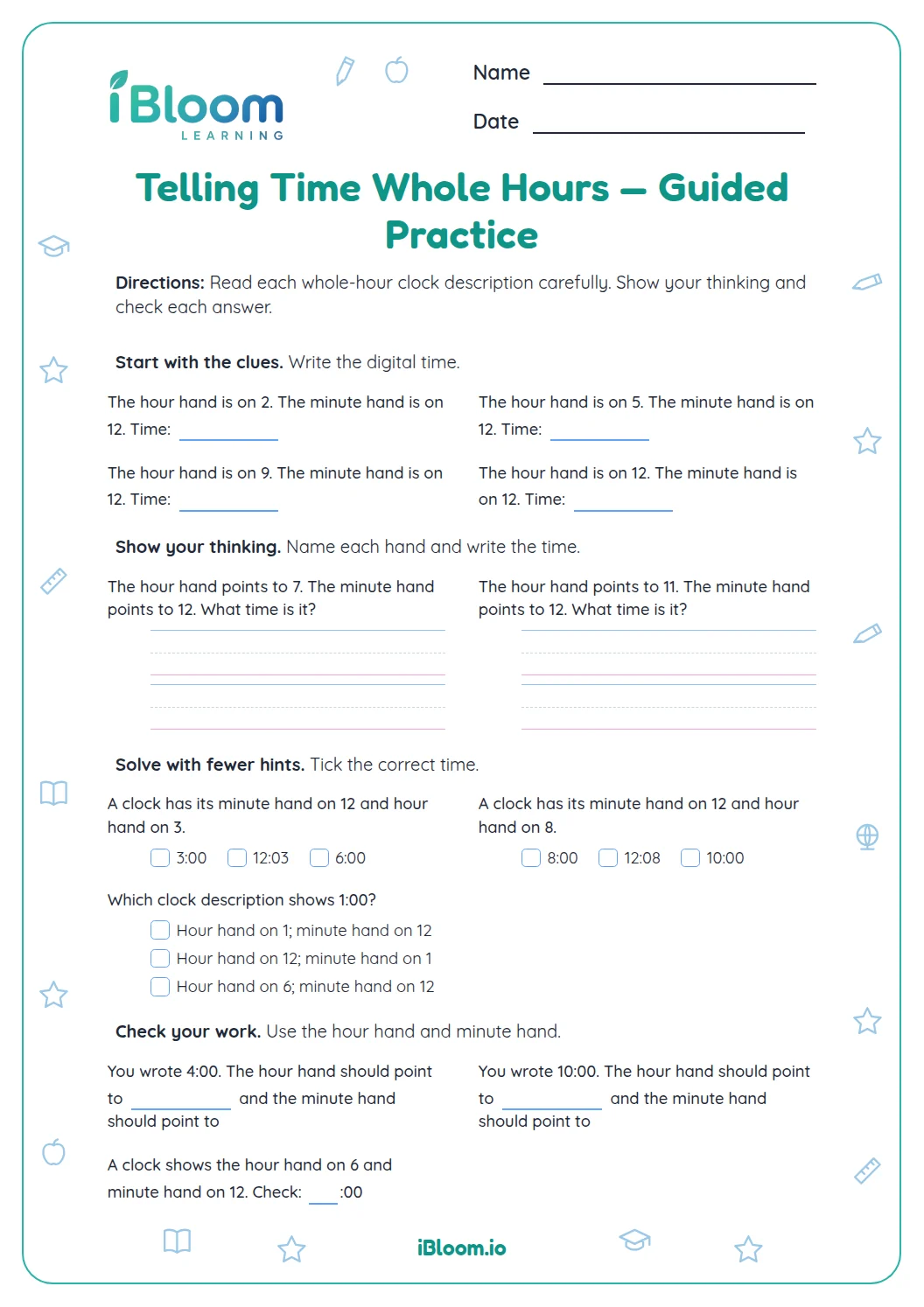
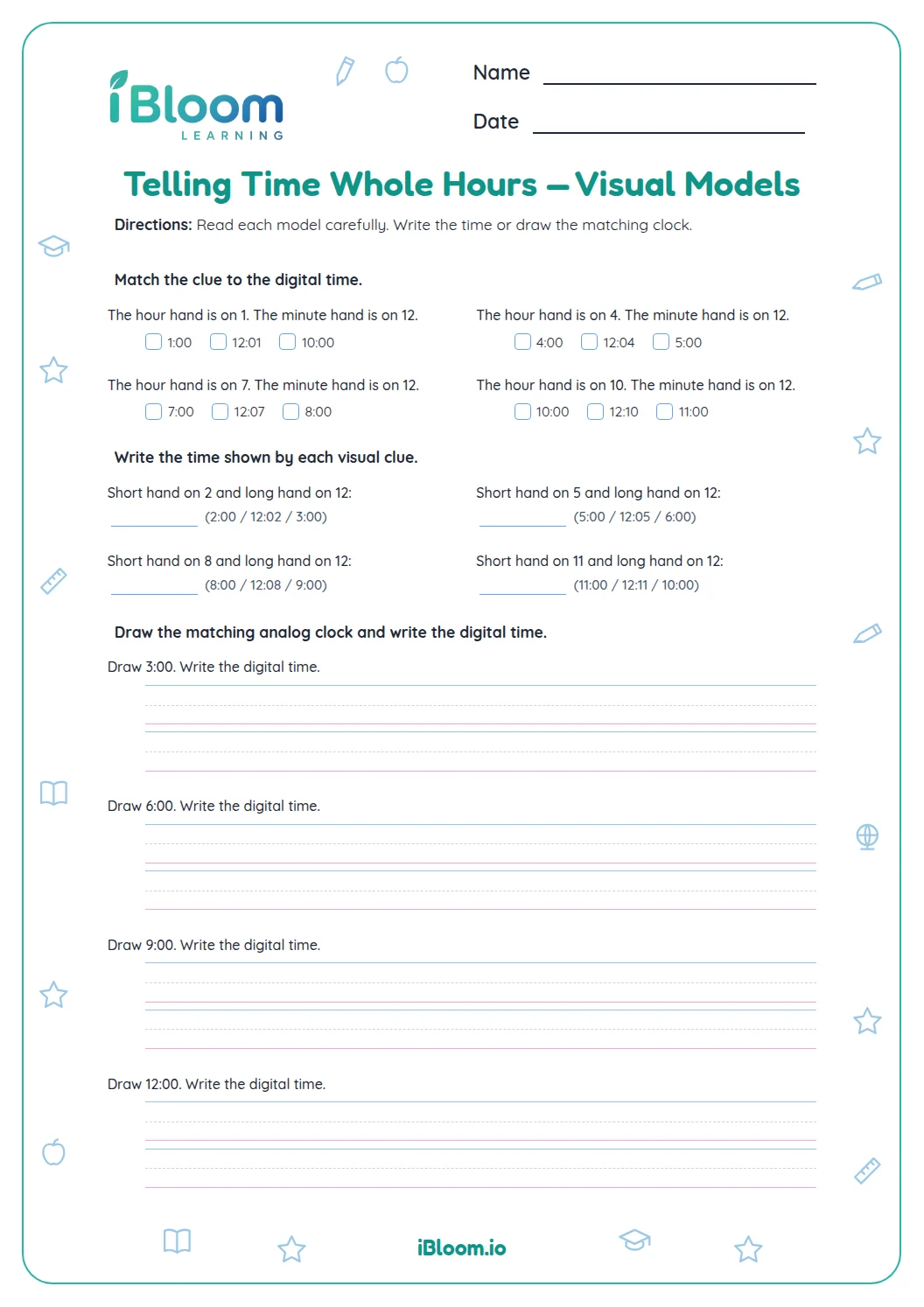
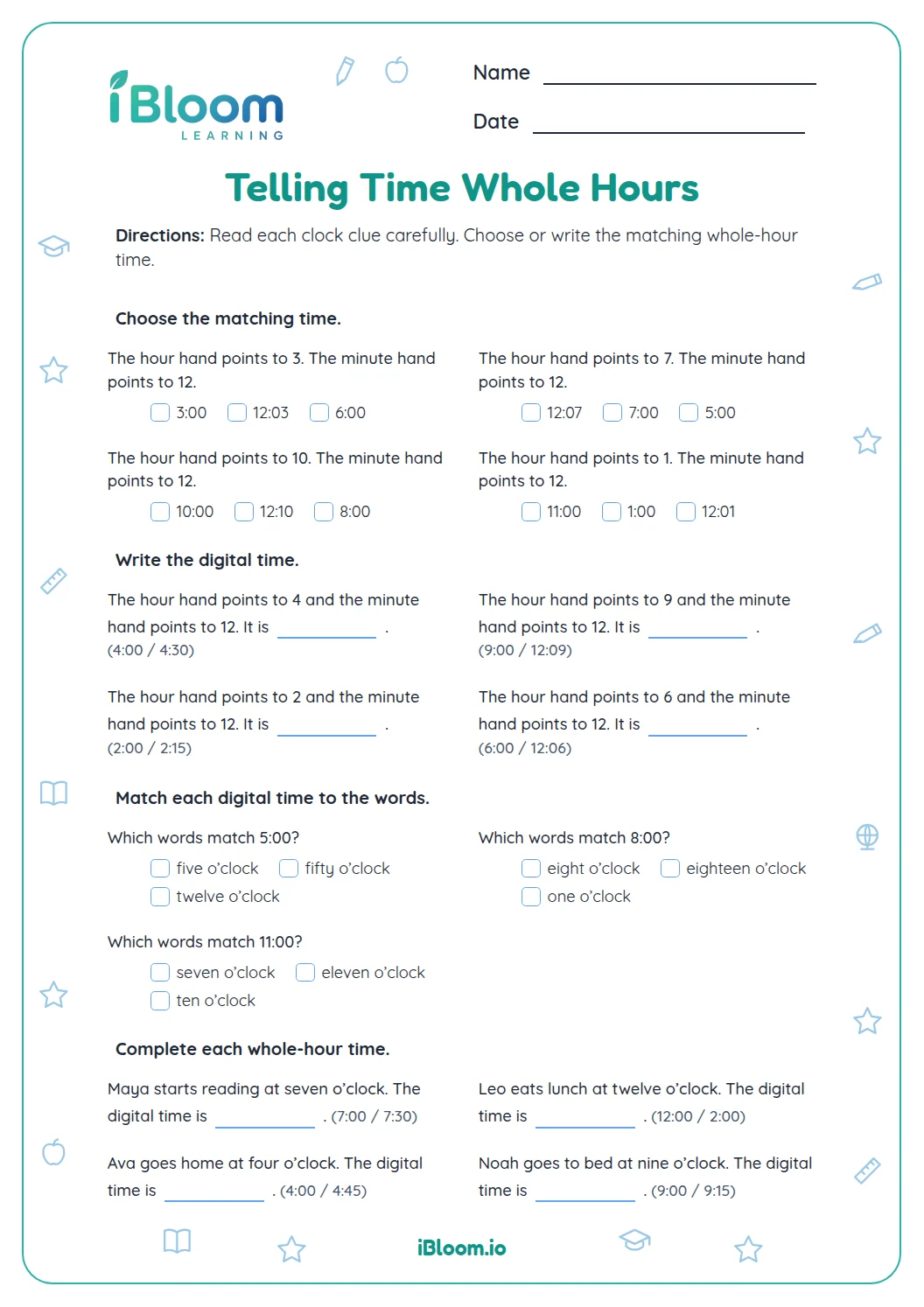
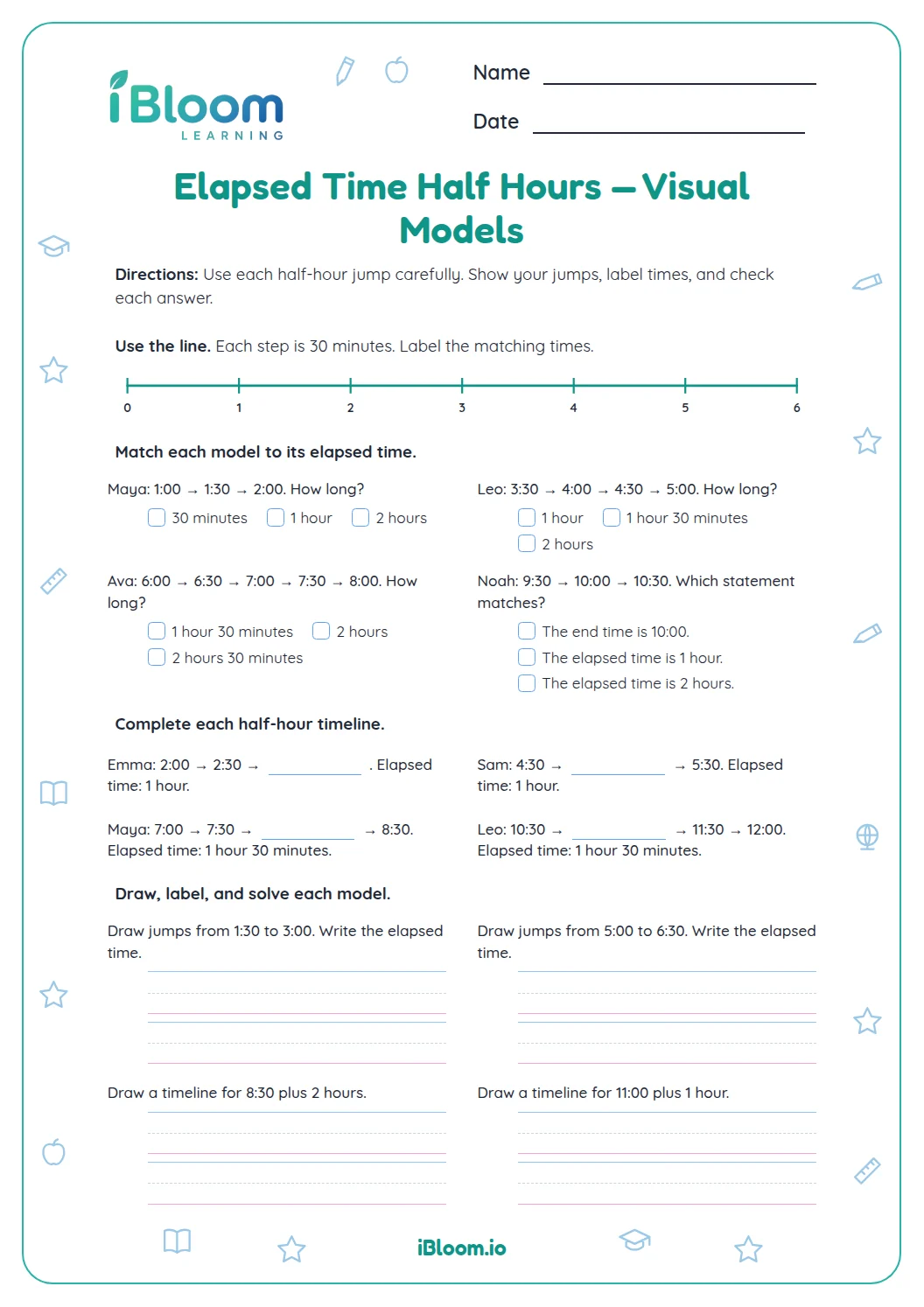
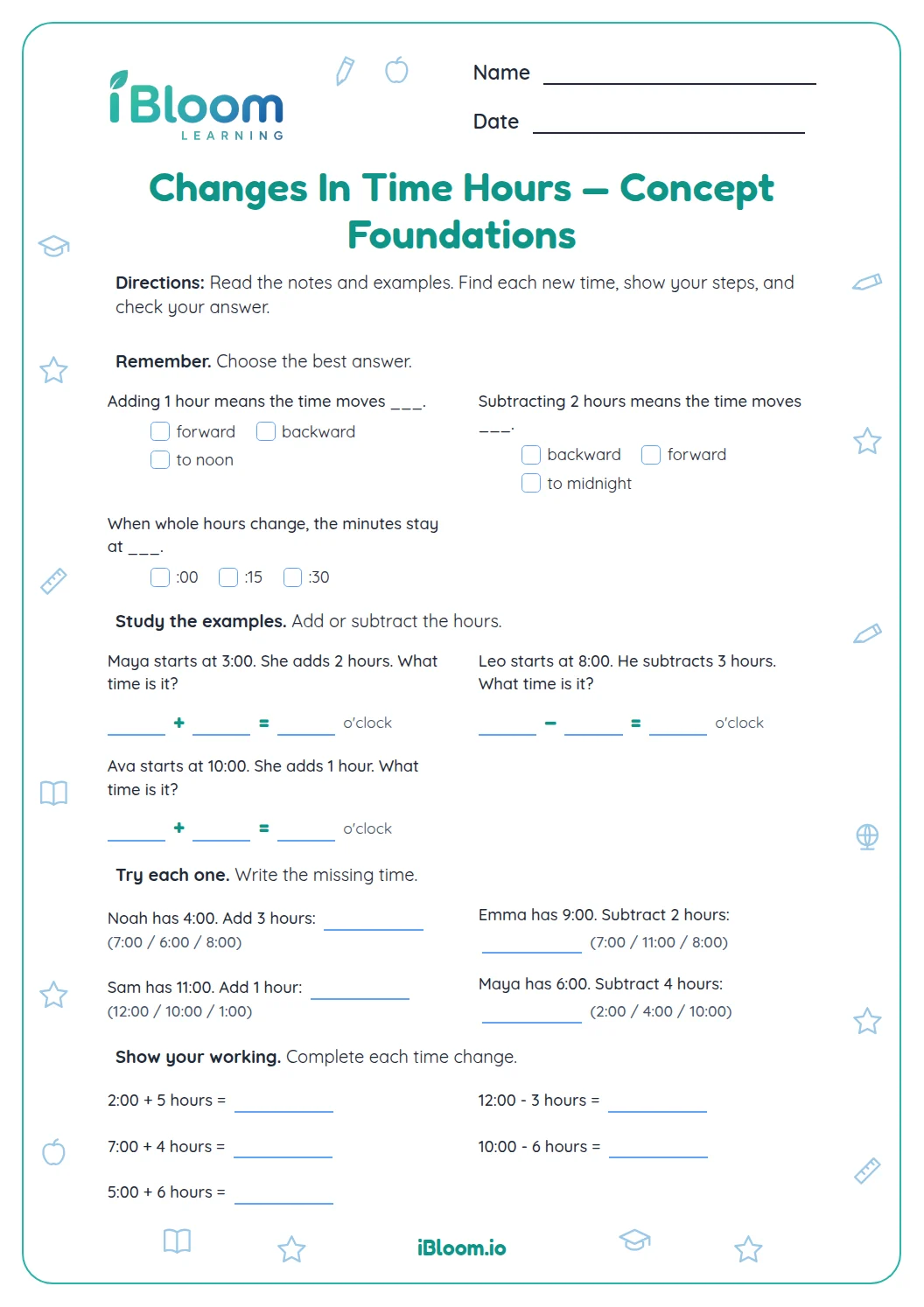
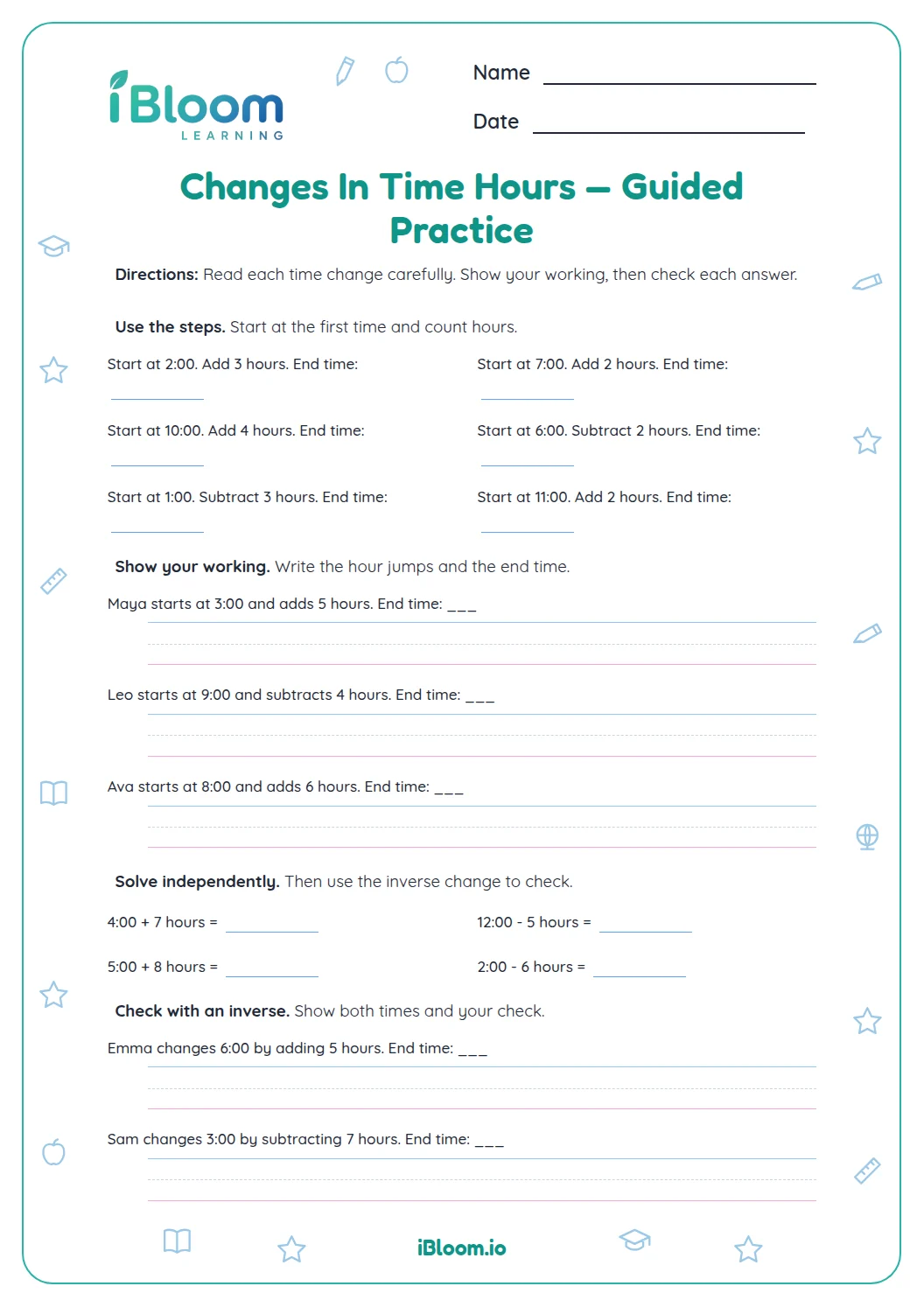
This Grade 2 printable gives students practice reading exact-hour clocks and finding changes in time by whole hours. Students count forward and backward, solve short schedule problems, and find a start time or duration when the ending time is known. The clock-reading items practice telling time from analog faces; the separate answer key shows the clock times and elapsed-hour answers.
Aligned to 2.MD.C.7
How do you read the clock before counting?
Read the short hand for the hour and check that the long hand points to 12 for an exact hour. The clock faces in this part show 2:00 and 5:00.
- 1A clock showing 5:00 is one hour before 6:00.
How do you find an ending time?
Keep the number of hours as equal jumps. From 9:00, count 10:00, 11:00, then 12:00: three jumps, so the elapsed time is three hours.
How do you work backward from an end time?
If the ending time is known, count backward by the duration. An activity that ends at 4:00 after two hours began at 2:00.
How to use this worksheet
- 1Read the clock or story for the known time.
- 2Mark whether the question asks for a start, finish, or duration.
- 3Count one step for each hour; do not skip the hour after 12.
- 4For a known end time, count backward.
- 5Write the time with minutes shown as :00.
Common mistakes and quick fixes
The mistake
Adding the duration when the problem asks when an event started.
The fix
Circle the word “after” or “ends,” then decide which direction to count.
The mistake
Counting the starting hour as one elapsed hour.
The fix
Begin with a jump to the next hour; the start itself is zero elapsed hours.
The mistake
Stopping at 12 and forgetting the next hour is 1:00.
The fix
Say the hour names in sequence as you count each jump.
Common Core alignment
Students read exact-hour analog clocks as part of the time work in this worksheet.
Students read exact-hour times on the analog clock faces used in the worksheet.
On this sheet:
Show the official wordingHide the official wording
Tell and write time from analog and digital clocks to the nearest five minutes, using a.m. and p.m.
What to practice next
Make more practice
Further reading
Questions parents and teachers ask
How does the worksheet practice elapsed time?
Students read exact-hour clock faces, count forward or backward by whole-hour jumps, and solve short schedule problems. The last part asks them to find a duration or a start time, then show a check for one response using the hour-counting strategy from the worksheet.
How many questions are included?
There are 15 questions in three parts: clock reading and hour changes, written elapsed-time problems, and problems with fewer hints. The answer key provides the clock readings and story answers, plus a sample check for the final written item.
How can a child count from 9:00 to 12:00?
Count one hour at a time: 10:00, 11:00, then 12:00. That makes three hours. Keeping the same one-hour jump at each step helps a child avoid counting the starting time as an extra hour in the total. Saying each time aloud can help keep the count organized.
How do you find a start time when the end is known?
Count backward from the ending time by the stated duration. In the worksheet’s lesson problem, an end time of 4:00 after two hours means moving back to 2:00. Checking forward from 2:00 confirms the ending time. A quick forward count is a useful way to verify the answer.
What does the answer key include?
The separate key gives answers for all 15 items, including exact-hour clock readings and the story problems. It also shows a sample hour-counting check so a student can compare the reasoning as well as the final time before correcting their work.