




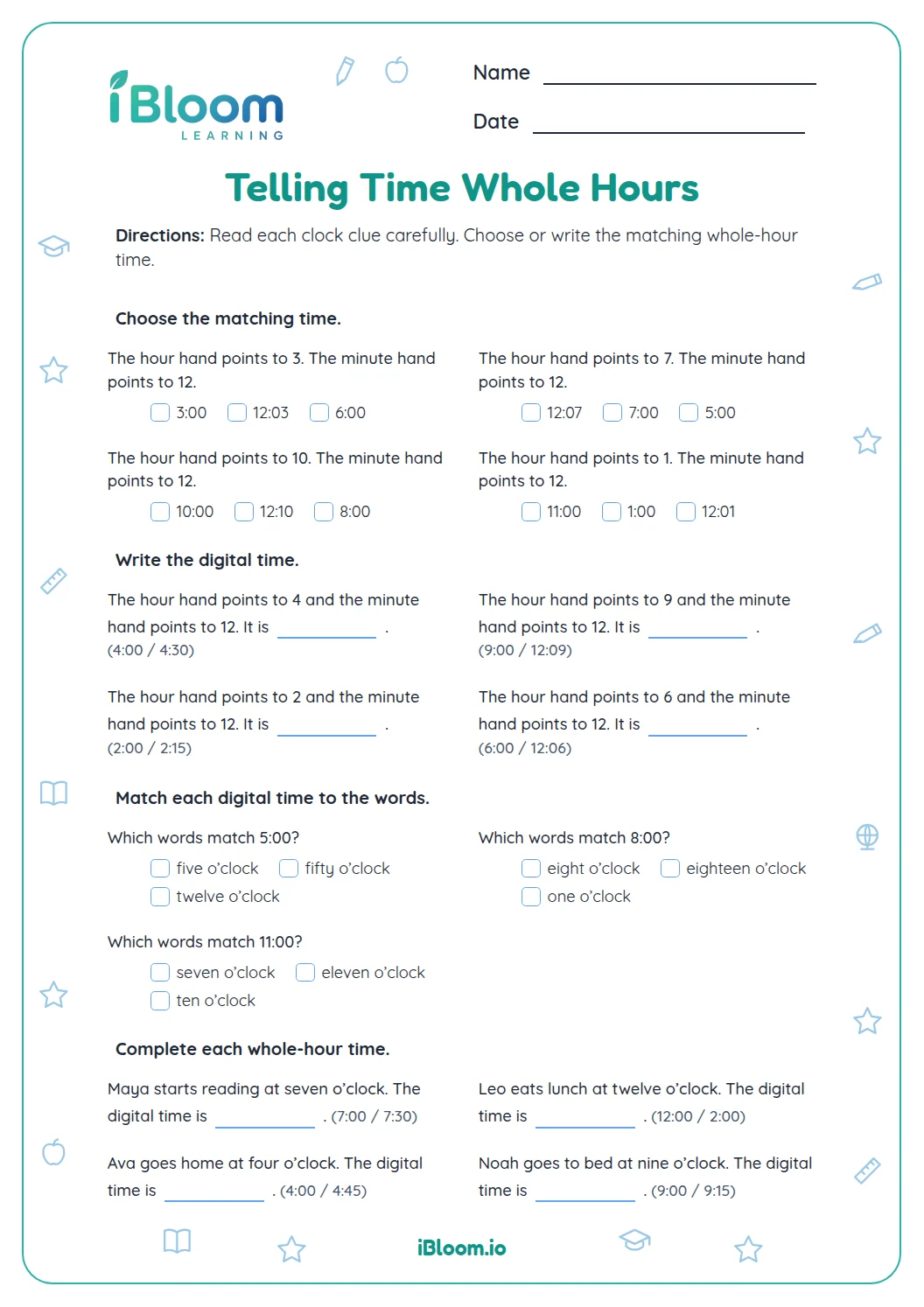
About this worksheet
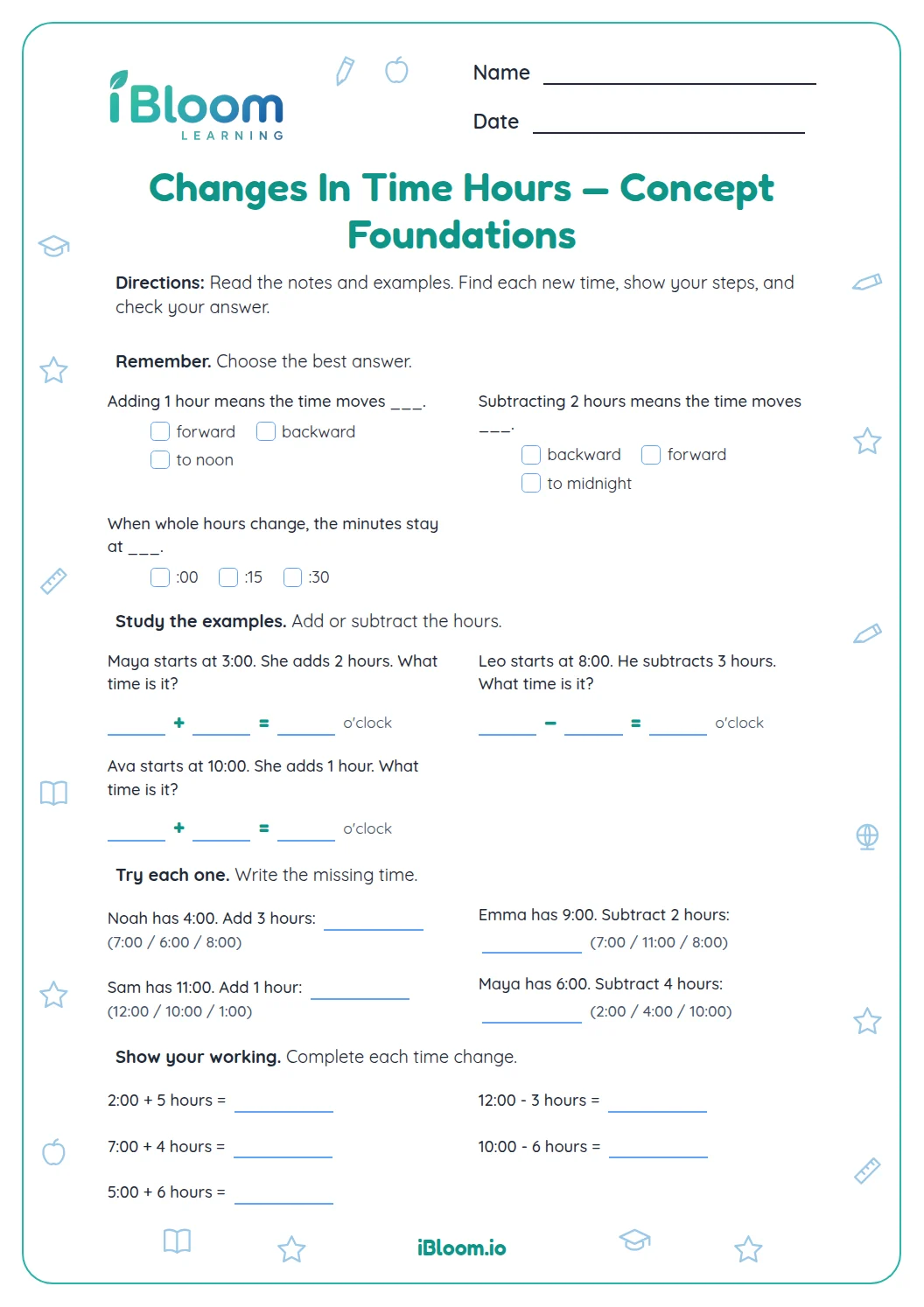
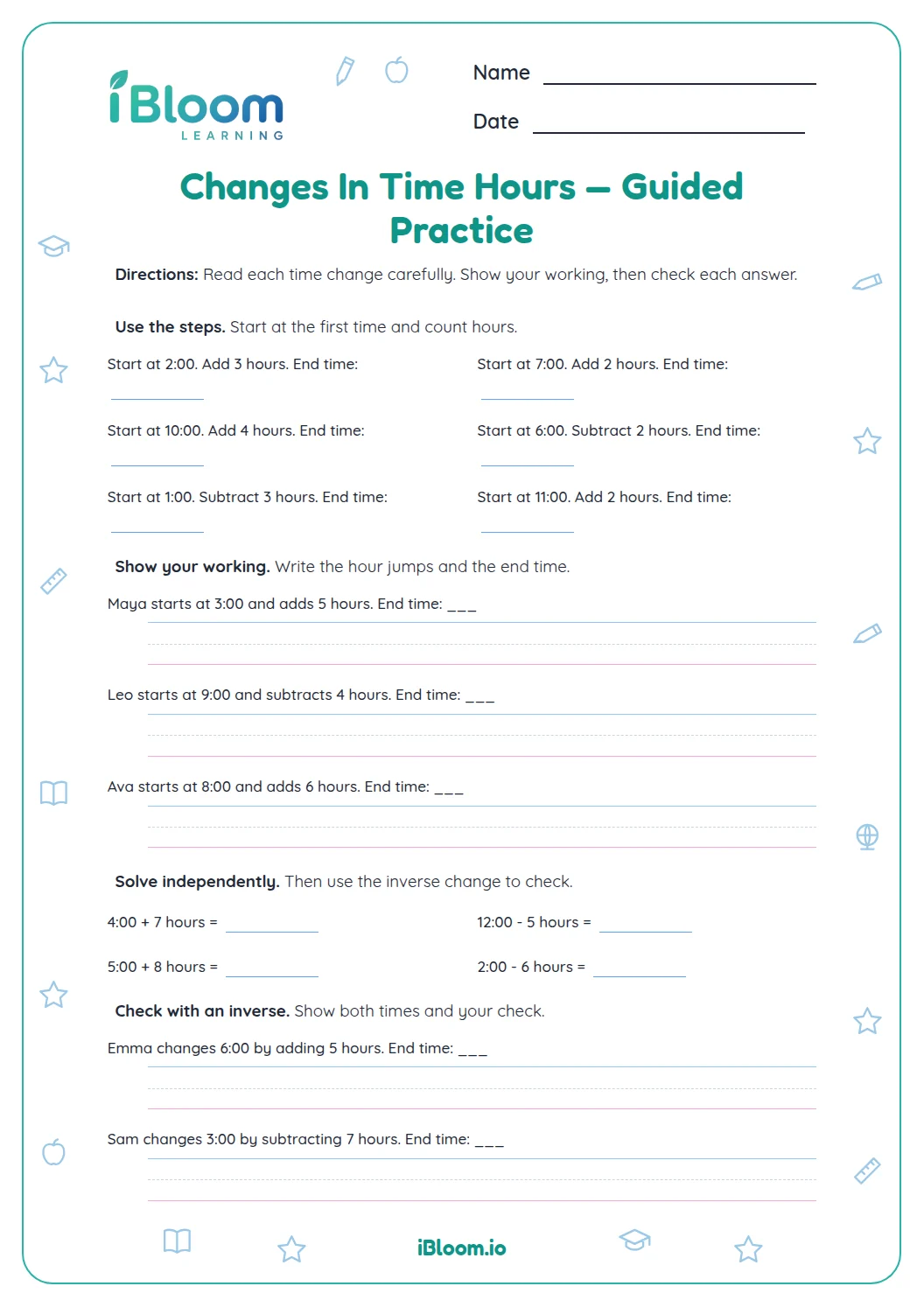
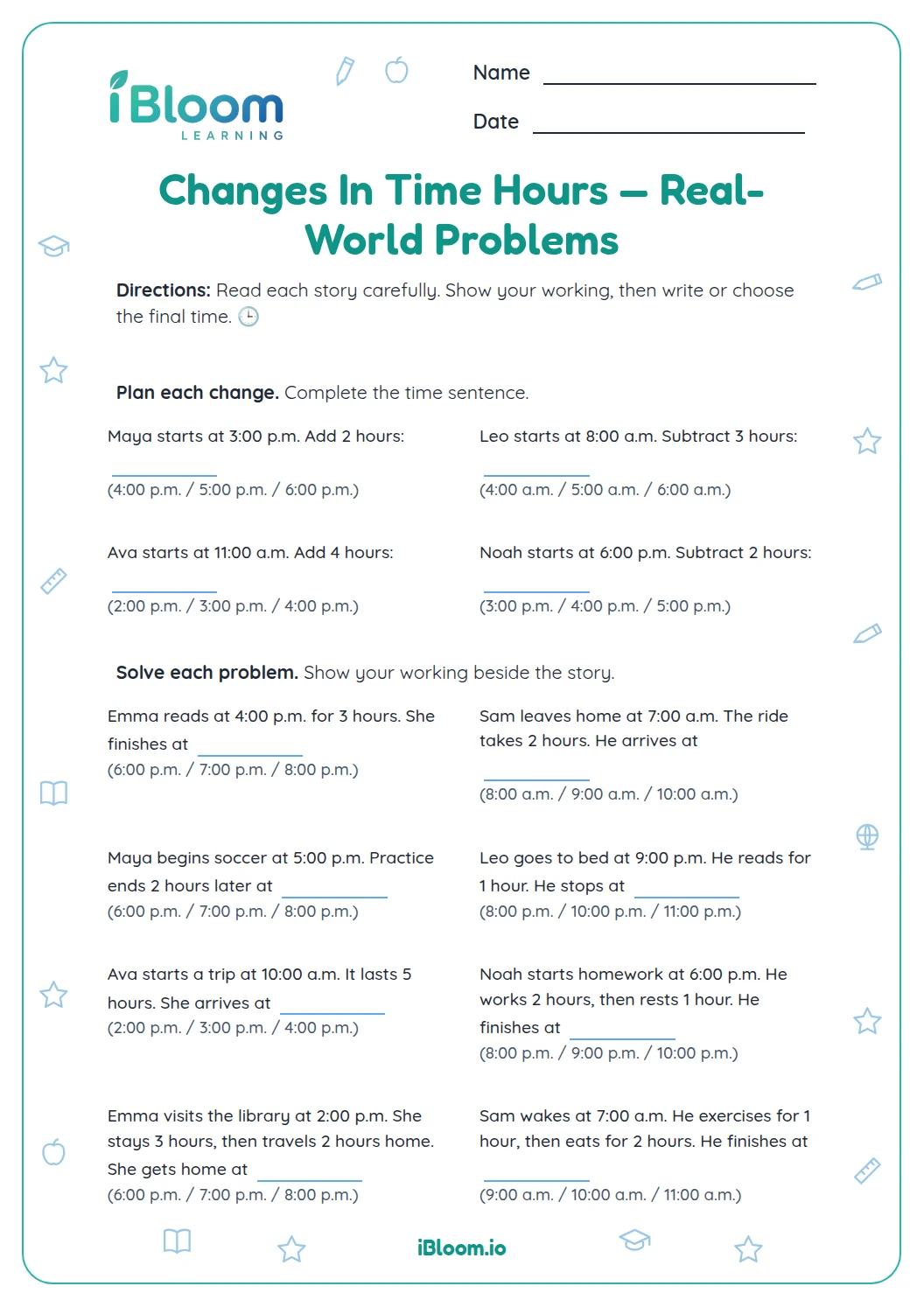
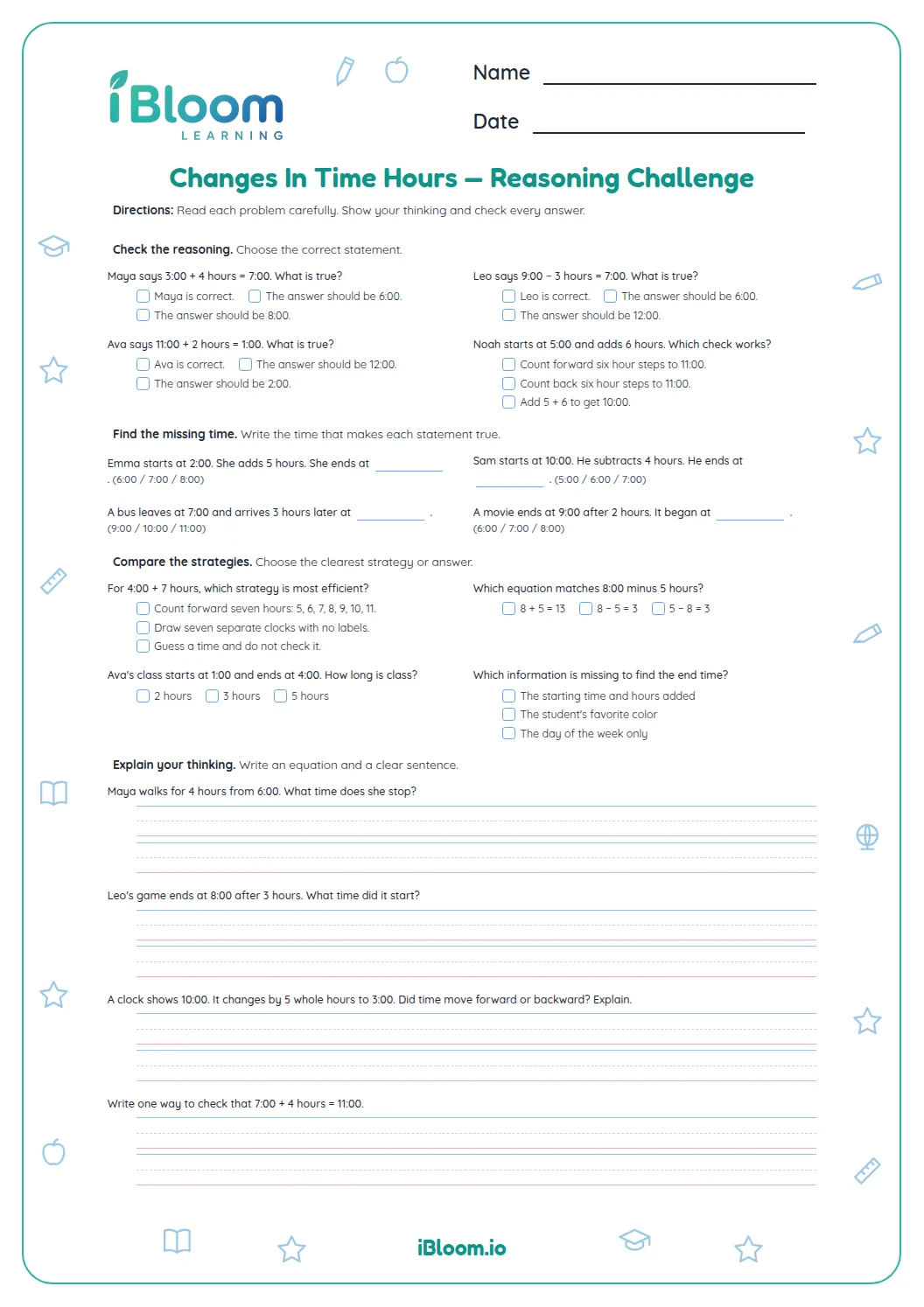
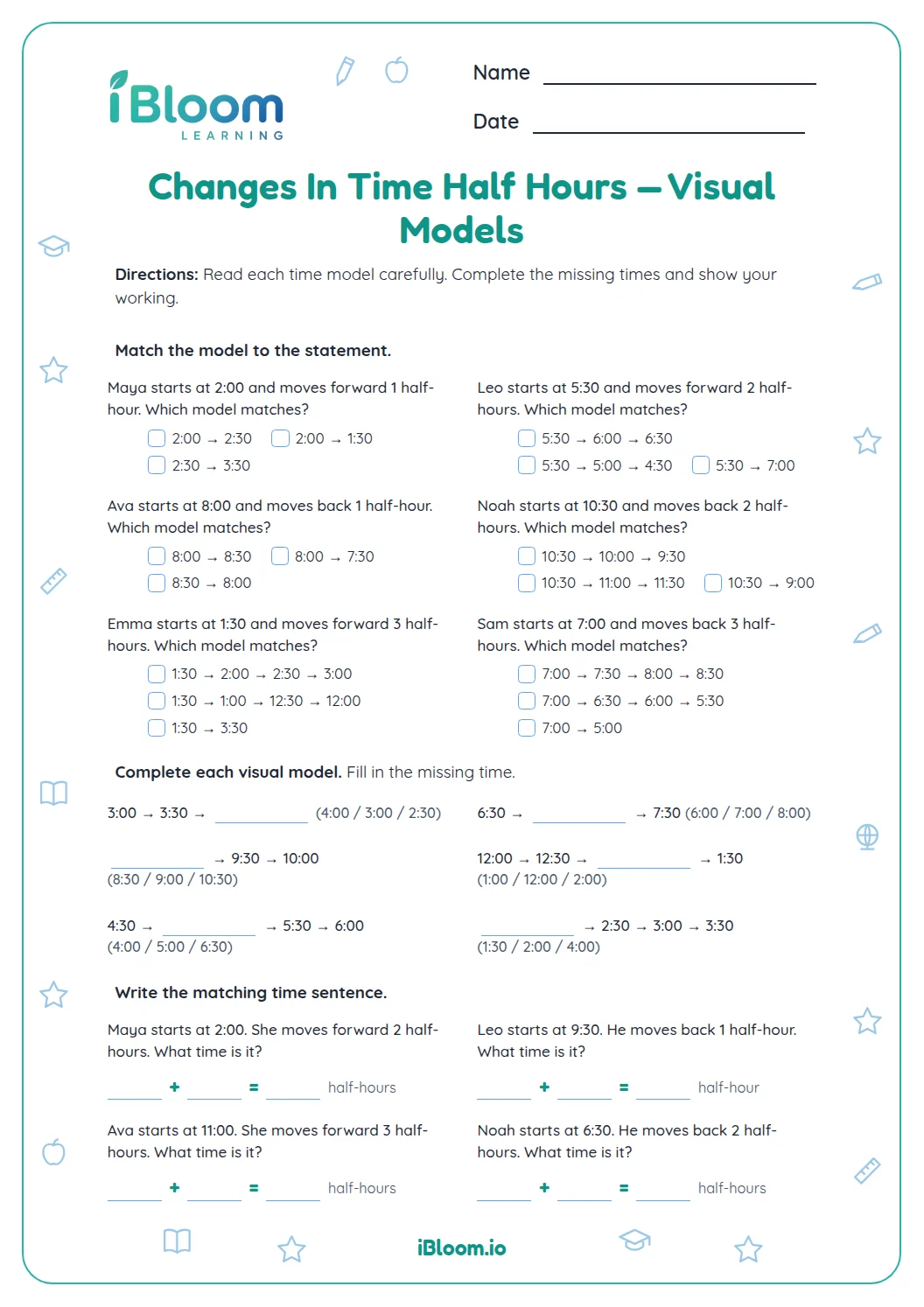
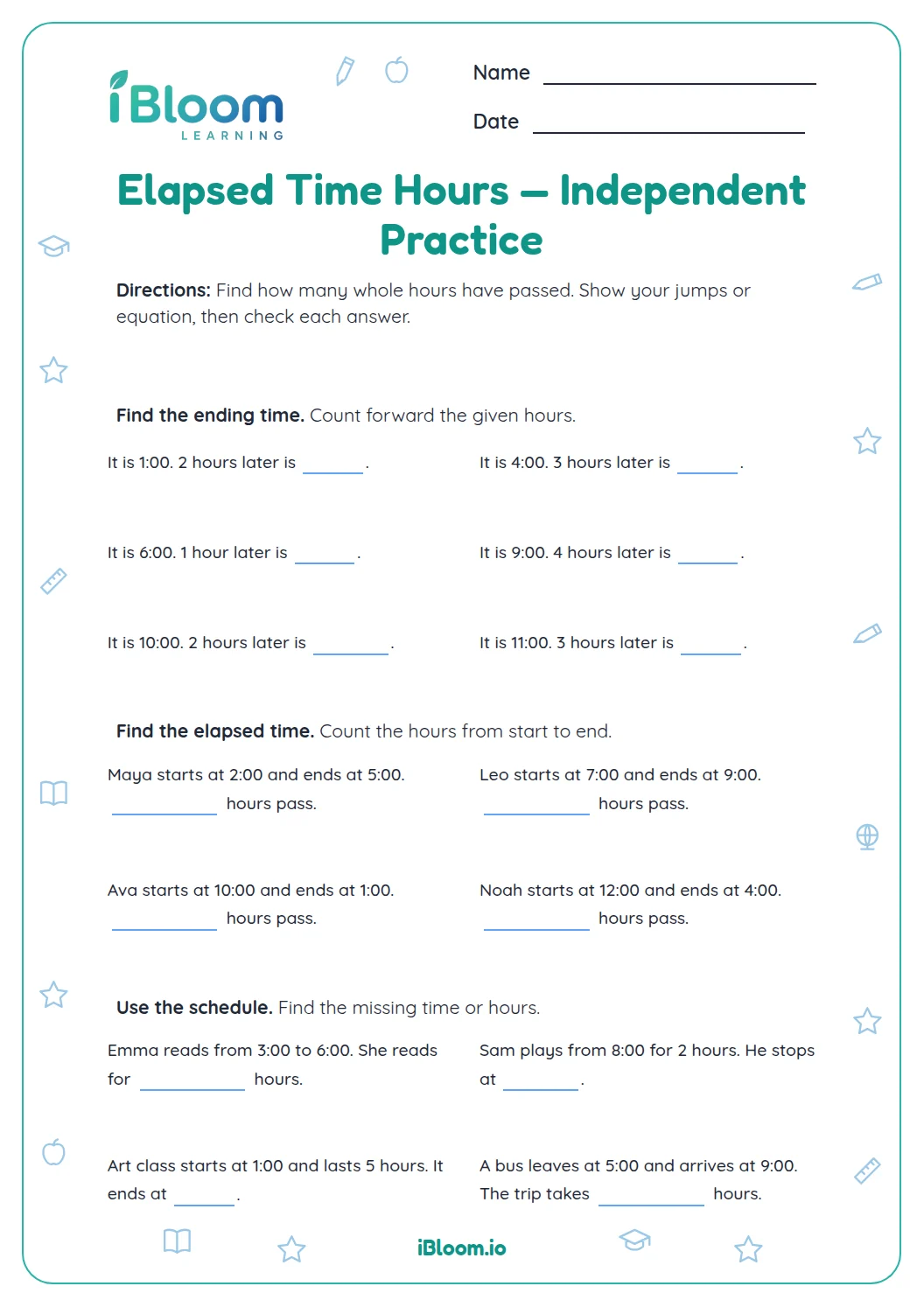
This Grade 2 worksheet practices finding a new time after adding or subtracting whole hours. Four prompts give a start time and an hour change, followed by six time sentences, four short stories, and four final checks. For example, starting at 2:00 and moving forward 5 hours gives 7:00. The answer key lists the resulting times.
Aligned to 3.MD.A.1
What time changes are on the worksheet?
The questions move from clock-supported examples to written hour changes and short stories. All intervals are whole hours. Students keep the minutes at :00 and count forward or backward, including changes that pass 12.
For example, 2:00 plus 5 hours is 7:00. Starting at 2, count five steps: 3, 4, 5, 6, 7.
- Four start-time questions
- Six hour-change sentences
- Eight story and check questions
What happens when a change passes 12?
Keep counting around the clock face. After 12:00 comes 1:00, so 12:00 plus 7 hours is 7:00. The worksheet practices this wraparound in both directions.
Do the minutes change in these problems?
No. Each starting time and interval is a whole number of hours, so the minutes remain :00. Focus on counting the hour changes carefully.
How to use this worksheet
- 1Read the start time before changing it.
- 2Count forward for hours later and backward for hours earlier.
- 3Keep the minutes at :00.
- 4Continue around the clock when a change passes 12.
- 5Check each answer with the key.
Common mistakes and quick fixes
The mistake
Stopping at 12 instead of continuing to 1.
The fix
Keep counting around the clock face.
The mistake
Subtracting when the prompt says later.
The fix
Match later with forward and earlier with backward.
The mistake
Changing the minutes during a whole-hour shift.
The fix
Keep :00 unchanged in these questions.
Common Core alignment
This worksheet practices the following mathematical ideas.
Solve elapsed-time problems by adding and subtracting time intervals.
On this sheet: Each problem adds or subtracts a whole-hour time interval and finds the resulting time.
Show the official wordingHide the official wording
Tell and write time to the nearest minute and measure time intervals in minutes. Solve word problems involving addition and subtraction of time intervals in minutes, e.g., by representing the problem on a number line diagram.
What to practice next
Make more practice
Further reading
Questions parents and teachers ask
How do children add hours to a time?
Begin at the starting hour and count forward one hour at a time. If the start is 2:00 and the change is 5 hours, count 3, 4, 5, 6, 7. The minutes stay at :00 because each problem changes a whole number of hours.
How do children subtract hours?
Count backward from the starting hour by the number of hours in the problem. For example, 9:00 minus 4 hours is 5:00. If counting backward crosses 12, continue around the clock face rather than stopping at 12. A written hour-change sentence makes each step clear.
How many questions are included?
The worksheet has 18 questions in four parts: four start-time questions, six time sentences, four short stories, and four checks. Every problem uses a whole-hour interval, so students focus on the hour and keep the minutes at :00. A separate answer key lists each resulting time.
What should a child do when the time change passes 12?
Continue around the clock. After 12:00 comes 1:00, so 12:00 plus 7 hours is 7:00. For a backward change, move from 12 to 11, then 10, and continue until all the hours have been counted. The first four start-time problems offer simpler guided practice.
Do the minutes change on this worksheet?
No. The starting times are on the hour and the changes use whole hours. The minutes stay at :00 in every answer. This lets students focus on counting hours and checking whether the prompt asks for a later or earlier time.
Is an answer key included?
Yes. A separate answer key lists a resulting time for each of the 18 items. Students can count the hour jumps aloud, then compare the result with the key and revisit any step that passed 12. The minutes remain :00 throughout the sheet.