




About this worksheet
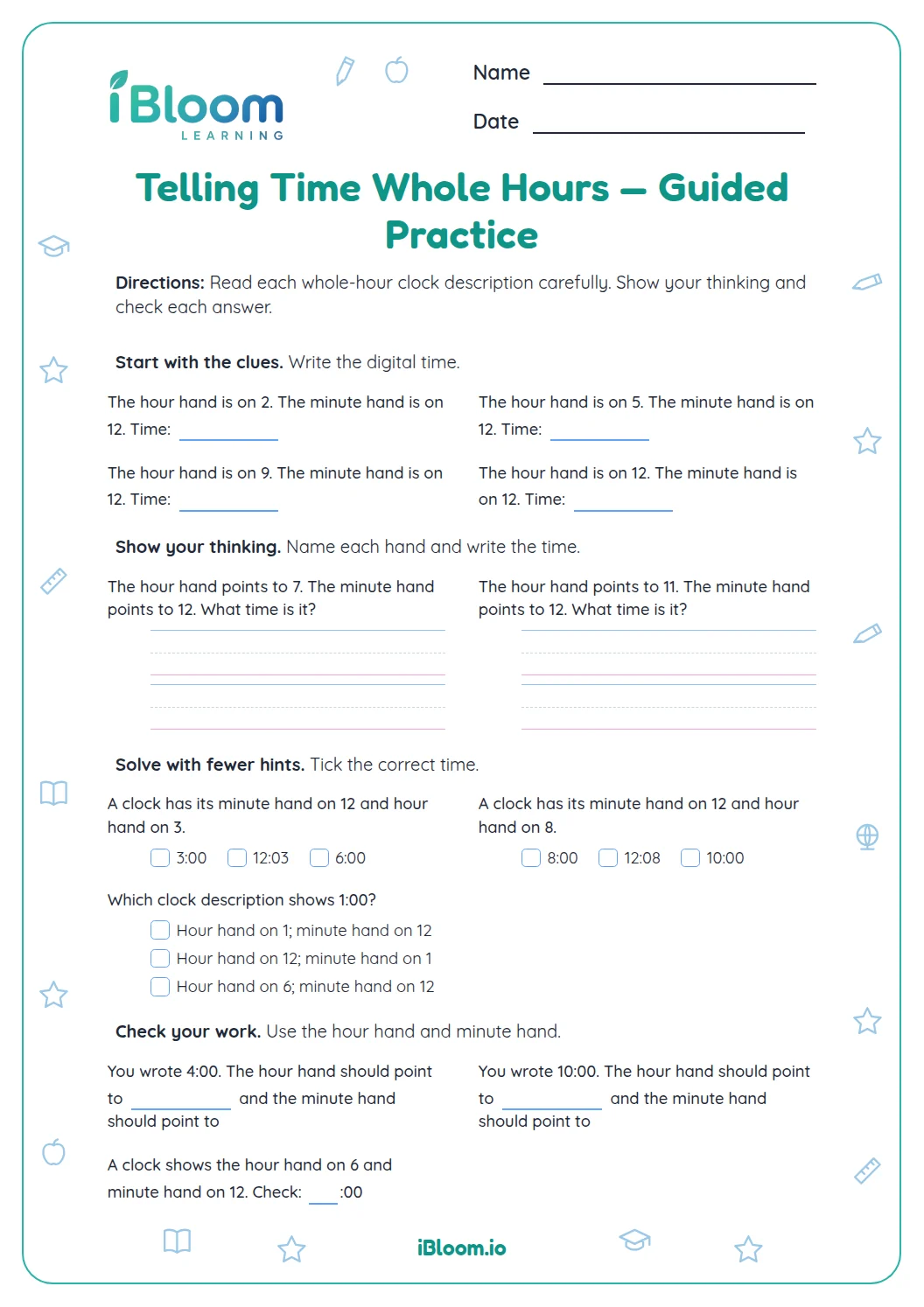
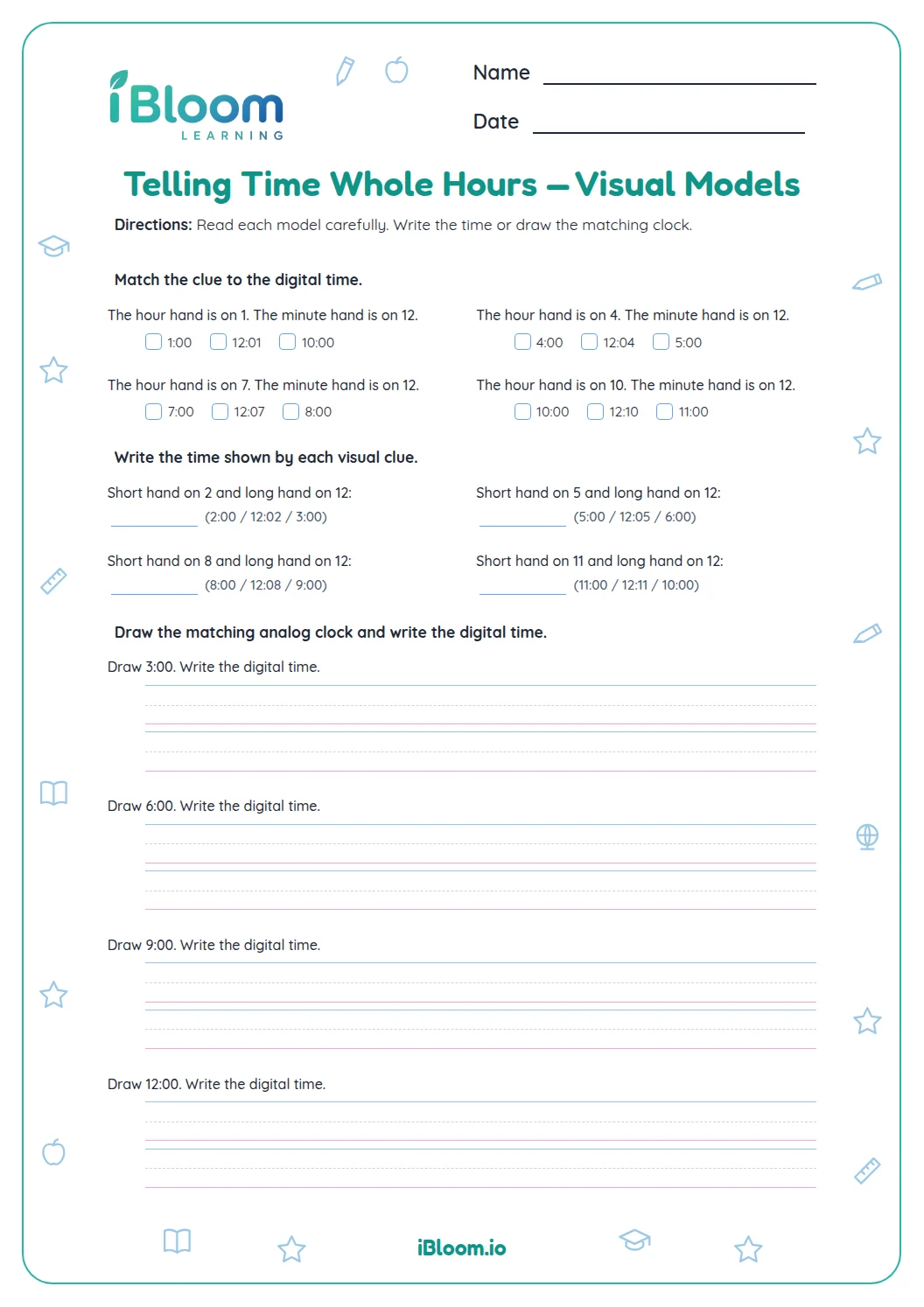
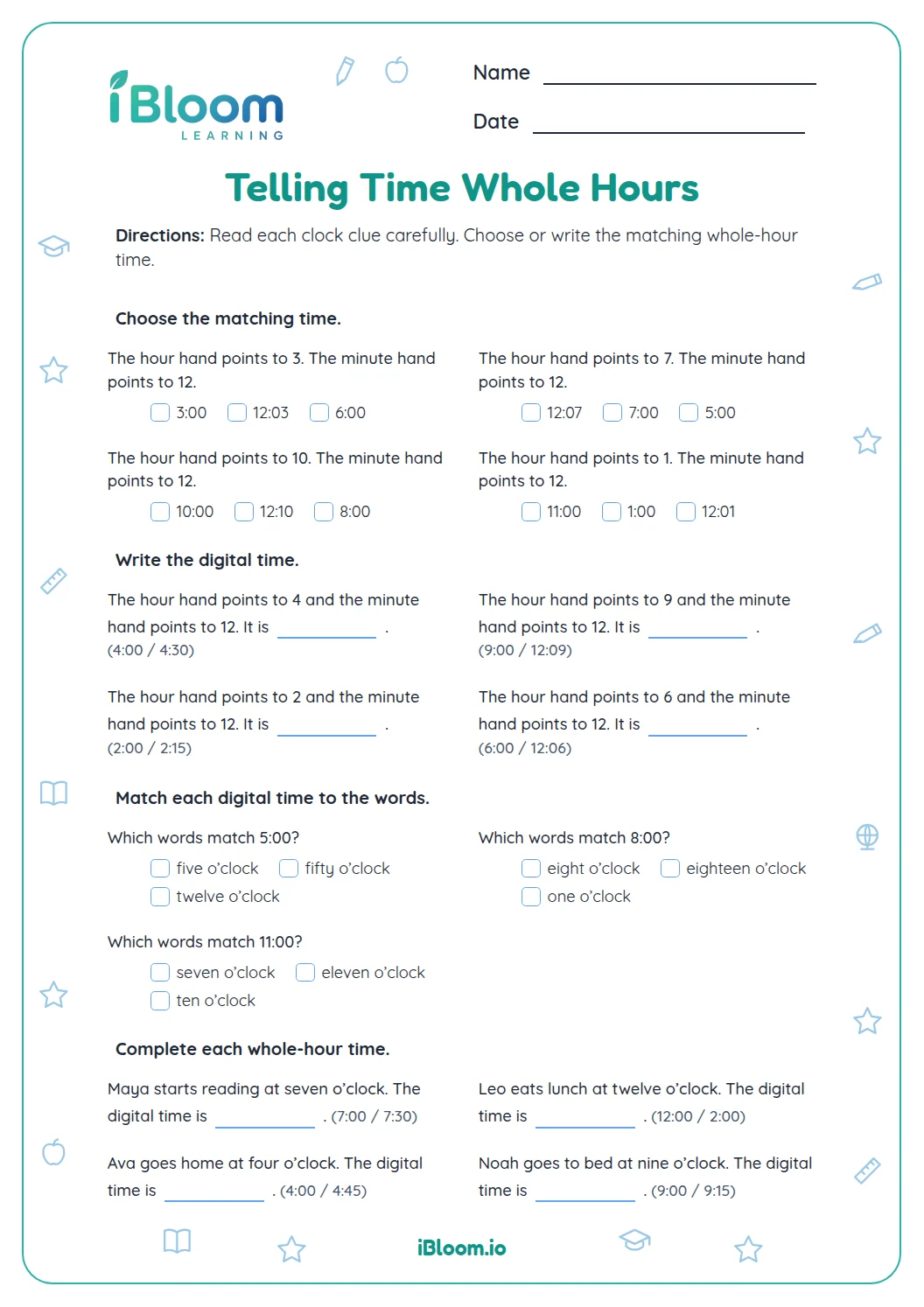
This printable Grade 2 math worksheet builds confidence reading analog clocks at whole hours. Each clock shows the minute hand at 12, so students can focus on using the shorter hour hand to name the time. The page provides four clock faces and ten short questions about whole-hour time, followed by an answer key. It supports CCSS 2.MD.C.7, which asks students to tell and write time from analog and digital clocks to the nearest five minutes.
Aligned to 2.MD.C.7
What does a whole-hour clock look like?
At a whole hour, the long minute hand points straight up to 12. The short hour hand points to the hour number. If it points to 5, the clock reads 5:00.
Part A starts with four analog clock faces. The remaining questions check the roles of the hands and how whole-hour times are written digitally.
- Check that the long hand points to 12
- Read the short hand’s number
- Write the hour followed by :00
How do you read 7:00?
Start by checking the minute hand. When it points to 12, zero minutes have passed in the hour. Then read the short hand.
- 1The minute hand points to 12.
- 2The short hand points to 7.
- 3Write 7:00.
What if both hands look close together?
At 12:00, both hands point toward 12. Use the short hand’s role, not the distance between hands: the long hand tells minutes and the short hand tells hours.
The later questions reinforce the same whole-hour rule without adding more clock drawings.
How to use this worksheet
- 1Point to the long minute hand and the short hour hand.
- 2For each clock, check whether the long hand reaches 12.
- 3Read the number the short hand points to.
- 4Write the time with two digits for minutes, such as 4:00.
- 5Check each answer against the separate key.
Common mistakes and quick fixes
The mistake
Reading the long hand as the hour hand.
The fix
Compare hand lengths: the shorter hand names the hour.
The mistake
Writing only the hour number.
The fix
Add :00 because the minute hand points to 12.
The mistake
Calling the clock 12:00 whenever a hand points to 12.
The fix
Check both hands; the short hand gives the hour except when it is also at 12.
Common Core alignment
This page practices the listed grade-level skill through short, checkable examples.
Read and write the whole-hour times shown on analog clocks.
On this sheet: Every item reads a whole hour from an analog clock, within the standard’s five-minute precision.
Show the official wordingHide the official wording
Tell and write time from analog and digital clocks to the nearest five minutes, using a.m. and p.m.
What to practice next
Make more practice
Further reading
Questions parents and teachers ask
What does the minute hand show at a whole hour?
At a whole hour, the long minute hand points to 12, which means zero minutes past the hour. Students can then read the shorter hand to find the hour number. For example, when the short hand points to 7, the clock reads 7:00.
How many clock questions are included?
There are 14 questions. Children read four analog clock faces, then complete ten short checks about the hands and digital whole-hour times. The worksheet prints on two pages, and the separate key also prints on two pages. This mix keeps the clock reading visual while giving quick practice with the whole-hour rule.
What if the hour hand looks between numbers?
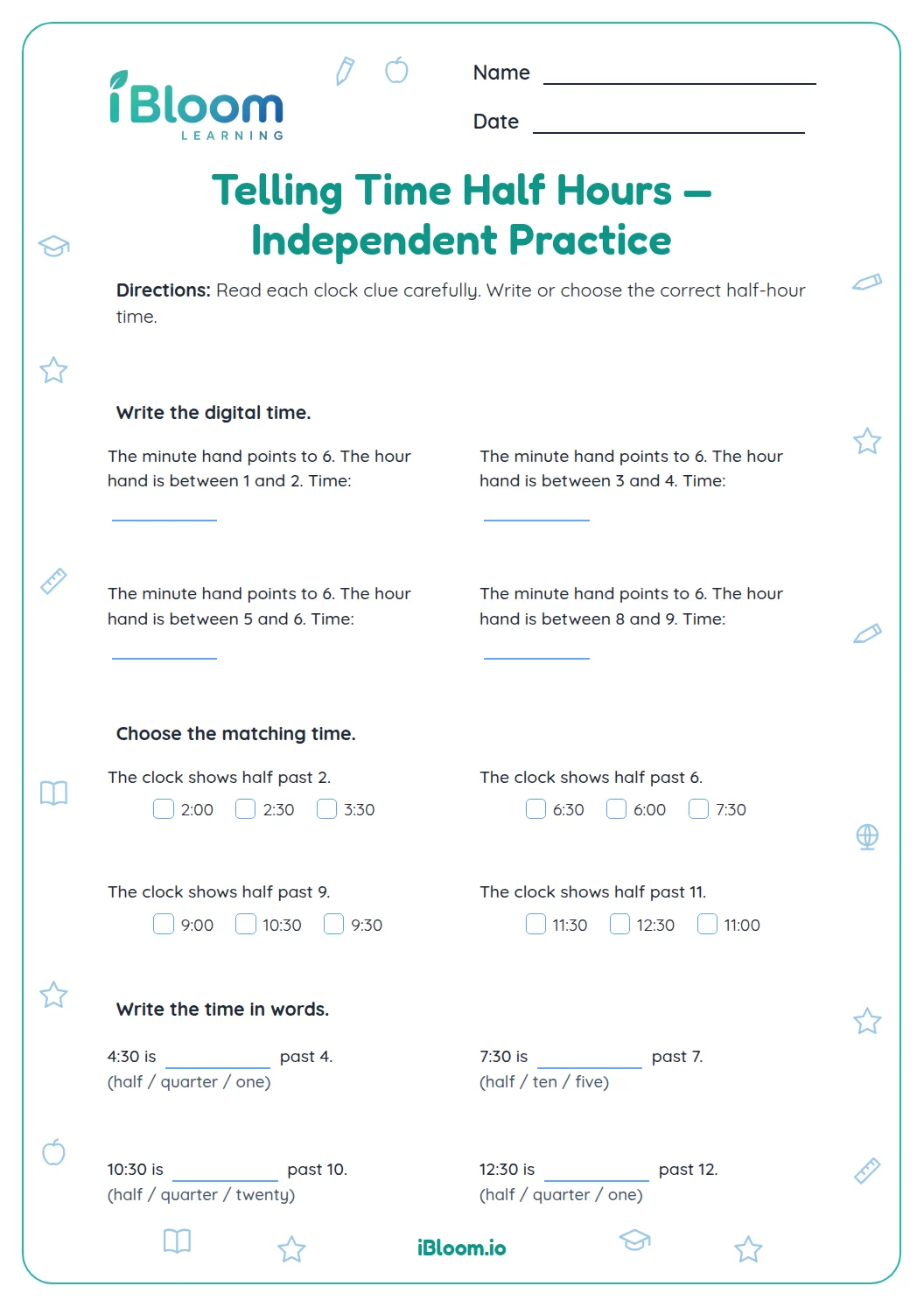
For the clocks on this worksheet, the hour hand points directly at a number. On clocks showing half hours or five-minute intervals, the hour hand can move between numbers, which is a useful next step after whole-hour reading.
How can I help my child check an answer?
First check that the long hand points to 12. Then ask your child to point to the short hand and name that number. The written answer should use the hour followed by :00, such as 4:00. The separate key lists each clock time.