







About this worksheet
This Grade 2 worksheet gives 14 real-world elapsed-time problems in half-hour steps. Each situation names an activity and gives its start and end times; students find how long it lasts. The answer key lists the durations. Students can count forward from one :00 or :30 mark to the next and combine two half-hour jumps into one hour.
How do you count forward by half hours?
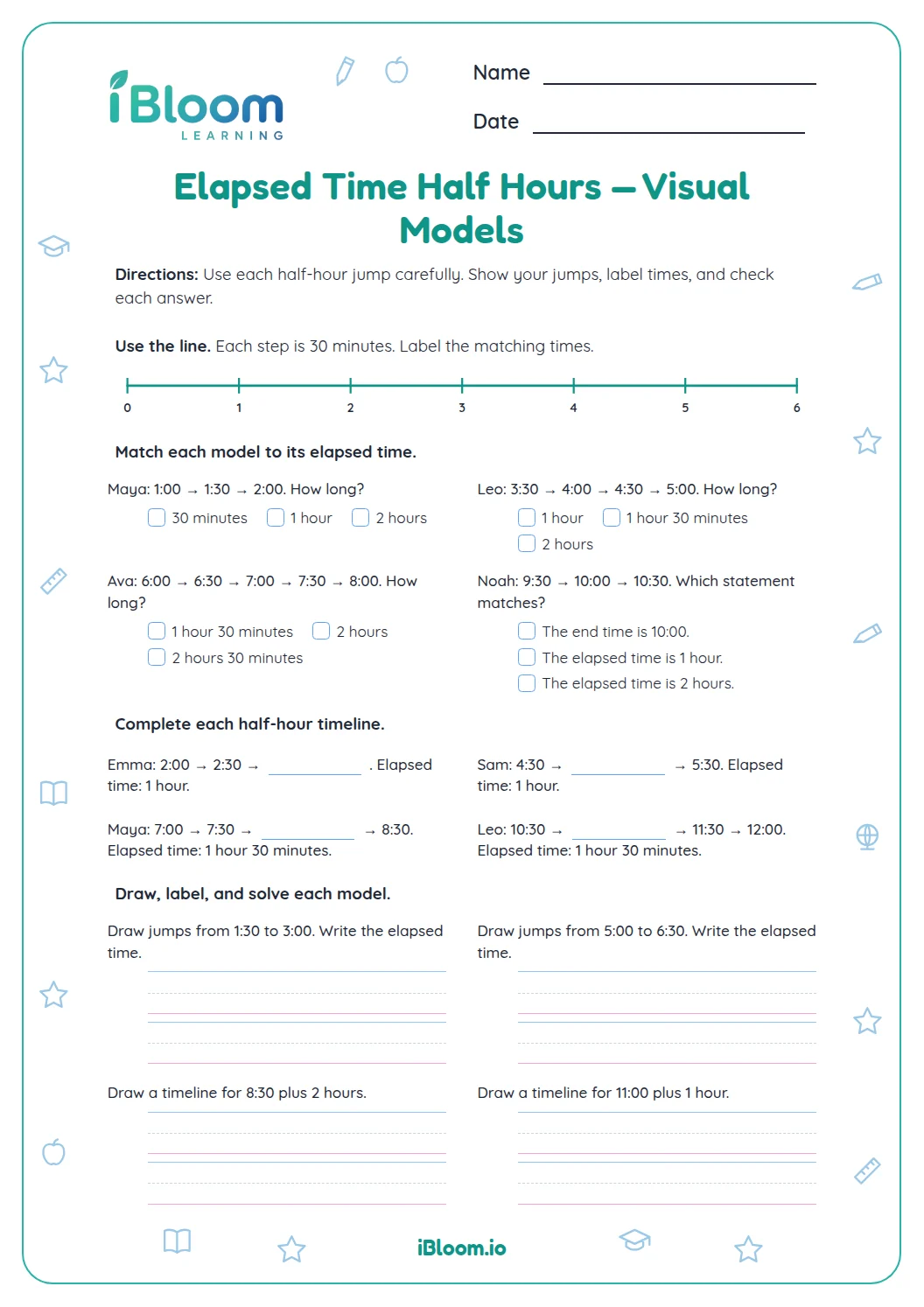
Start at the beginning time and move to the next :30 or :00. Each jump is 30 minutes. In question 1, a library visit from 9:00 to 9:30 lasts one half-hour jump, or 30 minutes.
- 19:00 → 9:30
- 2One 30-minute jump = 30 minutes.
How can two half hours make an hour?
Count two jumps of 30 minutes. For question 3, 2:00 to 3:30 has three jumps: 2:00 to 2:30, to 3:00, then to 3:30. That is 90 minutes, or 1 hour 30 minutes.
What should you write as the duration?
Give the amount of time that passed, not the ending clock time. If two full hours pass, write “2 hours.”
How to use this worksheet
- 1Read the start time from the analog clock.
- 2Find the ending time written in the situation.
- 3Count forward in 30-minute jumps.
- 4Combine two half-hour jumps as one hour.
- 5Write the elapsed duration, then check it with the key.
Common mistakes and quick fixes
The mistake
Writing the ending time instead of the time that passed.
The fix
Ask “How long?” and count the jumps between start and end.
The mistake
Calling one half-hour jump one hour.
The fix
Remember that two 30-minute jumps make 60 minutes, or one hour.
The mistake
Skipping the :30 time while counting.
The fix
Say each clock time in order: :00, :30, next hour :00.
What to practice next
Make more practice
Questions parents and teachers ask
What does elapsed time mean?
Elapsed time is how much time passes between a starting time and an ending time. The 14 situations ask students to find the duration of familiar activities by counting forward in half-hour steps. The key lists the duration for every problem.
How many time problems are included?
There are 14 real-world problems across two worksheet pages, followed by a two-page answer key. Each problem gives an activity, a start time, and an end time. Students write how long the activity lasted by counting half-hour jumps. Students can say each clock stop aloud and count one 30-minute jump at a time before writing the duration.
What is one half-hour jump?
A half-hour jump moves the clock forward by 30 minutes. For example, from 9:00 the next half-hour mark is 9:30. Two such jumps make one hour, which helps students combine intervals in the longer problems. Students can say each clock stop aloud and count one 30-minute jump at a time before writing the duration.
Should students count minutes one at a time?
No. The sheet focuses on half-hour intervals, so students can count from one :00 or :30 mark to the next. The written start and end times show where to begin and stop. This keeps the work focused on half-hour jumps.
What is the difference between elapsed time and the end time?
The end time tells when the activity finishes. Elapsed time tells how long it lasted. For a 9:00 start and 9:30 finish, 9:30 is the ending time while 30 minutes is the elapsed time. Students can say each clock stop aloud and count one 30-minute jump at a time before writing the duration.
What can we practice after this sheet?
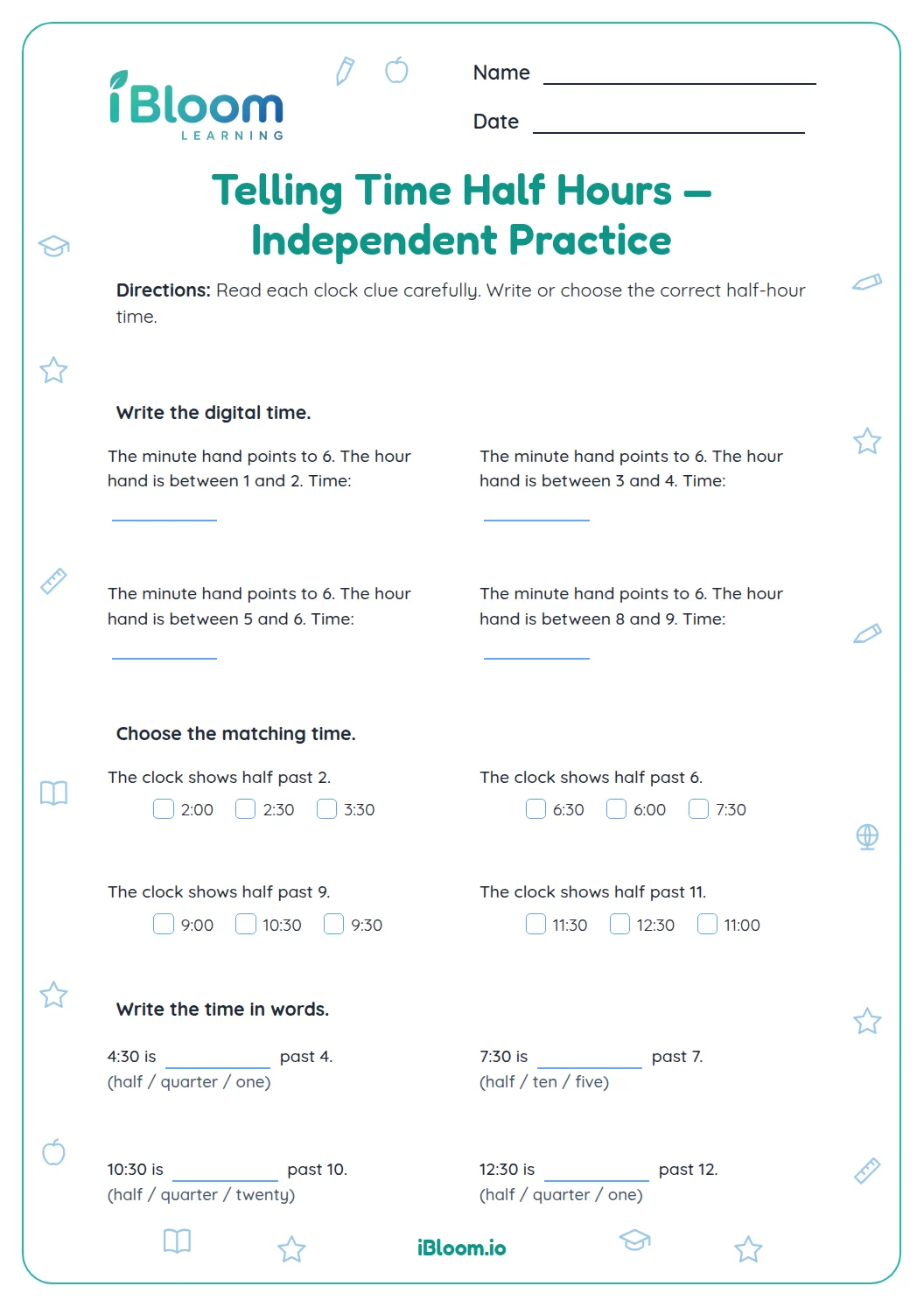
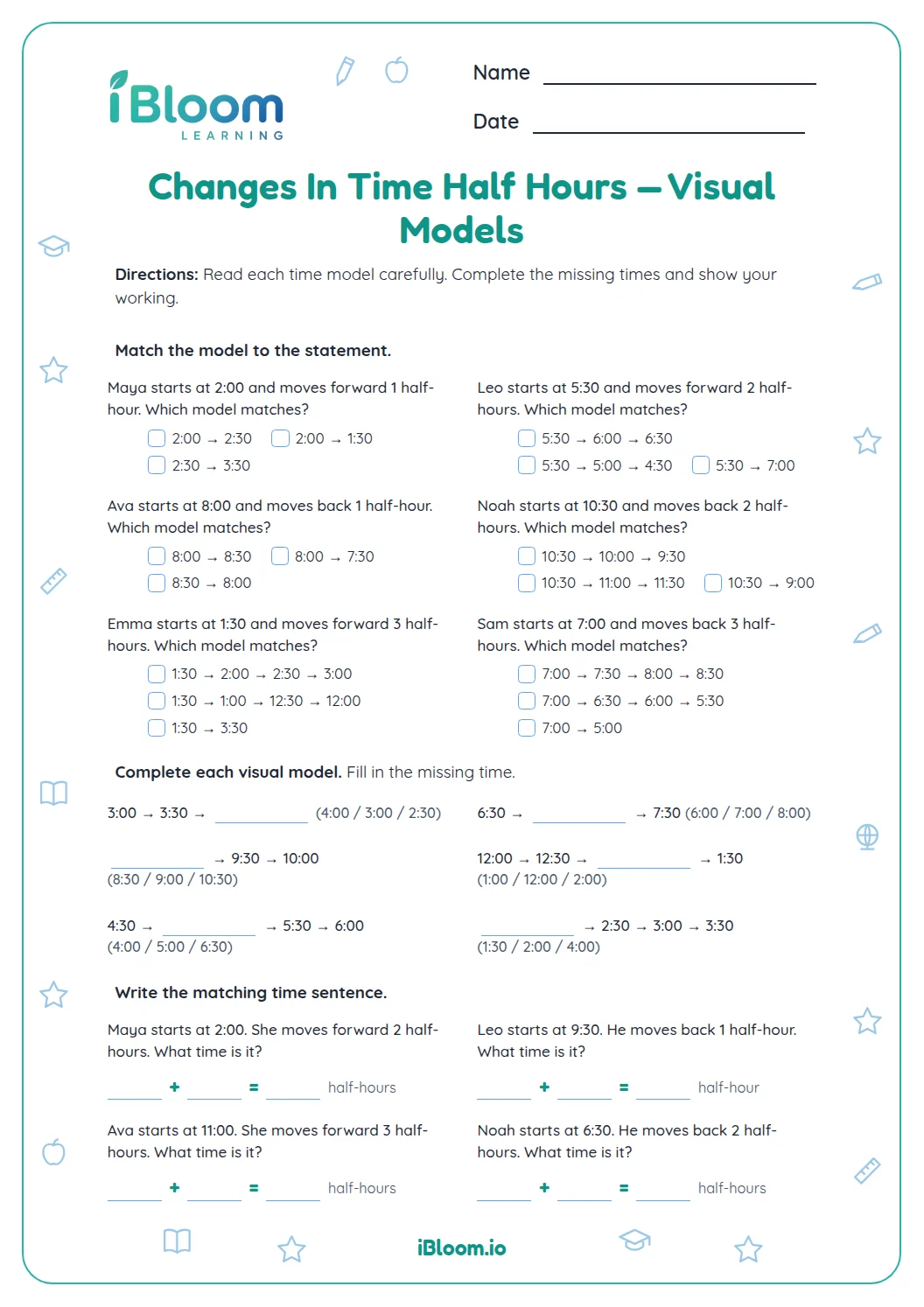
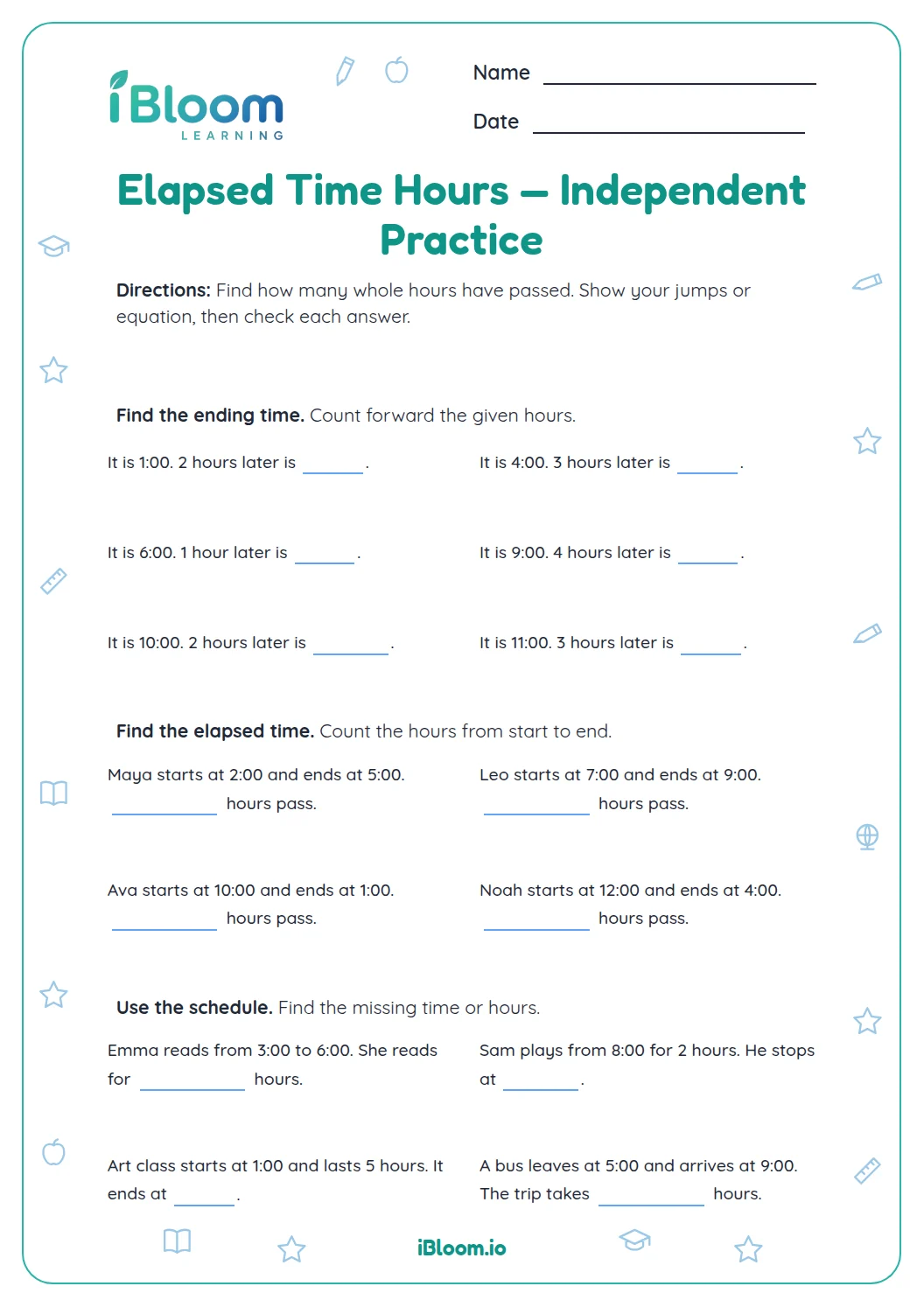
Students can review telling time to the half hour, use visual models for elapsed-time jumps, and then try a reasoning challenge. The related pages follow those steps while keeping time intervals familiar. Students can say each clock stop aloud and count one 30-minute jump at a time before writing the duration.