




About this worksheet
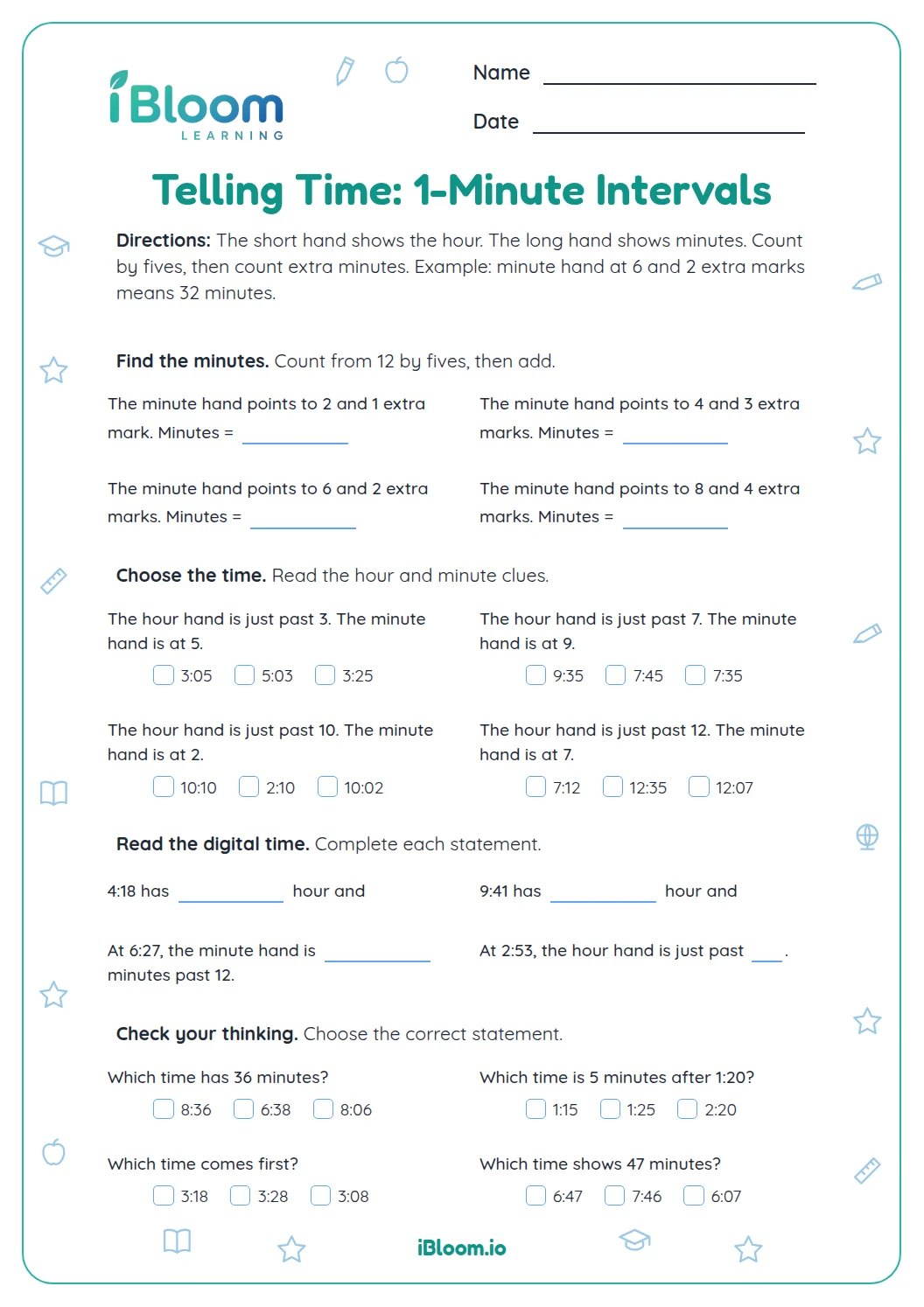
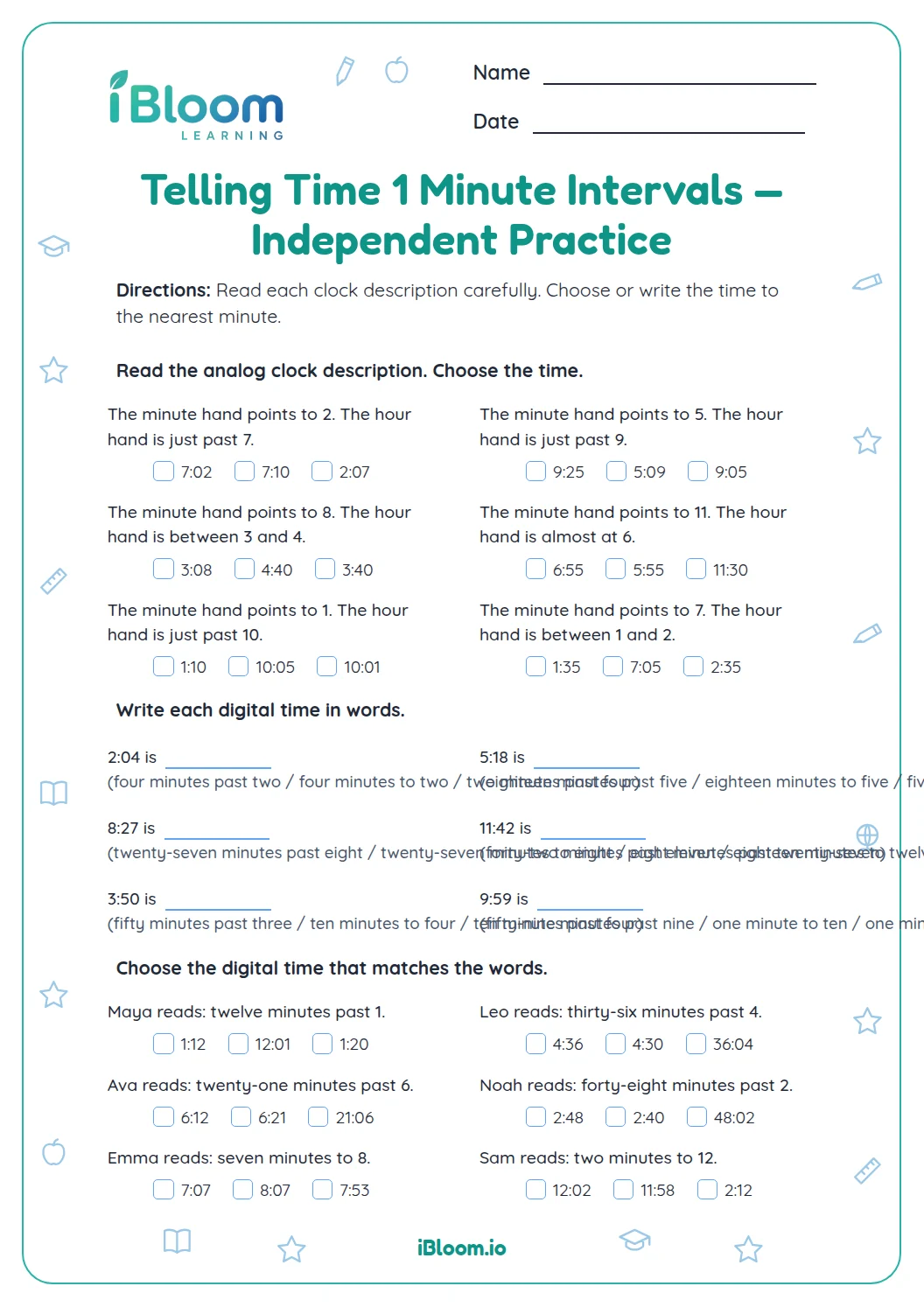
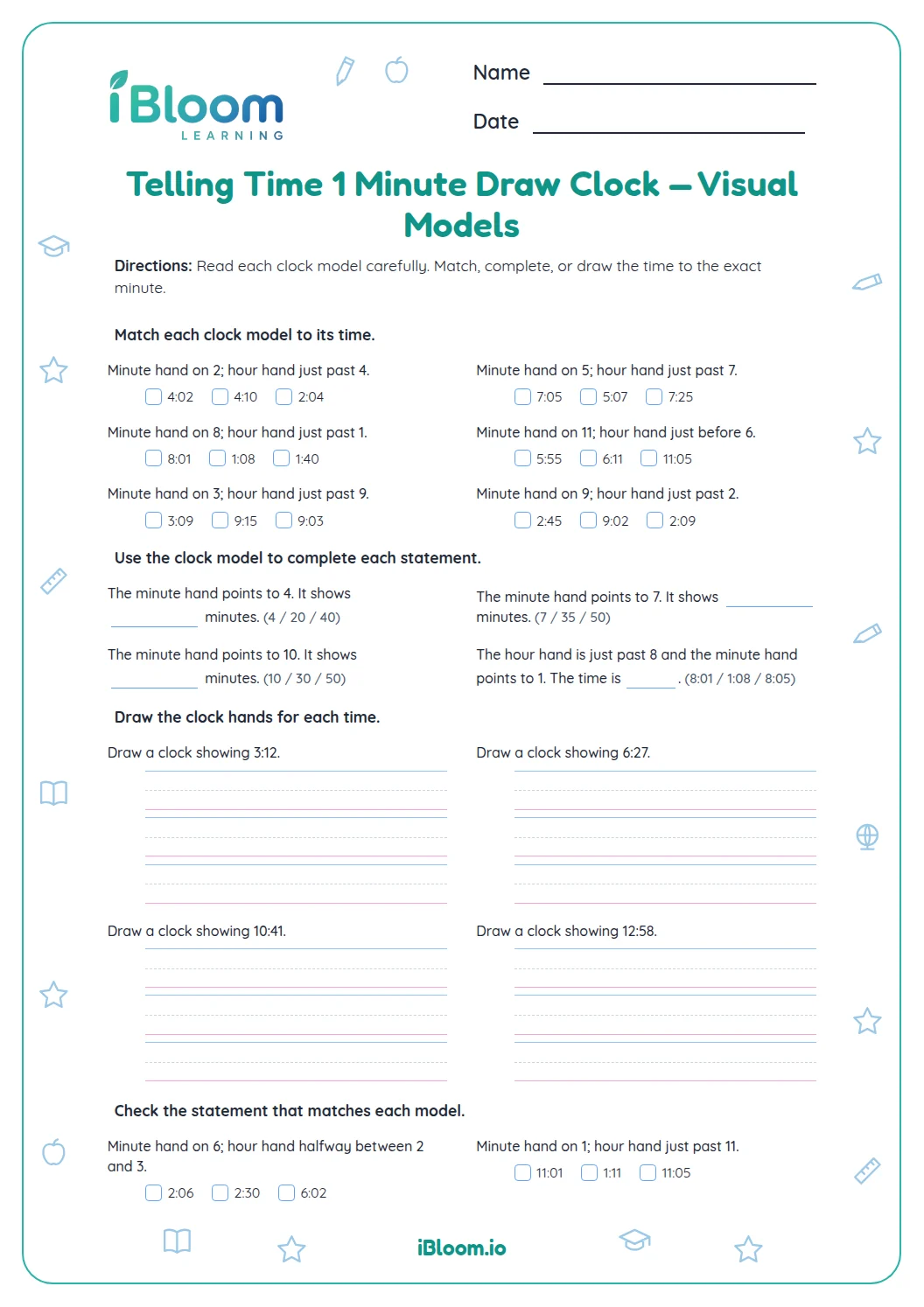
This free Grade 2 math worksheet gives guided practice reading time to the exact minute. Children read four analog clocks, then interpret written clues that describe the hour and the minute hand between five-minute marks. They record exact times in h:mm form. The reading skill matches the minute-reading portion of CCSS 3.MD.A.1. The printable has 16 questions in two parts and a separate answer key.
Aligned to 3.MD.A.1
How do you read the minute hand?
Begin at 12 and count the small tick marks clockwise until you reach the minute hand. The large numbers mark groups of five minutes, while the small marks let you read each minute between them.
For 4:13, the minute hand is three ticks past the 10-minute mark. It points to minute 13, not 15.
- 1Clock: 4:13
- 2The minute hand is at 13 minutes; the hour hand is past 4.
- 3Answer: 4:13
How do you tell which hour has begun?
The shorter hour hand moves gradually toward the next number as minutes pass. If it is between 4 and 5, the hour is still 4. Use the minute hand to decide how far through that hour it is.
Read both hands together: the hour first, then a colon, then the two-digit minute number.
How should you record a time to the minute?
Write the hour, a colon and two digits for the minutes. Add a zero before a one-digit minute, as in 7:03.
Part A uses clock faces with three choices. Part B describes the hand positions in words; use the same five-minute landmarks and one-minute counts to write each exact time.
How to use this worksheet at home or in class
- 1Start at 12 and count the minute ticks clockwise.
- 2Use the shorter hand to identify the hour that has begun.
- 3In Part A, select the time that matches both hands.
- 4In Part B, write the hour and two-digit minute as h:mm.
Common mistakes and quick fixes
The mistake
Reading the large number as the minute count.
The fix
Each number is five minutes; count the small ticks to find an exact minute.
The mistake
Calling the next hour before the hour hand reaches it.
The fix
Name the hour the shorter hand has passed, not the number it is approaching.
The mistake
Writing 7:3 for seven hours and three minutes.
The fix
Use two digits for minutes: write 7:03.
Curriculum alignment
This page practices reading analog clocks to the nearest minute.
Read an analog clock to the nearest minute.
On this sheet: The page practices the time-reading portion by naming the exact minute on each analog clock.
Show the official wordingHide the official wording
Tell and write time to the nearest minute and measure time intervals in minutes. Solve word problems involving addition and subtraction of time intervals in minutes, e.g., by representing the problem on a number line diagram.
What to practice next
Make more practice
Further reading
Questions parents and teachers ask
How does the minute hand show an exact minute?
Each small tick mark on an analog clock stands for one minute. Start at 12 and count by ones to the minute hand; the shorter hour hand shows which hour has begun. The written clues name a five-minute mark and how many ticks to count beyond it.
Why does 4:13 not mean 4:15?
The minute hand pointing to 13 means it has moved thirteen ticks past 12, so the time is 4:13 when the hour hand is just past 4. The five-minute labels help with orientation, but counting the small marks gives the exact minute.
What does h:mm mean in the written answers?
Write the hour, a colon, and two digits for the minutes. For example, seven hours and three minutes is written 7:03. The zero keeps the minutes in the correct place. The answer key uses this h:mm format for all 14 clock-reading questions.
How many clock-reading questions are included?
There are 14 multiple-choice questions in two parts. Part A introduces hand-position clues, and Part B gives more exact-minute practice. Each item asks children to use the hour that has begun and the minute hand’s position; the separate key marks the correct h:mm time.
Why practice times that are not multiples of five?
The small marks around a clock represent individual minutes, so an exact reading may land between the larger five-minute labels. Each question gives the minute hand’s position directly or describes ticks beyond a five-minute mark, then asks children to choose the matching time.