






About this worksheet
This free printable Grade 2 telling time worksheet puts minute-by-minute clock reading to work in everyday situations. Part A shows three analog clocks, and children choose the matching digital time, such as 8:13 or 7:46. Part B asks how many minutes passed between a start and an end time, with room for working. Part C gives a start time and a length of time, and children work out when the activity ends. It supports CCSS 3.MD.A.1, telling time to the nearest minute and solving time interval problems in minutes. A two-page answer key follows the sheet.
Aligned to 3.MD.A.1
How do you read a clock to the exact minute?
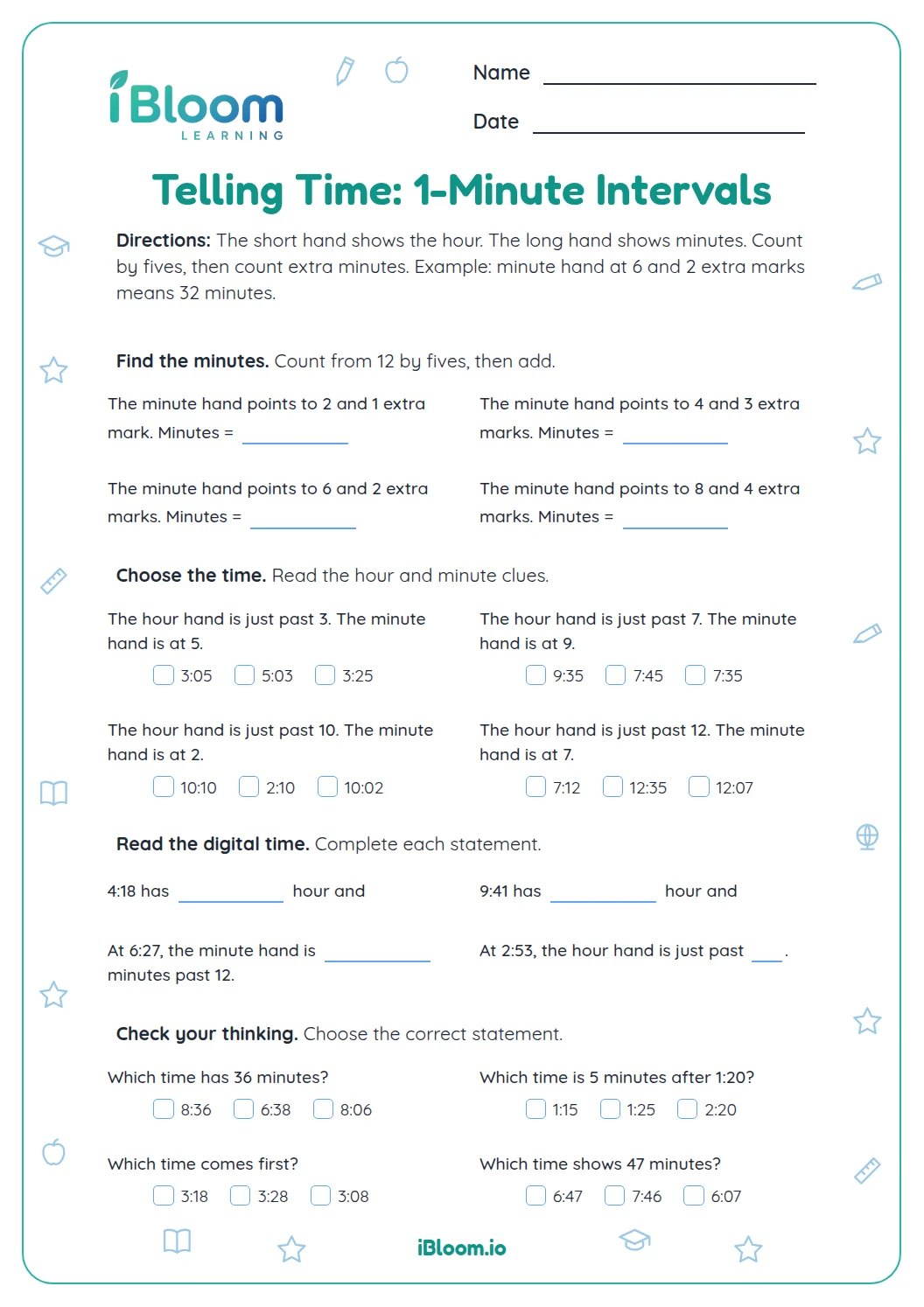
Read the short hour hand first, then count minutes with the long hand. Each small mark on the clock is one minute, and each number is five minutes, so a long hand two marks past the 2 means 12 minutes. The hour hand helps check the answer: at 3:28 it sits just before halfway between the 3 and the 4.
Question 3 shows why both hands matter. The minute hand is near the 6, so it is almost half past, and the hour hand is still between the 3 and the 4. The hour is 3, not 4.
- 1The short hour hand is just past the 8, so the hour is 8.
- 2The long minute hand points a little past the 2. The 2 means 10 minutes.
- 3Count 3 more small marks: 10 + 3 = 13 minutes.
- 4The time is 8:13.
How do you find how long something lasted?
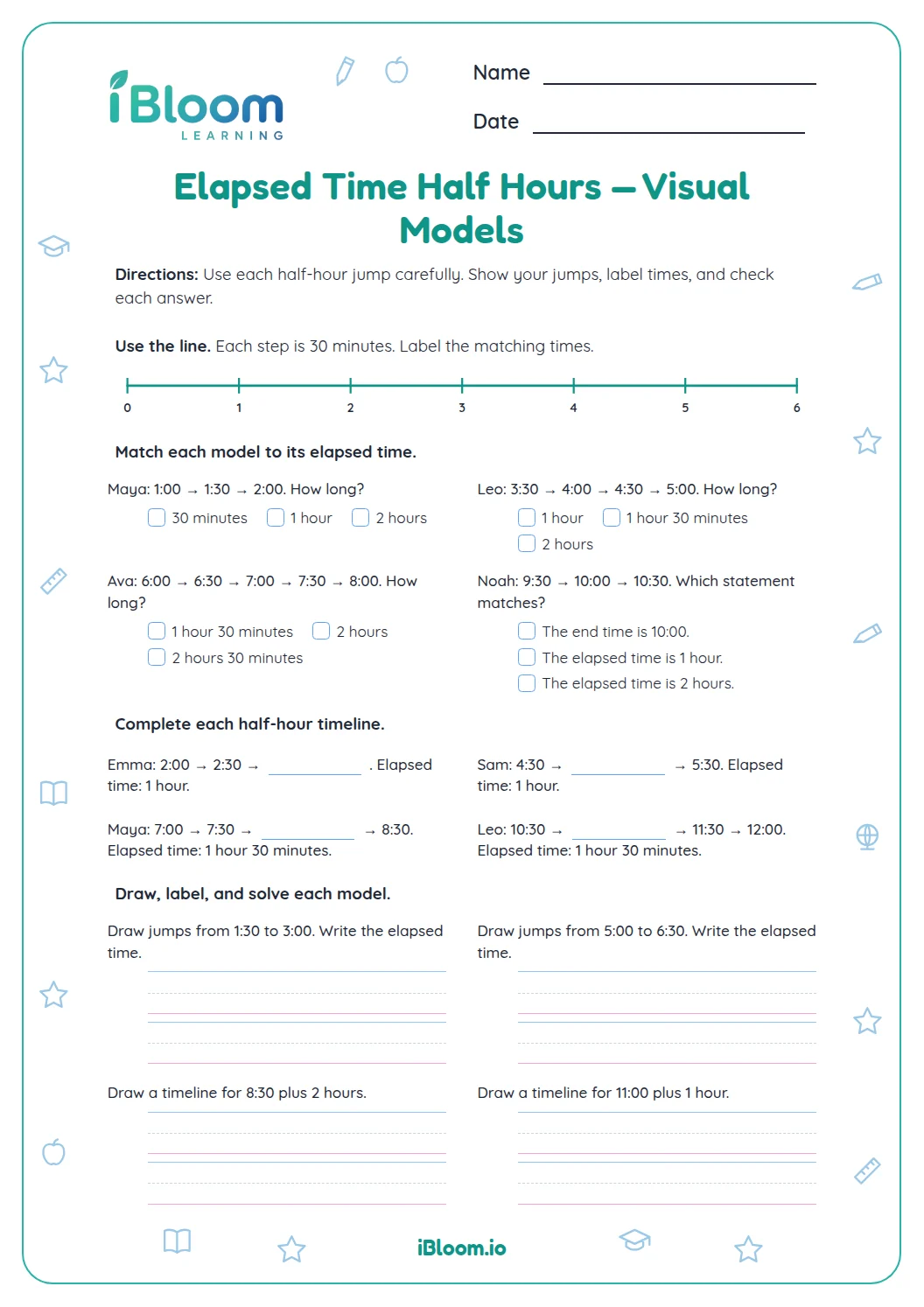
Subtract the start minutes from the end minutes when both times are in the same hour. Emma practices piano from 4:12 to 4:25, so 25 minus 12 is 13 minutes. A number line also helps: start at 12, jump 8 to reach 20, then 5 more to reach 25, and add the jumps: 8 + 5 = 13.
Part B has two of these problems with room to show the work. Writing the unit, minutes, matters: it tells the reader that 13 is a length of time, not a clock time.
How do you find what time something ends?
Add the minutes to the start time. A class that starts at 9:08 and lasts 24 minutes ends at 9:32, because 8 plus 24 is 32. Count on from the start time with jumps of 10, 10 and 4 if that is easier.
The last question crosses an hour. Ben starts at 4:48 and works 15 minutes. From 4:48, 12 minutes reaches 5:00, and 3 more minutes reaches 5:03.
How to use this worksheet at home or in class
- 1Draw a clock on scrap paper and have your child show 8:13 by moving the hands, then say how they found it.
- 2Do Part A by looking at the hour hand first, then counting minutes with the long hand in fives and ones.
- 3Read question 4 aloud and ask: "What time did it start? What time did it end?" Circle both times in the sentence.
- 4Let your child solve Part B with the working space, writing the unit after every answer.
- 5For Part C, have your child draw a quick number line from the start time and jump to the end.
- 6Check with the answer key, and ask your child to explain one answer using the words start, end and minutes.
Common mistakes and quick fixes
The mistake
Reading the minutes to the nearest 5, such as calling 8:13 "8:15" in question 1.
The fix
Count the small marks one by one after the last number. Each small mark is one minute.
The mistake
Adding the start and end times instead of finding the gap, such as 4:12 plus 4:25 in question 4.
The fix
Ask "How many minutes from start to end?" Draw a number line from 12 to 25 and count the jumps.
The mistake
Writing 5:03 as 5:3 or 4:63 in question 7 after adding 48 and 15.
The fix
Remember that an hour has only 60 minutes. Go to 5:00 first with 12 minutes, then add the last 3.
Common Core alignment
The sheet practices the standard below.
Read clocks to the minute and solve time problems in minutes.
On this sheet: Part A reads clocks to the minute, and Parts B and C solve problems about minutes that pass and the time something ends.
Show the official wordingHide the official wording
Tell and write time to the nearest minute and measure time intervals in minutes. Solve word problems involving addition and subtraction of time intervals in minutes, e.g., by representing the problem on a number line diagram.
What to practice next
Make more practice
Further reading
Questions parents and teachers ask
Is this worksheet for Grade 2?
Yes. It is built for second graders who are ready to read a clock to the exact minute and work with minutes in short stories. It supports CCSS 3.MD.A.1. Children who are still reading to the nearest five minutes can start with the 5-minute sheet first.
Why do the problems stay within one hour?
Most problems start and end in the same hour, so children can subtract the minutes directly. Only the last question crosses an hour, from 4:48 to 5:03. If your child finds it hard, skip it, or draw a number line and jump to 5:00 first.
How can a number line help with these problems?
A number line turns time into jumps. To find the time from 6:04 to 6:42, draw a line from 4 to 42 and jump in tens and ones. Add the jumps for the total. Many children find this easier than subtracting in their heads.
What if my child writes only a number, like 13?
Ask what the 13 counts. The answer 13 minutes tells the reader that it is a length of time. The sheet reminds children to write the unit, and the answer key shows minutes or a clock time for every response.
What do the clock questions in Part A ask?
Each of the three clocks shows a time to the exact minute, such as 8:13, and children choose the matching digital time from three choices. The wrong choices are slips children really make: rounding to the nearest five minutes, like 8:15, or reading the hour that comes next, like 4:28 for 3:28.
How long does it take, and is there an answer key?
Most children finish in about 20 minutes. There is a two-page answer key after the worksheet that shows every answer, including the units. Print the key with the sheet or on its own, and use it to talk through any problem your child found tricky.