






About this worksheet
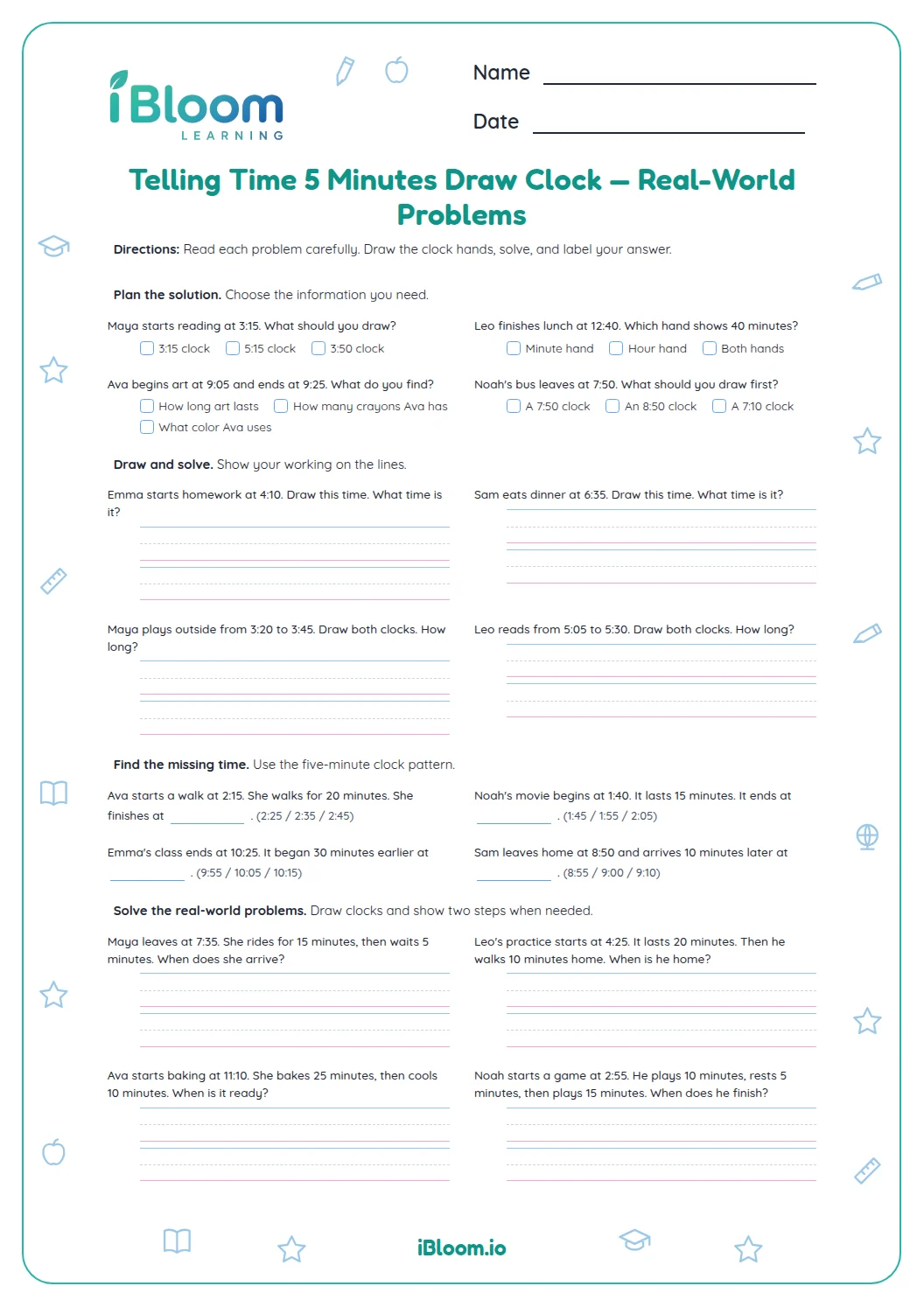
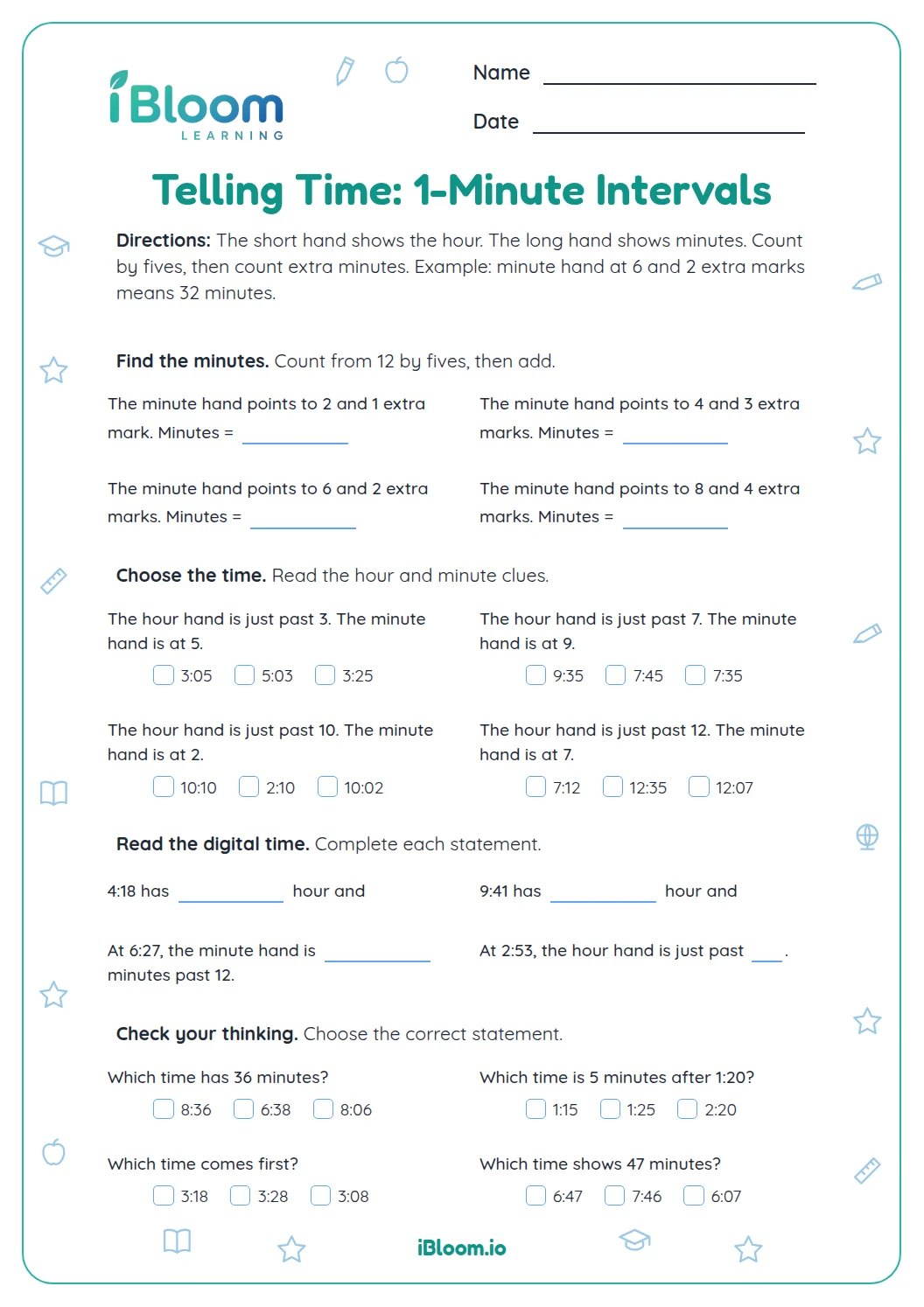
This printable focuses on time to five minutes. Children read six drawn analog clocks, record times from hour-and-minute clues, and reason about positions such as five minutes before the hour. The clock drawings replace open-ended clock drawing with supported read-the-clock practice.
Aligned to 2.MD.C.7
How do you read a clock to five minutes?
Each number around an analog clock stands for five minutes when you read the long minute hand. Start at 12 and count by fives. The short hand shows the hour; when it sits between two numbers, use the hour it has just passed.
What is on the worksheet?
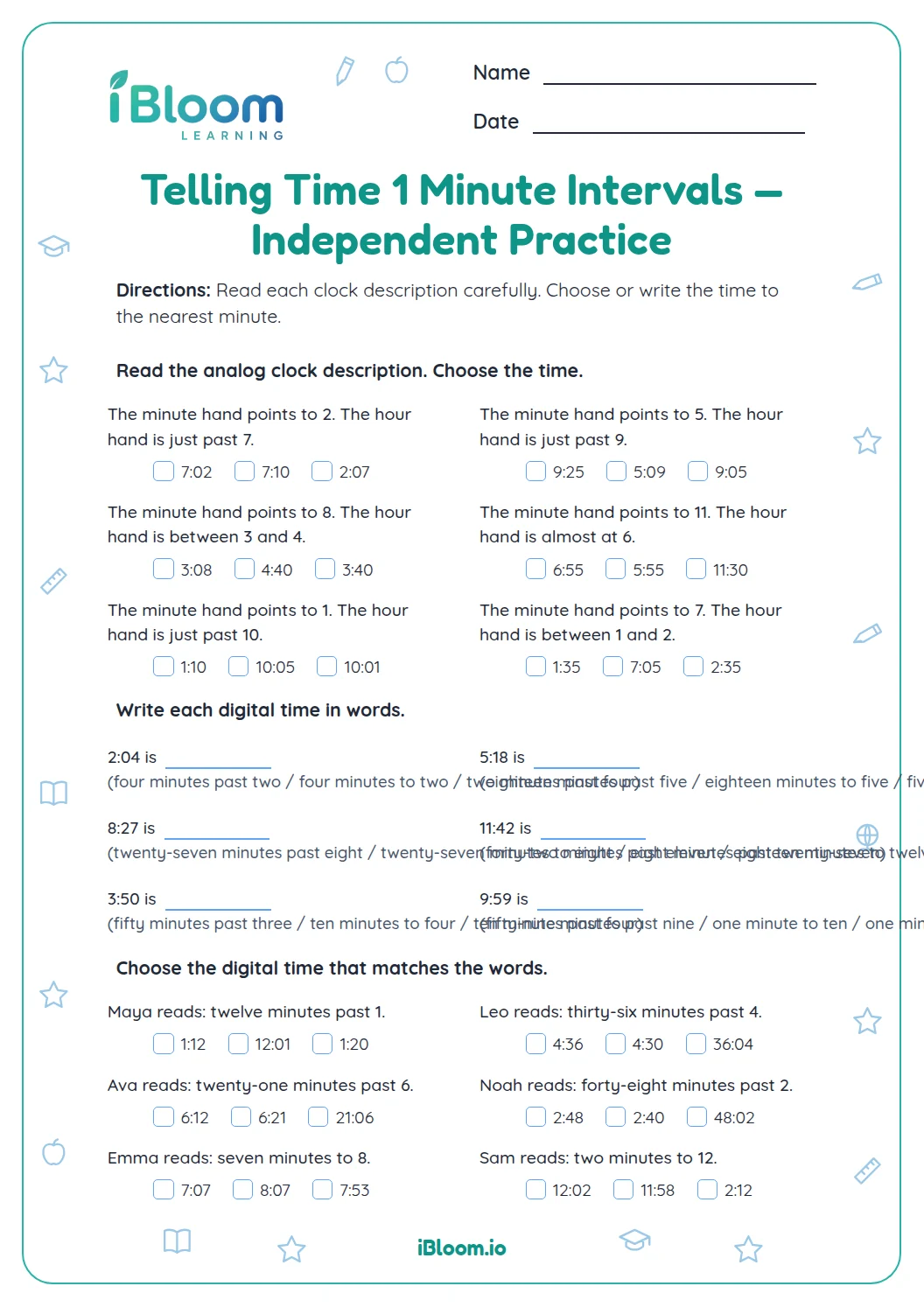
Part A reads six clock drawings and answers four minute-hand clues. Part B matches four spoken times to digital notation.
How to use the page
- 1Start at 12 and count by fives to read the minute hand.
- 2Use the hour number the short hand has passed.
- 3Read each clock in Part A, then match the spoken times in Part B.
- 4Check the hour and minute digits with the answer key.
Common slips
The mistake
Reading the number the minute hand points to as the minute count.
The fix
Count by fives from 12; the hand at 4 means 20 minutes.
The mistake
Naming the next hour when the short hand is still between hours.
The fix
Use the hour number the short hand has passed.
Curriculum alignment
This worksheet practices the skill named in its title.
Tell and write time from analog and digital clocks to the nearest five minutes.
On this sheet: Every time is a multiple of five minutes and students read analog clock hands.
Show the official wordingHide the official wording
Tell and write time from analog and digital clocks to the nearest five minutes, using a.m. and p.m.
What to practice next
Make more practice
Further reading
Questions parents and teachers ask
How many minutes does each clock number represent?
Each number represents five minutes when reading the long minute hand. Count by fives from 12: the 1 means 5 minutes, the 2 means 10 minutes, and the 6 means 30 minutes after the hour. An answer should include the hour and a two-digit minute count.
Why might the short hand sit between two numbers?
The short hand moves gradually toward the next hour as the minutes pass. When it is between 8 and 9, but has not reached 9, the hour is still 8. Read the long hand for the exact minutes. An answer should include the hour and a two-digit minute count.
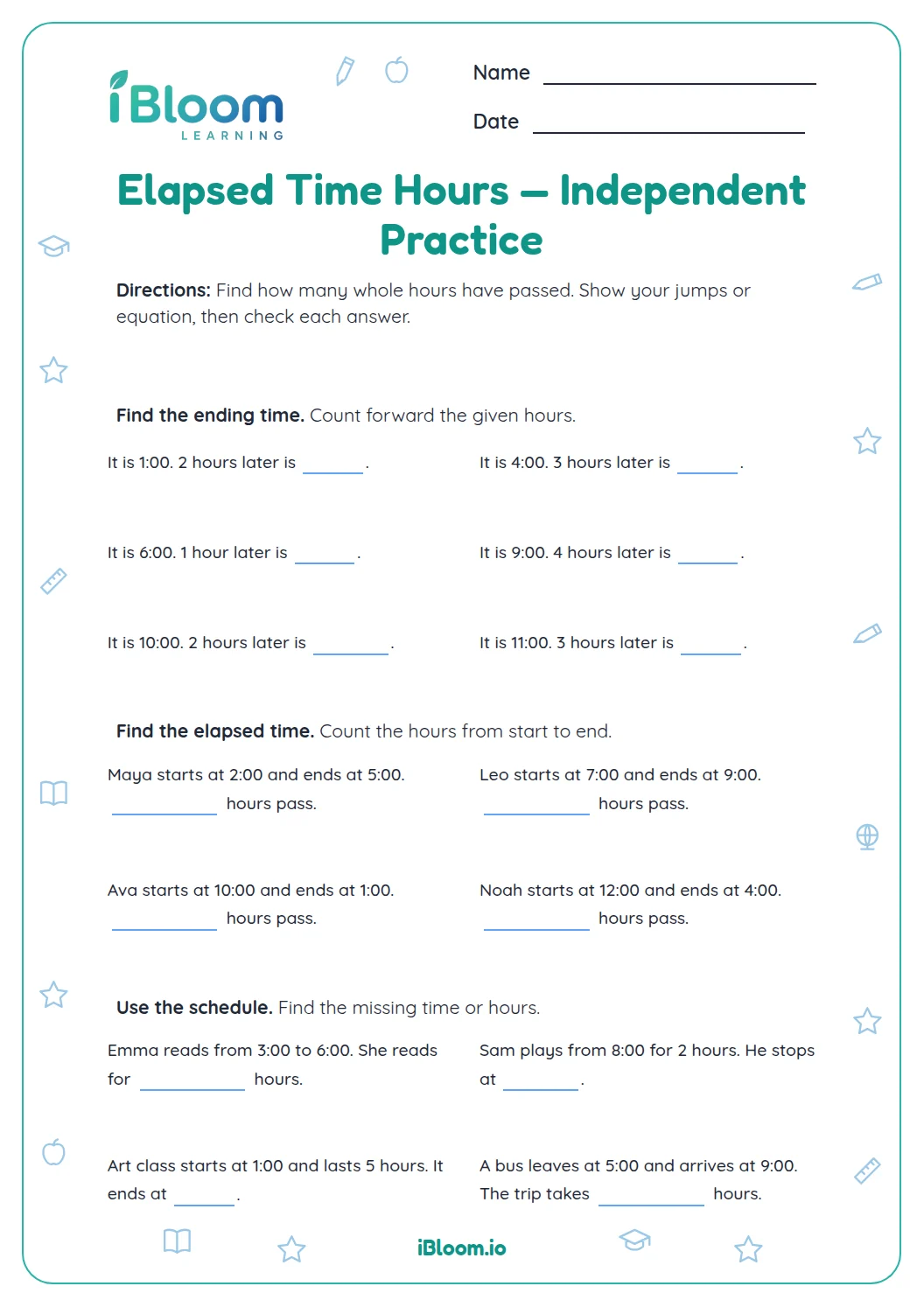
Does this worksheet practice elapsed time?
The 14 questions focus on reading clock faces and matching spoken times to digital notation. Children identify the hour hand and count minutes by fives. For example, a long hand at 7 means 35 minutes after the hour.
Is an answer key included?
Yes. The separate key lists all six clock readings, the minute-hand facts, and the spoken times written with digits. Children can check each part of a time separately, then read the complete time aloud to confirm the hour and minutes.
What does the minute hand show at 7?
The 7 stands for 35 minutes because each number represents five minutes from 12. Start at the top and count 5, 10, 15, 20, 25, 30, 35. Then read the short hand to find which hour has passed.