






About this worksheet
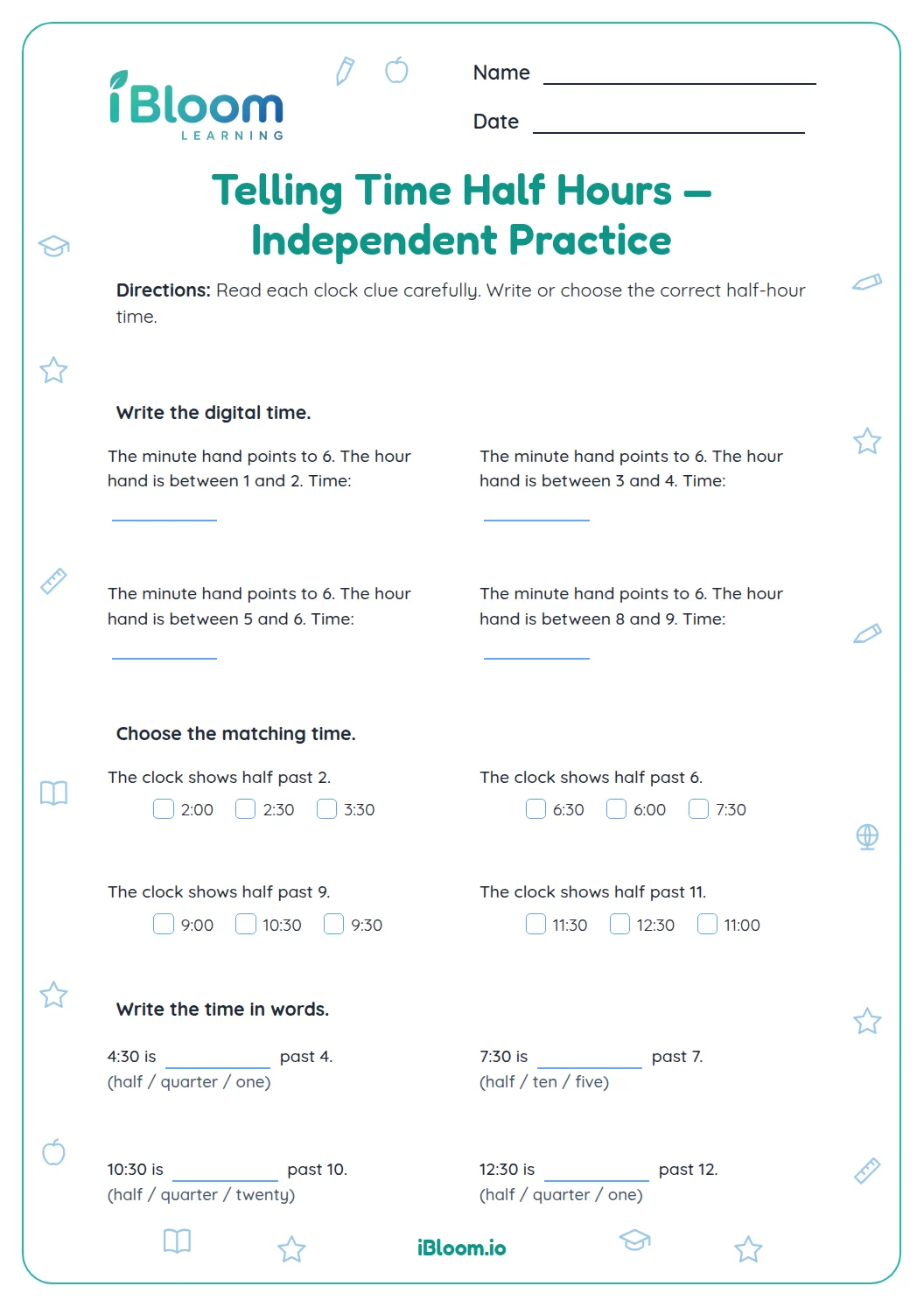
This free Grade 2 printable builds fluency with half-hour times on analog clocks and in everyday situations. Children read a clock face, write half-past times in digits, and solve short problems that move forward or backward by 30 minutes. The 14 questions fit across two worksheet pages, with a separate answer key. The skill aligns with CCSS 2.MD.C.7, which asks students to tell and write times from analog and digital clocks.
Aligned to 2.MD.C.7
How do you read a half-hour clock?
When the minute hand points to 6, 30 minutes have passed. Read the hour hand’s position to name the hour. Question 1 shows 2:30, or half past 2.
- 1The minute hand points to 6: :30
- 2The hour hand is between 2 and 3.
- 3The time is 2:30.
How do you move forward or back 30 minutes?
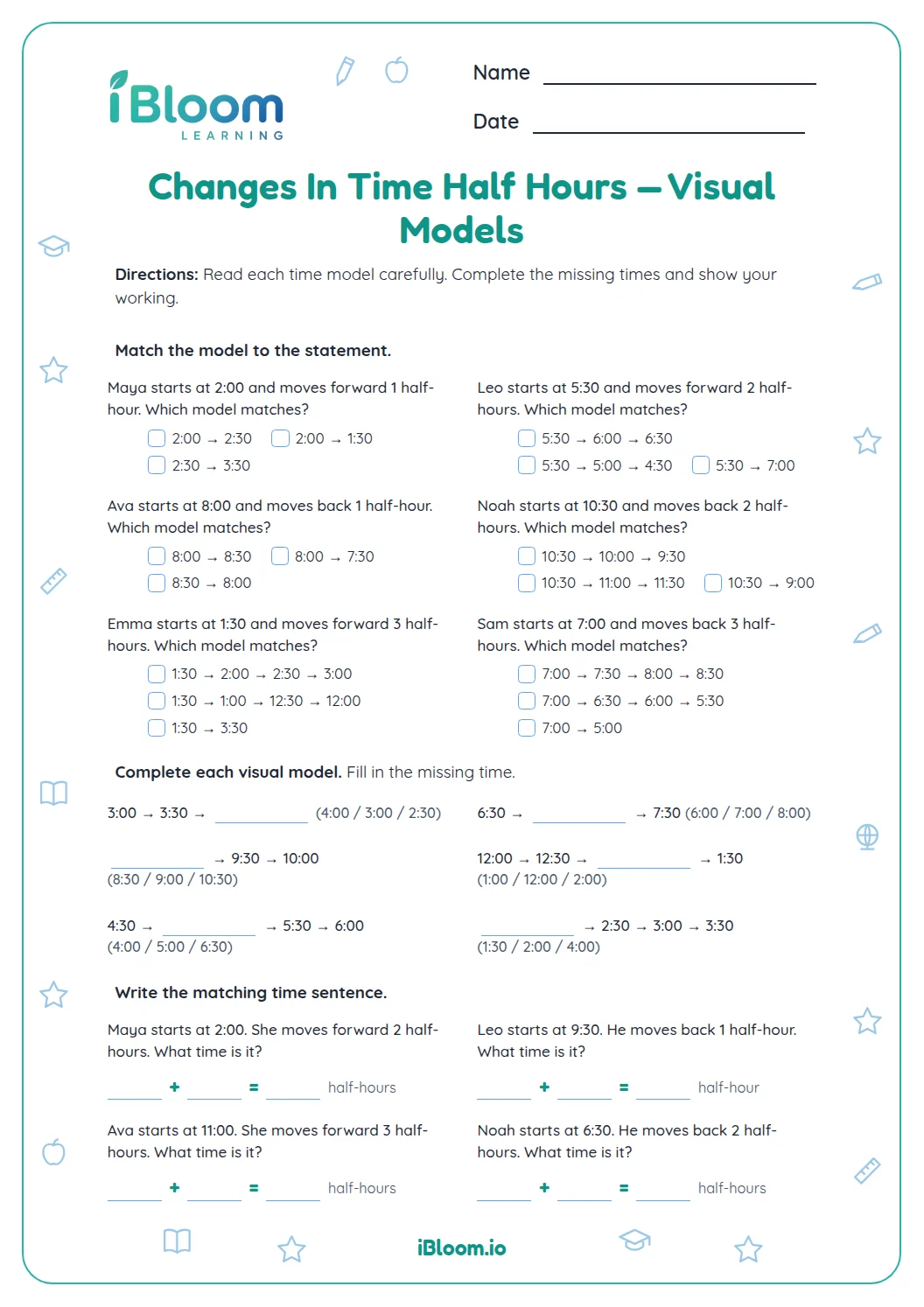
Keep the hour and move the minute hand to the next half-hour mark. Thirty minutes after 1:00 is 1:30; thirty minutes before 6:00 is 5:30. For a story, note whether the event starts, ends, or happens before another time.
- Part A: read clocks and write half-hour times
- Part B: solve real-world problems that use half-hour steps
How can you check an end time?
Count one 30-minute step from the start. If art begins at 10:00 and lasts half an hour, the end time is 10:30. Move backward when the problem gives the end time instead.
How to use this worksheet
- 1Find the hour hand and minute hand.
- 2When the minute hand points to 6, write :30.
- 3Mark whether the story moves forward or backward.
- 4Move one half-hour step from the given time.
- 5Check that the answer names the requested start time, end time, or duration.
Common mistakes and quick fixes
The mistake
Reading the hour hand as if it were exactly on the next number at :30.
The fix
At :30, it is halfway between the hour numbers.
The mistake
Moving forward when the story says “before” or “left.”
The fix
Count back 30 minutes for an earlier time.
The mistake
Giving a clock time when asked for elapsed minutes.
The fix
State 30 minutes when the question asks how long.
Common Core alignment
Students read analog clocks to the half hour and solve short time problems.
Tell and write time from analog and digital clocks to the nearest five minutes, using a.m. and p.m.
On this sheet: Reading and writing half-hour times practices telling time to the nearest five minutes on analog clocks.
Show the official wordingHide the official wording
Tell and write time from analog and digital clocks to the nearest five minutes, using a.m. and p.m.
What to practice next
Make more practice
Questions parents and teachers ask
What does half past mean?
Half past an hour means 30 minutes after that hour. The minute hand points to 6, and the digital time ends in :30. For example, half past 8 is 8:30. The first part of this worksheet includes clocks and written times that practice this connection.
How do I find a time 30 minutes later?
Move forward one half-hour step. From 1:00, the next half-hour time is 1:30; from 12:30, it is 1:00. Read the starting time carefully, then decide whether the problem asks for a time or a duration. The answer key shows each result.
How do I find a time 30 minutes earlier?
Move backward one half-hour step. If a bus arrives at 3:30 after traveling for half an hour, it left at 3:00. On the worksheet, some stories give the ending time, so notice words such as “before” and “arrives.”
What kinds of questions are included?
The worksheet has 14 questions: clock and time readings, four multiple-choice items, and seven short everyday problems about schedules, reading, practice, and a movie. Most ask for a time one half-hour earlier or later; one asks for a duration in minutes. A separate answer key is provided.
What does the answer key show?
The key gives the time or duration for each question. Check that a time answer matches the requested event, such as when an activity ends or when a bus left. For duration questions, the answer is written in minutes rather than as a clock time.